
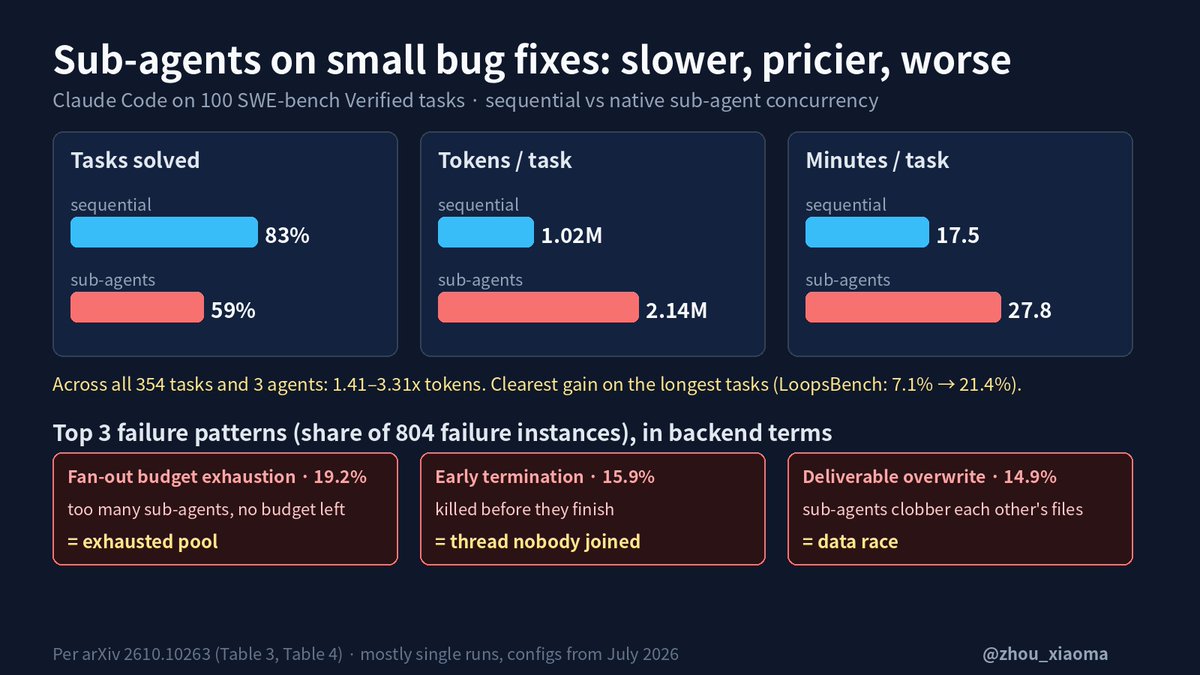
A comprehensive empirical study evaluated native sub-agent concurrency across 2,124 runs on Claude Code, Codex, and Kimi Code (354 tasks, ~$20.8K API cost). On 100 standard SWE-bench Verified tasks, enabling sub-agents caused Claude Code's solve rate to collapse from 83% to 59% (with latency increasing from 17.5 to 27.8 minutes) and Kimi Code from 77% to 59%, while token consumption inflated by 1.41x to 3.31x. The study revealed severe failure modes including budget-exhausting fan-outs, orphaned child processes, and concurrent delivery race conditions.
Key Takeaways
- ✓A $20,800 empirical study across 2,124 runs revealed the real costs of native sub-agent concurrency in Claude Code, Codex, and Kimi Code
- ✓On SWE-bench Verified, sub-agent concurrency dropped Claude Code's solve rate from 83% to 59% and Kimi Code from 77% to 59%
- ✓Token consumption inflated by 1.41x-3.31x while execution times lengthened, caused by thread race conditions and budget exhaustion
- ✓Delivered gains only on massive multi-file projects (LoopsBench: 7.1% to 21.4%); authors recommend sequential execution as the default
Heavy Claude Code use: compare subscription limits and API bills
Compare 40 dev plans & simulate token costs vs $20/mo subscriptions
In-Depth Technical Analysis
Background and the Problem
The AI developer tooling landscape has heavily hyped multi-agent and sub-agent concurrency as the silver bullet for complex software development. Frameworks claim that delegating tasks to concurrent child agents for parallel searching, coding, and review accelerates turnaround times. However, in distributed computing, concurrency without synchronization triggers race conditions, deadlocks, and resource exhaustion. Until now, the community lacked controlled, large-scale empirical benchmarks measuring the net utility of sub-agent decomposition. Systems researcher @zhou_xiaoma released a comprehensive evaluation across over $20,800 of API invocations, delivering critical insights.
Architecture and How It Works
- Rigorous Paired Empirical Evaluation:
- Evaluated three state-of-the-art coding systems:
Claude Code,Codex, andKimi Code; - Executed 2,124 complete coding sessions across 354 tasks, comparing single-agent sequential execution against native sub-agent concurrency under identical prompts and sandboxes;
- Three Dominant Concurrency Failure Modes:
- Unbounded Fan-Out & Budget Exhaustion: Parent agents aggressively spawn dozens of sub-agents, exhausting context windows and token budgets before implementing fixes;
- Orphaned / Unjoined Deliverables: Parent agents conclude and submit solutions prematurely while long-running sub-agents are terminated before returning results;
- Delivery Race Conditions: Concurrent sub-agents modify overlapping source files, overwriting each other's changes and inducing compilation breaks.
Benchmarks and Measured Results
Based on 2,124 execution traces (Figure 1, Benchmark Disclosures):
- SWE-bench Verified (100 Standard Bug Fixes):
- Claude Code: Single-agent sequential execution solved 83%, which plummeted to 59% with sub-agents enabled (a 24-point drop), while execution time lengthened from 17.5 to 27.8 minutes;
- Kimi Code: Dropped from 77% to 59%;
- Codex: Remained stagnant at 71%;
- Token Inflation: Sub-agent concurrency drove token consumption up to 1.41x to 3.31x that of sequential baselines;
- Long-Horizon Multi-File Challenges (LoopsBench):
- On sprawling multi-repository tasks, sub-agents proved their utility: Claude Code's success rate surged from 7.1% to 21.4%.
Getting Started for Developers
- Source Disclosure: Verified on X via
@zhou_xiaoma(status/2112363831284650435); - Architectural Rules of Thumb:
- Sequential by Default: For 90% of bug fixing and refactoring, maintain a single sequential agent loop to avoid 3x token penalties and a 20%+ accuracy degradation;
- When Sub-Agents Make Sense: Enable concurrency only when tasks have strictly isolated file ownership boundaries, when running parallel speculative attempts (picking the best result), or when deploying read-only independent verifier agents.
Benchmark side-by-side against alternatives, or calculate monthly token cost vs subscription break-even.
Discussion & Comments
0Sign in to join the discussion
Connect with AI developers to exchange benchmark insights.