
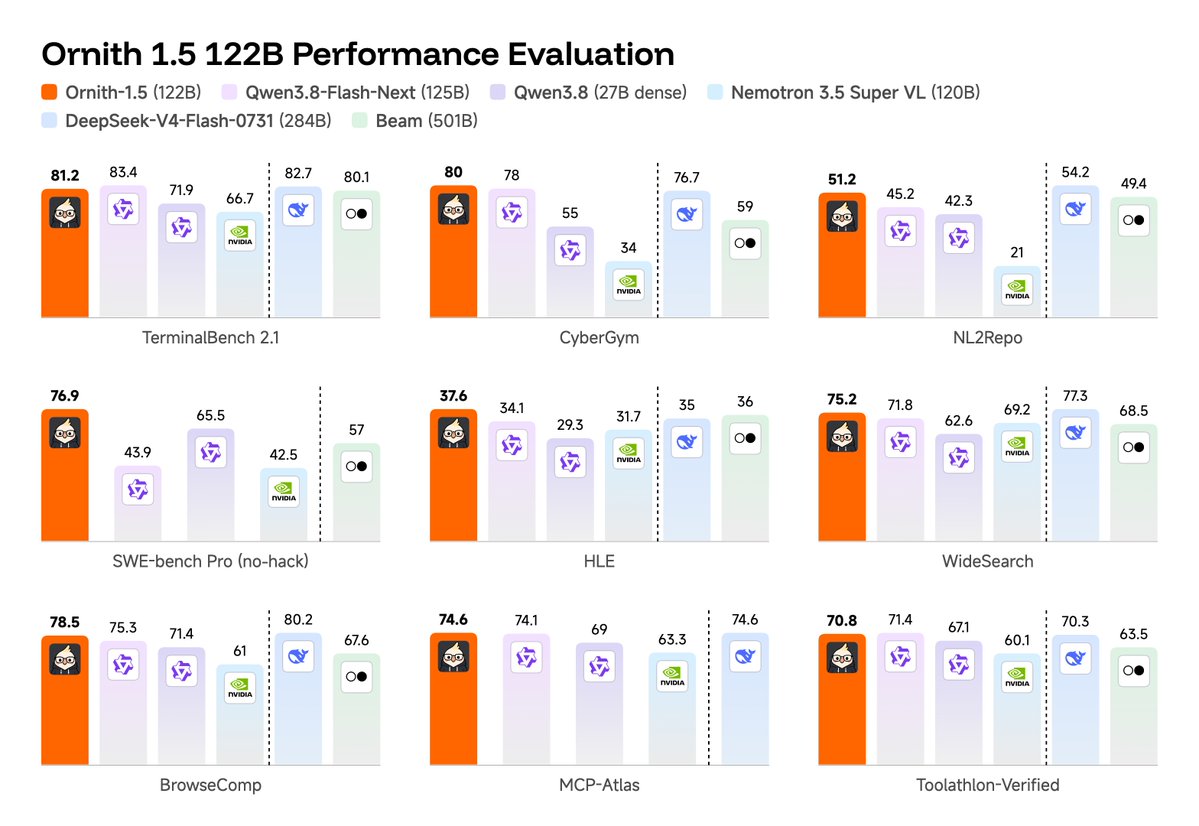
The Ornith AI team officially released Ornith-1.5-122B under the permissive MIT license, a 122-billion parameter mixture-of-experts (MoE) reasoning model optimized to execute on a single GPU node (such as a single DGX). The model is immediately available across vLLM (0.19.1+), SGLang (0.5.9+), Hugging Face, and Ollama (ornith-1.5:122b) with native FP8, GGUF, and MLX quantization. Across independent agentic evaluations in the OpenHands harness, Ornith-1.5-122B registered 84.5 on SWE-bench Verified, 76.9 on SWE-bench Pro (surpassing Qwen3.8-Flash-Next's 43.9 by 33 points), 81.2 on TerminalBench 2.1, and 74.6 on MCP-Atlas.
Key Takeaways
- ✓Ornith-1.5-122B released under the permissive MIT license, offering a fully open, frontier-grade 122B MoE coding reasoning model
- ✓Engineered to fit inside a single GPU node (single DGX), with immediate runtime support on vLLM, SGLang, and Ollama (
ornith-1.5:122b) - ✓Achieves 76.9 on SWE-bench Pro, drastically outperforming the comparable open-weight baseline Qwen3.8-Flash-Next (43.9)
- ✓Delivers balanced agentic performance with 81.2 on TerminalBench 2.1, 80.0 on CyberGym, and 74.6 on MCP-Atlas
Not enough VRAM? Compare cloud API and self-hosting costs
Compare 40 dev plans & simulate token costs vs $20/mo subscriptions
Project Links & Resources
Direct AccessIn-Depth Technical Analysis
Background and the Problem
Autonomous coding agents and software engineering tools have historically demanded a painful compromise: top-tier commercial models (such as Claude 3.7 Sonnet) offer high benchmark solve rates but present strict data exfiltration risks and ballooning API costs; conversely, mid-sized open-weight models have suffered steep drop-offs when dealing with multi-file dependency resolution and complex terminal debugging. Enterprise engineering organizations urgently require frontier-grade coding performance contained within a single on-premises GPU node (such as an 8-GPU DGX server). On October 20, 2026, the Ornith AI team answered this demand by open-sourcing Ornith-1.5-122B under the MIT license.
Architecture and How It Works
- Single-Node MoE Topology:
- Features 122 billion total parameters structured in a fine-grained mixture-of-experts configuration, designed specifically to saturate the NVLink interconnect and memory bandwidth of a single DGX node;
- Immediate Multi-Runtime Support:
- Ready day-one on vLLM 0.19.1+, SGLang 0.5.9+, and Transformers 5.8.1+;
- Simultaneously published in production-ready FP8, local GGUF formats, and Apple Silicon MLX weights, indexed directly on Ollama as
ornith-1.5:122b;
- Reinforced Agentic Loop Alignment:
- Trained with specialized reinforcement learning across CodeAct sandboxes and multi-turn terminal execution traces, suppressing unproductive retry loops and embedding Git-diff-based hypothesis generation.
Benchmarks and Measured Results
Evaluated within the standardized OpenHands agent harness against prominent open baselines:
- SWE-bench Software Engineering Confrontation:
- SWE-bench Verified: Ornith-1.5-122B registers 84.5 points (surpassing Qwen3.8-Flash-Next at 82.8);
- SWE-bench Pro: Reaches a dominant 76.9 points, thrashing Qwen3.8-Flash-Next (43.9 points) by an unprecedented 33-point margin;
- SWE-bench Multilingual: Delivers 76.4 points (vs. Qwen's 73.0);
- System and Terminal Metrics:
- Scores 81.2 on TerminalBench 2.1 and 80.0 on CyberGym;
- Attains 74.6 on the MCP-Atlas tool protocol benchmark, closing within striking distance of 284B flagship models.
Getting Started for Developers
- Model Card & Weights: Access directly on Hugging Face at
https://huggingface.co/ornith-ai/Ornith-1.5-122B; - Official Announcement: Reference
@ornith_statushttps://x.com/ornith_/status/2112553477457268799; - Engineering Recommendation: Teams implementing internal code copilots or autonomous PR triage can run Ornith-1.5-122B via vLLM in FP8 on an on-prem DGX, connecting seamlessly to OpenHands or Cline for zero-API-cost private coding autonomy.
Benchmark side-by-side against alternatives, or calculate monthly token cost vs subscription break-even.
Discussion & Comments
0Sign in to join the discussion
Connect with AI developers to exchange benchmark insights.