
Liquid AI released d1-ultra on Oct 15: a multimodal decision model that takes text and images and, in one forward pass, returns probabilities for yes/no, choice and score questions without generating tokens; billed on input only. Artificial Analysis ranks it #1 on Decision Index v1.0 at 65, at least 8 points ahead, with an 85% non-hallucination rate. Available on the Liquid API, Vercel AI Gateway and OpenRouter.
Key Takeaways
- ✓Artificial Analysis Decision Index v1.0: 65, ranked #1 and at least 8 points ahead (independent)
- ✓AA-Omniscience-Decision non-hallucination 85% vs 40% for runner-up Microsoft-Decision-1; more abstention drops accuracy to 32% vs d1's 41%
- ✓$0.042 per M input tokens, output free; a 1024x1024 image counts as 1,536 tokens
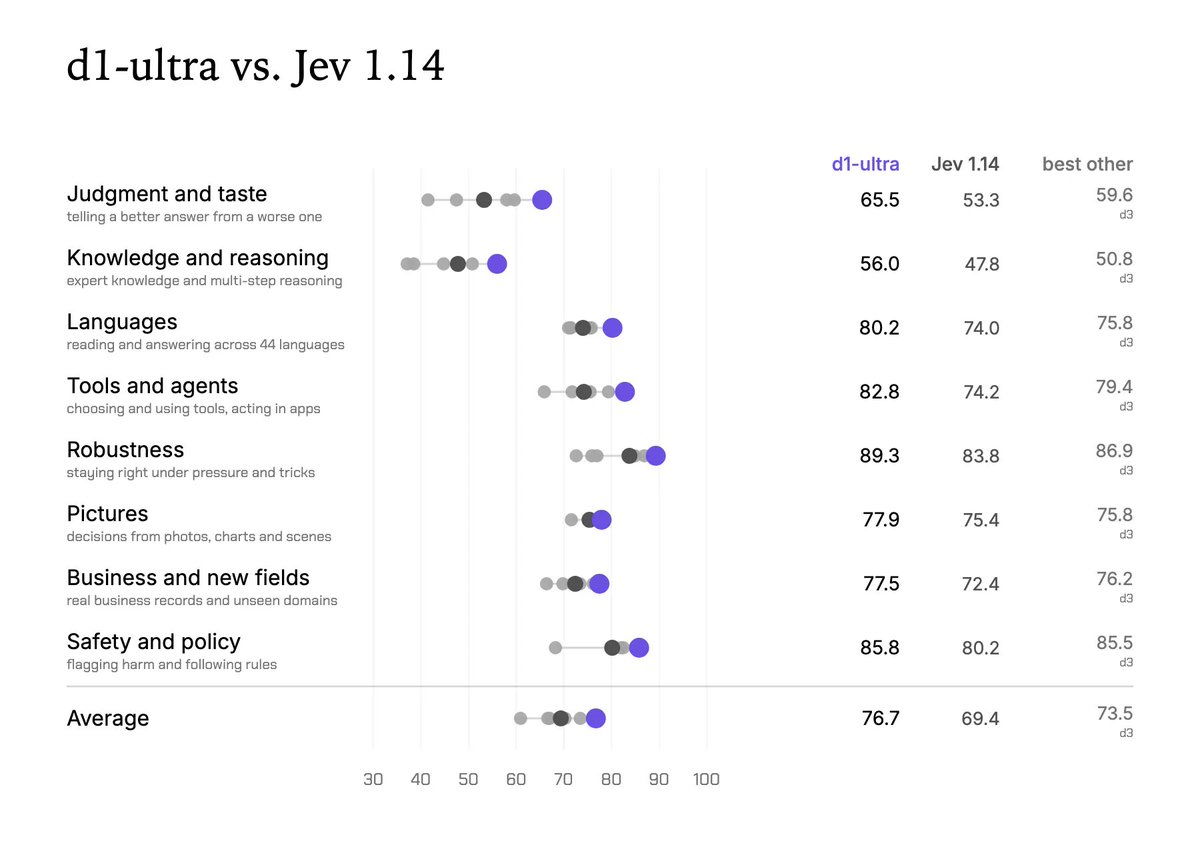
- ✓32,768-token context, 44 languages, leads all eight categories of Liquid's 112-eval suite (vendor)
- ✓Call via Liquid /decisions/v1/systemone with model d1-ultra, or liquid/d1-ultra on Vercel AI Gateway / OpenRouter
Key Decision Metrics at a Glance
Turn your technical choice into a development budget
Compare 40 dev plans & simulate token costs vs $20/mo subscriptions
Project Links & Resources
Direct AccessIn-Depth Technical Analysis
Background
Classification, routing, moderation and guardrail tasks are usually done by asking an LLM to generate text and parsing it, which is slow, costly and poorly calibrated. Liquid AI open-sourced small d1 decision models earlier in October and on Oct 15 shipped the hosted flagship d1-ultra for harder cases such as checking a circuit board against its spec or a damage claim against customer photos.
How it works
d1-ultra reads text, images or both and returns probabilities in a single forward pass with no generated tokens. Three question types: noul (yes/no probability), choice (per-label probabilities) and score (ordered scale), several per request. It is built on a larger open-weights model with Liquid-specific customizations and trained for calibration, so a 90% answer should be right at least 90% of the time.
Benchmarks
Artificial Analysis Decision Index v1.0: 65, ranked #1, at least 8 points ahead. AA-Omniscience-Decision non-hallucination rate 85% vs 40% for Microsoft-Decision-1, though more abstention lowers accuracy to 32% vs d1's 41%. Liquid also reports it beats Jev 1.14 across its 112-eval suite (vendor).
Getting started
Call POST /decisions/v1/systemone on the Liquid API with model d1-ultra, or use liquid/d1-ultra on Vercel AI Gateway and OpenRouter. 32,768-token context; $0.042 per M input tokens, output free, each question billed separately. Use it as an agent router, cascade gate or moderation guardrail.
Benchmark side-by-side against alternatives, or calculate monthly token cost vs subscription break-even.
Discussion & Comments
0Sign in to join the discussion
Connect with AI developers to exchange benchmark insights.