
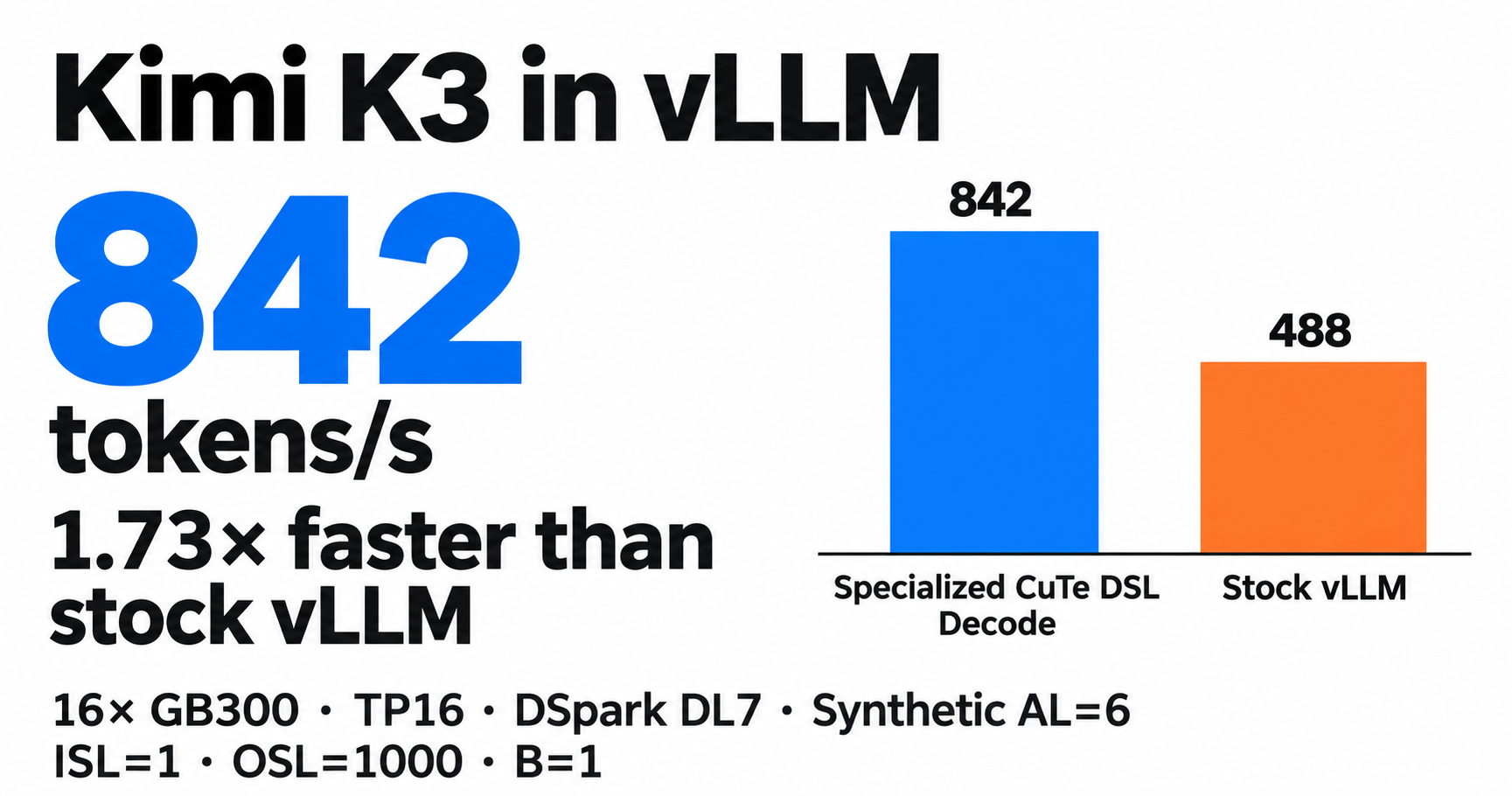
A vLLM blog post by NVIDIA engineer Benjamin Chislett details an agent-assisted CuTe DSL decode path for Kimi K3 on NVIDIA GB300 that fuses attention, MoE and NVLink communication, cutting per-layer time from 130 µs across 23 kernels to 69 µs across 13. With DSpark speculative decoding on 16 GPUs it reaches 842 tok/s at batch 1, 1.73x stock vLLM; PR #61867 was merged on Oct 16.
Key Takeaways
- ✓842 tok/s at batch 1 on 16 GB300 GPUs with DSpark (7 draft tokens, synthetic AL=6) vs 488 for stock vLLM, 1.73x (vendor figures)
- ✓Without speculation TP16 gains 1.62–1.92x (3,606 tok/s at batch 64); TP8 gains 1.31–1.58x
- ✓Per layer: 23 kernels and 130 µs down to 13 kernels and 69 µs
- ✓AgentX P90 interactivity 403.2 vs 223.7 tok/s/user (1.8x), though the baseline is an earlier 8-GPU run
- ✓The same fast-track approach now covers DeepSeek-V4.1-Flash (PR #61868, open); early Muse Spark Open results exceed 950 tok/s/user
Key Decision Metrics at a Glance
Not enough VRAM? Compare cloud API and self-hosting costs
Compare 40 dev plans & simulate token costs vs $20/mo subscriptions
Project Links & Resources
Direct AccessIn-Depth Technical Analysis
Core Background & Industry Pain Points
For huge MoE models like Kimi K3, low-concurrency decode speed decides how responsive a coding agent feels. Small-batch inference is bound by memory bandwidth and kernel launch overhead, and stock vLLM launches 23 kernels per K3 layer. Meanwhile agent-written optimizations now outpace maintainers' line-by-line review, while merging blindly risks production bugs.
Architecture Highlights & Mechanism
With coding-agent assistance, the team built a unified CuTe DSL decode path for Blackwell (8 or 16 GPUs in one NVLink domain, batch 1–64): batch-aware small-matrix or split-K kernels, attention output projection fused with all-reduce and the residual step, router scoring split across TP ranks and exchanged over NVLink, a separate stream for the shared expert, and weight prefetch during communication. Decode context parallelism handles long contexts. It follows the fast-track RFC (#59665): keep changes inside model code, bound the scope, and validate correctness and performance systematically.
Benchmarks & Measured Performance
All figures are from vLLM/NVIDIA. With DSpark (7 draft tokens, synthetic acceptance length 6) on 16 GPUs, batch-1 decode hits 842 tok/s vs 488 stock, 1.73x; this is a controlled synthetic setting and real acceptance will be lower. Without speculation, TP16 reaches 256.4 tok/s at batch 1 (1.88x) and 3,606 tok/s at batch 64 (1.62x); TP8 gains 1.31–1.58x. AgentX P90 interactivity is 403.2 vs 223.7 tok/s/user, but the baseline is an earlier 8-GPU run.
Developer Quick Start
PR #61867 was merged into vLLM on Oct 16 and targets GB300/Blackwell multi-GPU deployments; per the sibling DeepSeek PR it is enabled through the opt-in decode_backend: latency_specialized switch, so check the PR for exact flags. The DeepSeek-V4.1-Flash port (#61868) is still under review, and a GLM-5.3 version is promised later.
Benchmark side-by-side against alternatives, or calculate monthly token cost vs subscription break-even.
Discussion & Comments
0Sign in to join the discussion
Connect with AI developers to exchange benchmark insights.