

Skyfall AI, founded by the team behind Maluuba (acquired by Microsoft), released a research preview of SKY-001 on October 19, billing it as the first engineering world model. Instead of next-token prediction, it starts from text or a 2D image, generates several rough 3D options in parallel, recursively decomposes the chosen design into a parts tree, sketches and extrudes each part, then assembles them hierarchically for viewing in CAD tools such as Autodesk Fusion. On its own 3D CAD test it reports 79.7% IoU versus 79.1% for GPT-6 Astra, at 3.9 s and $0.005 per case versus 199 s and $0.75. Access is waitlist-only, with commercial deployment targeted for early 2027; all benchmarks are self-reported.
Key Takeaways
- ✓3D CAD (self-reported): SKY-001 79.7% IoU, 3.9 s, $0.005 per case; GPT-6 Astra 79.1%, 199 s, $0.75; Opus 5.5 69.4%; Grok 4.7 completed none.
- ✓BIM (self-reported): SKY-001 43.6% IoU, 1.22 s, about $0.0024 per case; best LLM Gemini 3.8 Flash at 42.3%; 118x faster and 188x cheaper than GPT-6 Astra.
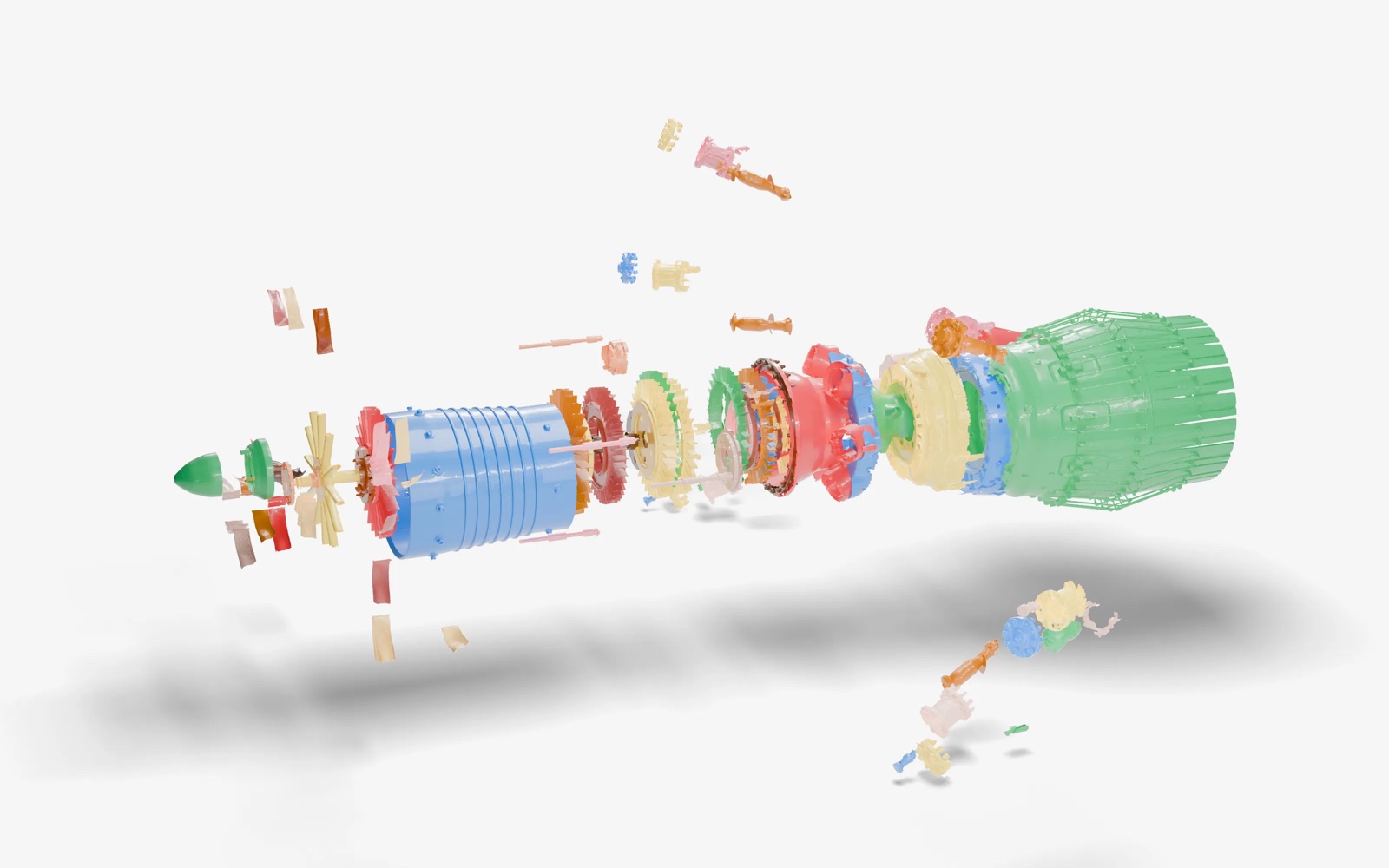
- ✓Four stages: parallel design exploration, recursive diffusion-based 3D decomposition, 2D-to-3D latent modeling, hierarchical assembly; the Jaguar E-Type demo yields 103 leaf parts and 139 nodes.
- ✓Availability: research preview behind a waitlist; the press release targets commercial deployment in early 2027; parameter count, training data and API pricing are not disclosed.
- ✓Team: Maluuba founders Sam Pasupalak, Kaheer Suleman and Sumit Pasupalak; backers include Fidelity, Touring Capital, M13 and iNovia Capital.
Key Decision Metrics at a Glance
Turn your technical choice into a development budget
Compare 40 dev plans & simulate token costs vs $20/mo subscriptions
Project Links & Resources
Direct AccessIn-Depth Technical Analysis
Background and the industry pain point
Large models are strong at code and retrieval, but designing a physical product with hundreds or thousands of parts needs geometric and spatial reasoning plus very long-horizon planning. Most 3D generators output good-looking surface meshes with no part hierarchy, constraints or parametric feature tree, so engineers still decompose and model by hand. Skyfall AI, founded by the team behind Maluuba (the deep learning lab Microsoft acquired), argues this is a sequential decision problem rather than a language problem, and on October 19 released a research preview of SKY-001.
Architecture and mechanism
SKY-001 is a hierarchical visual world model and does not do next-token prediction. It works in four stages: generate several rough 3D options in parallel from text or a single 2D image; recursively decompose the chosen design with a diffusion-based process down to screws and fasteners; recreate each part the way a designer would, sketching 2D strokes and then extruding or cutting them into 3D; and assemble the parts hierarchically into a full assembly viewable in standard CAD tools such as Autodesk Fusion. In the Jaguar E-Type demo the car splits into 103 leaf parts and 139 nodes at depth 5.
Benchmarks
All figures are Skyfall's own and have not been independently reproduced. On 3D CAD, SKY-001 scores 79.7% IoU at 3.9 s and $0.005 per case; GPT-6 Astra 79.1% at 199 s and $0.75; Claude Opus 5.5 69.4%; Gemini 3.8 Flash 54.7%; Kimi K3 9.5%; Grok 4.7 completed none. On BIM, SKY-001 scores 43.6% at 1.22 s; the best LLM is Gemini 3.8 Flash at 42.3%, with GPT-6 Astra at 40.6% and 144.4 s. The "51-125x faster, 150-210x cheaper" claim in the launch post maps to the CAD and BIM charts on the blog. Eval set size, composition and parameter count are not disclosed.
Getting started
There is no API or open weights yet, only a waitlist on the website, and the press release targets commercial deployment in early 2027. Teams building CAD/BIM, hardware or digital-twin tools can study the 3D decomposition demos on the blog to judge whether a parts tree plus build steps fits their pipeline. Skyfall notes the final material finishes in the demo shots are applied afterwards, not predicted by the model, and the multipliers should not drive tool choices until you can test on your own parts.
Benchmark side-by-side against alternatives, or calculate monthly token cost vs subscription break-even.
Discussion & Comments
0Sign in to join the discussion
Connect with AI developers to exchange benchmark insights.