

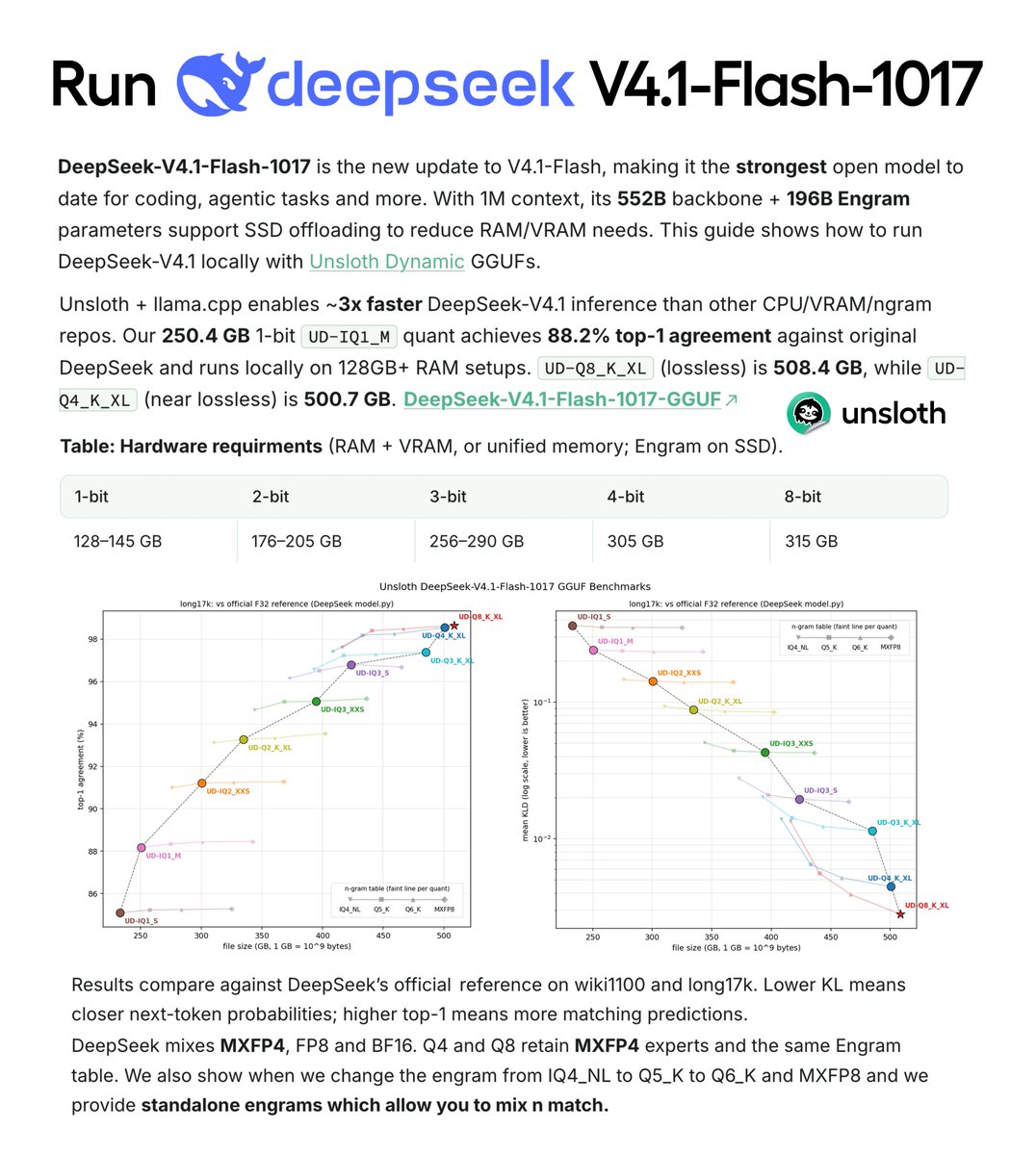
On Oct 19 (UTC) Unsloth released dynamic GGUF quants and a run-locally guide for DeepSeek-V4.1-Flash-1017. Per Unsloth, the 1-bit UD-IQ1_M quant is 250.4 GB (vs 508.4 GB for lossless Q8), keeps 88.2% top-1 agreement with the official weights on long17k, and runs on 128 GB+ RAM machines, because the model's 110.6–202.8 GB Engram n-gram table can stay on SSD via mmap. Running it currently requires Unsloth's llama.cpp PR build or Unsloth Desktop.
Key Takeaways
- ✓1-bit UD-IQ1_M is 250.4 GB, about 51% smaller than lossless UD-Q8_K_XL (508.4 GB), with 88.2% top-1 agreement on long17k and 87.1% on wiki1100 (Unsloth-reported)
- ✓The smallest UD-IQ1_S (233.0 GB) targets 128 GB RAM machines such as a Mac or DGX Spark at 82.8–85.1% agreement; 3-bit UD-IQ3_XXS needs ~256 GB (e.g. Mac Studio) at 94.6–95.1%
- ✓The model pairs a 552B backbone with 196B Engram parameters; the 110.6–202.8 GB Engram n-gram table can stay on SSD via mmap, saving RAM but not disk
- ✓Unsloth claims ~3x faster inference than other CPU/VRAM/ngram-focused repos on top of llama.cpp (vendor claim, no independent test yet)
- ✓The Hugging Face repo is MIT-licensed with 9 quant levels from IQ1_S to Q8_K_XL plus standalone Engram files at different precisions
Key Decision Metrics at a Glance
Not enough VRAM? Compare cloud API and self-hosting costs
Compare 40 dev plans & simulate token costs vs $20/mo subscriptions
Project Links & Resources
Direct AccessIn-Depth Technical Analysis
DeepSeek-V4.1-Flash-1017, released by DeepSeek on Oct 17 under the MIT license (DeepSWE 77.0, vendor-reported), is one of the most watched open-weight models, but its lossless weights exceed 500 GB, which keeps most developers on the API. On Oct 19 Unsloth published dynamic GGUF quants and a run-locally guide. According to Unsloth, the model combines a 552B backbone with 196B Engram parameters. Engram is a conditional memory where n-grams of up to four tokens touch only a few table rows per token, so the 110.6–202.8 GB table can stay on SSD via mmap and load rows on demand, cutting RAM/VRAM needs but not disk. Unsloth-reported agreement with DeepSeek's reference weights: UD-IQ1_M (250.4 GB) 88.2% top-1 on long17k and 87.1% on wiki1100; UD-IQ1_S (233.0 GB) 85.1%/82.8%; UD-IQ3_XXS (394.7 GB) 95.1%/94.6%; UD-Q4_K_XL (500.7 GB) 98.5%/98.2%. Top-1 agreement is not task accuracy, and no quantized task benchmarks were published. Unsloth also claims ~3x faster inference than other CPU/VRAM/ngram-focused repos. To try it, budget ~128–145 GB of RAM+VRAM for 1-bit or ~256–290 GB for 3-bit, download unsloth/DeepSeek-V4.1-Flash-1017-GGUF via Unsloth Desktop or build Unsloth's llama.cpp PR (mainline is not yet supported), use temperature 1.0 and top_p 1.0 (reasoning_effort defaults to 75), and serve it with unsloth run to connect Claude Code or Codex locally.
Benchmark side-by-side against alternatives, or calculate monthly token cost vs subscription break-even.
Discussion & Comments
0Sign in to join the discussion
Connect with AI developers to exchange benchmark insights.