

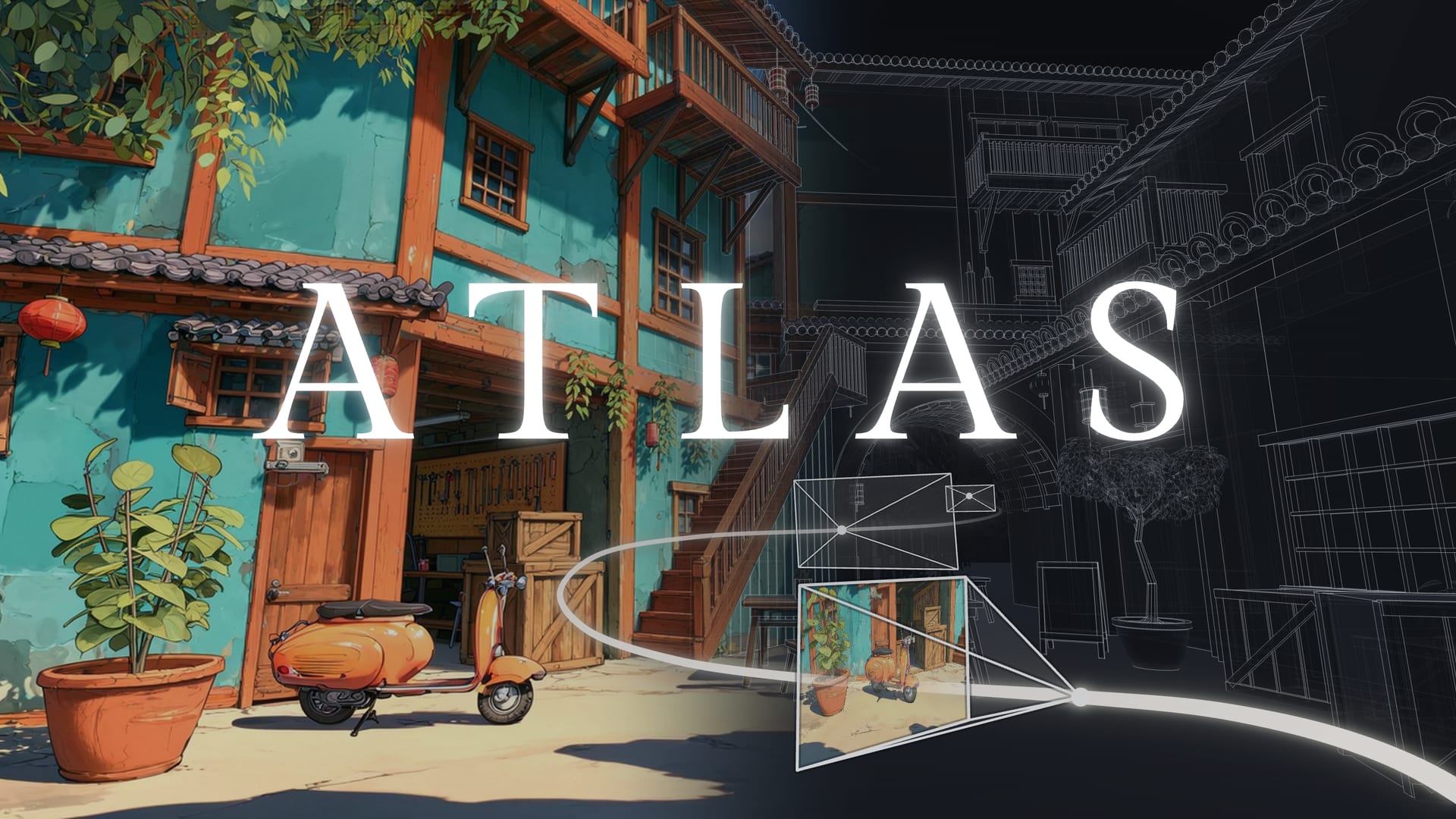
On November 12, World Labs, the company founded by Fei-Fei Li, opened its Atlas world model to every registered user. When Atlas was announced in September only a few partners could try it, and the Frameboy demo released on November 5 only offered preset scenes. This launch adds four tools: Viewfinder rebuilds scenes from photos or generated images, Chisel generates from a graybox layout, Splats to Mesh converts Gaussian splats into meshes, and Relight changes lighting. World Labs also opened all the API endpoints behind these apps, with Blender integration. The model is closed and hosted only, and no price has been published.
Key Takeaways
- ✓Who can use it: from November 12 anyone can sign up at atlas.worldlabs.ai; Viewfinder had been a closed beta with a waitlist
- ✓Four tools: Viewfinder rebuilds scenes from photos and renders camera paths; Chisel controls scene structure with a graybox; Splats to Mesh turns Gaussian splats into meshes with real geometry; Relight changes lighting on splat scenes
- ✓Developer API: all API endpoints behind the apps are open, returning keyframes, video clips and 3D Gaussian splats, with Blender listed as an integration
- ✓Target uses: World Labs highlights film and VFX, architecture and design, and robotics simulation
- ✓Limits: the model is closed and hosted only, with no open weights; World Labs has not published Atlas pricing, quotas or rate limits
Key Decision Metrics at a Glance
Turn your technical choice into a development budget
Compare 40 dev plans & simulate token costs vs $20/mo subscriptions
Project Links & Resources
Direct AccessIn-Depth Technical Analysis
Background and the problem
Building 3D scenes has always been labor-intensive: modeling, texturing and lighting each need specialists, and film previs, architectural concepts and robot simulation all get stuck at this step. World Labs, founded by Fei-Fei Li, launched the Marble world model and World API in 2025, then announced its next-generation world model Atlas on September 1, 2026, available only to a few partners. On September 28 the company said it was joining AMD. The Frameboy demo released on November 5 let people explore Atlas worlds in real time in the browser, but only preset scenes; uploading your own images still required a waitlist. From November 12, Atlas is open to every registered user.
Architecture and how it works
Atlas is an image-to-3D-world model: photos or generated images go in, and out comes a scene you can move a camera through, exportable as keyframes, video clips and 3D Gaussian splats. The launch is split into four tools. Viewfinder handles reconstruction: upload one or more images, find new viewpoints, plan camera paths and render video, with views kept spatially consistent. Chisel handles structure: block out room layouts and object positions as a graybox, let Atlas fill in the detail, and every camera view updates; World Labs says it is built around agentic workflows and can be driven by text or reference images. Splats to Mesh converts Gaussian splats into meshes with real geometry, and Relight adjusts lighting on splat scenes.
Benchmarks and measured results
The launch publishes no benchmark scores and no quantitative figures for mesh accuracy, polygon counts or rendering speed. What can be confirmed are the product limits: the free Frameboy demo streams from the cloud at up to about 15 fps with preset scenes only, while Viewfinder custom scenes now need only registration instead of an invite. Atlas output quality can so far be judged only from official demo videos and users' own tests, with no third-party evaluation yet.
Getting started for developers
Sign in at atlas.worldlabs.ai to use Viewfinder and Chisel. The developer API exposes all the endpoints behind both apps, so you can call Atlas from your own programs, pipeline scripts or agents, and World Labs lists a Blender integration. It suits film previs, architectural space planning and robot simulation environments. Three cautions: the model is closed and hosted only, so you depend on World Labs' service and terms; World Labs has not published Atlas pricing, quotas or rate limits, so run a small pilot and record usage before committing; and Gaussian splats work well for previs and backgrounds, but a playable game level usually still needs retopology, collision and levels of detail.
Benchmark side-by-side against alternatives, or calculate monthly token cost vs subscription break-even.
Discussion & Comments
0Sign in to join the discussion
Connect with AI developers to exchange benchmark insights.