AI Coding Live News

Deep Principle Open-Sources Hydrogen-1.0, a 753B Science Model Post-Trained From GLM-5.3 on Lab Records, MIT Licensed

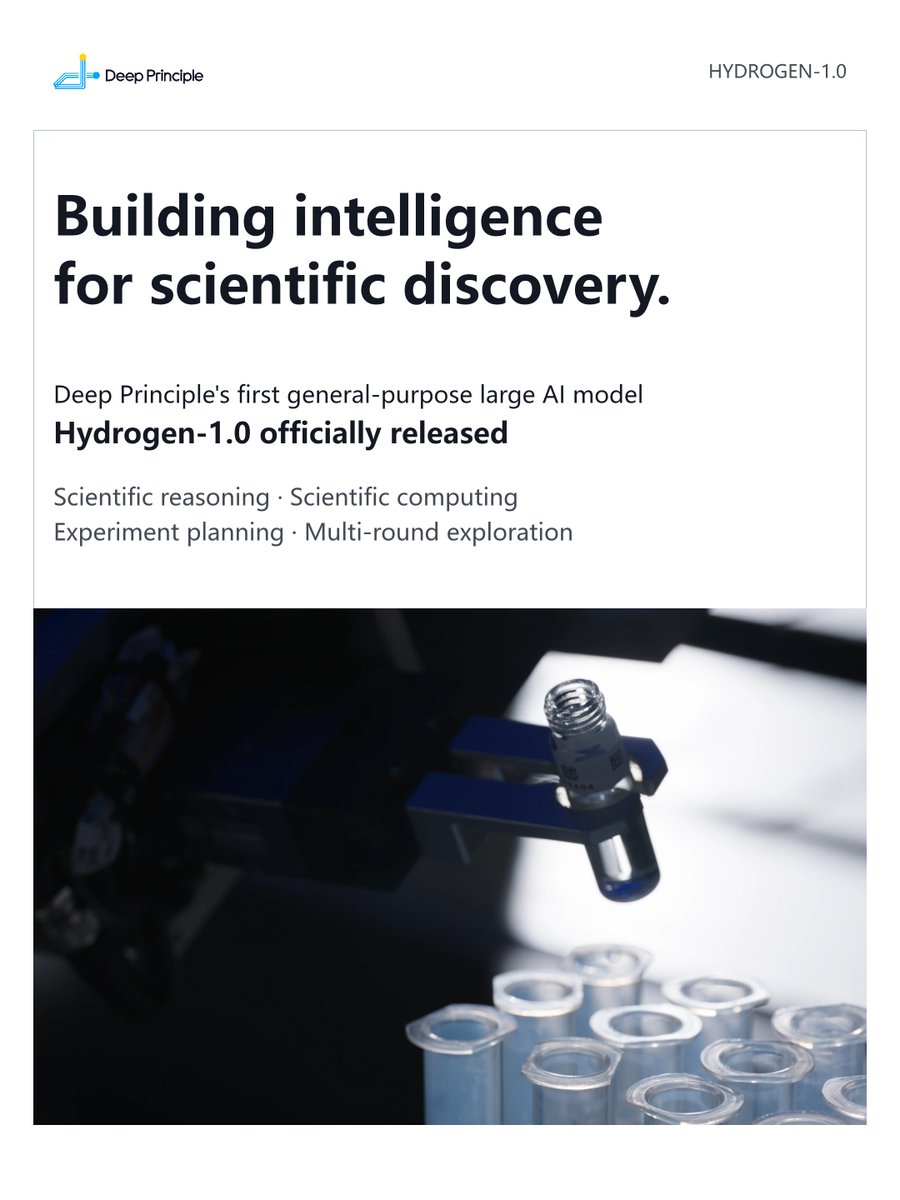
Hangzhou-based AI-for-science company Deep Principle released Hydrogen-1.0 on November 2, its first general-purpose scientific model. It post-trains Zhipu's GLM-5.3 with SFT and RL on chemistry, materials and life-science data plus its own lab records and discovery trajectories, and ships about 753B parameters of BF16 weights on Hugging Face under the MIT license. By the vendor's own evaluation it scores 38.3% on FrontierScience-Research versus 33.3% for GPT-6 Astra; none of the results have been independently reproduced yet.
Deep Principle Open-Sources Hydrogen-1.0, a 753B Science Model Post-Trained From GLM-5.3 on Lab Records, MIT Licensed

Key Takeaways

  • Scale: Hugging Face lists about 753B total parameters (BF16, roughly 1.5 TB of weights), glm_moe_dsa architecture, 1M-token context and 128K max output, MIT licensed (download requires accepting HF terms).
  • Benchmarks (vendor-reported): 38.3% on FrontierScience-Research vs 33.3% for GPT-6 Astra; 93.0% on GPQA Diamond, which the company says roughly matches Kimi K3.
  • Internal scenarios (vendor-reported): leads max-thinking GPT-6 Astra by 5.13 points on scientific computing and 4.76 points on forward reaction prediction, but trails it by 3.33 points on NMR structure elucidation.
  • Materials discovery: after five rounds of transition-metal-complex search, the mean best HOMO-LUMO gap reached 4.318 eV vs 3.689 eV for GPT-6 Astra and 3.353 eV for Kimi K3 (official blog).
  • Access: weights on HF and ModelScope, plus NVFP4 (B200/B300) and MXFP4 (MI350X/MI355X) quantized repos; API via NeuroSpark and in-app use in the Mira AI Scientist; tested with SGLang on 8 GPUs.
Read full story

Anthropic expands AI for Science to 20 foundations, institutions and projects, including NSF, Simons and Sloan, with free Claude credits

Anthropic is extending its AI for Science program, launched in May 2025, from individual researchers to institutions: six science funders (including the US NSF, Simons, Sloan and Schmidt Sciences) will distribute Claude credits to researchers, six institutions (such as STScI, Sanger, the Crick and EMBL) will use credits in-house, and six public-good research projects (such as gnomAD, FlyWire and the Lean math library Tau Ceti) get direct support. Anthropic did not disclose the total value of the credits.

Anthropic expands AI for Science to 20 foundations, institutions and projects, including NSF, Simons and Sloan, with free Claude credits

Key Takeaways

  • Anthropic names 20 partners in three groups: funders and societies, research institutions, and specific research projects (per Anthropic)
  • Funders include the roughly $9B-a-year US NSF, Simons, Sloan, Schmidt Sciences and CAS (American Chemical Society), which will pass Claude credits on to researchers
  • Institutions include STScI, which runs science operations for Hubble and Webb, plus Wellcome Sanger, the Francis Crick Institute, EMBL and Gladstone
  • Projects include gnomAD (DNA data from 800,000+ people), the FlyWire fruit-fly connectome and Tau Ceti, a Lean autoformalized math library
  • Total credit value, grant sizes and how to apply were not disclosed; Anthropic earlier launched a discounted Team plan for scientists
Read full story
Linked Models & Agents:
⚡ Claude🌐 Anthropic

Anthropic opens a Claude Team plan for 10,000 scientists: free standard seats, $15 premium

Anthropic opened a Claude Team plan for scientists, starting with 10,000 seats across math, chemistry, physics, and other fields. Standard seats are free; premium seats with 5x usage limits cost $15 per month for one year, an 80% discount. Principal investigators at academic and nonprofit labs can enroll and add their groups. The expansion builds on Claude Science and the AI for Science credit program, with Anthropic saying it will grow well beyond the initial 10,000 seats.

Key Takeaways

  • 10,000 scientific seats launch with free standard access and $15/month premium seats at 5x usage for one year.
  • PIs at academic and nonprofit labs can enroll their groups.
  • The plan extends Claude Science and AI for Science credits, with more seats promised later.
Read full story