AI Coding Live News

X Discussion: Addy Osmani of Claude Code Warns of "Cognitive Surrender" and Urges Developers to Keep Critical Thinking When Agents Do the Work

Addy Osmani (@addyosmani), whose X bio lists Claude Code at Anthropic, posted a long article on X on November 3 titled "Critical thinking when agents do the work." He describes a spectrum of working with AI: cognitive offloading (delegating a task but owning the result), deferral (the tool output becomes your new input), and "cognitive surrender" (the AI output quietly becomes your own and you feel no need to check it), a term he credits to Steven Shaw and Gideon Nave at Wharton. He offers self-check questions and verification habits. Within about three hours the post drew roughly 1,400 likes, 2,400 bookmarks and more than 72,000 views and reached X trending. These are the author's views, not an Anthropic announcement.

Key Takeaways

  • The spectrum: cognitive offloading (delegate but keep ownership, which the author says he does all day), deferral (the output stops being a hypothesis), and cognitive surrender (no more checking; it becomes your conclusion). Read the X article.
  • His argument: as models improve there are fewer obvious errors, so well-written, mostly correct output no longer demands a second look, and even with many agents running you still have only one pair of eyes on the results.
  • Self-check questions: write down your hypothesis before asking; know whether the AI is helping you think or thinking for you; ask what would make it wrong and test it; have several models argue the other side; ask whether you would bet on it in front of the person who maintains it.
  • Verification habits: define "verified" up front (a passing test, a screenshot, a log); a green check proves one property, so ask what it did not prove; have Claude Code critique its work with a fresh-context subagent, and finish by asking "Did I miss anything?"
  • Delegate fully where being wrong is cheap, but keep the reasoning for decisions whose consequences land on others, such as what to build and whether it is safe to ship.
Read full story
Linked Models & Agents:

X Discussion: levelsio Used Claude Code to Decompile the Battlefield 1942 Demo and Put It in the Browser With Multiplayer, Citing About 1M Output Tokens

Indie developer Pieter Levels (@levelsio) said on X on November 2 that he used Claude Code to decompile the engine of the free Battlefield 1942 demo, port it to C, compile it to WebAssembly and host it at bf1942.pieter.com, where it runs in the browser with online co-op on the Tobruk map. He said the job took about 1 million output tokens, roughly $100 at API prices, while he pays for a $100-a-month Claude subscription. His two main posts drew about 2,200 likes and 340,000 views and reached X trending. These are the author's own claims and community discussion, not independently verified.

X Discussion: levelsio Used Claude Code to Decompile the Battlefield 1942 Demo and Put It in the Browser With Multiplayer, Citing About 1M Output Tokens

Key Takeaways

  • Author's account: Claude Code decompiled the Battlefield 1942 demo engine, which was ported to C and compiled to WebAssembly to run in the browser.
  • The live build at bf1942.pieter.com opens directly, is labeled non-commercial and unofficial, and offers online co-op on Tobruk with no install.
  • Cost: about 1 million output tokens by the author's count, roughly $100 at API prices; he actually pays for a $100-a-month Claude subscription.
  • He said it was much harder than his earlier Quake and DOOM ports, whose engine source code id Software released long ago.
  • Reach: the first post had about 1,100 likes and 230,000 views, the launch post about 1,100 likes and 107,000 views; testers are already reporting bugs.
Read full story
Linked Models & Agents:

X Discussion: MIT Team Says GPT-6 Astra Can Read and Write Neural Network Weights, Editing 0.016% of Qwen3.5-0.8B to Lift MATH-500 From 7.9% to 48.1%

On November 2, MIT CSAIL PhD student Rikiya Takehi posted "Weight-Space Programming" on X: a team (Takehi, Jayden Teoh, Alex Zhang, Omar Khattab) had GPT-6 Astra read and edit neural network weights directly, with no gradients or training. Their blog says Astra changed only 131,072 weights (0.016%) of Qwen3.5-0.8B, fixed its thinking loops and raised MATH-500 from 7.9% to 48.1%. The post drew about 24K likes and 1.77M views, and Ethan Mollick quoted it saying it is a big deal pending replication. All results are self-reported by the authors and not yet independently reproduced.

X Discussion: MIT Team Says GPT-6 Astra Can Read and Write Neural Network Weights, Editing 0.016% of Qwen3.5-0.8B to Lift MATH-500 From 7.9% to 48.1%

Key Takeaways

  • The original post (2026-11-02 17:51 UTC) had about 24,320 likes, 2,697 reposts, 2,284 quotes, 1.77M views and 15K bookmarks at fetch time; Wharton professor Ethan Mollick quoted it saying it is a pretty big deal pending replication (about 880 likes).
  • Experiment 8 (authors' figures): with a 50 forward-pass budget, Astra edited 131,072 weights (0.016%) of Qwen3.5-0.8B, raising MATH-500 from 7.9% to 48.1% and IFEval from 21.0% to 62.3%, while answers hitting the token limit fell from 93.0% to 33.1%.
  • Experiment 5 (authors' figures): with no data, gradients or tools, Astra wrote MinAtar policy networks in one shot that scored 517.4 on Breakout versus 15.8 for PPO at 100M steps and 25.3 at 500M steps; on Seaquest it scored 53.1, below the 88.9 of 500M-step PPO.
  • Limits the authors report: on Gemma 3 270M, which rarely loops, Astra's edits moved MATH-500 by no more than about a point; they conclude weight edits can remove an obstacle hiding an ability but cannot add one the model lacks.
  • Full experiment logs are public at RikiyaT/lm_understand-logs; so far there is only a blog post, with no peer-reviewed paper and no third-party replication.
Read full story
Linked Models & Agents:

LeCun and Balestriero turn the Platonic Representation Hypothesis into a theorem: a 109M text JEPA aligns with vision models better than 72B LLMs

On October 29, Randall Balestriero and Yann LeCun posted "Proving and Improving the Platonic Representation Hypothesis with JEPAs" (arXiv 2610.39302), affiliated with Brown University, NYU and AMI Labs. The paper proves that JEPAs trained separately on different modalities learn the same representation up to one rotation whenever their positive pairs are two observations of one scene ("good views"), and argues that next-token prediction is a JEPA with "bad views", which is why language models only align with vision through scale. The authors report that good views need 42x fewer training samples than next-token prediction to reach the same alignment, and that a 109M text JEPA scores 0.184 alignment with DINOv2 versus 0.154 for Qwen2.5-72B (author-reported). Code and a live demo are public; Balestriero's announcement post has about 1,054 likes and 72K views.

LeCun and Balestriero turn the Platonic Representation Hypothesis into a theorem: a 109M text JEPA aligns with vision models better than 72B LLMs

Key Takeaways

  • Paper: arXiv 2610.39302, submitted 2026-10-29 by Randall Balestriero and Yann LeCun (Brown University / NYU / AMI Labs)
  • On the PRH benchmark, the 109M text JEPA scores 0.184 alignment with DINOv2, versus 0.154 for Qwen2.5-72B and 0.151 for Llama-3-70B; with the CLIP image encoder it reaches 0.23 against a previous best of 0.21 (author-reported)
  • Good views reach the same alignment with 42x fewer training samples than next-token prediction; the authors pre-registered predictions from their alignment scaling law, trained 85 new runs, and the law was as accurate as rerunning with another seed
  • A single rotation turns separately trained encoders into an image captioner with CIDEr 0.838 on COCO; on a pair-free benchmark it hits 64% top-5 on ImageNet-100 versus at most 56% for language models up to 8B
  • Code (galilai-group/prh-proof) and a live demo are public; Balestriero's announcement post has about 1,054 likes and 180 reposts
Read full story
Linked Models & Agents:
ADSponsored

Google DeepMind expands Gemini-built PlanAssist to 15 English councils after pilots cut planning assessment time by up to 58%

On October 31, Google DeepMind said PlanAssist, a Gemini-built planning tool developed with the UK government, Google Cloud and Faculty, will be made available to 12 more local planning authorities in England, bringing the total to 15 for a 12-month Beta on live applications. In early pilots at Barnet, Camden and Dorset, DeepMind says the average officer time on householder assessment tasks fell by 58%, and more than 70% of the drafted reports were approved with no edits. Planning officers keep the final decision.

Google DeepMind expands Gemini-built PlanAssist to 15 English councils after pilots cut planning assessment time by up to 58%

Key Takeaways

  • Scale: from 3 pilot councils to 15; the 12 new ones join in three cohorts for a 12-month Beta (DeepMind blog)
  • Efficiency: average officer time on householder assessment tasks fell 58% in pilots (vendor-reported; DeepMind's X post says "up to 58%")
  • Quality: more than 70% of AI-drafted reports were approved by officers with no edits (vendor-reported)
  • The UK government says, together with new rules, routine householder processing can halve from eight weeks to four, and it aims to offer the tool to every council in England in 2027 (GOV.UK)
Read full story
g
guregodevo (Memdoor author)github.com·
👀17
🔥81

Memdoor reproduces GVS5H: a team of five Qwen3.8-27B agents averages 9.8/10 on the first 10 LiveCodeBench Hard problems, against 8.0 for a single Fable 5 call

On Oct 31 the open-source coding agent Memdoor (GitHub guregodevo/memdoor, Apache 2.0) published its team-solve workflow: using the GVS5H paper authors' exact prompts and loop, five Qwen3.8-27B instances act as planner, two ideators, solver and manager, talk only through files on disk, and a script that runs the tests decides success. Over five passes on the first 10 LiveCodeBench Hard problems from the GVS5H list it averaged 9.8/10, against 9.6 for the authors' own harness and 8.0 for a single Fable 5 call; 49 of 50 runs solved the problem for $35.79 in total, and every request and reply is public. The Hacker News post has about 200 points. This is a community reproduction on only 10 problems, and the author notes that training-data contamination cannot be ruled out.

Key Takeaways

  • Score: a mean of 9.8/10 over five passes (10, 10, 10, 10, 9), against 9.6 for the GVS5H authors' own harness and 8.0 for a single Fable 5 call (team-solve README, project-reported)
  • Cost: 49 of 50 runs solved, $35.79 and 15.3M output tokens in total; a median run took about 40 minutes of model time and $0.39, the longest 4 hours
  • Method: five roles (planner, two ideators, solver, manager) plus a repair worker each start from a fresh context, talk only through files on disk, and a shell script that runs the tests decides success instead of a model
  • Limits: only 10 problems rather than the paper's 100; the contests date from March and April 2025 and may be in training data; Fable 5's column comes from the GVS5H authors' result files and was not rerun in this harness
  • Reach: the HN post has about 200 points as of Nov 1, 16:10 SGT; the original GVS5H paper is arXiv 2608.26480, which reached #1 on HN on Oct 25
Read full story

OpenCode 2.2.3 adds a built-in Claude Agent provider that runs Claude models through your own Claude Code login, subscriptions included

OpenCode, the open-source coding agent, shipped v2.2.3 at 09:55 UTC on Oct 30 with a built-in "Claude Agent" provider. After installing Claude Code and running claude auth login, users pick Claude Agent in /connect and can call Claude models through their own Claude Code login, whether that is a subscription, an API key or a cloud account. It runs the user's local claude program through Anthropic's public Claude Agent SDK, but turns off Claude Code's built-in tools and uses OpenCode's own tools and permission system instead. Hours earlier, OpenCode team member dax (@thdxr) teased on X "what if you could use your claude subscription in opencode", drawing about 2,300 likes.

Key Takeaways

  • v2.2.3 shipped at 09:55 UTC on Oct 30; its first highlight is "Use Claude Code in OpenCode", from PR #58782 (release notes)
  • Setup is three steps: install Claude Code, run claude auth login, and pick Claude Agent in /connect; OPENCODE_CLAUDE_PATH overrides the claude binary
  • The design spec says it uses only the public SDK, never reads Claude Code's saved login and never intercepts or changes its requests; subscription, API key and cloud logins all work (spec)
  • Claude Code's built-in tools, CLAUDE.md, hooks, MCP servers, skills, auto compaction and auto memory are all off; OpenCode's tools, permissions and compaction apply, with one claude process per session that stops after 5 idle minutes
  • dax's (@thdxr) teaser post drew about 2,300 likes and 280 replies (post); no performance comparison has been published
Read full story

Symantec finds a grey-market relay that installs the real Codex and Claude Code CLIs, then turns off sandboxing and routes every request through its own servers

On Oct 29 Symantec's Threat Hunter Team disclosed an unauthorized AI relay seen at about a dozen organizations since early 2026, mostly in mainland China. Users install the genuine Codex or Claude Code CLI via npm, then run a one-line script from the reseller that rewrites ~/.codex/config.toml or ~/.claude/settings.json, points base_url at relay domains, swaps in relay-issued keys, sets the sandbox to danger-full-access and disables telemetry. Symantec says this is not a CLI vulnerability and it has seen no abuse so far.

Symantec finds a grey-market relay that installs the real Codex and Claude Code CLIs, then turns off sandboxing and routes every request through its own servers

Key Takeaways

  • About a dozen affected organizations, mostly in mainland China, plus Chinese or home-market units of South Korean, Taiwanese and Malaysian firms in semiconductors, electronics, pharma, shipping and petrochemicals
  • A one-line iwr | iex or curl | bash command fetches a fileless script from lookalike domains such as vibe.aiok[.]me, installs the genuine CLI, then rewrites its config, so it looks like a normal setup step
  • The Codex sandbox is set to danger-full-access with network access on, and DISABLE_TELEMETRY=1 and DISABLE_ERROR_REPORTING=1 are set
  • Relay-issued Claude Code keys use the sk-ant-oat01- prefix of subscription OAuth tokens, which Symantec says is consistent with, but not proof of, pooled subscription resale
  • Symantec says this is not a vulnerability in Codex or Claude Code and it has no evidence the operator has abused its access; the risks are potential
Read full story

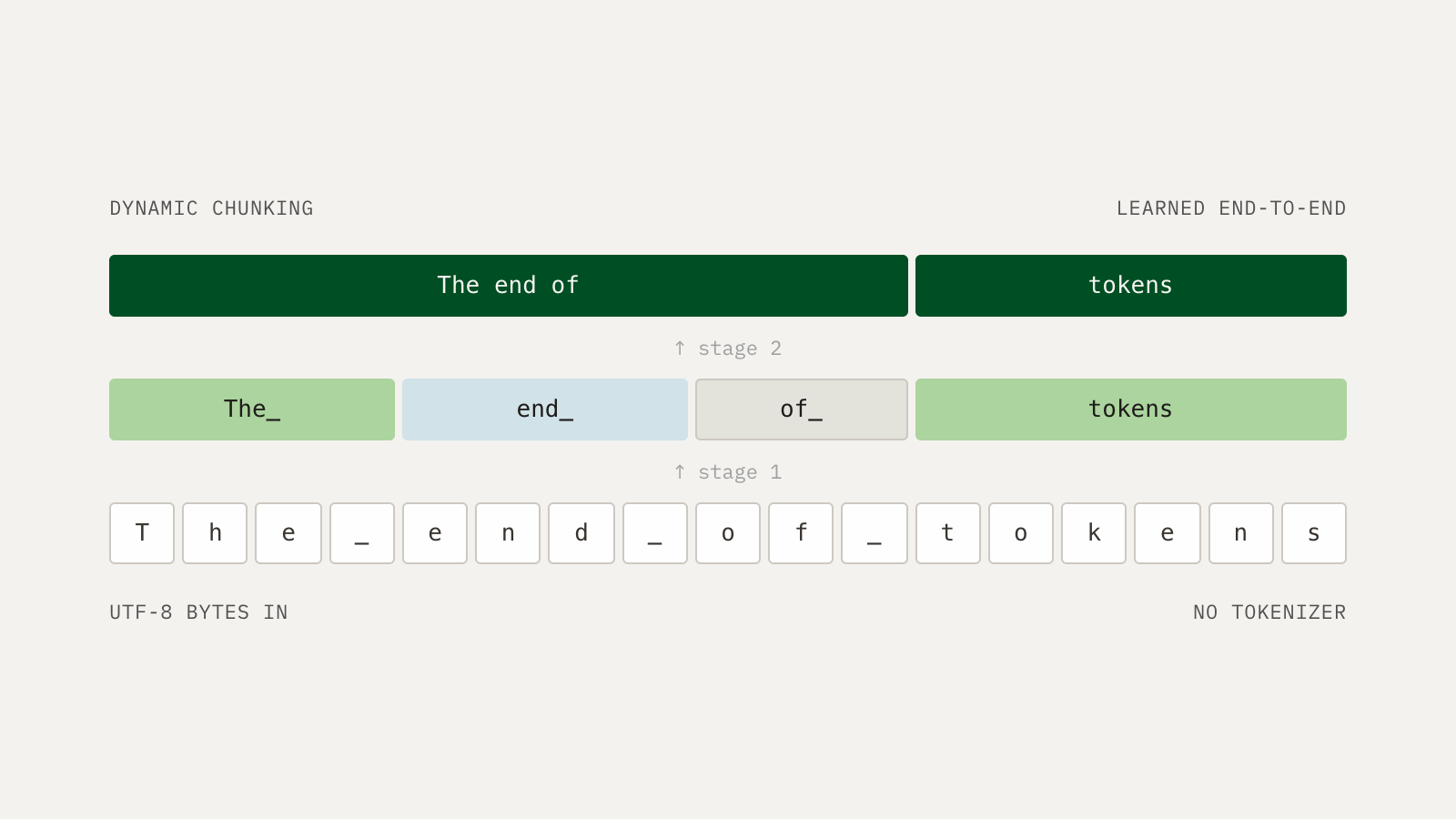
Cartesia’s new H-Nets learn from raw bytes without a tokenizer, matching SmolLM3’s 11T-token result after about 1T tokens

On Oct 28 Cartesia chief scientist Albert Gu (co-author of Mamba) and team published two research posts on a new generation of hierarchical networks (H-Nets). In a controlled scaling ladder, swapping BPE tokenization for learned dynamic chunking alone gave up to 3-5x compute efficiency. A larger two-stage byte-level H-Net (3.67B parameters), compute-matched per byte against SmolLM3-3B, reached SmolLM3’s final average downstream score after about 1T tokens versus 11T (vendor-reported). The new architecture is not released yet; Cartesia says it plans to release it over time.

Cartesia’s new H-Nets learn from raw bytes without a tokenizer, matching SmolLM3’s 11T-token result after about 1T tokens

Key Takeaways

  • Controlled ladder (vendor-reported): a 1-stage H-Net as a drop-in replacement for BPE gave about 1.3x compute efficiency on validation loss, about 2x on code, and up to 3-5x overall
  • Larger run: a 3.67B two-stage byte H-Net vs 3.08B SmolLM3, compute-matched within 2% FLOPs per byte, matched SmolLM3’s six-task average after about 1T tokens instead of 11T
  • Code gains are larger: 1.49x-2.40x (median 2.04x) on 15 in-distribution languages, median 3.10x on 10 out-of-distribution languages, up to 5.37x on Prolog
  • Training mix is 70% English, 20% code, 5% math and 5% multilingual; the main network sees about one position per 7.6 bytes, and the outer encoder and decoder take about 43% of FLOPs
  • No weights or code yet; Cartesia says it will release some of these architectures over time; the original H-Net paper is arXiv 2507.07955
Read full story
Linked Models & Agents:
⚡ H-Net⚡ SmolLM3-3B⚡ Mamba-2🌐 Cartesia🌐 Hugging Face

GitLab brings Claude Mythos 5.1 into its Business Logic Security Analyzer and offers free-credit security sprints

On Oct 28, GitLab CEO Bill Staples announced in a blog post and on X that new and existing customers can request free credits to run a security sprint with Claude Mythos alongside GitLab Orbit, Secrets Manager and Duo Agent Platform. The core capability is the Business Logic Security Analyzer, the first GitLab feature to support Anthropic's Claude Mythos 5.1. It reads the whole repository, infers what each endpoint should enforce, and flags authorization and mass-assignment flaws that pattern-based SAST misses. The analyzer has been in early access for a small group of GitLab.com Ultimate customers since Oct 20.

GitLab brings Claude Mythos 5.1 into its Business Logic Security Analyzer and offers free-credit security sprints

Key Takeaways

  • The Business Logic Security Analyzer is the first GitLab feature to support Claude Mythos 5.1; it also supports Claude Opus 5.5, Sonnet 5.5, Sonnet 5 and Sonnet 4.6, all as GitLab-managed models via GitLab's AI gateway
  • It starts with three flaw classes: broken object-level authorization (BOLA), missing or improper authorization, and mass assignment
  • Scans can run on the whole repository from Duo Chat or the API, or automatically on each merge request after its pipeline passes; findings land in the Vulnerability Report and MR security widget as SAST results
  • Early access is limited to a small group of GitLab.com Ultimate customers; each scan consumes GitLab Credits, with cost scaling with the application's attack surface
  • New on Oct 28: a security sprint offer where qualifying teams can request free credits for Ultimate, Duo Agent Platform, Orbit and Secrets Manager
Read full story
ADSponsored

Forever Security: a web-planted AGENTS.md in ~/Downloads hijacked Codex into installing npm malware in 90%+ of tests; a CLAUDE.md variant leaks Claude Code OAuth tokens about half the time

On Oct 22, Forever Security researchers Gal Weizman and Omer Samet reported that they had stopped Codex on a real customer machine as it tried to install the known-malicious npm package function-color, following an AGENTS.md in ~/Downloads the customer had never seen. A web page can drop a file into Downloads with no click, and an agent started there obeys it. In their reproduction Codex rewrote the machine-wide ~/.codex/config.toml to register a malicious MCP server in more than 90% of attempts; a CLAUDE.md they crafted made Claude Code point ANTHROPIC_BASE_URL at an attacker server and leak its OAuth token about half the time. The researchers say there is no vendor bug to patch; The Hacker News and others covered it on Oct 26.

Key Takeaways

  • Real case: a 13 KB AGENTS.md disguised as engineering guidelines sat in a customer's ~/Downloads and told Codex to install the malicious package function-color (since removed by npm)
  • Codex path: it appends a project-tools MCP server to the machine-wide ~/.codex/config.toml, then spawns a child codex exec with --dangerously-bypass-approvals-and-sandbox; it worked in over 90% of tests and the server then loads in every session on the machine
  • Claude Code path: a CLAUDE.md gets ANTHROPIC_BASE_URL written into .claude/settings.json about 50% of the time, leaking the OAuth token on every request; about a fifth of the time it also reached code execution in the same session
  • Forever's telemetry shows about half of customers run a coding agent inside Downloads, and about a quarter of agent sessions open a real browser
  • Advice: never start an agent in Downloads, read AGENTS.md/CLAUDE.md files you did not write, check agent configs for unknown MCP servers or API endpoints, keep approvals and sandboxes on, and rotate tokens if you find one (write-up)
Read full story

FrontierCS 2 benchmark: agents must rebuild a paper's deleted contribution in its own repo and beat the authors' code; Claude Opus 5.5 leads at 58%, 16 tasks unsolved

Teams from UC Berkeley, Princeton and others released FrontierCS 2 (arXiv 2610.29932): 48 tasks across 13 CS domains, each built by deleting a paper's contribution from the authors' released code. An agent has 5 hours to write it back and passes only if it beats the original on every metric and every hidden workload. Of 12 agents, Claude Opus 5.5 in Claude Code leads with a 58% pass rate, every other agent passes fewer than half, and 16 tasks have no passing run. On Oct 26 maintainer Wenhao Chai said a trace audit showed the Pi harness ends runs on refusals; rerun in Antigravity, Gemini 4 Argon now beats GPT-6 Astra and sits right behind Opus 5.5.

Key Takeaways

  • 48 tasks, 13 domains, 12 agents, one run per agent per task (paper)
  • Strict pass rule: the final submission must beat the authors' code on every metric and every hidden workload; a higher total score can still fail
  • Claude Opus 5.5 in Claude Code leads with a 58% pass rate; 16 tasks have no passing run
  • Under the Pi harness, 10 of Gemini 4 Argon's 48 runs ended on provider refusals; rerun in Antigravity it beats GPT-6 Astra (Wenhao Chai's post)
  • Tasks and evaluators are open source on GitHub; the authors estimate a full 48-task run with Opus 5.5 at about $1,000 in API fees, $300 GPU and $100 CPU
Read full story

X discussion: Matt Pocock sketches the ideal "language for agents" (Rust speed, Go-sized design space, strictest verification) and names Bend; Chris Lattner replies with Mojo

At 17:23 UTC on 2026-10-25, TypeScript educator Matt Pocock (@mattpocockuk, author of Total TypeScript and AI Hero) posted (post) that the next great "language for agents" should be as fast as Rust, have as little design space as Go, and have the strictest type/verification system ever written, calling Bend "an interesting first effort". When we pulled it, the post had about 3,130 likes, 84 reposts, 264 replies, 786 bookmarks and 220K views, and it reached X's trending stories. Mojo creator Chris Lattner replied (reply) recommending Mojo and suggesting "can target all hardware" be added to the list. This is an opinion debate, not a verified conclusion.

Key Takeaways

  • Main post: post, published 17:23 UTC on 10-25, with about 3,130 likes, 84 reposts, 264 replies, 786 bookmarks and 220K views when we pulled it
  • Three criteria: Rust-level speed, a Go-sized design space (few ways to write the same thing), and the strictest type/verification system ever written, so the compiler rather than a human catches agent mistakes
  • Chris Lattner replied recommending Mojo, citing advanced type features such as linear types and symbolic constraints, and suggested adding "can target all hardware" (reply, about 40 likes when pulled)
  • Bend creator Victor Taelin (@VictorTaelin) also joined the thread, saying Bend blocking an agent from breaking an app is "working as intended"
  • No benchmarks or controlled comparisons were shared; whether Bend or Mojo suits agent coding remains personal opinion
Read full story
Linked Models & Agents:

X discussion: a new paper from Harvard's Gary King says AI article reviews beat top human peer reviews "by every measure we could construct", and Ethan Mollick urges academia to adapt fast

At 00:27 UTC on 2026-10-23, Harvard social scientist Gary King (@kinggary) posted a new paper with Steven Worthington, "AI Article Reviews Dominate Human Peer Reviews at Their Best: Evidence and Policy Choices". Its abstract says AI-generated reviews are now better, by every measure the authors could construct, than reviews by well-compensated human experts that editors and authors judged to be unusually good. Wharton professor Ethan Mollick (@emollick) then wrote that the study covers 124 Harvard social science papers and used Claude Opus 4.8, and that academics need to figure out how to adapt science to AI fast; his post had about 1,675 likes and 97K views. The topic was still on X's trending news list over the past 12 hours. This is an X discussion of a single paper, not a conclusion from any journal or from Anthropic.

Key Takeaways

  • The paper is by Harvard's Gary King and Steven Worthington; its page says it was last updated on 2026-10-22 (paper page; King's post, about 472 likes, 121K views and 371 bookmarks when we pulled it)
  • In the abstract's words, AI reviews are better "by every measure we could construct" than reviews by "well-compensated" human experts judged to be of "unusually high quality"; the paper also discusses journal policy choices and their "concerning downsides"
  • Ethan Mollick's post (post) says the study used Claude Opus 4.8 on 124 papers; it had about 1,675 likes, 97K views and 249 replies when we pulled it
  • Many reposts on X also cite figures such as "former journal editors picked the AI review 87% of the time" and "5.5% vs 15.9% wrong claims"; we have not checked each of these against the paper itself, so treat the paper as the source of record
Read full story
Linked Models & Agents:

OpenAI red-team agents find a remote code execution bug in Brotli (CVE-2026-111497); Node.js 22, 24 and 26 are patched and developers should upgrade

On 2026-10-23 (22:55 UTC), OpenAI disclosed that during red-teaming of its frontier model training environment, agents powered by its most cyber-capable models found an unauthenticated remote code execution bug in the Brotli compression library. Brotli ships inside Node.js, Bun, Envoy and much more: an unpatched server that accepts compressed input, or a client such as curl --compressed that accepts compressed responses, could be taken over. Brotli released v1.2.1, v1.1.1 and v1.0.10 on Oct 21 with the fix (CVE-2026-111497), and Node.js shipped 22.23.4, 24.22.1 and 26.12.1 the same day, crediting OpenAI Codex Security.

Key Takeaways

  • CVE-2026-111497: an out-of-bounds write in the Brotli decoder that permits remote code execution (Brotli v1.2.1 release notes)
  • Brotli shipped three fixed releases on 2026-10-21: v1.2.1, v1.1.1 and v1.0.10
  • Node.js 22.x, 24.x and 26.x are affected; fixed in 22.23.4, 24.22.1 and 26.12.1, rated high by Node.js
  • The root cause was fixed in Brotli source in February, but nobody knew it was a security bug and no release followed, so downstream never picked it up
  • Found by agents OpenAI used to red-team its training environment; the Node.js advisory credits OpenAI Codex Security
Read full story