AI Coding Live News

Perplexity Open-Sources pplx-decider v1.3 Decision Models: New Locate Span Extraction, 91.6% Mean Accuracy Across 63 Classification Tasks for the 26B Model, Apache 2.0, Free on OpenRouter Until November 19

On November 12 Perplexity released pplx-decider-v1.3 (built on Qwen3.8-27B, about 26.1B parameters) and the distilled pplx-decider-flash-v1.3 (built on Qwen3.5-4B, about 4.5B). The weights are on Hugging Face under Apache 2.0, and both models are served through the Decisions API and OpenRouter. The new Locate feature extracts verbatim spans by label or instruction and returns character offsets. Perplexity says v1.3 averages 91.6% accuracy across 63 classification tasks, 6.54 points above its production classifiers.

Perplexity Open-Sources pplx-decider v1.3 Decision Models: New Locate Span Extraction, 91.6% Mean Accuracy Across 63 Classification Tasks for the 26B Model, Apache 2.0, Free on OpenRouter Until November 19

Key Takeaways

  • Two open-weight sizes: v1.3 has about 26.1B parameters (fine-tuned from Qwen3.8-27B) and Flash v1.3 about 4.5B (distilled onto Qwen3.5-4B), both Apache 2.0; running v1.3 locally in BF16 needs about 49 GiB of GPU memory
  • New Locate feature: extracts verbatim spans by label or instruction with start and end character offsets and a score, covering NER, PII detection and extractive QA, and can share a request with classification and scoring questions
  • Classification (vendor-reported): 91.6% mean accuracy across 63 classification tasks, 6.54 points above Perplexity's production classifiers; ahead of Jev 1.14 in all 7 domains, by up to 12.9 points in finance
  • Retrieval and stability: nDCG@10 of 83.99 across 72 retrieval tasks, 1.81 above Qwen3-Reranker-8B; answers changed on only 0.27% of questions under input rewrites, versus 2.69% to 4.84% for Jev 1.14
  • Where to get it: Hugging Face downloads, the Perplexity Decisions API, and OpenRouter, where both v1.3 models are free until November 19
Read full story
Linked Models & Agents:
⚡ pplx-decider-v1.3⚡ pplx-decider-flash-v1.3⚡ Qwen3.8-27B⚡ Qwen3.5-4B⚡ Jev 1.14⚡ Qwen3-Reranker-8B🌐 Perplexity🌐 Hugging Face🌐 OpenRouter
Anthropic Publishes a Claude Model Selection Guide: Start Most Coding on Opus 5.5 at Medium, Tune Effort Before Switching Models, Put Subagents on Haiku 5.5

On November 9, Anthropic's developer blog claude.dev published a selection guide by Addy Osmani, "Which Claude model should you build with?"; the ClaudeDevs post drew about 9,200 likes and 12,000 bookmarks. The core advice: start most coding and knowledge work on Opus 5.5 at medium effort (the Claude Code default); drop to Sonnet 5.5 for well-scoped bug fixes and spec-driven work; use Haiku 5.5 for classification, routing, extraction, and log-reading subagents; and move up to Fable 5.2 for major refactors, migrations, and deep research. Before switching models, tune effort and give the model a way to verify its own work. The guide also lists prices, default effort levels, and compatibility differences that can trigger 400 errors when migrating.

Anthropic Publishes a Claude Model Selection Guide: Start Most Coding on Opus 5.5 at Medium, Tune Effort Before Switching Models, Put Subagents on Haiku 5.5

Key Takeaways

  • Prices (vendor figures, per million input/output tokens): Haiku 5.5 $0.10/$0.50 ($0.50/$2.50 above 100K), Sonnet 5.5 $2/$10, Opus 5.5 $4/$20, Fable 5.2 $8/$40; all four have a 1M context window and 128K max output
  • Anthropic's own FrontierCode 2.0 runs: Fable 5.2 at high scores 45.3% vs Opus 5.5 at max 45.5% for roughly half the cost per task, so test Fable before pushing Opus past high
  • On a SWE-bench Pro subset, running Opus 5.5 at low and re-running failures at high passed about 97% at about $0.17 per task, versus 95.3% at $0.29 with everything at high
  • An Opus 5.5 lead over up to 25 parallel Sonnet 5.5 workers searching about 22 million tokens of code cost about a third less than Opus alone, with a similar score
  • Migration traps: Fable 5.2 enables preserved thinking on all API accounts, so editing earlier context returns a 400; tool_choice any/tool also returns 400 on Sonnet 5.5, Opus 5.5, and Fable 5.2
Read full story

Axiom uses AI agent swarms to fully formalize the Classification of Finite Simple Groups in Lean in 24 days: about 43.1M lines, the first complete computer-checked proof of the longest proof in math history

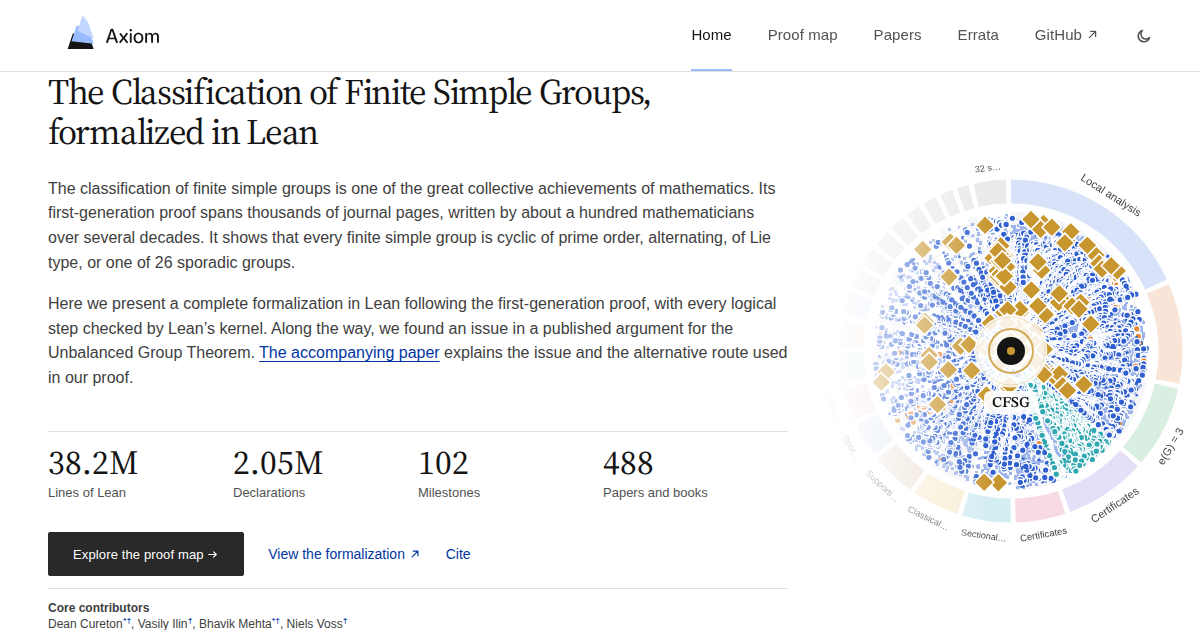
AI math company Axiom announced on Oct 27 that swarms of dozens of AI agents formalized the Classification of Finite Simple Groups (CFSG; the original proof runs about 15,000 pages across 500+ articles by about 100 mathematicians) in the Lean proof assistant in 24 days, producing about 43.1M lines of Lean and 2.05M declarations, with the repo public on GitHub. The work surfaced 34 noteworthy deviations from the published record, and AxiomProver produced a new alternative argument for the Unbalanced Group Theorem.

Axiom uses AI agent swarms to fully formalize the Classification of Finite Simple Groups in Lean in 24 days: about 43.1M lines, the first complete computer-checked proof of the longest proof in math history

Key Takeaways

  • Per Axiom: 24 days and swarms of dozens of AI agents produced about 43.1M lines of Lean, 2.05M declarations and 100 milestones, drawing on 715 papers and books
  • The original CFSG proof spans about 15,000 pages in 500+ articles by about 100 mathematicians; this is the first time it has been fully computer-checked
  • Formalizing it exposed 34 noteworthy deviations from the literature, the biggest a closure assertion in Walter's 1986 Unbalanced Group Theorem argument, with explicit counterexamples such as PSL2(49)
  • AxiomProver produced an alternative argument built on Solomon's 1976 theory and proved a new theorem, "Preservation of simple tops", published on Hexagon (2610.00575)
  • Humans stayed essential: original CFSG group theorists including Richard Lyons and Ronald Solomon were consulted, and an errata list will be published with an advisory board
Read full story
Linked Models & Agents:
⚡ AxiomProver🌐 Axiom

Baseten open-sources decision models mammoth-1 (27B) and elephant-1 (9B): per-option probabilities instead of text, #1 on the Jev Decision Index

On Oct 21, Baseten's research team Base Labs released open decision models mammoth-1 (27B) and elephant-1 (9B), full fine-tunes of Qwen3.5 that skip text generation and return per-option probabilities in one forward pass for routing, classification and scoring. Per Baseten, mammoth-1 tops the Jev Decision Index 0.4 at 71.24 and elephant-1 ties for #1 on the Artificial Analysis Decision Index. Weights are on Hugging Face and the Baseten API is free through Oct 27.

Baseten open-sources decision models mammoth-1 (27B) and elephant-1 (9B): per-option probabilities instead of text, #1 on the Jev Decision Index

Key Takeaways

  • Benchmarks (vendor): mammoth-1 scores 71.24 on Jev Decision Index 0.4, #1 of 208 decision models; 65.9 on AA Decision Index
  • elephant-1 (9B): 62.6 on Jev, best 9B; 65.2 on AA Decision Index, tied #1 with d1-ultra
  • Training: full fine-tunes of Qwen3.5-27B / 9B on 6.21M decision examples incl. abstention and safety data
  • Mechanism: block-bidirectional attention plus shared-prefix caching, one forward pass for many questions; up to ~10x faster than a reasoning model (vendor claim)
  • Try it: Hugging Face weights (MIT); Baseten API free until Oct 27 11:59 PM PT with zero data retention
Read full story
Linked Models & Agents:
⚡ Mammoth 1⚡ Elephant 1⚡ Qwen3.5-27B⚡ Qwen3.5-9B🌐 Baseten🌐 Base Labs
ADSponsored

Microsoft launches Microsoft-Decision-1: a Qwen3.5-9B-based decision-scoring model at $0.042/M input tokens, free output, on Foundry and OpenRouter

On Oct 9 Microsoft released Microsoft-Decision-1, a decision-scoring model that returns calibrated probabilities over fixed options instead of generating text, aimed at routing, classification, verification, agent guardrails and AI judging. Microsoft reports top accuracy across 36 blind benchmarks, ~35x lower P50 latency than GPT-6 Sol and a 1.3% decision-flip rate under perturbation. Available on Microsoft Foundry and OpenRouter, 32K context, $0.042/M input, free output.

Microsoft launches Microsoft-Decision-1: a Qwen3.5-9B-based decision-scoring model at $0.042/M input tokens, free output, on Foundry and OpenRouter

Key Takeaways

  • Pricing: $0.042/M input tokens, $0 output, 32,768-token context (OpenRouter)
  • Vendor-reported: highest accuracy across 36 blind benchmarks (~150K questions); 2.5x faster than runner-up H2O-Lightning-4B v1.1 and 35x faster than GPT-6 Sol
  • Robustness: 1.3% average decision flips across 8 perturbation types; zero flips when options are paraphrased, reversed or shuffled
  • Base: post-trained from Qwen3.5-9B for single-pass scoring; Microsoft plans to rebase on MAI and OpenAI models
  • Internal use: Xbox Research labeled 10K+ feedback items at near GPT-6 Sol quality, 14x+ faster and ~200x cheaper (vendor-reported)
Read full story
Linked Models & Agents:
⚡ Microsoft-Decision-1⚡ Qwen3.5-9B⚡ GPT-6 Sol🌐 Microsoft🌐 OpenRouter

Anthropic launches Claude Haiku 5.5: $0.10/M input, 72.4% on OSWorld 2.1, about 75% cheaper than Haiku 4.5 on average

On Oct 7 Anthropic shipped Claude Haiku 5.5 (claude-haiku-5-5), completing the Claude 5.5 family. It targets high-volume, cost-sensitive work such as summaries, compaction, classification and coding subagents, and Anthropic calls it its fastest model at standard speed. Prompts up to 100K cost $0.10 input / $0.50 output per million tokens, and it is the first Haiku with effort levels. It scores 72.4% on the OSWorld 2.1 offline subset (Haiku 4.5: 15.7%) and 39.2% on Terminal-Bench 4.0. Sonnet 5.5 cache reads were cut 50% the same day, and Max/Team plans get monthly API credits.

Anthropic launches Claude Haiku 5.5: $0.10/M input, 72.4% on OSWorld 2.1, about 75% cheaper than Haiku 4.5 on average

Key Takeaways

  • Pricing: prompts up to 100K cost $0.10 input / $0.50 output / $0.01 cache reads per million tokens ($0.50 / $2.50 above 100K) vs $1 / $5 for Haiku 4.5; Anthropic says about 75% cheaper on average (announcement)
  • OSWorld 2.1 offline subset: 72.4% vs 15.7% (Haiku 4.5), 48.9% (GPT-6 Luna), 83.9% (Sonnet 5.5)
  • Terminal-Bench 4.0: 39.2% (Haiku 4.5 0.0%, GPT-6 Luna 16.4%); FrontierCode 1.1 Main: 46.4% (Sonnet 5.5 xhigh 52.1%)
  • First Haiku with low/medium/high/xhigh/max effort; Claude Code v2.1.293 makes it the default Haiku on the API with 1M context (release notes)
  • Same day: Sonnet 5.5 cache reads cut from $0.20 to $0.10/M; Max 5x / 20x get $100 / $200 monthly API credits, Team $20 (Standard) / $100 (Premium) per seat pooled up to $500; not valid for interactive Claude Code, no rollover
Read full story

Ollama 0.35.0: Decision Models via /v1/systemone (Jev); Nimble & Tev1 return choices, probabilities, confidence

Ollama shipped v0.35.0 on 2026-09-28 (GitHub prerelease): Decision Models via TypeSafe’s Jev API at /v1/systemone. Instead of free text, models answer choice/noul/score questions with options, probabilities, and confidence—for ticket triage, model routing, and classification. First models: Nimble (Bespoke Labs) and Tev1 (Together AI). ~7 commits / 66 files vs v0.34.4; Settings no longer blocks on discovery; macOS update menu and stalled MLX downloads fixed.

Ollama 0.35.0: Decision Models via /v1/systemone (Jev); Nimble & Tev1 return choices, probabilities, confidence

Key Takeaways

  • v0.35.0 (prerelease) adds Decision Models at POST /v1/systemone (TypeSafe Jev)
  • Question types: choice (with probabilities), noul, score — not free-text generation
  • First models: Nimble (Bespoke Labs) and Tev1 (Together AI) on ollama.com/library
  • ~7 commits / 66 files vs v0.34.4; Settings/macOS update/MLX download fixes
Read full story

OpenRouter ships Jev Labs demos: decision-model triage, tool pick, and ticket tags

OpenRouter explained TypeSafe Jev as a decision model for yes/no and multiple-choice questions with confidence scores, saying it can be about 10x cheaper and faster than an LLM for those steps. OpenRouter Labs published mini apps with source for support triage, agent tool selection, X reply classification, and meeting-note actions, plus a model page link.

Key Takeaways

  • Framed as a decision model for yes/no and multiple-choice answers with confidence, fit for every message or tool call.
  • Labs mini apps with source are at openrouter.ai/labs/jev.
  • Model page: openrouter.ai/~typesafe/jev-latest.
Read full story
Linked Models & Agents: