AI Coding Live News

Karpathy builds HackerTube in about 2 hours with Claude Code and Opus 5.5: a YouTube clone of 6,454 videos recommended on Hacker News

On Oct 31 Andrej Karpathy published HackerTube (hackertube.org) on his personal blog: a YouTube-style site that only lists the 6,454 YouTube videos recommended in Hacker News comments from 2007 to 2026, grouped into 150 topics. He says Opus 5.5 in Claude Code did the work: it downloaded every HN comment, ran Sonnet over them in a Workflow to narrow things down to about 40K comments recommending a video, wrapped the result in a YouTube UI, then deployed and hardened it on a VPS, all in about 2 hours. His only manual steps were creating a YouTube API key, booting the VPS and buying the domain. His HN submission reached the front page with about 1,005 points and 308 comments.

Key Takeaways

  • Source: Karpathy's personal blog post HackerTube (Oct 31), with the site live at hackertube.org
  • Scale: from every HN comment it narrowed things down to about 40K comments recommending a YouTube video, giving 6,454 videos across 150 topics from 2007 to 2026 (author-reported)
  • Method: Opus 5.5 ran the download and overall pipeline, used Claude Code's Workflow feature to have Sonnet filter comments and drop spam in bulk, then built a YouTube-style front end and deployed and hardened it on a VPS
  • Product details: it uses the frame at the 50% mark instead of the uploaded thumbnail, offers account-free For You picks with state kept only in the local browser, supports keyboard shortcuts, and exports the site's data so you can hand it to your own agent to build a variant
  • Workflow: Karpathy says Opus 5.5 on Medium effort is his default and he no longer reads or writes code or runs terminal commands himself; the HN post has about 1,005 points and 308 comments (public HN data as of Nov 1, 14:10 SGT)
Read full story
Linked Models & Agents:

Benji Taylor, head of design at X and SpaceXSI, open-sources Stageshow, an agent skill for realistic faux product UI and animated demos

On Oct 31, Benji Taylor, head of design at X and SpaceXSI, released Stageshow on X: an open-source skill (MIT license) for coding agents that helps them produce faux product UI that looks real, including stills, cursor demo animations, and bento grids, delivered as ordinary React components. It installs with one command, and he says it works with Grok Build, Claude Code, Codex, Gemini, and others. The launch post drew about 4,500 likes and 6,500 bookmarks. He notes it rarely nails a demo in one shot and most still take a few rounds of feedback.

Benji Taylor, head of design at X and SpaceXSI, open-sources Stageshow, an agent skill for realistic faux product UI and animated demos

Key Takeaways

  • Install: npx skills add benjitaylor/skills --skill stageshow; the author says it works with Grok Build, Claude Code, Codex, Gemini, and other agents (author's post)
  • Contents: a seven-step workflow in SKILL.md, reference rule docs, dozens of gold examples, a React kit, and self-check scripts such as film.mjs (GitHub)
  • License: the stageshow folder is MIT licensed; the repo was created Oct 26 and had about 61 stars at writing time
  • Reach: the launch post had about 4,521 likes, 6,561 bookmarks, and 213k views as of Nov 1, 08:00 SGT
  • Quality claims are the author's own: the same prompts did better with the skill, but no quantitative evaluation was published
Read full story

Anthropic adds two sentences to Claude Code's Opus 5.5 prompt to steer it away from recreating specific existing games; original and genre games still allowed

Around Oct 27, users noticed Claude Code receiving a new server-side rule (flag name tengu_heron_brook): build original games, games in a genre, and games from the user's own designs and assets, but do not build a recreation of a specific existing game, even if it is renamed or called original. The post that surfaced it drew about 8,700 likes and nearly 2 million views on Oct 30. The same day, Addy Osmani, who works on Claude Code at Anthropic, confirmed on X that the team added two sentences to Claude Code's prompt on Opus 5.5 because using Claude to infringe IP is against Anthropic's usage policy. He said original games, genre games, and games built from your own designs and assets should keep working, that the team will keep iterating, and that users can send him wrongly refused requests.

Key Takeaways

  • Scope: the change is just 2 sentences in Claude Code's system prompt for Opus 5.5, pushed from the server with no user-side toggle (Addy Osmani's post)
  • Rule text (per the flag tengu_heron_brook users captured): original games, genre games, and games from the user's own designs and assets are allowed; a recreation of a specific existing game is not, "even if it is renamed or called original" (original report, about 8,700 likes and nearly 2M views)
  • Basis: Anthropic's Usage Policy prohibits using its products to infringe, misappropriate, or violate a third party's intellectual property rights
  • Feedback path: Osmani says the team will keep tuning the line and asked users to send him wrongly refused requests; there is no separate Anthropic blog post yet, and benchmarks do not apply
Read full story

Microsoft Research and UC Berkeley open-source TokenEconomizer, a plugin that cuts Claude Code and Codex costs by 18.4–30.9% on SWE-Bench without changing the agent

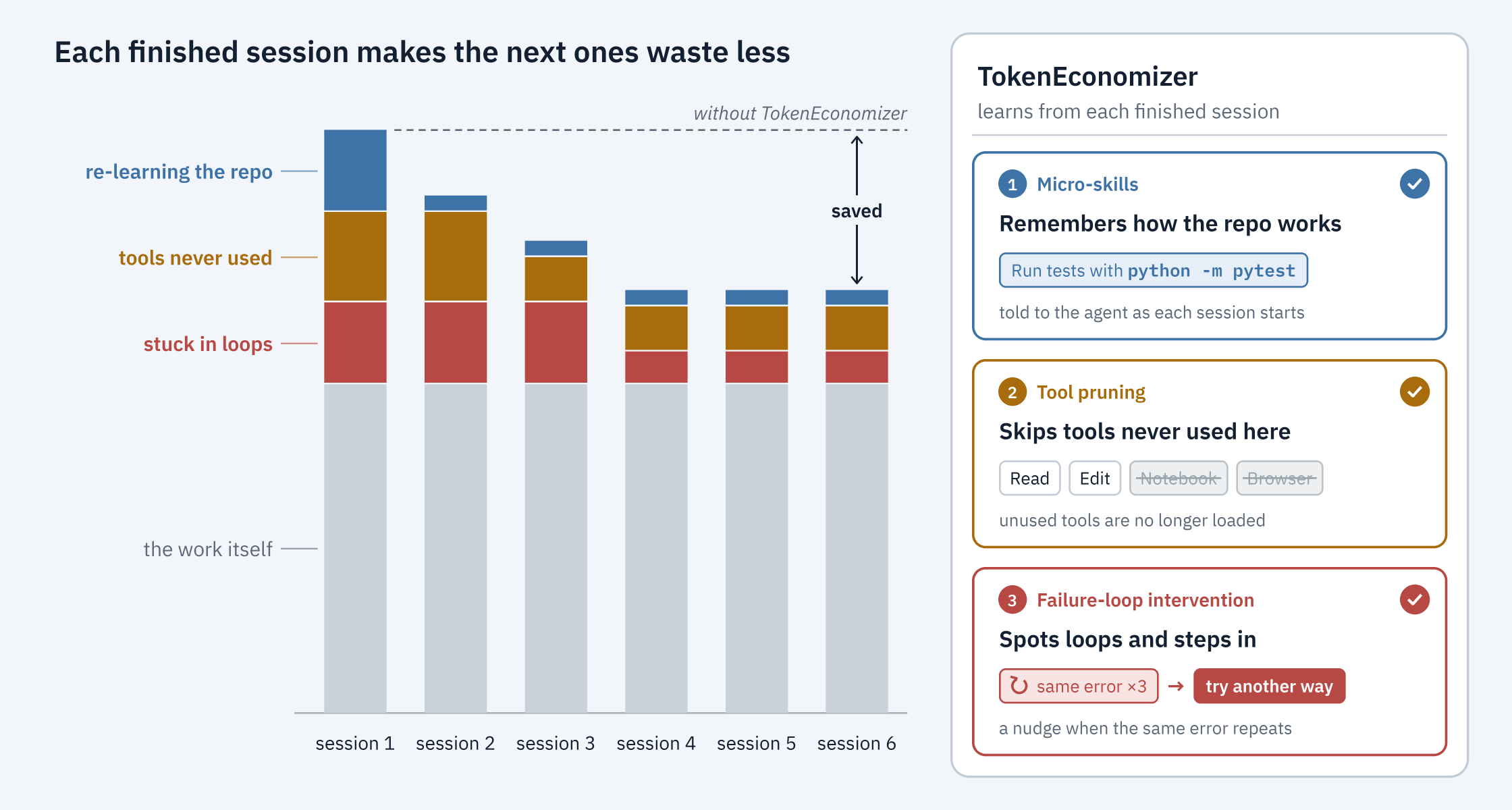
Microsoft Research, Microsoft Security and UC Berkeley open-sourced TokenEconomizer on GitHub (Apache 2.0, v0.1.0 released October 26), a plugin for Claude Code, Codex, GitHub Copilot CLI and Pi, with experimental opencode support. It learns from earlier sessions in the same repository: micro-skills remember repo facts, tool pruning drops tool definitions that go unused, and a loop guard nudges an agent that is stuck. The paper reports 18.4–30.9% lower mean cost across five agent and model combinations on 277 SWE-Bench tasks (paper figures).

Microsoft Research and UC Berkeley open-source TokenEconomizer, a plugin that cuts Claude Code and Codex costs by 18.4–30.9% on SWE-Bench without changing the agent

Key Takeaways

  • Cost: on 277 SWE-Bench tasks across 6 repositories and 5 agent and model combinations, mean cost fell 18.4–30.9%, and all 30 repository-by-combination cells got cheaper (paper figures, including the plugin's own model calls)
  • Success rate: Pass@1 rose in 4 of 5 combinations, e.g. Copilot CLI with Sonnet 5 cost 18.4% less with Pass@1 +2.6, while Claude Code with Opus 4.8 cost 30.9% less with Pass@1 -1.0
  • Three mechanisms: micro-skills (repo facts stated only after three sessions confirm them), tool pruning (by default a tool unused over 10 prompts across 2 sessions is left out), and a failure-loop guard (one redirect when a judge is at least 0.7 confident, never stopping a turn itself)
  • Generalization: 16–21% lower cost on Web-Bench and 6–20% lower on two security-auditing benchmarks where every task is a new repository
  • Deployment: Apache 2.0, Python 3.10+, no API key of its own, and learned experience stays local in ~/.tokeneconomizer
Read full story
ADSponsored

Kaggle and IBM Research launch the ScarfBench Java migration leaderboard: Gemini 4 Argon with Antigravity leads at 75.2%, and about 72% of failures happen at runtime

Kaggle announced ScarfBench with IBM Research, a 204-task benchmark that tests whether coding agents can migrate enterprise Java apps between Jakarta EE, Quarkus and Spring without changing behavior. IBM's October 27 technical note shows Gemini 4 Argon with Antigravity first on the smoke score at 75.2%, Claude Opus 5.5 with Claude Code highest on all-tests-pass at 72.1%, and GPT-6.1 Sol with Codex cheapest at $1.25 per solved task.

Kaggle and IBM Research launch the ScarfBench Java migration leaderboard: Gemini 4 Argon with Antigravity leads at 75.2%, and about 72% of failures happen at runtime

Key Takeaways

  • 204 migration tasks and 10 model-plus-harness configurations; top smoke scores are Gemini 4 Argon + Antigravity 75.2%, Claude Opus 5.5 + Claude Code 70.5% and Claude Opus 5 + Claude Code 69.8% (IBM figures)
  • Claude Opus 5.5 + Claude Code has the highest all-tests-pass rate at 72.1%, just ahead of Gemini 4 Argon at 71.1%
  • Compiling is mostly solved: 8 of 10 configurations compiled at least 97% of solvable tasks, yet smoke scores spanned more than 50 points
  • 535 of 745 classified failing runs (about 72%) were runtime behavioral failures, including 210 lost-route/404 failures
  • Cost per solved task: $1.25 for GPT-6.1 Sol + Codex, $1.59 for Gemini 3.8 Flash + mini-swe and $10.10 for Claude Opus 5.5 + Claude Code; public submissions are not open yet
Read full story

OpenCode 2.2.3 adds a built-in Claude Agent provider that runs Claude models through your own Claude Code login, subscriptions included

OpenCode, the open-source coding agent, shipped v2.2.3 at 09:55 UTC on Oct 30 with a built-in "Claude Agent" provider. After installing Claude Code and running claude auth login, users pick Claude Agent in /connect and can call Claude models through their own Claude Code login, whether that is a subscription, an API key or a cloud account. It runs the user's local claude program through Anthropic's public Claude Agent SDK, but turns off Claude Code's built-in tools and uses OpenCode's own tools and permission system instead. Hours earlier, OpenCode team member dax (@thdxr) teased on X "what if you could use your claude subscription in opencode", drawing about 2,300 likes.

Key Takeaways

  • v2.2.3 shipped at 09:55 UTC on Oct 30; its first highlight is "Use Claude Code in OpenCode", from PR #58782 (release notes)
  • Setup is three steps: install Claude Code, run claude auth login, and pick Claude Agent in /connect; OPENCODE_CLAUDE_PATH overrides the claude binary
  • The design spec says it uses only the public SDK, never reads Claude Code's saved login and never intercepts or changes its requests; subscription, API key and cloud logins all work (spec)
  • Claude Code's built-in tools, CLAUDE.md, hooks, MCP servers, skills, auto compaction and auto memory are all off; OpenCode's tools, permissions and compaction apply, with one claude process per session that stops after 5 idle minutes
  • dax's (@thdxr) teaser post drew about 2,300 likes and 280 replies (post); no performance comparison has been published
Read full story

Cursor marketplace served a tampered Claude Code 2.1.313 extension with an SSH backdoor, affecting at most 5,000 users

Cursor posted a security notice on X at 07:46 UTC on Oct 30: version 2.1.313 of Anthropic.claude-code in its VS Code extension marketplace was a maliciously modified build, not developed by Anthropic, available from about 2:27am to 1:35pm PT on Oct 29 and affecting at most 5,000 users. The payload collects host details, adds an attacker SSH key, tries to open a reverse SSH tunnel and installs persistence. Cursor pulled the version, shut down and rebuilt the marketplace, rotated keys and had the attacker server taken offline; it asks users to update Claude Code for VS Code to 2.1.314 and follow the check and cleanup steps in its blog post.

Key Takeaways

  • Scope: Anthropic.claude-code 2.1.313 (darwin-arm64 and win32-x64 packages) in the Cursor extension marketplace, downloadable from about 2:27am to 1:35pm PT on Oct 29 (about 11 hours), at most 5,000 users
  • Payload: collects hostname, username, OS, environment variable names, Git email and public IP; adds an attacker SSH key labeled svc-telemetry; tries a reverse SSH tunnel, retrying about every 60 seconds; reports to /beacon on port 8099
  • Cursor says enabling the local SSH service needs admin rights, so that step fails on most macOS and Windows hosts, but the key, persistence and beacon still run; the attacker server is now offline
  • Cursor pulled the version, shut down and rebuilt the marketplace, rotated keys and confirmed no other extensions were tampered with; it has no evidence other versions or Anthropic's official distribution were affected
  • Self-check: on macOS run grep svc-telemetry ~/.ssh/authorized_keys; if found, isolate the host, run Cursor's remediation script, rotate credentials from a trusted machine, and update to 2.1.314
Read full story

Factory launches Droid 1.0: programmatic tool calling by default, hundreds of tool calls per model request, leads native harnesses on its own Terminal-Bench 4 runs

AI coding agent company Factory announced Droid 1.0 on X and its blog at 22:31 UTC on Oct 29, calling it the largest update yet to its agent harness. The key change makes programmatic tool calling (PTC) the default: the model writes a JavaScript program that runs up to hundreds of tool calls in a sandbox in one model request. In Factorys own Terminal-Bench 4 runs, Droid scored 57.6% with GPT-6.1 Sol ($0.79 per passed task) and 65.2% with Claude Opus 5.5 ($4.73), ahead of Codex, Claude Code, Cursor, OpenCode and Devin on the same models.

Factory launches Droid 1.0: programmatic tool calling by default, hundreds of tool calls per model request, leads native harnesses on its own Terminal-Bench 4 runs

Key Takeaways

  • Programmatic tool calling is now the default: the model writes JavaScript that runs in a sandbox with no file, network or system access of its own, making up to hundreds of tool calls per request, with independent calls run concurrently
  • Factory example: moving and verifying 151 Linear issues took 312 tool calls; direct calls needed about 36 requests and 3.1M input tokens, a Script needed 2 requests and 61K tokens
  • Terminal-Bench 4 (Factory runs, Oct 23-28, three trials per task): with GPT-6.1 Sol, Droid 57.6% vs Codex 54.0%, OpenCode 51.0%, Devin 45.0%; with Opus 5.5, Droid 65.2% vs Cursor and OpenCode 62.1%, Devin 59.6%, Claude Code 57.6%
  • The first request shrank from 20,887 to 13,055 tokens (-37%) and up-front tool definitions went from 11 to 2; newly loaded MCP tools are appended to keep the prompt cache intact, and a typical production request reads 98% of input from cache
  • Available now as a macOS and Windows desktop app, a terminal UI and the Droid SDK (@factory/droid-sdk); the benchmarks are vendor-run with no third-party reproduction yet
Read full story
A
Anthropic@AICoder·
👀77
🔥80

Claude Code 2.1.314 adds a block on writes outside working directories, IdP group routing for the apps gateway, and idle compaction in VS Code and Desktop

Anthropic published Claude Code v2.1.314 on GitHub at 01:06 UTC on Oct 30. The official CHANGELOG lists 119 entries, more than half of them fixes. The new features lean enterprise: permissions.blockWritesOutsideWorkingDirectories makes Write, Edit and NotebookEdit refuse paths outside the working directories in every permission mode; Claude apps gateway upstreams can be limited to IdP groups, and Bedrock upstreams can log which guardrail fired; idle compaction now also runs in VS Code and the Code tab of Claude Desktop. It also fixes sessions failing repeatedly when an admin caps effort, and claude -p exiting 0 with no output when startup failed.

Key Takeaways

  • Size: the official v2.1.314 CHANGELOG has 119 entries, more than half of them fixes; released at 01:06 UTC on Oct 30
  • Safety: the new permissions.blockWritesOutsideWorkingDirectories setting stops Write, Edit and NotebookEdit from writing outside the working directories in every permission mode
  • Enterprise gateway: upstreams take an optional groups list so only developers in those IdP groups are routed there, failover included; Bedrock upstreams gain guardrail_trace
  • Experience: idle compaction now runs in VS Code and the Claude Desktop Code tab, summarizing idle conversations above 200K tokens
  • Fixes: when an admin caps effort, Claude Code lowers it and retries; a failed claude -p startup now prints the error and exits 1
Read full story
Linked Models & Agents:

Symantec finds a grey-market relay that installs the real Codex and Claude Code CLIs, then turns off sandboxing and routes every request through its own servers

On Oct 29 Symantec's Threat Hunter Team disclosed an unauthorized AI relay seen at about a dozen organizations since early 2026, mostly in mainland China. Users install the genuine Codex or Claude Code CLI via npm, then run a one-line script from the reseller that rewrites ~/.codex/config.toml or ~/.claude/settings.json, points base_url at relay domains, swaps in relay-issued keys, sets the sandbox to danger-full-access and disables telemetry. Symantec says this is not a CLI vulnerability and it has seen no abuse so far.

Symantec finds a grey-market relay that installs the real Codex and Claude Code CLIs, then turns off sandboxing and routes every request through its own servers

Key Takeaways

  • About a dozen affected organizations, mostly in mainland China, plus Chinese or home-market units of South Korean, Taiwanese and Malaysian firms in semiconductors, electronics, pharma, shipping and petrochemicals
  • A one-line iwr | iex or curl | bash command fetches a fileless script from lookalike domains such as vibe.aiok[.]me, installs the genuine CLI, then rewrites its config, so it looks like a normal setup step
  • The Codex sandbox is set to danger-full-access with network access on, and DISABLE_TELEMETRY=1 and DISABLE_ERROR_REPORTING=1 are set
  • Relay-issued Claude Code keys use the sk-ant-oat01- prefix of subscription OAuth tokens, which Symantec says is consistent with, but not proof of, pooled subscription resale
  • Symantec says this is not a vulnerability in Codex or Claude Code and it has no evidence the operator has abused its access; the risks are potential
Read full story
ADSponsored

Claude Code lead Boris Cherny on faster usage drain: every shared session reviewed, no regression found, fixes for a few smaller issues rolling out

Since Oct 21 many developers on X have complained that Claude Code was draining usage limits much faster. On Oct 28 (UTC) Boris Cherny, who leads Claude Code at Anthropic, replied on X that the team reviewed every session ID users shared, found no single root cause and no regression in Claude Code, and is rolling out fixes for a few smaller issues that made some sessions burn tokens faster. Most fast-drain cases traced back to one or two heavy sessions using xhigh effort, /goal, Workflows, Agent Teams or long SDK jobs.

Key Takeaways

  • The complaint post that started it said usage was draining 5x faster and drew about 1,660 likes and 240+ replies (a user claim, not official data)
  • Boris Cherny: the team checked every shared session ID, found no single root cause or Claude Code regression, and is rolling out fixes for a few smaller issues
  • Heavy features were the main driver: xhigh effort, /goal, Workflows, Agent Teams and long SDK jobs
  • Subagents inherit the session effort level by default, which adds up fast; /usage shows where tokens went
  • The official docs say Agent Teams use about 7x more tokens than standard sessions when teammates run in plan mode
Read full story
Linked Models & Agents:

GitHub Universe 2026: Copilot Fusion is generally available, routing and orchestrating models automatically, with Fusion Max scoring 60 on the Artificial Analysis Coding Agent Index at about half the cost of Claude Code with Opus 5.5 Max

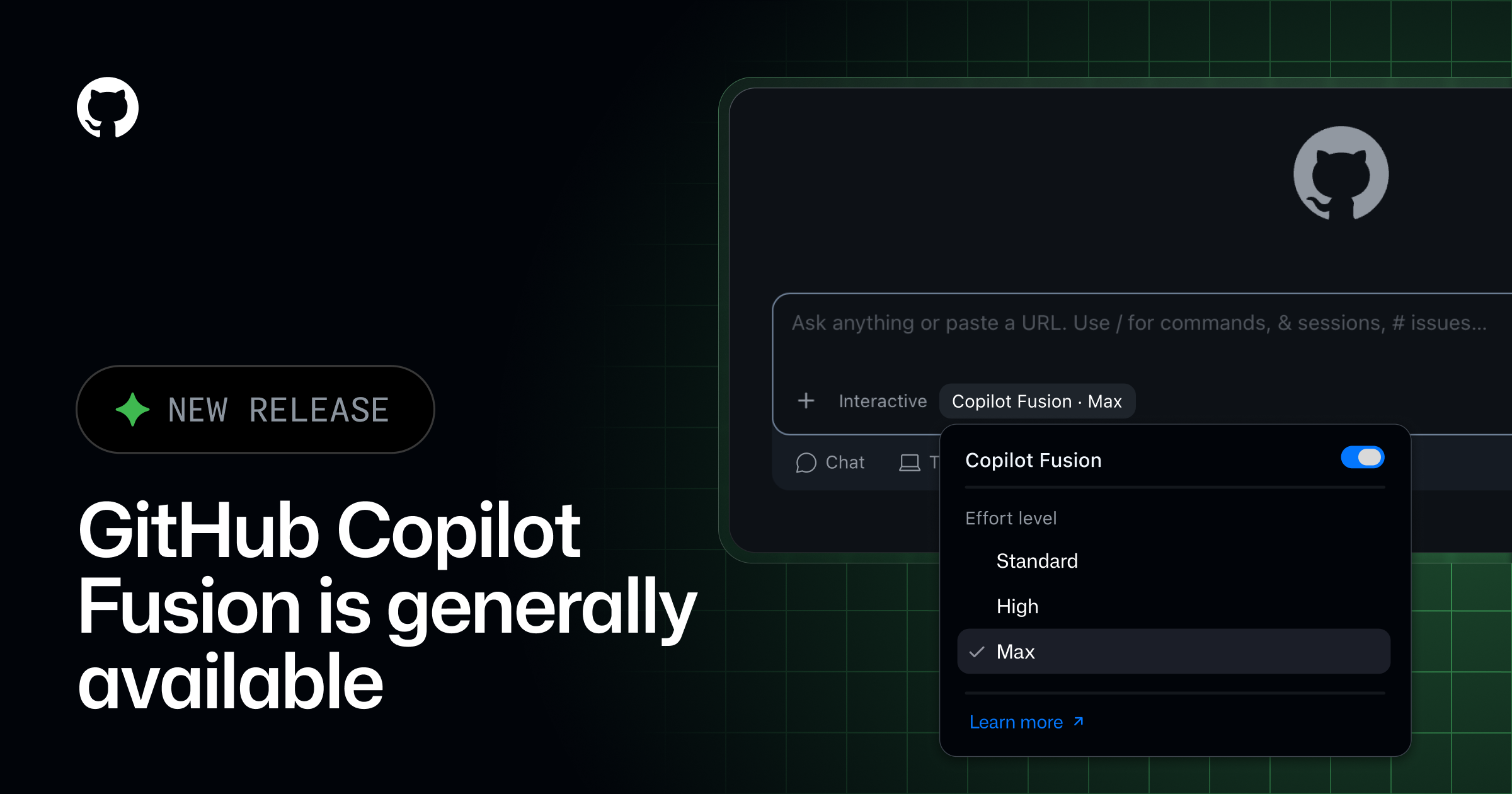
At GitHub Universe 2026 on Oct 28, GitHub made Copilot Fusion generally available. It merges the multi-model orchestration of the Project HydraFusion research preview with Copilot auto model selection: users pick Copilot Fusion and an effort level (Standard, High or Max) in the model picker, and the system decides which models to use and whether to run a Single, Cascade or Critique workflow. GitHub says Fusion Max scored 60 on the Artificial Analysis Coding Agent Index, two points below Claude Code with Opus 5.5 Max, at about half the API cost per task, about half the tokens and about 40% less time. Each underlying model is billed at its standard rate, and paid plans get 30% off through Nov 30.

GitHub Universe 2026: Copilot Fusion is generally available, routing and orchestrating models automatically, with Fusion Max scoring 60 on the Artificial Analysis Coding Agent Index at about half the cost of Claude Code with Opus 5.5 Max

Key Takeaways

  • Scores (Artificial Analysis Coding Agent Index v2.0): Fusion Max 60 versus 62 for Claude Code with Opus 5.5 Max; $5.59 per task versus $11.42, while the Devin Fusion pairing scores 62 at $8.00
  • Breakdown: a slight lead on Terminal-Bench 4.0 at 71, third on FrontierCode at 51 (Claude Code 56, Devin Fusion 54), and a weaker 57 on SWE-Atlas-QnA-AA
  • Efficiency: about 7.2M tokens per task, roughly half of Claude Code with Opus 5.5 and 30% fewer than Devin Fusion; GitHub reports about 40% less time per task
  • The pool includes Claude Opus 5.5, Claude Sonnet 5.5, GPT-6 Astra and GPT-6 Sol; admins can disable individual models for Fusion only and set Fusion as the default
  • Availability: all Copilot plans in VS Code, the Copilot app, Copilot CLI and JetBrains IDEs; existing auto, HydraFusion and HydraFusion Max selections migrate to matching effort levels
Read full story

X discussion: Box CEO Aaron Levie says under 1% of enterprise workflows really use AI agents, echoing Sarah Guo's "early Claude Code era" take

Conviction founder Sarah Guo posted on Oct 27 that enterprise workflow automation is "in the autocomplete / early claude code era", "but not for long", drawing about 80K views and nearly 500 likes. Box CEO Aaron Levie quoted it the next day and argued that most enterprise workflows have not had agents applied in any meaningful way, putting deployment at probably under 1%, mainly because of AI capability itself; he says computer use, long-running agents and agent swarms are changing that. His post has about 635 likes, 486 bookmarks, 63K views and 150+ replies. These are opinions and rough estimates, not measured statistics.

Key Takeaways

  • Sarah Guo (Conviction founder): enterprise workflow automation is still in the "autocomplete / early claude code era", but not for long
  • Aaron Levie (Box CEO): most enterprise workflows have not had agents applied meaningfully, and deployment across the economy is "probably < 1%", which is his estimate
  • Levie says the main bottleneck is AI capability itself, with enterprise adoption speed a smaller factor
  • He points to computer use, long-running agents, harness improvements and agent swarms as what now makes more complex workflows workable for agents
  • His view: the shift is less about users prompting agents and more about organizations re-engineering workflows, with the biggest impact in finance, life sciences, healthcare and other information-heavy fields
Read full story

Anthropic study: 50 professional data analysts working with Claude Code followed the agent's secretly assigned lean on 86% of key judgment calls

On Oct 27 Anthropic's Alignment team published a randomized controlled trial, "How AI agents shape experts' judgment calls", shared on X by researcher Alex Tamkin. Fifty analysts experienced in causal inference used Claude Code (Claude Opus 4.8) to evaluate a program for a fictional farming cooperative, and on each analytical decision the agent's lean was set by coin flip without the analyst being told. Their choices matched the agent's lean 86% of the time (about 50% would mean no effect), and 77% later repeated the agent's arguments while only 15% credited the agent.

Anthropic study: 50 professional data analysts working with Claude Code followed the agent's secretly assigned lean on 86% of key judgment calls

Key Takeaways

  • Agreement with the agent's lean was 92%, 82%, 81% and 90% on the four analytical decisions, 86% overall; the final rollout recommendation shifted too (54% recommended rollout when the agent leaned that way vs 36% when it leaned against)
  • In 38 cases where analysts stated a preference first, they switched 60% of the time when the agent disagreed vs 6% when it agreed (small sample; 95% CI 24 to 82 percentage points)
  • The four coin-flip leans alone let a statistical model predict 82% of final recommendations (61% baseline); none of 10 traits such as experience, education or trust in AI reliably predicted who deferred
  • 52% of analysts called the final recommendation more their own than the agent's, and their confidence was about the same as everyone else's (71 vs 73)
  • 6 of 11 analysts who skipped the agent made serious methodological errors vs 3 of 50 who used it, though the groups differed in experience; the study covers one task and one model, with the agent's lean deliberately strengthened
Read full story

X discussion: Zerodha CEO Nithin Kamath asks what traders are building with free Kite APIs and AI coding agents

On Oct 26, Zerodha founder and CEO Nithin Kamath asked on X how people are using Kite APIs with AI agents now that they are free, and what they have built. He said AI coding agents such as Claude Code and Codex have made it much easier for traders and investors to build their own tools without much coding experience, and that Zerodha is seeing more Kite API usage because of these agents. Within about 10 hours the post drew more than 2,200 likes, over 2,000 bookmarks and 200+ replies. This is an X discussion and the CEO's own view, not a new product launch.

X discussion: Zerodha CEO Nithin Kamath asks what traders are building with free Kite APIs and AI coding agents

Key Takeaways

  • Engagement (as of 2026-10-26 21:08 UTC, public X API metrics): about 183K views, 2,256 likes, 2,039 bookmarks, 219 replies and 113 reposts
  • Source of the view: an original post by Zerodha founder and CEO Nithin Kamath (@Nithin0dha), who says coding agents are driving more Kite API usage; Zerodha has not published how much
  • Pricing (per the official Zerodha API page): the Personal tier is free with orders, GTT, alerts, margin computation and portfolio management; the Connect tier costs ₹500/month and adds realtime WebSocket streaming and historical candles
  • Official SDKs cover 8 languages (Python, Java, Node.js, C#/.NET, Go, Rust, PHP and C++), so coding agents can generate client code directly
  • The debate: AI coding agents make it common for non-programmers to build their own trading tools, which also puts risk control and automated order placement in individual hands
Read full story