AI Coding Live News

Meituan ships LongCat-2.5, a 1.6T-parameter (about 48B active) native multimodal agentic model, with API pricing of $0.30/$1.20 per 1M tokens

On Nov 2 Meituan's LongCat team listed LongCat-2.5 in its API platform change log as the full release of September 25's LongCat-2.5-Preview. The official technical blog says it has 1.6 trillion total parameters with about 48 billion activated per token, builds on LongCat-2.0 with stronger native visual understanding and agentic coding, and was trained and served with W4A4 inference on domestic AI accelerators. Vendor-reported scores include 88.4 on Terminal Bench v2.1, 38.5 on Terminal Bench v4.0, 91.9 on BrowseComp and 83.1 on MCP Atlas. The API speaks both OpenAI and Anthropic formats with a 1M-token context and up to 128K output tokens, at a limited-time price of $0.30 per 1M uncached input tokens, $0.006 cached input and $1.20 output.

Meituan ships LongCat-2.5, a 1.6T-parameter (about 48B active) native multimodal agentic model, with API pricing of $0.30/$1.20 per 1M tokens

Key Takeaways

  • Scale: a 1.6-trillion-parameter MoE with about 48B active per token, a 1M-token context and up to 128K output tokens (official blog, API docs)
  • Code agents (vendor-reported): Terminal Bench v2.1 88.4 (Claude Opus 5 89.1, GPT-5.6-Sol 88.8), Terminal Bench v4.0 38.5 (GPT-5.6-Sol 37.3, Claude Opus 5 53.9), DeepSWE v1.1 64.6
  • General agents (vendor-reported): BrowseComp 91.9, MCP Atlas 83.1, AutomationBench v1.0.6 51.8, HLE with tools 63.1; AutomationBench jumps from 15.8 on LongCat-2.0
  • Pricing: limited-time $0.30 per 1M uncached input tokens, $0.006 cached input and $1.20 output (pricing page)
  • Engineering: W4A4 inference raises prefill throughput 43.3% and decode throughput 42.77% over a W8A8 baseline; FSDP gives 86% higher per-device throughput than DDP in long-sequence SFT
Read full story

X discussion: Shopify CEO Tobi Lütke backs the monorepo as a Shopify engineer calls it a boon for coding agents, while critics still prefer split repos

Shopify distinguished engineer Burke Libbey posted on November 1 that moving to a monorepo has been a boon for agents at Shopify; it needs thoughtful tooling and has downsides that take effort to mitigate, but he would not go back. He was replying to Darren Shepherd, who said a day earlier that he hates the idea that monorepos are great for agents. Shopify CEO Tobi Lütke then quoted Burke and recalled Mikhail Parakhin telling him that every engineer hates the idea of moving to a monorepo, yet once it is there no engineer would want to work somewhere without one. Tobi's post drew about 1,115 likes, 454 bookmarks and 89K views and set off a wide debate. These are practitioner opinions, not an official technical announcement.

Key Takeaways

  • Original post: @tobi, Nov 1, 15:39 UTC, about 1,115 likes, 454 bookmarks, 95 replies and 89K views at fetch time
  • Shopify distinguished engineer Burke Libbey wrote that moving to a monorepo has been a boon for agents at Shopify; it needs thoughtful tooling and its downsides take effort to mitigate, but he would not go back
  • On the other side, Darren Shepherd (Rancher and k3s background) posted on Oct 31 that he hates the idea that monorepos are great for agents and that the best way to scale is to avoid scaling
  • Mikhail Parakhin replied to Tobi's retelling: "True story! And now, with agents, it more true than ever."
  • Supporters in the quote posts say agents can see every caller at once and get cross-stack type checking and atomic changes; skeptics ask whether agents make independent, separately evolving repos more attractive
Read full story
Linked Models & Agents:
g
guregodevo (Memdoor author)github.com·
👀13
🔥81

Memdoor reproduces GVS5H: a team of five Qwen3.8-27B agents averages 9.8/10 on the first 10 LiveCodeBench Hard problems, against 8.0 for a single Fable 5 call

On Oct 31 the open-source coding agent Memdoor (GitHub guregodevo/memdoor, Apache 2.0) published its team-solve workflow: using the GVS5H paper authors' exact prompts and loop, five Qwen3.8-27B instances act as planner, two ideators, solver and manager, talk only through files on disk, and a script that runs the tests decides success. Over five passes on the first 10 LiveCodeBench Hard problems from the GVS5H list it averaged 9.8/10, against 9.6 for the authors' own harness and 8.0 for a single Fable 5 call; 49 of 50 runs solved the problem for $35.79 in total, and every request and reply is public. The Hacker News post has about 200 points. This is a community reproduction on only 10 problems, and the author notes that training-data contamination cannot be ruled out.

Key Takeaways

  • Score: a mean of 9.8/10 over five passes (10, 10, 10, 10, 9), against 9.6 for the GVS5H authors' own harness and 8.0 for a single Fable 5 call (team-solve README, project-reported)
  • Cost: 49 of 50 runs solved, $35.79 and 15.3M output tokens in total; a median run took about 40 minutes of model time and $0.39, the longest 4 hours
  • Method: five roles (planner, two ideators, solver, manager) plus a repair worker each start from a fresh context, talk only through files on disk, and a shell script that runs the tests decides success instead of a model
  • Limits: only 10 problems rather than the paper's 100; the contests date from March and April 2025 and may be in training data; Fable 5's column comes from the GVS5H authors' result files and was not rerun in this harness
  • Reach: the HN post has about 200 points as of Nov 1, 16:10 SGT; the original GVS5H paper is arXiv 2608.26480, which reached #1 on HN on Oct 25
Read full story

X discussion: Stripe CEO Patrick Collison adds an agent-powered "improvements" box to his vibecoded apps and calls it liquid software

A widely discussed idea on X: on Oct 31 Stripe CEO Patrick Collison (@patrickc) posted that he is building an "improvements" feature into all of his personal vibecoded applications, a freeform text input hooked up to an agent that implements whatever is submitted. He says another person who uses one of the apps has already implemented 150 improvements in a few days, and he floats the name "liquid software" for the pattern. He is also candid that he does not know whether it scales: whether it becomes unmaintainable, how collaborative software works this way, and whether it can be secure and reliable. The post drew about 2,130 likes, 1,900 bookmarks and 147K views. This is a write-up of a personal opinion and the discussion around it, not an official Stripe product announcement.

X discussion: Stripe CEO Patrick Collison adds an agent-powered "improvements" box to his vibecoded apps and calls it liquid software

Key Takeaways

  • Buzz: about 2,133 likes, 1,896 bookmarks, 217 replies, 76 quotes and 147K views (public X metrics as of Nov 1, 12:15 SGT)
  • Pattern: every personal app gets a freeform text box wired to an agent that yolo implements whatever is submitted, which makes sanding a small rough edge almost free
  • Data point: Collison says another person using one of his apps implemented 150 improvements in a few days (self-reported; the app itself is not public)
  • His own open questions: does it become unmaintainable, can model gains outpace feature appetite, how does collaborative software work, and can it be secure and reliable
  • Debate: supporters say it will become standard and could even ship bespoke per-user features behind flags; skeptics note conflicts start once a second user asks for the opposite change, and maintenance and security remain unsolved; Collison himself compares it to the user-modifiable visions of Lisp machines, Smalltalk and HyperCard
Read full story
Linked Models & Agents:
ADSponsored

Benji Taylor, head of design at X and SpaceXSI, open-sources Stageshow, an agent skill for realistic faux product UI and animated demos

On Oct 31, Benji Taylor, head of design at X and SpaceXSI, released Stageshow on X: an open-source skill (MIT license) for coding agents that helps them produce faux product UI that looks real, including stills, cursor demo animations, and bento grids, delivered as ordinary React components. It installs with one command, and he says it works with Grok Build, Claude Code, Codex, Gemini, and others. The launch post drew about 4,500 likes and 6,500 bookmarks. He notes it rarely nails a demo in one shot and most still take a few rounds of feedback.

Benji Taylor, head of design at X and SpaceXSI, open-sources Stageshow, an agent skill for realistic faux product UI and animated demos

Key Takeaways

  • Install: npx skills add benjitaylor/skills --skill stageshow; the author says it works with Grok Build, Claude Code, Codex, Gemini, and other agents (author's post)
  • Contents: a seven-step workflow in SKILL.md, reference rule docs, dozens of gold examples, a React kit, and self-check scripts such as film.mjs (GitHub)
  • License: the stageshow folder is MIT licensed; the repo was created Oct 26 and had about 61 stars at writing time
  • Reach: the launch post had about 4,521 likes, 6,561 bookmarks, and 213k views as of Nov 1, 08:00 SGT
  • Quality claims are the author's own: the same prompts did better with the skill, but no quantitative evaluation was published
Read full story

DeepSeek Harness team open-sources dsh-superagent, a proactive coding agent prototype for a single GitHub repo, alongside its Super-agent architecture article

On Oct 31, deepseek-ai open-sourced dsh-superagent-prototype on GitHub under the MIT license: a proactive coding agent that runs as a DeepSeek Harness bundle, lives on one GitHub repository and can optionally listen to Feishu. When an allowed person asks for work, it opens a work item, works in its own session and directory, and answers in the original conversation, for example with a pull request. The README states it is a research prototype, not an official DeepSeek product. The companion article, Exploring Super-agent Design, proposes a two-layer Router-Worker architecture; the team test, as reproduced by media, reports a p95 completion time of 15.7 minutes versus 29.5 minutes for a single-session setup.

Key Takeaways

  • Open source: deepseek-ai/dsh-superagent-prototype went public on Oct 31 under MIT, written in TypeScript, with about 1,800 stars at the time of writing
  • Scope: each deployment serves 1 GitHub repository, with optional Feishu; it acts only when an allowed person addresses it or a team-written rule allows it
  • Delivery: by default it only allows auto-merge for an approved pull request opened for a ticket with fewer than 200 changed lines, and never enables auto-merge as the agent account
  • Team test (as reproduced by media, vendor-reported): in a simulation with about 300 messages and 20 requests, p50 / p95 completion was 12.4 / 15.7 minutes versus 20.4 / 29.5 for a single session with a subagent tool
  • Risk: worker sessions run commands without approval as the operator's OS user, and the README asks users to review and adapt the code first
Read full story

OpenCode team ships Hex 3.0 stable: local voice dictation for Mac, Windows and Linux, built for talking to coding agents

Anomaly, the company behind open-source coding agent OpenCode, shipped Hex 3.0 stable: hold a shortcut, speak, and the text is pasted at your cursor. Recognition runs on-device, local model memory drops from about 900 MB to about 160 MB, and it adds vocabulary hints, a hex CLI and optional OpenCode rewriting.

OpenCode team ships Hex 3.0 stable: local voice dictation for Mac, Windows and Linux, built for talking to coding agents

Key Takeaways

  • Hex v3.0.0 was released on GitHub at 00:38 UTC on Oct 31; it is MIT-licensed, written in Rust, and the repo has about 1,557 stars (release notes)
  • Vendor figures: local model memory drops from about 900 MB to about 160 MB; since 2.3.0 it streams, so a 2-minute dictation finishes about 0.1 s after release on an RTX 5070 Ti
  • Runs on macOS 15+ (Apple silicon), Windows x64/ARM64 and Linux x64/ARM64, with new .deb and .rpm packages on Linux
  • 3.0 does not auto-update from 2.3.1 and starts fresh, so settings, History and models must be set up again; Voice Action and spoken commands are removed
  • The @opencode launch post drew about 2,400 likes, 1,600 bookmarks and 100k+ views (post)
Read full story
Linked Models & Agents:
⚡ Parakeet⚡ Whisper🤖 OpenCode🤖 Hex🌐 Anomaly

Vercel Labs launches agent-desktop: computer use for any coding agent via OS accessibility trees, not pixels, on macOS, Windows and Linux

On October 31, Chris Tate of Vercel Labs, creator of agent-browser, announced agent-desktop on X as "agent-browser, for your whole computer". It is an Apache-2.0 Rust CLI and C library that reads a desktop app's OS accessibility tree and returns every actionable element as a JSON ref; the agent clicks or types on a ref and snapshots again to verify, with no pixel matching, headless by default. Version 1.0.0 shipped on October 27 and added Linux support; the current npm release is 1.0.2.

Vercel Labs launches agent-desktop: computer use for any coding agent via OS accessibility trees, not pixels, on macOS, Windows and Linux

Key Takeaways

  • Install: npm install -g agent-desktop, one package with native x64/ARM64 binaries; 1.0.0 (Oct 27) added Linux (glibc 2.35+, via AT-SPI), and the latest npm release is 1.0.2 (Oct 30)
  • Loop: snapshot prints a JSON tree with refs, click @<snapshot_id>:eN acts, then snapshot again to verify; a changed UI returns STALE_REF, and errors say whether a retry is safe
  • Scope: the README lists 60 command names, 56 of them operational, spanning windows, keyboard and mouse, notifications, clipboard, waits and session traces
  • Headless by default: ref actions go through accessibility APIs without moving the pointer or stealing focus, with --headed for physical input; Chris Tate says multiple agents can use the computer in parallel, each with its own cursor
  • Benchmarks: no official success-rate or speed numbers; it is a tool with no model inside, and web pages stay with agent-browser
Read full story

Kaggle and IBM Research launch the ScarfBench Java migration leaderboard: Gemini 4 Argon with Antigravity leads at 75.2%, and about 72% of failures happen at runtime

Kaggle announced ScarfBench with IBM Research, a 204-task benchmark that tests whether coding agents can migrate enterprise Java apps between Jakarta EE, Quarkus and Spring without changing behavior. IBM's October 27 technical note shows Gemini 4 Argon with Antigravity first on the smoke score at 75.2%, Claude Opus 5.5 with Claude Code highest on all-tests-pass at 72.1%, and GPT-6.1 Sol with Codex cheapest at $1.25 per solved task.

Kaggle and IBM Research launch the ScarfBench Java migration leaderboard: Gemini 4 Argon with Antigravity leads at 75.2%, and about 72% of failures happen at runtime

Key Takeaways

  • 204 migration tasks and 10 model-plus-harness configurations; top smoke scores are Gemini 4 Argon + Antigravity 75.2%, Claude Opus 5.5 + Claude Code 70.5% and Claude Opus 5 + Claude Code 69.8% (IBM figures)
  • Claude Opus 5.5 + Claude Code has the highest all-tests-pass rate at 72.1%, just ahead of Gemini 4 Argon at 71.1%
  • Compiling is mostly solved: 8 of 10 configurations compiled at least 97% of solvable tasks, yet smoke scores spanned more than 50 points
  • 535 of 745 classified failing runs (about 72%) were runtime behavioral failures, including 210 lost-route/404 failures
  • Cost per solved task: $1.25 for GPT-6.1 Sol + Codex, $1.59 for Gemini 3.8 Flash + mini-swe and $10.10 for Claude Opus 5.5 + Claude Code; public submissions are not open yet
Read full story

OpenCode 2.2.3 adds a built-in Claude Agent provider that runs Claude models through your own Claude Code login, subscriptions included

OpenCode, the open-source coding agent, shipped v2.2.3 at 09:55 UTC on Oct 30 with a built-in "Claude Agent" provider. After installing Claude Code and running claude auth login, users pick Claude Agent in /connect and can call Claude models through their own Claude Code login, whether that is a subscription, an API key or a cloud account. It runs the user's local claude program through Anthropic's public Claude Agent SDK, but turns off Claude Code's built-in tools and uses OpenCode's own tools and permission system instead. Hours earlier, OpenCode team member dax (@thdxr) teased on X "what if you could use your claude subscription in opencode", drawing about 2,300 likes.

Key Takeaways

  • v2.2.3 shipped at 09:55 UTC on Oct 30; its first highlight is "Use Claude Code in OpenCode", from PR #58782 (release notes)
  • Setup is three steps: install Claude Code, run claude auth login, and pick Claude Agent in /connect; OPENCODE_CLAUDE_PATH overrides the claude binary
  • The design spec says it uses only the public SDK, never reads Claude Code's saved login and never intercepts or changes its requests; subscription, API key and cloud logins all work (spec)
  • Claude Code's built-in tools, CLAUDE.md, hooks, MCP servers, skills, auto compaction and auto memory are all off; OpenCode's tools, permissions and compaction apply, with one claude process per session that stops after 5 idle minutes
  • dax's (@thdxr) teaser post drew about 2,300 likes and 280 replies (post); no performance comparison has been published
Read full story
ADSponsored

LM Studio Bionic 1.1.10 adds the oMLX engine, bringing RAM-plus-SSD KV caching and MLX speculative decoding to local models on Macs

LM Studio posted on X at 15:32 UTC on Oct 29 that users can now download a new oMLX engine inside LM Studio and run it with MLX models they already have. The official changelog lists it in Bionic 1.1.10, alongside speculative decoding for MLX models and an in-app terminal. oMLX is an open-source Apple Silicon inference server maintained by developer jundot (Apache 2.0, about 23,000 GitHub stars) built around continuous batching and a two-tier RAM and SSD KV cache. LM Studio has not published speed comparisons for the engine.

LM Studio Bionic 1.1.10 adds the oMLX engine, bringing RAM-plus-SSD KV caching and MLX speculative decoding to local models on Macs

Key Takeaways

  • LM Studio says the oMLX engine can now be downloaded inside the app and used with existing MLX models; the post has about 540 likes (post)
  • The Bionic 1.1.10 changelog (Oct 29) also lists speculative decoding for MLX models, a public in-app terminal and llama.cpp 2.66.0 extension packs (changelog)
  • oMLX is Apache 2.0 open source with about 23,000 GitHub stars and needs macOS 15+ on Apple Silicon M1 to M5 (GitHub)
  • Its core is a two-tier KV cache: hot blocks stay in RAM, overflow is written to SSD as safetensors, and matching prefixes are restored from disk even after a restart
  • LM Studio has published no speed comparison with its existing MLX engine; one user reported that restart-to-update failed after launch and LM Studio is investigating
Read full story

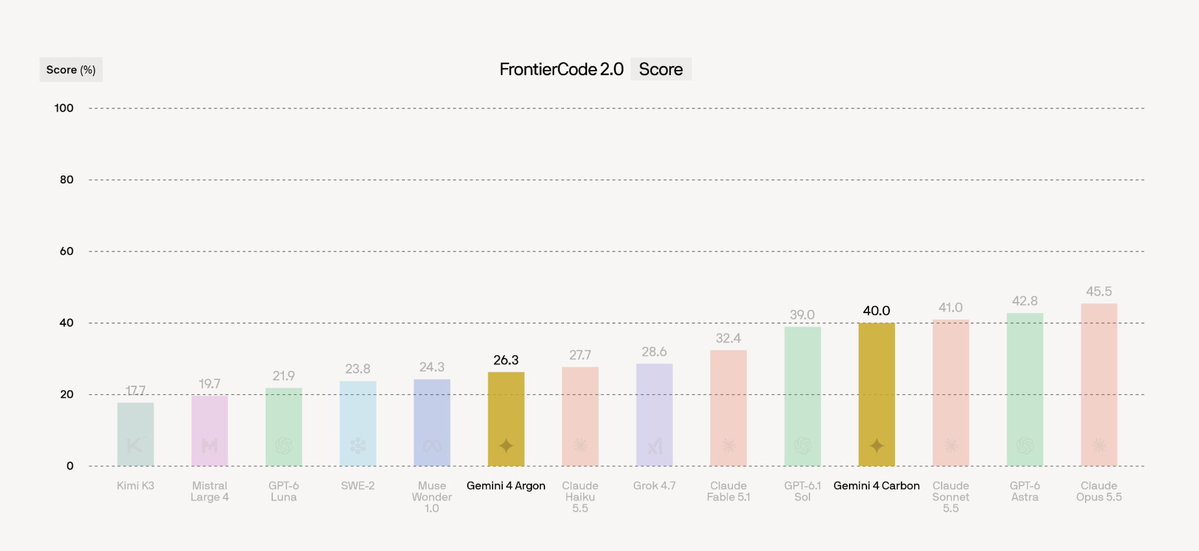
Cognition scores Gemini 4 Carbon at 40% on FrontierCode 2.0 for $4.04 a task, near the top, while Gemini 4 Argon gets 26.3% at $6.41

Cognition, the company behind Devin, posted on X at 01:45 UTC on Oct 30 that Google's new Gemini 4 Carbon scores 40% on its FrontierCode 2.0 coding benchmark at $4.04 per task, near the top and behind only Claude Opus 5.5, GPT-6 Astra and Claude Sonnet 5.5. The earlier Gemini 4 Argon scores 26.3% at a higher $6.41 per task. The results are Cognition's own runs, and the leaderboard on its site has been updated.

Cognition scores Gemini 4 Carbon at 40% on FrontierCode 2.0 for $4.04 a task, near the top, while Gemini 4 Argon gets 26.3% at $6.41

Key Takeaways

  • Gemini 4 Carbon scores 40% on FrontierCode 2.0 at $4.04 per task, behind Claude Opus 5.5 (45.5%), GPT-6 Astra (42.8%) and Claude Sonnet 5.5 (post)
  • Gemini 4 Argon scores 26.3% at $6.41 per task, ahead of Muse Wonder 1.0 but behind Claude Haiku 5.5 and Grok 4.7
  • From Argon to Carbon the score rises about 13.7 points while cost per task drops about $2.37
  • The changelog shows Gemini 4 Carbon was added on Oct 28; FrontierCode 2.0 has 132 tasks scored on whether a maintainer would merge the PR (leaderboard)
  • All figures are Cognition's own runs; Google has not published FrontierCode results itself
Read full story

Factory launches Droid 1.0: programmatic tool calling by default, hundreds of tool calls per model request, leads native harnesses on its own Terminal-Bench 4 runs

AI coding agent company Factory announced Droid 1.0 on X and its blog at 22:31 UTC on Oct 29, calling it the largest update yet to its agent harness. The key change makes programmatic tool calling (PTC) the default: the model writes a JavaScript program that runs up to hundreds of tool calls in a sandbox in one model request. In Factorys own Terminal-Bench 4 runs, Droid scored 57.6% with GPT-6.1 Sol ($0.79 per passed task) and 65.2% with Claude Opus 5.5 ($4.73), ahead of Codex, Claude Code, Cursor, OpenCode and Devin on the same models.

Factory launches Droid 1.0: programmatic tool calling by default, hundreds of tool calls per model request, leads native harnesses on its own Terminal-Bench 4 runs

Key Takeaways

  • Programmatic tool calling is now the default: the model writes JavaScript that runs in a sandbox with no file, network or system access of its own, making up to hundreds of tool calls per request, with independent calls run concurrently
  • Factory example: moving and verifying 151 Linear issues took 312 tool calls; direct calls needed about 36 requests and 3.1M input tokens, a Script needed 2 requests and 61K tokens
  • Terminal-Bench 4 (Factory runs, Oct 23-28, three trials per task): with GPT-6.1 Sol, Droid 57.6% vs Codex 54.0%, OpenCode 51.0%, Devin 45.0%; with Opus 5.5, Droid 65.2% vs Cursor and OpenCode 62.1%, Devin 59.6%, Claude Code 57.6%
  • The first request shrank from 20,887 to 13,055 tokens (-37%) and up-front tool definitions went from 11 to 2; newly loaded MCP tools are appended to keep the prompt cache intact, and a typical production request reads 98% of input from cache
  • Available now as a macOS and Windows desktop app, a terminal UI and the Droid SDK (@factory/droid-sdk); the benchmarks are vendor-run with no third-party reproduction yet
Read full story

Google is winding down its async coding agent Jules: read-only after Nov 11 and shut down on Dec 31, with its learnings moving into Antigravity

On Oct 29, Google announced through the official @julesagent account and the Jules changelog that Jules will wind down on December 31, 2026. Users can keep finishing sessions until November 11, after which Jules becomes read-only until the end of the year. Google says its learnings from Jules are going into Google Antigravity, its agent-first development platform, to combine autonomous remote background task execution with an agent-first environment. Google also published an export path for settings, environment variables, scheduled tasks, repositories, memories and every session.

Key Takeaways

  • Key dates: sessions can run until Nov 11, then Jules is read-only, and it shuts down on Dec 31
  • Next stop: Jules learnings go into Google Antigravity; Google does not promise automatic migration of sessions, memories or schedules
  • Export: run npm install -g @google/jules and jules login, then paste the official export prompt into a CLI coding agent; data lands in ~/jules-export
  • Code, branches and PRs already live in GitHub and are unaffected; env-variables.json holds secrets, so keep the export folder out of repos
Read full story

Alibaba Cloud opens a Netherlands region at its first international Apsara Conference, plans agentic AI services, and JetBrains explores Qwen for Junie

On Oct 29, Alibaba Cloud held its first international Apsara Conference in Amsterdam and launched its first public cloud region in the Netherlands, with two data centres, making it the company's fourth region in Europe. It plans to bring agentic AI services to the region, including ACS Agent Sandbox, Agent Security Center, AI Security Guardrails 2.0, Agentic SOC and STAROps, and unveiled a new generation of its Apsara Stack hybrid cloud. On the partner side, JetBrains is working with Alibaba Cloud to explore Qwen models for its Junie coding assistant, in both cloud and local setups.

Alibaba Cloud opens a Netherlands region at its first international Apsara Conference, plans agentic AI services, and JetBrains explores Qwen for Junie

Key Takeaways

  • The Netherlands region has 2 data centres and is Alibaba Cloud's 4th in Europe after Frankfurt, London and Paris; the global footprint is now 32 regions and 109 availability zones (company figures)
  • Five agentic AI services are planned for the region: ACS Agent Sandbox (hardware-level isolation), Agent Security Center, AI Security Guardrails 2.0, Agentic SOC and STAROps
  • The new Apsara Stack offers 80+ cloud and AI products; Alibaba says AI-driven operations reach 92.5% accuracy and a 70% automation rate
  • JetBrains is exploring Qwen models for Junie, running either in-region in the cloud or fully local; orq.ai, Monks, Magnific and Idea.ai also integrate Alibaba models
  • Over the next 12 months Alibaba plans its first region in Finland and more data centre capacity in Germany and France, as part of its previously announced US$53B AI and cloud investment
Read full story
Linked Models & Agents: