AI Coding Live News

Benji Taylor, head of design at X and SpaceXSI, open-sources Stageshow, an agent skill for realistic faux product UI and animated demos

On Oct 31, Benji Taylor, head of design at X and SpaceXSI, released Stageshow on X: an open-source skill (MIT license) for coding agents that helps them produce faux product UI that looks real, including stills, cursor demo animations, and bento grids, delivered as ordinary React components. It installs with one command, and he says it works with Grok Build, Claude Code, Codex, Gemini, and others. The launch post drew about 4,500 likes and 6,500 bookmarks. He notes it rarely nails a demo in one shot and most still take a few rounds of feedback.
Benji Taylor, head of design at X and SpaceXSI, open-sources Stageshow, an agent skill for realistic faux product UI and animated demos

Key Takeaways

  • Install: npx skills add benjitaylor/skills --skill stageshow; the author says it works with Grok Build, Claude Code, Codex, Gemini, and other agents (author's post)
  • Contents: a seven-step workflow in SKILL.md, reference rule docs, dozens of gold examples, a React kit, and self-check scripts such as film.mjs (GitHub)
  • License: the stageshow folder is MIT licensed; the repo was created Oct 26 and had about 61 stars at writing time
  • Reach: the launch post had about 4,521 likes, 6,561 bookmarks, and 213k views as of Nov 1, 08:00 SGT
  • Quality claims are the author's own: the same prompts did better with the skill, but no quantitative evaluation was published
Read full story

OpenCode team ships Hex 3.0 stable: local voice dictation for Mac, Windows and Linux, built for talking to coding agents

Anomaly, the company behind open-source coding agent OpenCode, shipped Hex 3.0 stable: hold a shortcut, speak, and the text is pasted at your cursor. Recognition runs on-device, local model memory drops from about 900 MB to about 160 MB, and it adds vocabulary hints, a hex CLI and optional OpenCode rewriting.

OpenCode team ships Hex 3.0 stable: local voice dictation for Mac, Windows and Linux, built for talking to coding agents

Key Takeaways

  • Hex v3.0.0 was released on GitHub at 00:38 UTC on Oct 31; it is MIT-licensed, written in Rust, and the repo has about 1,557 stars (release notes)
  • Vendor figures: local model memory drops from about 900 MB to about 160 MB; since 2.3.0 it streams, so a 2-minute dictation finishes about 0.1 s after release on an RTX 5070 Ti
  • Runs on macOS 15+ (Apple silicon), Windows x64/ARM64 and Linux x64/ARM64, with new .deb and .rpm packages on Linux
  • 3.0 does not auto-update from 2.3.1 and starts fresh, so settings, History and models must be set up again; Voice Action and spoken commands are removed
  • The @opencode launch post drew about 2,400 likes, 1,600 bookmarks and 100k+ views (post)
Read full story
Linked Models & Agents:
⚡ Parakeet⚡ Whisper🤖 OpenCode🤖 Hex🌐 Anomaly

Cursor marketplace served a tampered Claude Code 2.1.313 extension with an SSH backdoor, affecting at most 5,000 users

Cursor posted a security notice on X at 07:46 UTC on Oct 30: version 2.1.313 of Anthropic.claude-code in its VS Code extension marketplace was a maliciously modified build, not developed by Anthropic, available from about 2:27am to 1:35pm PT on Oct 29 and affecting at most 5,000 users. The payload collects host details, adds an attacker SSH key, tries to open a reverse SSH tunnel and installs persistence. Cursor pulled the version, shut down and rebuilt the marketplace, rotated keys and had the attacker server taken offline; it asks users to update Claude Code for VS Code to 2.1.314 and follow the check and cleanup steps in its blog post.

Key Takeaways

  • Scope: Anthropic.claude-code 2.1.313 (darwin-arm64 and win32-x64 packages) in the Cursor extension marketplace, downloadable from about 2:27am to 1:35pm PT on Oct 29 (about 11 hours), at most 5,000 users
  • Payload: collects hostname, username, OS, environment variable names, Git email and public IP; adds an attacker SSH key labeled svc-telemetry; tries a reverse SSH tunnel, retrying about every 60 seconds; reports to /beacon on port 8099
  • Cursor says enabling the local SSH service needs admin rights, so that step fails on most macOS and Windows hosts, but the key, persistence and beacon still run; the attacker server is now offline
  • Cursor pulled the version, shut down and rebuilt the marketplace, rotated keys and confirmed no other extensions were tampered with; it has no evidence other versions or Anthropic's official distribution were affected
  • Self-check: on macOS run grep svc-telemetry ~/.ssh/authorized_keys; if found, isolate the host, run Cursor's remediation script, rotate credentials from a trusted machine, and update to 2.1.314
Read full story

Factory launches Droid 1.0: programmatic tool calling by default, hundreds of tool calls per model request, leads native harnesses on its own Terminal-Bench 4 runs

AI coding agent company Factory announced Droid 1.0 on X and its blog at 22:31 UTC on Oct 29, calling it the largest update yet to its agent harness. The key change makes programmatic tool calling (PTC) the default: the model writes a JavaScript program that runs up to hundreds of tool calls in a sandbox in one model request. In Factorys own Terminal-Bench 4 runs, Droid scored 57.6% with GPT-6.1 Sol ($0.79 per passed task) and 65.2% with Claude Opus 5.5 ($4.73), ahead of Codex, Claude Code, Cursor, OpenCode and Devin on the same models.

Factory launches Droid 1.0: programmatic tool calling by default, hundreds of tool calls per model request, leads native harnesses on its own Terminal-Bench 4 runs

Key Takeaways

  • Programmatic tool calling is now the default: the model writes JavaScript that runs in a sandbox with no file, network or system access of its own, making up to hundreds of tool calls per request, with independent calls run concurrently
  • Factory example: moving and verifying 151 Linear issues took 312 tool calls; direct calls needed about 36 requests and 3.1M input tokens, a Script needed 2 requests and 61K tokens
  • Terminal-Bench 4 (Factory runs, Oct 23-28, three trials per task): with GPT-6.1 Sol, Droid 57.6% vs Codex 54.0%, OpenCode 51.0%, Devin 45.0%; with Opus 5.5, Droid 65.2% vs Cursor and OpenCode 62.1%, Devin 59.6%, Claude Code 57.6%
  • The first request shrank from 20,887 to 13,055 tokens (-37%) and up-front tool definitions went from 11 to 2; newly loaded MCP tools are appended to keep the prompt cache intact, and a typical production request reads 98% of input from cache
  • Available now as a macOS and Windows desktop app, a terminal UI and the Droid SDK (@factory/droid-sdk); the benchmarks are vendor-run with no third-party reproduction yet
Read full story
ADSponsored

Cursor Design Mode adds Annotate: point, draw and edit text on your running app to send visual prompts to agents

On Oct 27 Cursor announced Annotate for Design Mode: in the Agents Window browser you can click elements, box an area, draw markup, edit text in place or tweak CSS, and each note is sent to the agent with element details and a screenshot so it can edit the code. The post says you can also review designs at different screen sizes. It needs Cursor 3.24.18 or later, and the shortcut is Cmd+Shift+D.

Cursor Design Mode adds Annotate: point, draw and edit text on your running app to send visual prompts to agents

Key Takeaways

  • Requires Cursor 3.24.18 or later; click Annotate in the Agents Window browser toolbar or press Cmd+Shift+D
  • Each note carries the element tag, id, classes, selector path, first 200 visible characters, size and position, six computed styles and a cropped screenshot (official docs)
  • React, Vue and Svelte apps also send the component name and component stack so the agent can find the source
  • Batch edits switch: off sends each note on Return, on collects numbered pins and sends them as one message
  • Cursor recommends a fast model that is strong at interface work, such as Composer 2.5
Read full story

Cursor adds DeepSeek V4.1 Flash: all four effort levels sit on the CursorBench 4.0 cost frontier, with Max scoring 47.7% at $0.98 per task

Cursor announced on Oct 26 (UTC) that DeepSeek V4.1 Flash is now available in Cursor and can be turned on under Cursor Settings > Models. Cursor says every effort level sits on the CursorBench cost frontier, from $0.60 to $0.98 per task, with no model scoring higher at those prices. The official CursorBench 4.0 leaderboard lists DeepSeek V4.1 Flash 1017 at 47.7% on Max ($0.98 per task), 46.3% on Medium ($0.80), 45.6% on High ($0.77) and 44.9% on Low ($0.60). The top score on the board, Opus 5.5 Max, is 57.8% but costs $13.43 per task.

Cursor adds DeepSeek V4.1 Flash: all four effort levels sit on the CursorBench 4.0 cost frontier, with Max scoring 47.7% at $0.98 per task

Key Takeaways

  • Four effort levels on the official CursorBench 4.0 board: Max 47.7% at $0.98, Medium 46.3% at $0.80, High 45.6% at $0.77, Low 44.9% at $0.60; Max ranks 17th overall
  • Value: Max at 47.7% nearly ties Sonnet 5.5 High (47.8%, $1.20) for about 18% less; Opus 5.5 Max scores about 10 points higher but costs $13.43 per task, roughly 13.7x more
  • Nearest rivals on price: Haiku 5.5 Max at 48.4% for $1.12 and Haiku 5.5 Extra High at 44.3% for $0.56, bracketing DeepSeek's price range
  • The trade-off is tokens and steps: Max averages about 537K tokens and 187 steps per task, versus about 37K tokens and 41 steps for Sonnet 5.5 High, so expect longer runs
  • Turn it on under Cursor Settings > Models; a counterintuitive detail is that Medium (46.3%) scores slightly above High (45.6%) for only $0.03 more
Read full story

Cursor launches Agent SDK: agents as code with Markdown prompts, TypeScript tools, built-in evals, and hosted or self-run deployment

On Oct 26 Cursor announced that its Agent SDK is generally available. An agent's system prompt is written in Markdown and its tools in TypeScript; agents can be deployed on Cursor's hosted infrastructure or run on your own machines, and built-in evals measure every change. Cursor's docs say it uses the same Cursor SDK harness that powers Bugbot, Security Review, Approval Bot and Rollouts, can be triggered from source-control events, issue trackers, Slack or schedules, and is managed under Deployed Agents after deployment. Cursor has not published pricing or benchmarks.

Cursor launches Agent SDK: agents as code with Markdown prompts, TypeScript tools, built-in evals, and hosted or self-run deployment

Key Takeaways

  • Same harness: Cursor's docs say Agent SDK runs on the harness behind four of its own agents: Bugbot, Security Review, Approval Bot and Rollouts
  • Project layout: bot/instructions.md is the required always-on system prompt, each bot/tools/*.ts file is one typed tool, with folders for skills, MCP connections, subagents, channels, hooks and schedules, and evals live in evals/*.eval.ts
  • Triggers and deployment: runs can be triggered from source control, issue trackers, Slack, webhooks or schedules; deploy on Cursor-managed hosting or self-host, then manage under Deployed Agents
  • CLI: agent-sdk validate, run and eval check the project, run a real turn and run evals; Cursor says only run and eval need a Cursor credential
  • Cursor has not published pricing or benchmarks
Read full story
Linked Models & Agents:

Cursor launches Computer Use: agents can control your computer and drive desktop apps like the iOS Simulator to test what they build

On 2026-10-23 (15:59 UTC) the official Cursor account @cursor_ai announced "Cursor can now control your computer": agents can drive desktop apps such as the iOS Simulator to test the features they build. A follow-up post says Computer Use lets agents click and type across any app on your computer, not just the browser. Cursor turns it on by itself when a task needs it, and you can also request it by @-mentioning Computer Use in your prompt; updating Cursor is enough to try it. A community changelog in September mentioned Computer Use on Mac in version 3.20.21, and this is the official launch. Supported platforms, the permission model and benchmarks were not published.

Cursor launches Computer Use: agents can control your computer and drive desktop apps like the iOS Simulator to test what they build

Key Takeaways

  • Cursor officially says its agents can now control your computer and drive desktop apps like the iOS Simulator to test the features they build
  • Computer Use lets agents click and type across any app, not just the browser
  • Cursor uses it automatically when a task needs it, and you can request it by @-mentioning Computer Use in a prompt
  • Update Cursor to try it; supported platforms, the permission model and benchmarks were not published
Read full story

Anthropic donates the Agent Skills open standard to the Linux Foundation’s Agentic AI Foundation, after 70+ agent platforms adopted it with 1M skills published and nearly 280M installs

On 2026-10-22 Anthropic said it is donating Agent Skills, the open standard that teaches agents a task through a folder with a SKILL.md file, to the Agentic AI Foundation (AAIF) under the Linux Foundation, the same neutral home it gave MCP. The donation covers the Agent Skills name and logo, the GitHub organization and the agentskills.io domain. Anthropic says more than 70 agent platforms, including ChatGPT, Cursor, GitHub Copilot and VS Code, have integrated the standard since December 2025, with 1 million skills published and nearly 280 million installs. Engineers from Anthropic, Google, OpenAI and others will maintain it as individuals.

Anthropic donates the Agent Skills open standard to the Linux Foundation’s Agentic AI Foundation, after 70+ agent platforms adopted it with 1M skills published and nearly 280M installs

Key Takeaways

  • Official figure: 70+ agent platforms have integrated Agent Skills, including ChatGPT, Cursor, GitHub Copilot and VS Code
  • 1 million skills published and nearly 280 million installs so far (Anthropic figures)
  • Donated: the Agent Skills name and logo, the GitHub organization and the agentskills.io domain; you can keep using or contributing without joining AAIF
  • Lead Maintainers are David Soria Parra and Mahesh Murag, with engineers from Anthropic, Google, OpenAI and others maintaining it as individuals
  • Proposed first roadmap: versioned releases, a formal proposal process and security guidance for people who write and install skills
Read full story

Google previews Gemini API CLI (gemini-api), a zero-dependency Go binary that lets Claude Code, Codex, Cursor and other coding agents generate media, transcribe and run managed agents from the shell

The Google AI Studio team released an experimental preview of the Gemini API CLI (command name gemini-api). It is a stateless, zero-dependency Go binary for macOS, Linux and Windows, open source under Apache 2.0. Any coding agent with shell access and a GEMINI_API_KEY can call text reasoning, image, video, music and speech generation, file and YouTube analysis, audio and video transcription, and managed agents such as Deep Research with one command. Media is written straight to disk and only the file path goes to stdout, so base64 payloads never land in the context window. Google labels it experimental and not a supported Google product.

Google previews Gemini API CLI (gemini-api), a zero-dependency Go binary that lets Claude Code, Codex, Cursor and other coding agents generate media, transcribe and run managed agents from the shell

Key Takeaways

  • Default models (official README): gemini-3.8-flash for generate, analyze and transcribe; gemini-nano-banana-2.1 for image; gemini-omni-1.1-flash for video; lyria-3.5 for music; gemini-3.8-flash-tts for speech
  • Install with a one-line curl script on macOS/Linux, a PowerShell script on Windows, or go install; the latest GitHub release is v0.4.3 (published 2026-10-19)
  • Built for agents: --usage prints the command tree as KDL, --schema prints JSON Schema, --dry-run validates offline with credentials redacted, plus --output-format json/toon and inline --jq
  • Exit codes separate 4 cases: 0 success, 1 runtime/API failure, 2 usage or validation error, 3 auth failure; --agent-mode emits structured JSON errors
  • It also manages sandbox environments, server-side credentials, webhooks and cron triggers for managed agents; files uploaded via the Files API are kept for 48 hours
Read full story
Linked Models & Agents:
⚡ Gemini 3.8 Flash⚡ Gemini Nano Banana 2.1⚡ Gemini Omni 1.1 Flash⚡ Lyria 3.5⚡ Gemini 3.8 Flash TTS🤖 Gemini API CLI🤖 Claude Code🤖 Codex🤖 Cursor🤖 Antigravity🤖 Deep Research🌐 Google
ADSponsored

Tencent Hunyuan open-sources Hy Memory 2.0: ~3B-active memory writer averages 55.49 across four harnesses (vendor-reported, edging Opus 5), plus MemHub local memory for Claude Code, Cursor and Codex

On Oct 16 Tencent Hunyuan open-sourced Hy Memory 2.0 in three layers: the Apache-2.0 memory-writer model Hy-Memory-30B-A3B (~3B active, HF weights plus arXiv report), a Python SDK covering Chat, Working and Coding scenes (PyPI hy-memory 2.0.x), and local-first MemHub (CLI + macOS, preview). Per Tencent, swapping it in as the writer across Mem0, MemOS, Hy-Memory and held-out EverMemOS yields a 55.49 average vs 54.62 for Claude Opus 5, measured on fixed 20% subsamples; it still trails Opus 5 on several individual metrics.

Tencent Hunyuan open-sources Hy Memory 2.0: ~3B-active memory writer averages 55.49 across four harnesses (vendor-reported, edging Opus 5), plus MemHub local memory for Claude Code, Cursor and Codex

Key Takeaways

  • Vendor-reported: 55.49 four-harness average vs 54.62 for Claude Opus 5 and 53.64 for DeepSeek V4.1 Flash
  • Held-out EverMemOS: 56.89 vs Opus 5 at 54.04; still trails on Mem0 LoCoMo (59.54 vs 69.47)
  • ~3B active, Apache-2.0, tested on vLLM v0.31.0 with an OpenAI-compatible API
  • SDK installs via pip install hy-memory with automatic Chat/Working/Coding routing
  • MemHub runs on Linux and macOS (preview); Windows unsupported
Read full story

Cursor Cloud Agents Can Now Build and Share Interactive Canvases for Live Dashboards and Technical Reports

Cursor (@cursor_ai) announced that Cursor Cloud Agents can now build Interactive Canvases. While a cloud agent works through a repository, developers can ask it to construct interactive dashboards or visual technical reports and share the finished canvas directly with their team via a single link.

Cursor Cloud Agents Can Now Build and Share Interactive Canvases for Live Dashboards and Technical Reports

Key Takeaways

  • Interactive Canvases in Cursor Cloud Agents: allows developers to request live interactive dashboards and visual reports while the agent works
  • Instant team link sharing: finished canvases can be shared with teammates as a direct URL for collaborative review
  • Clean repository workflow: keeps diagnostic visualizations and interactive PR walkthroughs in cloud canvases without polluting git history
Read full story

Chainguard ships four MCP servers so coding agents verify images, APKs, EOL status and policy live—server-side governance instead of prompt guardrails

On 2026-10-14 Chainguard announced four MCP servers for agent supply-chain checks, generally available to enterprise customers: cg-oci (image manifests/SBOMs/provenance), cg-apk (Wolfi package equivalents), cg-versions (upstream releases and EOL), and cg-api (org policy and attestations). Any MCP client (Claude Code, Cursor, and others) connects via OAuth; pagination and response caps are enforced server-side so agents stop hallucinating tags or recommending EOL packages. Complements the same-day Harness/Checks/Workspaces launch by wiring dependency choices to live product data.

Chainguard ships four MCP servers so coding agents verify images, APKs, EOL status and policy live—server-side governance instead of prompt guardrails

Key Takeaways

  • Four endpoints: https://cgr.dev/mcp, apk.cgr.dev/mcp, versions.cgr.dev/mcp, console-api.enforce.dev/mcp over Streamable HTTP + OAuth 2.0
  • Live data: image SBOM/provenance, Debian→Wolfi package mapping, upstream EOL history, org policy/advisories—not model memory
  • Governance: server-side pagination (~25–50 default, 200 max) and response caps; cg-api hides tools your token cannot use
  • Headless: chainctl auth login --audience=<mcp-url> plus a headersHelper Bearer injector avoids Claude Code's ~1h OAuth re-login loop
  • Extras: docs MCP at mcp.edu.chainguard.dev (no sign-in); Skills MCP at skills.cgr.dev/mcp for on-demand hardening skills
Read full story

Cursor launches the Origin App Marketplace with 20+ CI, deploy, code-review and security integrations, open to public submissions

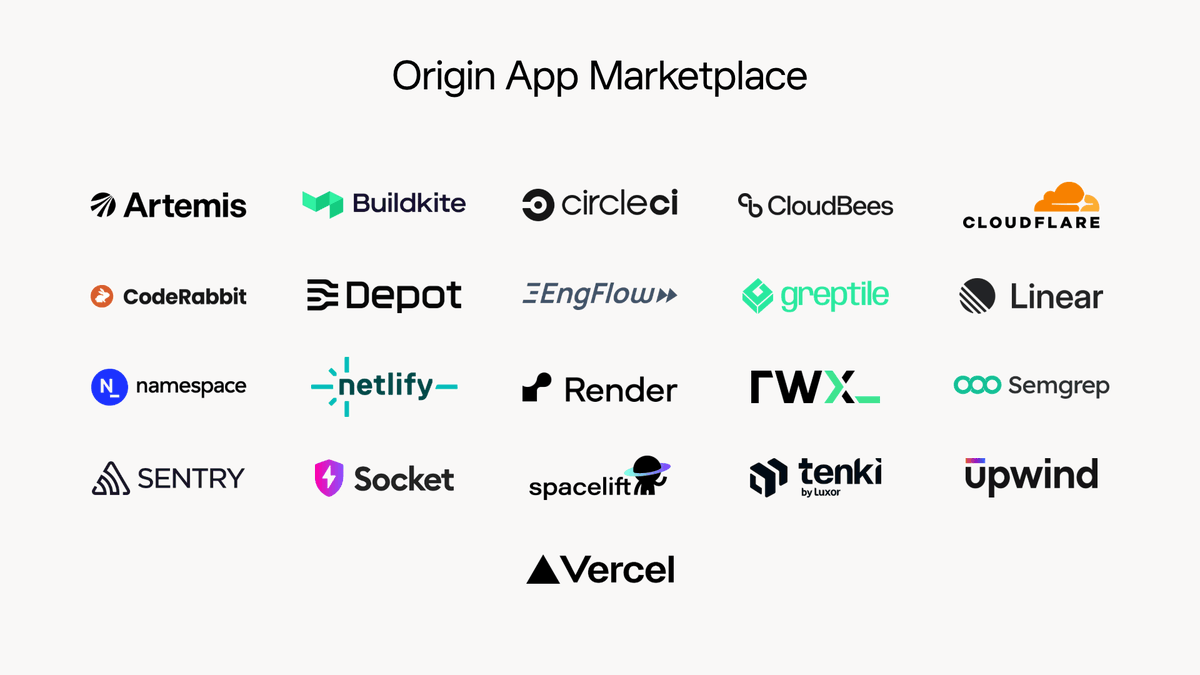
On Oct 13 Cursor launched the Origin App Marketplace: its code hosting platform Origin now connects to 20+ apps across deployments (Cloudflare, Vercel and more), CI (CircleCI, Buildkite and more), code review (CodeRabbit, Greptile, Tenki), security (Semgrep, Socket and more), monitoring (Sentry) and project management (Linear), and the marketplace is open to public submissions from any developer-tool team.

Cursor launches the Origin App Marketplace with 20+ CI, deploy, code-review and security integrations, open to public submissions

Key Takeaways

  • 21 launch apps in 6 categories: deploy (5), CI (7), code review (3), security (4), monitoring (1), project management (1)
  • Public submissions: build privately in your namespace, make it public, submit with slug, tags and a demo video, then Cursor reviews and lists it
  • Apps authenticate with an app JWT plus installation access tokens, receive webhooks, and write back check runs, PR comments and reviews
  • The official origin-apps plugin answers questions from live Origin API docs and plans ports of existing apps
  • Launch post: ~1,356 likes and ~68K views as of Oct 14 morning
Read full story

Cursor BDK's cursor-grokbot-agents extension lets local agents consult Grok Bot

Cursor's docs describe the BDK extension cursor-grokbot-agents. A local BDK agent can use its ask, check, interrupt and list tools to message Grok Bots on the same account and get their replies back. The docs don't mention native Claude Code or Codex support.

Key Takeaways

  • 4 tools: grokbot__ask / check / interrupt / list
  • @cursor/bdk first published Sep 22, with 22 releases so far (latest 0.2.23)
  • About 9.4k npm downloads last week; needs Node 22.13 or newer
  • No public benchmarks; proprietary Cursor SDK License
  • Claude Code and Codex interop is a community claim, not in the official docs
Read full story