AI Coding Live News

Marvell to Acquire Lumentum in $115 Billion All-Stock Deal, Betting on Optical Connectivity for AI Data Centers

Marvell and Lumentum announced on November 2 a definitive agreement for Marvell to acquire Lumentum in an all-stock deal: 4.5 Marvell shares per Lumentum share, an implied enterprise value of $115 billion (about $1,132 per share, a roughly 23.9% premium). Marvell holders will own about 67% of the combined company. The companies say AI clusters are shifting from copper to optics, and the combination will cover connectivity from data center interconnect down to in-package links, targeting a $550 billion market. Closing is expected in the first half of 2028.
Marvell to Acquire Lumentum in $115 Billion All-Stock Deal, Betting on Optical Connectivity for AI Data Centers

Key Takeaways

  • Fixed exchange ratio of 4.5 to 1 implies a $115 billion enterprise value for Lumentum, a roughly 23.9% premium to the unaffected October 28 close.
  • Marvell holders will own about 67% and Lumentum holders about 33%; Matt Murphy stays chairman and CEO, and three Lumentum directors including CEO Michael Hurlston join the board.
  • The deal combines Marvell electrical and optical interconnect, switching and custom XPU silicon with Lumentum lasers, optical transceivers, optical circuit switching (OCS) and indium phosphide (InP) manufacturing.
  • The companies cite more than $1 billion in run-rate cost synergies and year-one non-GAAP EPS accretion; shareholder and regulatory approvals are required, with closing expected in the first half of 2028.
Read full story

Microsoft Open-Sources Mage-VL-Cowork, a 4B Computer-Use Agent That Chooses Between Clicking the GUI and Running Bash, Scoring 66.0% on OSWorld-Verified

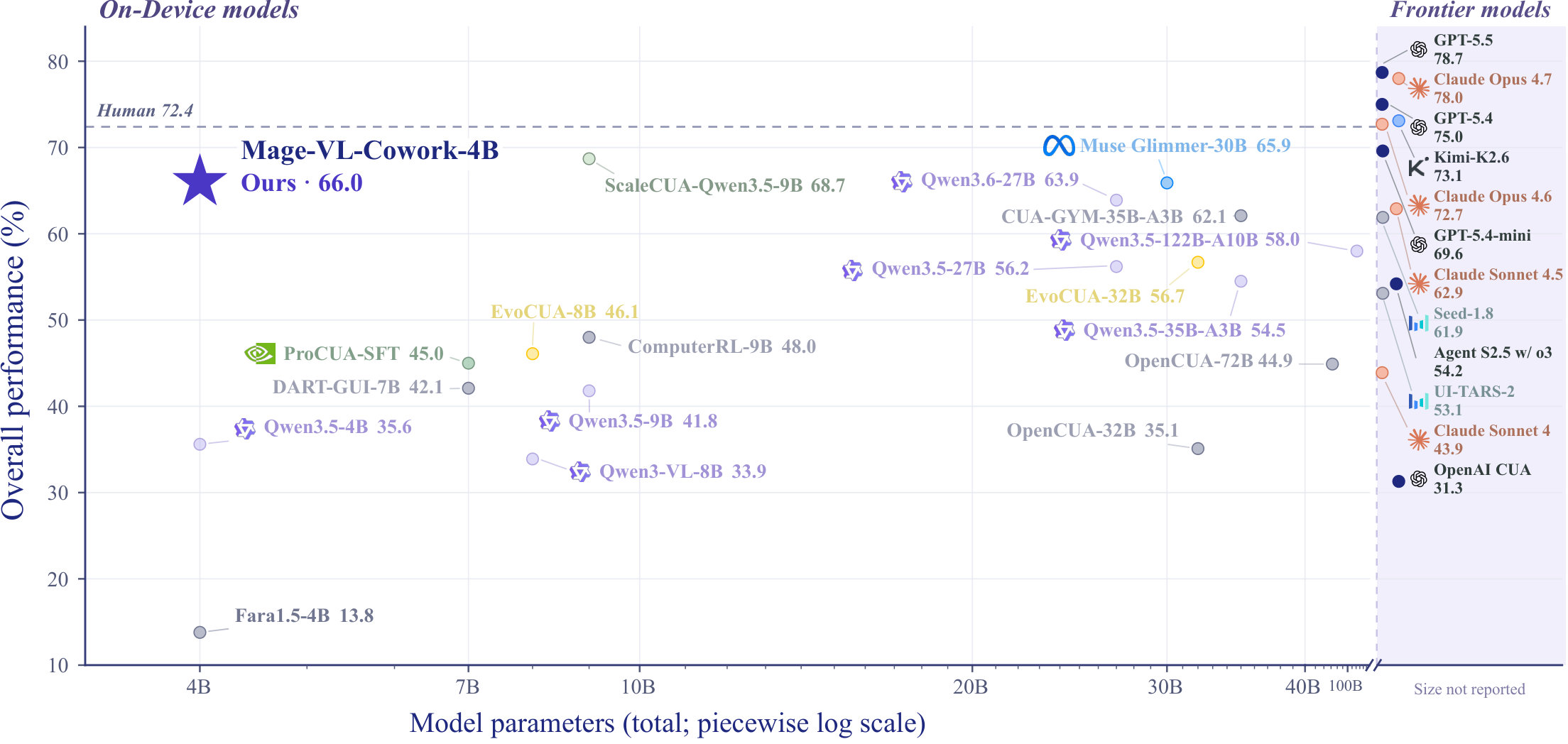
On October 30, Microsoft's Mage team released Mage-VL-Cowork on Hugging Face under Apache-2.0: a 4B multimodal computer-use agent in which a single model decides at every step whether to act through screenshots and GUI clicks (computer_use) or through bash and Python in a terminal, with no external orchestrator. Microsoft reports a two-run average of 66.0% on OSWorld-Verified (361 tasks, 50-step budget), above Qwen3.6-27B at 63.9% but below the 9B SCALECUA-Qwen3.5-9B at 68.7%.

Microsoft Open-Sources Mage-VL-Cowork, a 4B Computer-Use Agent That Chooses Between Clicking the GUI and Running Bash, Scoring 66.0% on OSWorld-Verified

Key Takeaways

  • 4B parameters, built on Mage-VL (Mage-ViT vision encoder plus Qwen3-4B-Instruct-2507); about 9.48 GB of bf16 weights under Apache-2.0.
  • On OSWorld-Verified, two independent runs scored 65.33% and 66.75% for a 66.0% average; 87.5% on operating-system tasks and 62.7% on multi-app workflows.
  • In Microsoft's side-by-side, a LibreOffice Calc chart task took 39 seconds (6 steps) via Python in the terminal, versus 9:56 (39 steps) for GUI-only Qwen3.6-27B.
  • Online RL adds 10.16 points over hybrid SFT while cutting mean model calls by 13.0% and output tokens by 25.4%.
  • Training data came from Mage-CUA-Forge, which synthesized about 294K desktop and web tasks across 6,915 skills and cut per-task generation cost from $0.906 to $0.158.
Read full story
Linked Models & Agents:
⚑ Mage-VL-Cowork⚑ Mage-VL⚑ Qwen3-4B⚑ Qwen3.6-27B🌐 Microsoft

South Korea Nearly Doubles 2027 AI and Chip Spending to 21.3 Trillion Won, With 4.7 Trillion for a Sovereign Frontier Model and 10,000 Vera Rubin GPUs

In his 2027 budget address to the National Assembly on November 2, South Korean President Lee Jae Myung proposed a record 820.9 trillion won budget (+12.8%), with 21.3 trillion won (about $16B) for semiconductors, physical AI, AI data centers and AI, nearly double the 10.8 trillion won in 2026. The Ministry of Planning and Budget document allocates 4.7 trillion won to a sovereign AI model aiming for world-leading performance, including the purchase of 10,000 Vera Rubin GPUs. Parliament still has to pass the budget.

South Korea Nearly Doubles 2027 AI and Chip Spending to 21.3 Trillion Won, With 4.7 Trillion for a Sovereign Frontier Model and 10,000 Vera Rubin GPUs

Key Takeaways

  • The three mega-projects plus AI rise from 10.8 to 21.3 trillion won, up 97.2%; the total budget is 820.9 trillion won, up 12.8% (official budget document).
  • The 4.7 trillion won frontier AI program buys 10,000 Vera Rubin GPUs (3.9T won), training data (0.8T won), and recruits 20 top overseas researchers (25B won).
  • Until then, about 7,000 government-owned GPUs go first, plus about 8,000 leased from industry and academia; companies are picked by open competition and the state invests as an equity holder.
  • A new 0.25 trillion won AI for All program builds public AI agents on the domestic model that can handle ID documents, KTX train bookings and passport renewals; AI education gets 2.1T won for 3.9 million people.
  • Another 70B won funds a dedicated AI security model and 50B won subsidizes AI security subscriptions for 10,000 SMEs; physical AI rises from 0.9T to 3.1T won.
Read full story

OpenAI Signs Four Abu Dhabi Agreements: ADNOC Becomes First Energy Company to Deploy Its Frontier Tech, Machine-Readable Government Pilot Already Live

On November 2, Abu Dhabi Crown Prince Sheikh Khaled met OpenAI CEO Sam Altman and witnessed four agreements: ADNOC, with G42 subsidiary Inception42, will deploy OpenAI frontier technology; the Abu Dhabi Government and OpenAI launched an AI-native Machine-Readable Government initiative whose first food-import compliance pilot is already in production; Mubadala will apply AI to investment analysis; and Inception42 and OpenAI signed a five-year partnership. Inference runs inside the UAE.

OpenAI Signs Four Abu Dhabi Agreements: ADNOC Becomes First Energy Company to Deploy Its Frontier Tech, Machine-Readable Government Pilot Already Live

Key Takeaways

  • Four agreements in one signing, spanning government, energy and investment, announced officially by the Abu Dhabi Media Office.
  • ADNOC becomes the first energy company globally to deploy OpenAI frontier technology, powered by GPT models on in-country UAE inference, with human experts keeping oversight of consequential decisions.
  • The Machine-Readable Government initiative turns a defined set of policies and regulations into machine-readable form to help officials with permit and certificate compliance checks, each traceable to the governing rule; its first pilot is already in production with ADAFSA on food imports.
  • Inception42 and OpenAI signed a five-year partnership for government, enterprise and education; Mubadala will use AI for investment analysis and risk assessment.
  • No deal value was disclosed.
Read full story
ADSponsored

X Discussion: Jason Calacanis Says Under $40K a Year in AI Subscriptions Delivers $2M+ in Value and Has Automated at Least Seven Full-Time Jobs

Angel investor and This Week in Startups host Jason Calacanis posted on X on November 2 that he spends under $40K a year on tokens and subscriptions from Anthropic, Lovable, Grok Bot, ElevenLabs and other AI products, yet gets more than $2M in value at LAUNCH and This Week in Startups. He said they have automated at least seven full-time jobs and become 100% faster at the average task, and that the last 90 days changed more than the previous two years. Within about 9 hours the post drew about 2,200 likes and 230K views, with debate centered on AI ROI and job replacement. All figures are his own claims and have not been independently verified.

Key Takeaways

  • This is Calacanis's personal post, not official data or an announcement from any AI company; the $40K, $2M, seven jobs and 100% faster figures are self-reported with no public breakdown.
  • The original post (2026-11-02 05:27 UTC) had about 2,201 likes, 106 reposts, 244 replies, 42 quotes, 230K views and 715 bookmarks at fetch time.
  • Tools he named include Anthropic, Lovable, Grok Bot and ElevenLabs plus a long tail of other products; he also said anyone who has not used the last 90 days of products for at least 30 hours a week has no idea how profound this software is.
  • Supporters: entrepreneur Steven Cohn (@spcohn) quoted it saying his team has seen the same level of ROI; Farzad (@farzyness), with about 400K followers, quoted it saying "The ROI for AI is mind-boggling," drawing about 157 likes.
  • Skeptics: one user mocked posting "we automated seven full-time jobs" with a siren emoji like a product launch, noting that 30 hours a week of usage is itself like a new full-time job.
Read full story

Meituan ships LongCat-2.5, a 1.6T-parameter (about 48B active) native multimodal agentic model, with API pricing of $0.30/$1.20 per 1M tokens

On Nov 2 Meituan's LongCat team listed LongCat-2.5 in its API platform change log as the full release of September 25's LongCat-2.5-Preview. The official technical blog says it has 1.6 trillion total parameters with about 48 billion activated per token, builds on LongCat-2.0 with stronger native visual understanding and agentic coding, and was trained and served with W4A4 inference on domestic AI accelerators. Vendor-reported scores include 88.4 on Terminal Bench v2.1, 38.5 on Terminal Bench v4.0, 91.9 on BrowseComp and 83.1 on MCP Atlas. The API speaks both OpenAI and Anthropic formats with a 1M-token context and up to 128K output tokens, at a limited-time price of $0.30 per 1M uncached input tokens, $0.006 cached input and $1.20 output.

Meituan ships LongCat-2.5, a 1.6T-parameter (about 48B active) native multimodal agentic model, with API pricing of $0.30/$1.20 per 1M tokens

Key Takeaways

  • Scale: a 1.6-trillion-parameter MoE with about 48B active per token, a 1M-token context and up to 128K output tokens (official blog, API docs)
  • Code agents (vendor-reported): Terminal Bench v2.1 88.4 (Claude Opus 5 89.1, GPT-5.6-Sol 88.8), Terminal Bench v4.0 38.5 (GPT-5.6-Sol 37.3, Claude Opus 5 53.9), DeepSWE v1.1 64.6
  • General agents (vendor-reported): BrowseComp 91.9, MCP Atlas 83.1, AutomationBench v1.0.6 51.8, HLE with tools 63.1; AutomationBench jumps from 15.8 on LongCat-2.0
  • Pricing: limited-time $0.30 per 1M uncached input tokens, $0.006 cached input and $1.20 output (pricing page)
  • Engineering: W4A4 inference raises prefill throughput 43.3% and decode throughput 42.77% over a W8A8 baseline; FSDP gives 86% higher per-device throughput than DDP in long-sequence SFT
Read full story

X Discussion: Wharton Finance Professor Sylvain Catherine Says His $200/Month Claude Plan Is Worth It, Yet Calls for AI Regulation and No Race to Superintelligence

Wharton associate finance professor Sylvain Catherine posted on X that his views on AI have "radically shifted": he loves the tools and pays $200/month for Claude, but thinks the industry should be far more regulated and that frontier labs need not race toward superintelligence. The post drew about 48K views and 389 likes and is being shared in AI policy circles.

Key Takeaways

  • He pays $200 a month for Claude and calls it "worth every penny, probably even more", and believes current tools can significantly raise future GDP.
  • He cannot see why the industry is not more regulated when its own leaders and employees ask for it, and urges readers to spend an hour on the full chain of events of the Hugging Face incident.
  • He argues large gains are available by deploying current technology in economic and scientific organizations, without pursuing superintelligence.
  • His median scenario matches many economists: slow diffusion, roughly one extra percentage point of GDP growth, disruption along the way, and new jobs in the end.
  • This is an opinion discussion, not a factual report; he says he is not trying to convince anyone, only urging people to get informed and vote accordingly.
Read full story
Linked Models & Agents:

SemiAnalysis releases GDPx, an agentic benchmark of 206 tasks across 11 high-value domains where the top model, Claude Opus 5.5, scores just 12%

On Nov 2, semiconductor and AI research firm SemiAnalysis released GDPx, a benchmark of agentic capability across 11 domains: chip design, cybersecurity, biology, finance, legal, quant trading, recursive self-improvement (RSI), hardware design, materials science, alignment and software engineering. Its 206 tasks were built by 14 specialist data partners, with SemiAnalysis doing final QA. On the official leaderboard Claude Opus 5.5 leads at 12.0%, followed by Gemini 4 Carbon at 10.9% and GPT-6 Astra at 9.6%; nearly every model scores 0 on finance and legal. SemiAnalysis says safety classifiers drag down Opus 5.5 and GPT-6 Astra, and plans a new version every 3–6 months. All scores are as reported by SemiAnalysis.

SemiAnalysis releases GDPx, an agentic benchmark of 206 tasks across 11 high-value domains where the top model, Claude Opus 5.5, scores just 12%

Key Takeaways

  • Scale: 11 domains, 14 data partners and 206 tasks, with a default time limit of 8 hours per task (GDPx site)
  • Leaderboard (as reported by SemiAnalysis): Claude Opus 5.5 12.0%, Gemini 4 Carbon 10.9%, GPT-6 Astra 9.6%, Muse Wonder Full 9.0%, Claude Fable 5.1 8.5%, GPT 6.1 Sol 8.4%, Claude Sonnet 5.5 8.2%
  • Lower tier and open weights: DeepSeek 4.1 Flash 1017 5.4%, GPT-6 Luna 5.1%, Grok 4.7 3.9%, GLM 5.3 2.7%; almost every model scores 0 on finance and legal
  • Method: each model runs in its native harness where one exists (Claude Code for Opus, Codex for Astra, Antigravity for Carbon), otherwise OpenCode; the headline is pass@1 over three attempts with all domains weighted equally (SemiAnalysis blog)
  • By domain: Opus 5.5 wins quant trading, hardware and chip design; Gemini 4 Carbon wins biology and software engineering; GPT-6 Astra wins RSI and materials science; Muse Wonder Full is the strongest cyber model
Read full story

X Discussion: Vercel CEO Guillermo Rauch Says "Own Your Intelligence," Urging Local Models to Keep Spreading and Developers to Own Their Agent Harness and Data

Vercel CEO Guillermo Rauch posted on X on November 1: "Own your intelligence. Anyone that opposes this has something to sell you (perhaps your own intelligence back to you.)" He argued that local models need to keep proliferating; since the biggest models may be out of reach locally for now, the best option is to keep your options open: own your harness, data, connections and runtime, meaning your agents, and embrace open source. Within about 12 hours the post drew about 2,500 likes, 128K views and over 100 quote posts, with debate centered on how to balance local and cloud AI.

Key Takeaways

  • This is Rauch's personal opinion post, not an official Vercel announcement or product release.
  • The original post (2026-11-01 21:08 UTC) had about 2,533 likes, 255 reposts, 266 replies, 107 quotes, 128K views and 581 bookmarks at fetch time.
  • Core claim: local models should keep spreading; until the biggest models can run locally, keep your options open by owning your harness, data, connections, runtime and agents, and embrace open source.
  • Mark (@marksuman), co-founder and CEO of Maple AI, replied in a quote post that it will be hybrid: cloud will always be more powerful, so local-first AI should be paired with private cloud.
  • Engineer Shantanu Goel (@shantanugoel) quoted it saying "Guillermo says the truth that most others won't!", drawing about 37 likes.
Read full story
Linked Models & Agents:

X Discussion: Elon Musk Says Grok Bot Serving Costs Were Unsustainably High Relative to Revenue; Replit CEO Amjad Masad Warns Subsidized AI Subscriptions Face a Rug Pull

After users on X complained that their Grok Bot usage ran out early this cycle, Elon Musk replied that "the cost of serving Grok Bot was unsustainably high relative to revenue", a reply with about 13K likes and 5.5M views. Replit CEO Amjad Masad then quoted the news, saying people enjoying subsidized AI subscriptions should "get ready to get rug pulled", sparking a debate over whether flat-rate AI plans can last. This is an X discussion with personal views; xAI has not published a formal pricing or limit announcement.

Key Takeaways

  • Trigger: user @DogecoinNorway said their Grok Bot usage hit 100% with 4 days left until reset, a post with about 1.24M views.
  • Musk replied that the cost of serving Grok Bot was unsustainably high relative to revenue, with about 13.2K likes, 5.51M views and 1,900+ quotes.
  • Amjad Masad (Replit CEO) quoted it, warning subsidized AI subscriptions are about to get rug pulled, with about 2,347 likes and 146K views; in replies he said Replit never subsidized.
  • xAI has not published a formal limit or pricing change; rely on official notices for specifics.
Read full story
ADSponsored

X discussion: a post saying AI is popular because it gives uncreative people "the illusion they are artistic" gets 34K likes, and Pessimists Archive curator Louis Anslow flips the line back

On October 31, X user @Dylanszn01 posted: "AI is popular because it gives dumb people the illusion they are smart and uncreative people the illusion they are artistic." By November 2 it had about 34K likes, 5,030 reposts and 512K views. On November 1, Louis Anslow, curator of Pessimists Archive, an account that collects historical moral panics about new technology, quoted it with the same all-caps format: "AI is unpopular because it breaks creative professionals' illusion they are special." His post has about 1,852 likes, 103 replies and 35K views. The two posts capture the emotional split between generative AI and creative workers. This is an opinion fight; neither side cites survey data or any institutional finding.

Key Takeaways

  • Original: @Dylanszn01's post, posted 2026-10-31 16:08 UTC, with about 34,464 likes, 5,030 reposts, 265 replies, 169 quotes and 512K views
  • Rebuttal: Louis Anslow's quote post, posted 2026-11-01 16:04 UTC, with about 1,852 likes, 82 reposts, 103 replies and 35K views
  • Anslow's bio says he curates Pessimists Archive (@PessimistsArc), an account that collects historical panics about new technology
  • The original drew roughly 18 times the likes of the rebuttal, so the anti-AI-art sentiment spread much further on X; likes measure reach, not how public opinion is split
  • Note: both posts are personal opinions and cite no survey or research data
Read full story
Linked Models & Agents:

X discussion: Shopify CEO Tobi LΓΌtke backs the monorepo as a Shopify engineer calls it a boon for coding agents, while critics still prefer split repos

Shopify distinguished engineer Burke Libbey posted on November 1 that moving to a monorepo has been a boon for agents at Shopify; it needs thoughtful tooling and has downsides that take effort to mitigate, but he would not go back. He was replying to Darren Shepherd, who said a day earlier that he hates the idea that monorepos are great for agents. Shopify CEO Tobi LΓΌtke then quoted Burke and recalled Mikhail Parakhin telling him that every engineer hates the idea of moving to a monorepo, yet once it is there no engineer would want to work somewhere without one. Tobi's post drew about 1,115 likes, 454 bookmarks and 89K views and set off a wide debate. These are practitioner opinions, not an official technical announcement.

Key Takeaways

  • Original post: @tobi, Nov 1, 15:39 UTC, about 1,115 likes, 454 bookmarks, 95 replies and 89K views at fetch time
  • Shopify distinguished engineer Burke Libbey wrote that moving to a monorepo has been a boon for agents at Shopify; it needs thoughtful tooling and its downsides take effort to mitigate, but he would not go back
  • On the other side, Darren Shepherd (Rancher and k3s background) posted on Oct 31 that he hates the idea that monorepos are great for agents and that the best way to scale is to avoid scaling
  • Mikhail Parakhin replied to Tobi's retelling: "True story! And now, with agents, it more true than ever."
  • Supporters in the quote posts say agents can see every caller at once and get cross-stack type checking and atomic changes; skeptics ask whether agents make independent, separately evolving repos more attractive
Read full story
Linked Models & Agents:

X discussion: Microsoft AI CEO Mustafa Suleyman posts "Don't build conscious superintelligence", saying AI development should stop if consciousness emerges in training

Microsoft AI CEO Mustafa Suleyman published an X article on November 1 titled "Don't build conscious superintelligence", responding to reactions to his September essay on model welfare. He clarified that his line "AIs are not conscious" was deliberately in the present tense: they are not today, and that is how they must remain. If consciousness started to emerge in training, he would call for everyone to stop AI development until those properties could be designed out. He argued that AI developers have no right to bring a new conscious species into the world and that welfare concerns should focus on humans, animals and the natural environment. He also credited Anthropic for publishing its constitution and research, while saying he disagrees with its approach. The post drew about 353 likes, 251 bookmarks and 290K views, with ethicists and practitioners on both sides. This is a personal opinion piece, not a Microsoft product or policy announcement.

X discussion: Microsoft AI CEO Mustafa Suleyman posts "Don't build conscious superintelligence", saying AI development should stop if consciousness emerges in training

Key Takeaways

  • Original post: @mustafasuleyman X article, Nov 1, 15:22 UTC, about 353 likes, 56 reposts, 79 replies, 251 bookmarks and 290K views at fetch time
  • It responds to reactions to his Sept 16 essay "It's time to talk about model welfare" (about 1,013 likes); his X bio lists CEO of Microsoft AI, author of The Coming Wave, and co-founder of DeepMind and Inflection
  • Core claim: "AIs are not conscious" describes today and that is how it must remain; any evidence of AI consciousness should be disclosed publicly at once; if consciousness emerges in training, development should stop
  • He credits Anthropic for publishing its constitution and a stream of papers and posts, says he disagrees with its approach, and calls for labs to research this together and share safety information
  • In quote posts, UMass Amherst economics and ethics scholar Itai Sher called it "very well put"; UCL professor Tim Colbourn agreed but doubted safety can be engineered by default; others noted there is no accepted theory or test of consciousness
Read full story

X discussion: FT chief data reporter John Burn-Murdoch says the US productivity jump "doesn't look like AI" and is mostly tech layoffs, while Gavin Baker argues it shows "ROI on AI"

On November 1, John Burn-Murdoch, a Financial Times columnist and chief data reporter, posted a long X thread with his FT piece arguing that the productivity rise in AI-adopting US sectors began in 2020, before AI agents existed, shows up only in the US, and comes mainly from tech layoffs and hiring pullbacks rather than AI. The thread opener has about 1,344 likes, 306 reposts and 186K views. Gavin Baker, managing partner and CIO of Atreides Management, quoted the FT charts and said it is hard not to see some evidence of "ROI on AI," citing a16z and EPB Research data; his post has about 793 likes and 102K views. Burn-Murdoch replied that he is "slightly on the fence" and that the data cannot rule out a role for AI. These are two readings of the same data, not a settled finding.

X discussion: FT chief data reporter John Burn-Murdoch says the US productivity jump "doesn't look like AI" and is mostly tech layoffs, while Gavin Baker argues it shows "ROI on AI"

Key Takeaways

  • Opener: John Burn-Murdoch's thread, posted 2026-11-01 15:04 UTC, with about 1,344 likes, 306 reposts and 186K views; his X bio says he is an FT columnist and chief data reporter
  • His core argument: the productivity rise in AI-adopting US sectors started in 2020, and even a 2022 re-acceleration is "too early to be AI. Back then it was chatbots, not agents"; other rich countries use AI just as widely but show no similar jump
  • Splitting productivity into output and headcount, he argues the US acceleration since 2022 is mainly a tech layoffs story: output stayed on trend while employment fell
  • Counterpoint: Gavin Baker's reply, with about 793 likes and 102K views; citing EPB Research, he says the 3 industries that adopted AI most went from 2.2% to 5% productivity growth, and that the US is 72% of Anthropic revenue (figures he cites from third parties; AICoder has not verified them)
  • Replying to Baker, Burn-Murdoch said he is "slightly on the fence": the "this looks like AI" case is overstated, but the data cannot rule out a role for AI either
Read full story
Linked Models & Agents:

X discussion: Scott Alexander's "Against SURA" criticizes the "stop unilaterally and raise awareness" line, as AI safety is accused of acting like a mass political movement

On October 31, Scott Alexander published "Against SURA" on LessWrong. He uses SURA (Stop Unilaterally + Raise Awareness) for the view that AI companies, their employees and countries should halt AI work on their own and focus on raising awareness, and argues it would hand the lead to companies that do not prioritize alignment and cost the US its bargaining chip with China. He cites AI Futures Project members' survival estimates for scenarios without a global pause, mostly in the 25%-50% range, to push back on 90%+ doom estimates. Blogger jessicat quoted it and said parts of AI safety now behave like a mass political movement with bad epistemics (about 359 likes, 63K views); Bloomberg Odd Lots co-host Joe Weisenthal summed it up as people competing to out-doom each other (about 287 likes, 38K views). This is an opinion debate, not a policy announcement from any organization.

X discussion: Scott Alexander's "Against SURA" criticizes the "stop unilaterally and raise awareness" line, as AI safety is accused of acting like a mass political movement

Key Takeaways

  • Source: Scott Alexander's "Against SURA" on LessWrong, posted 2026-10-31 19:32 UTC; SURA stands for Stop Unilaterally + Raise Awareness
  • AI Futures Project members' survival estimates for three no-global-pause scenarios (C+ / C / D), as cited: Daniel Kokotajlo 40%/20%/10%, Ryan Greenblatt 60%/63%/55%, Eli Lifland 50%/45%/32%, Thomas Larsen 45%/35%/20%, Romeo Dean 40%/35%/20%; the AI forecaster FutureSearch gave 44%
  • He says that if the US unilaterally passed Sanders' "Ban Artificial Superintelligence Act" (endorsed by MIRI), the AI forecaster he asked put the chance of China agreeing to a pause within a year at only 7%, up from 1%
  • jessicat's quote post (Oct 31, 23:01 UTC) has about 359 likes, 28 reposts and 63K views; Joe Weisenthal's quote (Nov 1, 14:57 UTC) has about 287 likes, 33 replies and 38K views
  • Note: the "10-40%" in Weisenthal's post is his paraphrase; the estimates in the essay's table range from 10% to 63%
Read full story
Linked Models & Agents: