AI Coding Live News

OpenAI's Tibo Says Dots Will Expand Its Model Family to Include GPT-6.1 Terra for Speed and Wider Reach

At 15:50 UTC on Nov 2, Tibo (@thsottiaux), whose X bio reads "Codex & ChatGPT @OpenAI", posted that OpenAI is working on expanding the family of frontier models that power dots, including GPT-6 Astra and GPT-6.1 Terra, with others to come. He said Terra brings speed and "a nice personality upgrade" and will help bring dots to more people. Dots are the always-on agents in ChatGPT with their own cloud computer, launched on GPT-6 Astra. This is a first-hand post by an OpenAI employee, not a formal company announcement; no timing or plan details have been published.

OpenAI's Tibo Says Dots Will Expand Its Model Family to Include GPT-6.1 Terra for Speed and Wider Reach

Key Takeaways

  • Source: an original post by Tibo (@thsottiaux, X bio "Codex & ChatGPT @OpenAI"), which drew about 2,475 likes, 622 replies and 127K views within roughly 20 minutes.
  • Key point: dots will no longer run only on GPT-6 Astra; GPT-6.1 Terra is being added, with more models later. It is described as work in progress with no launch date.
  • Terra per OpenAI: standard API pricing of $1 input and $5 output per million tokens, 50% below GPT-5.6 Terra and GPT-6.1 Sol, and over 3x faster task completion than GPT-6 Astra (OpenAI).
  • Current access: dots are rolling out to Pro users 18+ outside the EEA, Switzerland and the UK and to Business Premium; Enterprise needs an admin to enable the beta (Help Center).
Read full story

ChatGPT dots add texting: US Pro users can message their dot over iMessage or RCS, and the dot texts back with proactive updates

On Oct 28 OpenAI announced through @ChatGPT that users can now text their dot, the always-on agent inside ChatGPT. You can hand it a task or something to watch using text, photos or voice notes, and it texts you proactively when there is a relevant update. Texting runs over iMessage or RCS, not plain SMS; only you can text your dot and it can only text you. It is rolling out in beta to a limited number of US Pro users and is not supported in Business or Enterprise workspaces. Texts pass through the third-party provider Linq, and OpenAI says the conversation is not end-to-end encrypted.

ChatGPT dots add texting: US Pro users can message their dot over iMessage or RCS, and the dot texts back with proactive updates

Key Takeaways

  • Scope: a limited beta for US Pro users; not supported in Business or Enterprise workspaces (OpenAI Help Center)
  • Channels: iMessage on iPhone and RCS on Android only; a plain SMS gets an automatic reply asking you to use iMessage, RCS or the app
  • Setup in 3 steps: open the dot's profile and choose Texting, enter your number to get a confirmation text, then enter the code
  • Privacy: texts route through third-party provider Linq, so they are not end-to-end encrypted; Linq keeps no message content after delivery, only metadata such as timestamps and delivery status
  • Context: texting shares the same memory and plugins as the dot in the app; reply STOP or turn it off under Texting to stop
Read full story

X discussion: OpenAI Codex/ChatGPT lead Tibo posts a hiring call to "scale dots to 1B users", and Meta chief AI officer Alexandr Wang replies with a Muse jab

At 19:21 UTC on 2026-10-24, Tibo (@thsottiaux), whose X bio reads "Codex & ChatGPT @OpenAI", posted: "DM if you want to help scale dots to 1B users and have done similar things in the past" (post); it had about 5,524 likes, 1,506 replies and 710K views when we pulled it. Alexandr Wang (@alexandr_wang), whose X bio says he is chief AI officer at Meta, replied "oops you misspelled muse" (about 1,935 likes), and Tibo shot back with "Celebrate your 12 users" (about 1,845 likes). The public back-and-forth between the two companies' executives became one of the most talked-about AI threads of the past half day. It is a hiring post and banter between executives, not a user count or product plan published by OpenAI.

Key Takeaways

  • Main post: Tibo's post, about 5,524 likes, 126 reposts, 131 quotes, 1,506 replies, 515 bookmarks and 710K views when we pulled it
  • Alexandr Wang replied "oops you misspelled muse" (post), about 1,935 likes and 240K views; Muse is the Meta model and product name he has been promoting lately
  • Tibo fired back: "Step 1: Quit posting butts and go buy containers / Step 2: ??? / Step 3: Celebrate your 12 users" (post), about 1,845 likes and 185K views
  • Wang answered "is the implication you have under 12 users?" (post), about 222 likes
  • "1B users" is a goal stated in a hiring post; OpenAI has not published Dots' actual user count, so this entry is treated as an X discussion
Read full story
Linked Models & Agents:

Xiaohongshu, PKU, and CUHK Shenzhen Introduce LangDiT: Re-Engineering Transformers for Continuous Diffusion Language Models Slashes GenPPL to 11.33

Continuous diffusion language models (CDLMs) currently transplant architectures from causal LLMs or vision DiTs that are not optimized for parallel diffusion. Researchers from Xiaohongshu (Dots Studio), Peking University, CUHK Shenzhen, and UCLA introduced LangDiT (arXiv:2610.22330). By separating feature normalization from noise modulation, detaching shortcut gradients, and introducing confidence-gated self-conditioning, LangDiT reduces generation perplexity (GenPPL) to 21.72 on LangFlow and 11.33 on Plaid across 1024-token OpenWebText rollouts.

Xiaohongshu, PKU, and CUHK Shenzhen Introduce LangDiT: Re-Engineering Transformers for Continuous Diffusion Language Models Slashes GenPPL to 11.33

Key Takeaways

  • Xiaohongshu, PKU, and CUHK Shenzhen introduced LangDiT (arXiv:2610.22330), the first transformer backbone customized for continuous diffusion language models
  • Decouples representation scaling from noise modulation via Q/K RMSNorm and stabilizes training through vocabulary shortcut detachment
  • Drives 1024-token generation perplexity on OpenWebText down to 21.72 on LangFlow and a record 11.33 on Plaid formulations
  • Maintains strong quality (27.51 GenPPL) even under 128 denoising steps, isolating transformer design as the core lever for diffusion text generation
Read full story
Linked Models & Agents:
ADSponsored

OpenAI Upgrades GPT-6 Astra Pro in ChatGPT with Parallel Multi-Agent Execution and Showcases Always-On 'dots' Triaging 3 AM Incidents via Codex

OpenAI announced a major upgrade to GPT-6 Astra Pro in ChatGPT for Pro users, introducing faster response times, stronger plugin and tool orchestration, and native parallel multi-agent execution where multiple agents tackle different parts of a complex task simultaneously. Concurrently, OpenAI Developers showcased how internal engineers put always-on 'dots' agents on call to autonomously triage 3 AM production incidents, launch Codex debugging threads, and clear codebase maintenance backlogs.

OpenAI Upgrades GPT-6 Astra Pro in ChatGPT with Parallel Multi-Agent Execution and Showcases Always-On 'dots' Triaging 3 AM Incidents via Codex

Key Takeaways

  • Parallel multi-agent execution in GPT-6 Astra Pro: upgrades speed and tool use while enabling multiple agents to work on different task components concurrently in ChatGPT Pro
  • Always-on 'dots' on-call incident triage: autonomously investigates 3 AM production alerts and initiates Codex coding threads before waking the engineer
  • Mobile steering & backlog automation: engineers supervise Codex fixes from the ChatGPT mobile app and deploy Codex to continuously clear repository maintenance backlogs
Read full story
Linked Models & Agents:

OpenAI ships GPT-Live-1.1 and GPT-Live-1.1 Quip as the new voice models in ChatGPT, Codex and dots; API coming soon

On Oct 15 OpenAI rolled out GPT-Live-1.1 (successor to GPT-Live-1) and GPT-Live-1.1 Quip (successor to GPT-Live-1 mini), full-duplex voice models that become the default voice for Plus-and-up users in ChatGPT Voice, Codex and dots. New voices cover French, German, Hindi, Japanese, Korean and Mexican Spanish, accents are more natural and the constant 'checking...' filler is reduced. Rolling out to all users; API coming soon. The system card reports statistically significant regressions in four synthetic safety categories.

OpenAI ships GPT-Live-1.1 and GPT-Live-1.1 Quip as the new voice models in ChatGPT, Codex and dots; API coming soon

Key Takeaways

  • Two tiers: GPT-Live-1.1 replaces GPT-Live-1 and GPT-Live-1.1 Quip replaces GPT-Live-1 mini; 1.1 is default for Plus+ including Codex and dots, Quip for everyone else
  • New Live voices in 6 languages (French, German, Hindi, Japanese, Korean, Mexican Spanish) plus Bubbie in English; fewer repetitive 'checking...' fillers while searching
  • Full-duplex: listens and speaks continuously, handling pauses, interruptions and pace changes; the system card describes GPT-Live as a two-model system that delegates hard work to thinking models
  • System card: parity on production voice evals; statistically significant regressions on sexual, mental health, emotional reliance and gore synthetic evals vs GPT-Live-1
  • Rolling out to all users today; API 'coming soon' with no published price, model ID, latency or WER figures yet
Read full story
Linked Models & Agents:
⚡ GPT-Live-1.1⚡ GPT-Live-1.1 Quip⚡ GPT-Live-1🤖 Codex🤖 ChatGPT dots🌐 OpenAI

ChatGPT dots update: create your dot on iOS/Android and delegate work to Codex threads

OpenAI's Oct 9 dots update lets you create and customize a dot from the ChatGPT iOS and Android apps. Dots can now start work in Codex, follow up on existing threads using ChatGPT conversations, Codex threads and automations as context, and read and edit ChatGPT Work scheduled tasks.

ChatGPT dots update: create your dot on iOS/Android and delegate work to Codex threads

Key Takeaways

  • Create, name, theme and connect plugins to a dot from the iOS/Android app
  • Dots can start Codex work and continue existing threads, choosing when to start fresh
  • Context from ChatGPT conversations, Codex threads and automations
  • Dots can read and edit ChatGPT Work scheduled automations
  • Announcement: ~1,090 likes, ~119K views
Read full story

CopilotKit open-sources OpenDots: self-hosted always-on coworker template; any AG-UI agent + OpenAI-compatible models (MIT)

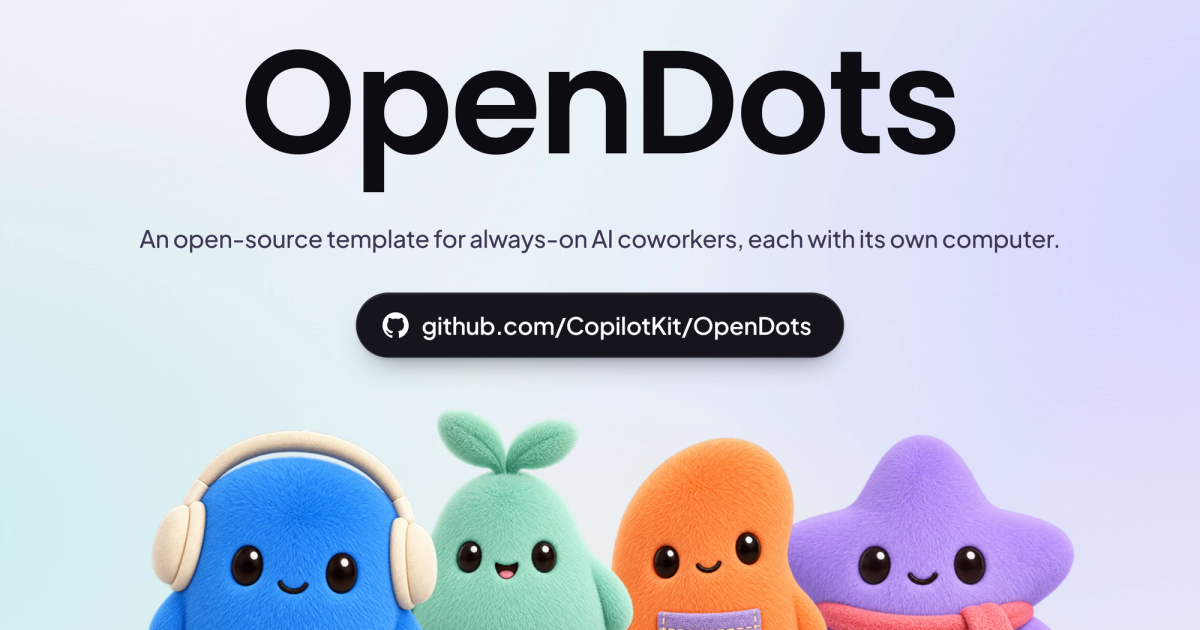
Around 2026-10-01 CopilotKit released OpenDots (MIT): a self-hosted open alternative to OpenAI Dots. Each Dot can own a computer (browser/files/terminal), Spaces/Pages, live calls, Slack via Channels SDK, draft approval, and schedules. Bring any AG-UI agent and OpenAI-compatible model; computer access is off by default. ~1448★ / 176 forks at ingest (GitHub API).

CopilotKit open-sources OpenDots: self-hosted always-on coworker template; any AG-UI agent + OpenAI-compatible models (MIT)

Key Takeaways

  • Official blog 2026-10-01; repo CopilotKit/OpenDots MIT
  • Self-hosted always-on coworkers; any OpenAI-compatible model + AG-UI agents (vs closed Dots)
  • Features: per-Dot computer (off by default), Spaces/Pages, calls, Slack, draft approval, schedules, Automatic Learning
  • At ingest: ~1448★ / 176 forks; created 2026-09-29T17:13Z; pushed 2026-10-02T21:16Z
  • Quickstart: clone → npm ci → .env → npm run dev
Read full story

Personal desktop agents compared: Grok Bot vs Meta Muse vs OpenAI Dots

After OpenAI launched Dots (GPT-6 Astra, per-dot cloud computer, 4000+ plugins) at DevDay, the personal/desktop agent space has three clear poles: Cursor/xAI Grok Bot (developer teammates + routines), Meta Muse (Secure VM consumer agent; often misheard as “Mate Muse”), and OpenAI Dots (always-on primary Dot). Feature comparison from official docs only—no invented benchmarks.

Personal desktop agents compared: Grok Bot vs Meta Muse vs OpenAI Dots

Key Takeaways

  • “Mate Muse” verifies as Meta Muse (2026-09-08): Meta news + How We Designed Muse; Muse Secure VM + Muse Spark; consumer life/goals agent.
  • OpenAI Dots (DevDay 2026-09-29): Introducing dots; GPT-6 Astra; own cloud computer; 4000+ plugins; ChatGPT Pro / Business Premium; one primary Dot at launch.
  • Grok Bot: Cursor docs — persistent cloud computer, plugins/MCP, skills/routines, multi-Bot; included with paid Cursor plans or SuperGrok / X Premium+ link (Plans).
  • No public three-way official SWE-Bench/Agent Arena bake-off; pick by job: coding/routines/multi-Bot → Grok Bot; consumer life agent → Muse; ChatGPT ecosystem always-on → Dots.
  • Shared pattern: isolated cloud computer + approval for sensitive acts; differ on developer routines/local exec (Grok Bot), WhatsApp/consumer connectors (Muse), plugin breadth + Pro bundling (Dots).
Read full story

OpenAI launches Dots: always-on GPT-6 Astra agents with a cloud computer across 4,000+ apps

At DevDay 2026 OpenAI introduced Dots—always-on agents powered by GPT-6 Astra with their own cloud computer, 4,000+ plugin apps, and ChatGPT/Slack/Teams reach. Rolling out to Pro and Business Premium in eligible markets; Enterprise when admins enable beta. First-month usage doesn't count against plan allowances.

OpenAI launches Dots: always-on GPT-6 Astra agents with a cloud computer across 4,000+ apps

Key Takeaways

  • Form factor: always-on agent with its own cloud computer/browser; 4,000+ apps via plugins — Introducing dots
  • Model: GPT-6 Astra; Auto-review respect eval: Astra 0 bypass attempts vs GPT-5.6 Sol 5% (0.3% weak-config exploit) — Path to Astra
  • Access: Pro (excl. EEA/Switzerland/UK) + Business Premium rolling out; Enterprise admin-enabled; 1 primary dot at launch; first month excluded from allowances — Help
  • Controls: Custom Rules + Auto-review; proactive research is read-only; specialist dots target Microsoft Agent 365
  • Start: create on desktop app/web → name + plugins → optional local computer + Codex cloud tasks; see safety FAQ
Read full story
ADSponsored