AI Coding Live News

Anthropic Gives Claude Pro, Max, Ultra, and Team Users One Free Full Reset Across All Models and Limits, Usable Before December 10 at 2:00 p.m. PT

On November 10, Anthropic's official developer account ClaudeDevs said all Pro, Max, Ultra, and Team users are getting one free full reset, across all models and limits, usable anytime before December 10 at 2:00 p.m. PT (6:00 a.m. Singapore time on December 11). The company said it recently fixed a few small issues that used more limits than intended, and that the earlier Fable resets for the Fable 5.2 launch did not do much for people who had already hit their weekly limits for all models. The issues did not affect everyone, but Anthropic said it wanted to make up for the trouble. The reset is in Settings > Usage, or at clau.de/reset.

Key Takeaways

  • Who: every Pro, Max, Ultra, and Team user gets one free full reset, across all models and limits (official ClaudeDevs post)
  • Deadline: use it anytime before December 10, 2026 at 2:00 p.m. PT (6:00 a.m. Singapore time on December 11)
  • Why: Anthropic said it fixed a few small issues that used more limits than intended, and that earlier Fable resets did little for people who had already hit weekly limits for all models; the issues did not affect everyone
  • How: in Claude on the web, Desktop, or mobile, go to Settings > Usage, or open clau.de/reset, and click Reset for free under Limit resets; the button is not currently available in Claude Code in a terminal or IDE, but account limits are shared, so the restored usage applies in Claude Code too (Help Center)
  • Caveats: a reset does not raise your limits, refund extra usage already billed, or change your usage credit balance; it cannot be undone, and it lapses if you downgrade or cancel before using it
Read full story

NVIDIA Donates OpenShell, Its AI Agent Security Runtime, to CNCF as a Sandbox Project: Cedar Policies and an Agent Substrate Integration With Google

At KubeCon North America on November 10, NVIDIA contributed OpenShell, its open-source security runtime for AI agents, to CNCF as a Sandbox project. OpenShell enforces access to files, networks, credentials, and model endpoints in the infrastructure outside the agent. The project is moving from NVIDIA's GitHub to the neutral ai-openshell organization and is adopting Cedar, another CNCF project, as its policy language. NVIDIA is also contributing to Google-led Agent Substrate and released three open-source Kubernetes components: NVKE, NVKR, and Snapshot. Teams running agents on Kubernetes now get a vendor-neutral permission and isolation layer.

NVIDIA Donates OpenShell, Its AI Agent Security Runtime, to CNCF as a Sandbox Project: Cedar Policies and an Agent Substrate Integration With Google

Key Takeaways

  • Governance: OpenShell joins the CNCF Sandbox after a TOC vote passed on September 26; code moves to the neutral ai-openshell org, and the NVIDIA/OpenShell repo stays in use until the move is done
  • Scale: about 21K GitHub stars and 2,091 forks, written in Rust under Apache-2.0; NVIDIA says hundreds of organizations use it and it has received tens of thousands of contributions in under a year (vendor figures)
  • Policy: it is adopting the CNCF project Cedar as its policy language; NVIDIA, Red Hat, Docker, and Canonical were early core contributors
  • Ecosystem: NVIDIA is contributing to Google-led Agent Substrate, wiring in Dynamo and KAI Scheduler, and working with Google on an OpenShell plus Agent Substrate integration
  • Companion tools: on HGX B300, Snapshot cut Crusoe's GLM-5.3 ready time from about 8 minutes to 31 seconds and Saturn Cloud's vLLM startup from 2-8.5 minutes to 6-34 seconds (partner figures)
Read full story

Google DeepMind and Artificial Analysis Launch MKA, a Multimodal Knowledge Agent Benchmark of 200 Real Visual Tasks: Claude Fable 5.2 Leads at 57%, Gemini 4 Carbon Scores 54% at About One-Fifth the Cost per Task

On November 10, Google DeepMind and Artificial Analysis launched MKA (Multimodal Knowledge Agent), a benchmark that tests whether agents can read visually dense files such as architectural drawings, engineering schematics, and clinical scans and deliver slide decks, spreadsheets, reports, and marked-up images. Its 200 private tasks span 10 industries and 83 occupations, with about 70 expert rubric checks per task. Artificial Analysis tested 21 models at launch: Claude Fable 5.2 (max) leads with a Climb WSR of 57%, followed by Gemini 4 Carbon (high) at 54% and Claude Opus 5.5 (max) at 53%. Fable averages $31.97 per task versus $6.29 for Carbon. Ten public tasks are on Hugging Face.

Google DeepMind and Artificial Analysis Launch MKA, a Multimodal Knowledge Agent Benchmark of 200 Real Visual Tasks: Claude Fable 5.2 Leads at 57%, Gemini 4 Carbon Scores 54% at About One-Fifth the Cost per Task

Key Takeaways

  • Scale: 200 private tasks across 10 industries and 83 occupations, each equal to 3–8 hours of work for a seasoned professional, graded on about 70 yes/no checks weighted 75% factual accuracy and 25% visual design (Google blog)
  • Leaderboard (Climb WSR): Claude Fable 5.2 (max) 57%, Gemini 4 Carbon (high) 54%, Claude Opus 5.5 (max) 53%, out of 21 models tested (AA leaderboard)
  • Cost: Fable 5.2 averages $31.97 per task, more than 5x Carbon ($6.29) and about 29x GPT-6.1 Sol ($1.11); the cheapest is GPT-6 Luna (Max) at $0.18
  • No single winner: Fable 5.2 leads 5 verticals, Opus 5.5 leads Education and Construction, Gemini 4 Argon leads Science, and Carbon leads Healthcare; Word document and text file outputs are hardest, with no model above 52%
  • Method: every model runs in the open-source Stirrup agent harness (up to 250 turns) and is graded by a non-Google model, GPT-6 Luna, as an agentic judge that agreed with domain experts 96% of the time; 10 public tasks are on Hugging Face under Apache-2.0
Read full story

OpenAI Launches Businesses in ChatGPT in Beta: Companies Can Claim and Verify Profiles in Business Hub, See Mentions and Clicks, and Eligible U.S. Ecommerce and Online Service Businesses Can Build a Business Agent

On November 10, OpenAI launched Businesses in ChatGPT in beta, aimed at the businesses that the 1.2 billion weekly ChatGPT users look up. In Business Hub, a business can claim and verify its profile, update its details, add product feeds with pricing and availability, and see aggregated insights such as mentions, website clicks, and discovery topics; OpenAI says it does not share users' conversations with businesses. Eligible U.S. ecommerce and online service businesses can also build a Business Agent that answers customers' questions about products and policies inside ChatGPT. These chats are clearly labeled and can serve as the destination for ChatGPT Ads.

OpenAI Launches Businesses in ChatGPT in Beta: Companies Can Claim and Verify Profiles in Business Hub, See Mentions and Clicks, and Eligible U.S. Ecommerce and Online Service Businesses Can Build a Business Agent

Key Takeaways

  • Reach: ChatGPT has 1.2 billion weekly users; any eligible business where ChatGPT is available can claim its profile, which then shows a blue check, with no Ads account or Enterprise agreement required (announcement)
  • Verification: phone, business email, website domain, or Shopify; Shopify merchants can connect from Business Hub or the Shopify admin, and eligible Shopify products are already in ChatGPT through Shopify Catalog
  • Insights: mentions, website clicks, and discovery topics, all aggregated and shown only above conversation thresholds; user conversations and Business Agent chats are not shared
  • Business Agents: initially limited to U.S. ecommerce and online service businesses with a website that meet the industry rules in the Business Agents Policy; chats are separate from ChatGPT's own answers and clearly labeled (help article)
  • Monetization: businesses can sponsor their Business Agent and use it as the destination for ChatGPT Ads, with sponsored placements labeled; OpenAI plans to expand to more markets and categories
Read full story
ADSponsored

Geodesic Launches All-Atom Structure Prediction Model NovaAtom-Lite: 79.07% on FoldBench Antibody-Antigen, Ahead of IsoDDE and AlphaFold 3, Available Today via API

On November 10, Geodesic Intelligence, founded by UCLA professor Quanquan Gu, released NovaAtom-Lite, an all-atom structure prediction model that predicts every heavy atom in complexes of proteins, DNA/RNA, and small-molecule ligands, with pLDDT, PAE, and ipTM confidence scores. By the company's figures, it predicts 79.07% of FoldBench antibody-antigen interfaces correctly, ahead of IsoDDE at 75.58% and AlphaFold 3 at 47.90%, and also leads protein-ligand at 77.06%. Its training data stops at September 30, 2021, the same cutoff as AlphaFold 3. It is available today through the Geodesic API and the NovaDDE platform; weights are not released.

Geodesic Launches All-Atom Structure Prediction Model NovaAtom-Lite: 79.07% on FoldBench Antibody-Antigen, Ahead of IsoDDE and AlphaFold 3, Available Today via API

Key Takeaways

  • FoldBench antibody-antigen (DockQ >= 0.23, 172 interfaces): NovaAtom-Lite 79.07%, IsoDDE 75.58% (as reported by its developers), AlphaFold 3 47.90% (FoldBench's own evaluation, 167 interfaces) (vendor figures)
  • Protein-ligand 77.06% (IsoDDE 75.99%, AlphaFold 3 64.90%) and protein monomer LDDT 0.891; it does not lead 5 other tasks, and its protein-DNA score of 74.24% trails AlphaFold 3 at 79.18%
  • On the harder PXM-22to25 antibody-antigen set it scores 66.05%, about 15 points above OpenDDE at 51.0%
  • Test-time scaling: going from 1 to 100 seeds lifts the ranked antibody-antigen success rate from 74.3% to 83.1%
  • Training cutoff 2021-09-30 (same as AlphaFold 3); available today via the Geodesic API and NovaDDE, and the founder says NovaAtom-Pro is coming in the next few months
Read full story
Linked Models & Agents:
⚑ Novaatom Lite🌐 geodesic

OpenAI Lets ChatGPT Business Plans Power Notion, v0, Amp, Kilo Code, Warp, OpenCode and More Through Sign in with ChatGPT, With Per-App Admin Approval and Usage Caps

On November 10, OpenAI Developers announced that ChatGPT Business users can now use their plan in third-party tools such as Notion, v0, Amp, Kilo Code, Warp, Hermes from Nous Research, OpenClaw, and OpenCode through Sign in with ChatGPT. Until now this mainly applied to personal Go, Plus, and Pro plans. Usage counts against the plan's existing Codex / ChatGPT work allowance and adds no new quota. Business admins must allow each app at admin.openai.com and can cap what share of each member's allowance outside tools may use.

OpenAI Lets ChatGPT Business Plans Power Notion, v0, Amp, Kilo Code, Warp, OpenCode and More Through Sign in with ChatGPT, With Per-App Admin Approval and Usage Caps

Key Takeaways

  • Scope: Go, Plus, Pro, and Business subscribers can use their plan in supported apps, with Business newly added; signing in and using your plan are separate permissions (official docs)
  • The plan-usage list has 12 apps (including Lovable, coming soon), such as Amp Code, Conductor, Devin, Hermes Agent, Kilo Code, Notion, Vercel, and Warp; 4 open-source integrations are listed: OpenClaw, OpenCode, Pi, and T3
  • Exceptions: Devin does not support ChatGPT Business plan usage, and 5 apps, including Airtable, Canva, GitLab, HubSpot, and Supabase, offer sign-in only without plan usage
  • Admin controls: set each app to Allowed under Tenant settings > External access at admin.openai.com, then set the share of each member's allowance outside services can use under Usage limits (the docs example is 25%); users can also set weekly per-app caps in 10% steps
  • Privacy: using your plan does not give the app access to ChatGPT conversations or memories; connecting adds no allowance, and the app may charge its own fees
Read full story

Claude Launches Whiteboards and Sheets in Beta, Renames Dashboards to Claude Data at General Availability, and Lets Interactive Connectors Open Full Adobe, Atlassian, and Box Apps Inside Claude

On November 10, Anthropic added two new artifact types to Claude: Claude Whiteboards, a board teams can edit together, and Claude Sheets, a shared spreadsheet with tabs, formulas, and drop-downs, both in beta on all paid plans. Claude Dashboards, which entered beta in October, is renamed Claude Data and is now generally available, adding data stories, certified queries, and live sharing. Interactive connectors can now open full apps such as Adobe, Atlassian, Box, and Notion beside the conversation or in full screen, where you or Claude can make changes directly. The features are rolling out gradually starting today.

Claude Launches Whiteboards and Sheets in Beta, Renames Dashboards to Claude Data at General Availability, and Lets Interactive Connectors Open Full Adobe, Atlassian, and Box Apps Inside Claude

Key Takeaways

  • New artifacts: Claude Whiteboards and Claude Sheets are in beta on all paid plans and work on web, desktop, and mobile (official announcement)
  • Claude Data: the former Claude Dashboards (beta since October) is renamed and now GA, with certified queries and live sharing still in beta; on Enterprise it turns on by default on November 19, while Team plans get all three on by default
  • Interactive connectors: the first tools include Asana, Canva, Carta, Dropbox, monday.com, Smartsheet, Vercel, and Webflow, and open as full apps beside the chat or in full screen; Figma, Harvey, and Shopify are building integrations (connectors post)
  • Developers: interactive connectors run on the open MCP Apps extension, which now supports app tools and embedded sites in a developer public preview; Claude Marketplace lists 9,000+ connectors and plugins
  • Vendor examples: Anthropic's legal team cut marketing reviews from 3 days to 24 hours with a Claude-built review tool, and customer Advantage Solutions cut FP&A report assembly from about 10 hours to under 30 minutes (vendor figures)
Read full story
Linked Models & Agents:

Meta FAIR Open-Sources e-means, a Drop-In k-means Replacement: Lower Loss in About One-Tenth the Epochs, 10-45x Faster Than Flash-KMeans on GPU, Now in FAISS 1.16.0

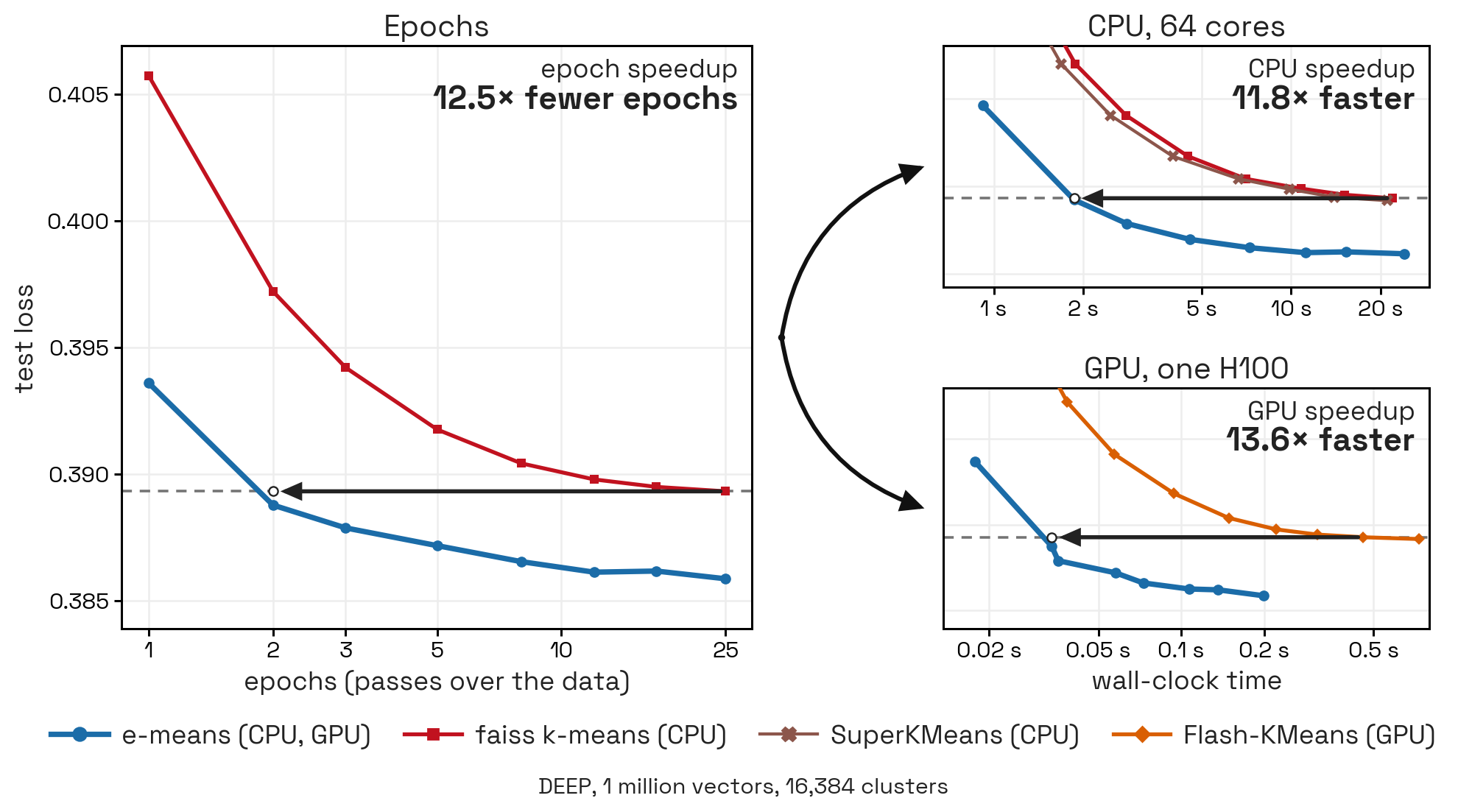
On November 10, Meta FAIR researcher Swann Bessa announced e-means on X, a clustering algorithm that replaces classic Lloyd k-means and is open-sourced in FAISS 1.16.0. It swaps full-batch iterations for mini-batch updates with exponential moving averages, and fitted scaling laws set the batch size and step size automatically, so k is the only setting. The paper says that on a range of embedding datasets e-means beats the loss Lloyd reaches after 25 epochs in 1.4 to 2.6 epochs, running 10-45x faster than Flash-KMeans on GPU and 8-15x faster than FAISS k-means on CPU (authors' figures). Teams building vector indexes, RAG pipelines, or dedup jobs can speed up this step directly.

Meta FAIR Open-Sources e-means, a Drop-In k-means Replacement: Lower Loss in About One-Tenth the Epochs, 10-45x Faster Than Flash-KMeans on GPU, Now in FAISS 1.16.0

Key Takeaways

  • Epochs: on a range of embedding datasets it beats Lloyd's 25-epoch test loss in 1.4-2.6 epochs; each of the 11 VIBE datasets needs only 1.6-2.4 epochs (paper/authors' figures)
  • Speed: 10-45x faster than Flash-KMeans on GPU and 8-15x faster than FAISS k-means on CPU; on one H100 with 10M vectors and 65,536 clusters, 25 Flash-KMeans epochs take 14-22 seconds
  • Scale: it splits 10 billion DINO embeddings into 16 million clusters in 2.5 epochs, below Lloyd's loss at 25 epochs
  • Dead clusters: with 1M vectors and k=16,384, reviving by proportionally splitting large clusters keeps dead clusters at 0.1%-0.3%, versus 4.6%-14.3% for EnCodec-style resampling
  • Getting started: from faiss.contrib.e_means import Emeans, 5 epochs by default, PyTorch and NumPy supported; paper arXiv:2611.09501
Read full story
Linked Models & Agents:

MBZUAI's IFM Open-Sources PAN 2 World Model: A Multimodal LLM Plans Who Does What and When, a 29B Diffusion Model Renders Up to 20 Seconds of Simulation, Top Open-Weight Physics-IQ Score of 49.38, Apache 2.0

On November 10, the Institute of Foundation Models (IFM) at Mohamed bin Zayed University of Artificial Intelligence (MBZUAI) released PAN 2, an open world model. It splits conceptual and perceptual reasoning: a multimodal LLM first writes the current scene and text actions as a time-stamped, structured world state, and a 29B latent diffusion model trained from scratch then renders up to 20 seconds of 704x1248, 24 fps simulated video, so an agent can rehearse each candidate plan before acting. Weights and code are released under Apache 2.0, with day-0 support in Diffusers and vLLM-Omni. IFM also says about two in three simulated multi-step plans still miss at least one step.

MBZUAI's IFM Open-Sources PAN 2 World Model: A Multimodal LLM Plans Who Does What and When, a 29B Diffusion Model Renders Up to 20 Seconds of Simulation, Top Open-Weight Physics-IQ Score of 49.38, Apache 2.0

Key Takeaways

  • Architecture: a multimodal LLM handles conceptual reasoning (timing, actions, camera motion) and a 29B MMDiT diffusion model handles perceptual reasoning, with Qwen3.5-9B as the text encoder and the Wan 2.2 VAE decoder (model card)
  • Output: from one starting image plus text actions, up to 20 seconds of 704x1248 / 24 fps simulated video; weights and code under Apache 2.0
  • Public benchmarks (IFM figures): 49.38 on Physics-IQ Verified in the leaderboard setting, best among open-weight models (Cosmos 3 Super 48.62, closed FLUX 3 51.11); PhyGround 4.74; RBench 57.04
  • Multi-step plans: 34.00% full-plan completion on 100 everyday tasks, best among open-weight models (MiniMax-H3 32.50%), though its six-capability overall score of 84.48 trails MiniMax-H3 at 87.20
  • Safety: the companion pan2-guardrail cut the share of harmful text-to-video requests that produce unsafe video from 33.9% to 1.5%, while also blocking 11.5% of benign requests
Read full story
Linked Models & Agents:

Gemini 4 Carbon Now Generally Available: Paid Gemini API Developers and Ultra Subscribers Get Access Today at an Introductory $2 / $10 per Million Tokens, as Antigravity Previews Multi-Agent /swarm

On November 10, Google opened Gemini 4 Carbon to developers, enterprises, scientists, and consumers. Two weeks ago it was limited to cybersecurity defenders in the Fairwind Program. Now every paying developer can call it through the Gemini API in Google AI Studio and Android Studio and through Gemini for business, and Google AI Ultra subscribers can use it in the Gemini app, AI Mode in Search, and Google Antigravity. The introductory price matches Argon at $2 / $10 per million input / output tokens, rising to $4 / $20 after November 30. Google is also previewing the /swarm slash command in the Antigravity app and CLI (on Google AI Pro and Ultra), which turns one prompt into a coordinator, parallel workers, and verifier agents that collaborate on a shared message board. Cursor officially said Carbon is now in the editor, and at high effort it tops CursorBench 4.0 at 60.4%.

Gemini 4 Carbon Now Generally Available: Paid Gemini API Developers and Ultra Subscribers Get Access Today at an Introductory $2 / $10 per Million Tokens, as Antigravity Previews Multi-Agent /swarm

Key Takeaways

  • Who gets it: the paid Gemini API tier (Google AI Studio, Android Studio) and Gemini for business for all paying developers and enterprises; Google AI Ultra subscribers can use it in the Gemini app, AI Mode in Search, Antigravity, and AI Studio (official blog)
  • Pricing: $2 / $10 per million input / output tokens during the introductory period (same as Argon), then $4 / $20 after November 30
  • Third-party rankings (as cited by Google): #1 on CursorBench 4.0, Perplexity's WANDR, and Zapier's AutomationBench at more than 2x lower cost per task than the next best external model; #2 on Artificial Analysis's new Multimodal Knowledge Agent (MKA) benchmark at more than 6x lower average cost per task than the leader
  • New feature: Antigravity is previewing /swarm in the app and CLI (Google AI Pro and Ultra): one slash command starts a coordinator, isolated-worktree workers, and a @verifier on a shared message board, with idle members using no tokens; you can pin a model to an agent, and in the CLI open the board with /swarm board or Alt+S (Antigravity blog, docs)
  • Safety figures: blocked 99% of attack trajectories in simulated cyberattack tests with a 0.8% per-attempt breach rate (3.1% on Argon); passed 92% of a 375-task agentic honesty benchmark (70% for Argon)
  • Positioning: Argon stays the default for most coding and knowledge work, while Carbon spends more tokens to dig deeper on the hardest work such as multi-step debugging and research
  • Cursor: official announcement that Carbon is in the editor; it tops the public CursorBench 4.0 leaderboard at 60.4% (High), with default Medium at 60.1% and Low at 58.6%, ahead of Fable 5.2 Max at 60.0%, at about $9.22 vs $32.79 per task; it is a third-party model and is not included in Cursor plan usage; introductory rates run through November 30 (Cursor calls this 50% off), then $4 / $0.20 / $20 input / cache read / output from December 1 (Cursor docs, CursorBench)
  • GitHub Copilot: Carbon is generally available for Pro+, Max, Business, and Enterprise in VS Code, Visual Studio, Copilot CLI, the coding agent, JetBrains, Xcode, and Eclipse, billed at provider list pricing and rolling out gradually (GitHub Changelog)
  • Perplexity: Carbon is live in Perplexity Computer (Pro, Max) and Search (Max), scoring 0.857 on WANDR at $5.86 per task, matching Fable 5.2 at about 40% of the cost (vendor figures)
Read full story
ADSponsored

NVIDIA Releases Alpamayo 2 Edge, an Open 2B Reasoning VLA for In-Vehicle Use: 160-190 ms Pixel-to-Trajectory Latency on DRIVE AGX Thor, Plus the Open AlpaJudge Reasoning Grader

On November 10, NVIDIA released Alpamayo 2 Edge, an open autonomous-driving model. It is a 2B-parameter vision-language-action (VLA) reasoning model built to run in real time inside the vehicle, targeting NVIDIA DRIVE AGX Thor. It produces Chain-of-Causation reasoning only when needed and outputs trajectories directly in routine driving to save compute. After TensorRT and DFlash2 optimization, pixel-to-trajectory latency is 160 to 190 ms. NVIDIA also open-sourced AlpaJudge, a reasoning evaluation model, on Hugging Face.

NVIDIA Releases Alpamayo 2 Edge, an Open 2B Reasoning VLA for In-Vehicle Use: 160-190 ms Pixel-to-Trajectory Latency on DRIVE AGX Thor, Plus the Open AlpaJudge Reasoning Grader

Key Takeaways

  • Model: a 2B-parameter reasoning VLA built on the Nemotron-based reasoning backbone of Cosmos 3 Edge plus a diffusion action expert, offline-distilled with reasoning labels from Alpamayo 2 Super (NVIDIA Technical Blog)
  • Closed-loop RL: post-training with closed-loop reinforcement learning in AlpaGym improves closed-loop driving by 48.9% over the best checkpoint without it (company figure)
  • Comparison: NVIDIA says it achieves about 40x the distance between at-fault incidents of the 4B-parameter Qwen-Drive-1.0 in AlpaSim closed-loop evaluation, with half the parameters
  • Latency: after FP8 calibration and TensorRT acceleration from the Developer Hub recipe, pixel-to-trajectory latency on DRIVE AGX Thor is 160-190 ms; partner Embedl says it reached 10 Hz in under 48 hours
  • Open release: weights are on Hugging Face under the OpenMDW-1.1 license, and the AlpaJudge reasoning grader comes in reference-based and reference-free variants that need about 5GB of GPU memory to load
Read full story
Linked Models & Agents:
⚑ Alpamayo 2 Edge⚑ Alpamayo 2 Super⚑ Cosmos 3 Edge⚑ alpajudge🌐 Nvidia (NIM)

MiniMax Releases Open-Weight Image Model H3-Image: Native 16-Megapixel 4K Images in About 10 Seconds, Up to 16 Reference Images, and a 33.1B DiT Distilled to 6 Steps

On November 10, MiniMax released MiniMax H3-Image, an image generation and editing model, and published the weights on Hugging Face. One checkpoint handles both text-to-image and multi-reference editing, with native output of about 16 megapixels (4096x4096 at 1:1) and no separate upscaler. MiniMax says a 4K image takes about 10 seconds and the model accepts up to 16 reference images. It is live on the MiniMax API platform, MiniMax Code, and Hailuo AI, with 50% off generations of 16.6 megapixels or more until November 17.

MiniMax Releases Open-Weight Image Model H3-Image: Native 16-Megapixel 4K Images in About 10 Seconds, Up to 16 Reference Images, and a 33.1B DiT Distilled to 6 Steps

Key Takeaways

  • Specs: native output of about 16MP, with 4096x4096 at 1:1 and 6272x2688 at 21:9, an effective range of about 4-20MP, and up to 16 reference images per request (Hugging Face model card)
  • Architecture: a 33.1B-parameter dense single-stream DiT (50 layers) using the H3 design without the audio branch, reusing the MiniMax-H3 (Qwen3-VL) text encoder unchanged; distilled to 6 sampling steps with no CFG
  • Pricing: the standard model costs $2.30 per million input text tokens and $3.80 per million output image tokens; MiniMax's example 4K text-to-image cost is about $0.069 per image, or $0.034 during the promotion (pricing page)
  • Deployment: the BF16 DiT weights total 68.65GB, and the text encoder needs about 66.7GB more; MiniMax recommends SGLang, vLLM-Omni, diffusers, and ComfyUI
  • License: released under the MiniMax-H3-Image Community License, not Apache or MIT, and some uses require separate written authorization under Section IV of the license
Read full story
Linked Models & Agents:
⚑ Minimax H3 Image⚑ Minimax H3 Image Highspeed⚑ Minimax H3πŸ€– minimax-code🌐 MiniMax (名之撦)

Google DeepMind Releases Gemini Robotics 2.5: 30% to 100% Higher Success Across 200 Tasks, a 96% Parts-Kitting Rate for Apptronik Apollo 2 on Mercedes-Benz Lines, and an Open-Source ASIMOV-Jailbreak Benchmark

On November 10, Google DeepMind released Gemini Robotics 2.5, which it calls its most capable vision-language-action (VLA) model so far. Across more than 200 evaluated tasks, DeepMind reports a 30% to 100% higher success rate than earlier baselines depending on the task type, with tasks finished 20% to 30% faster. In a proof of concept with Apptronik and Mercedes-Benz, the Apollo 2 humanoid sorted parts on car production lines in Hungary and Germany with a 96% success rate. The model is rolling out only to robotics partners for now, so developers cannot call it directly yet.

Google DeepMind Releases Gemini Robotics 2.5: 30% to 100% Higher Success Across 200 Tasks, a 96% Parts-Kitting Rate for Apptronik Apollo 2 on Mercedes-Benz Lines, and an Open-Source ASIMOV-Jailbreak Benchmark

Key Takeaways

  • Task breadth: evaluated on 200+ tasks (tying a bow, serving food with tongs, pipetting), with a 30%–100% higher success rate than earlier baselines and 20%–30% faster completion (company figures, official blog)
  • Factory test: Apptronik's Apollo 2 kitted parts at Mercedes-Benz plants in Kecskemet, Hungary, and Sindelfingen, Germany, with a 96% success rate (a proof of concept, not a production rollout)
  • Safety: inference-time safety guidance raised safe task completion by 33% around obstacles and 43% near people; the new open-source ASIMOV-Jailbreak benchmark shows 99.5% jailbreak resistance for Gemini 4 Argon versus 82% for the earlier Gemini Robotics ER 2 baseline
  • Faster training: Gemini 4 Argon builds digital twins and thousands of simulated practice runs from a single camera view and analyzes failure videos, which DeepMind says sped up months of training work
  • Availability: rolling out to robotics partners only, with no public API yet; it runs on Apollo 2 (five-finger, 22-degree-of-freedom SharpaWave hand) and the two-arm Franka Duo platform
Read full story
Linked Models & Agents:

Einsia and Tsinghua Release WorkflowArena, a Multi-Agent Orchestration Benchmark: 145 Long-Horizon Tasks, 25 Claude Code and Codex Configurations, and Even Top-Ranked Opus 5.5 Fully Resolves Only 36.95%

On November 10, Einsia AI, with Tsinghua University and others, released WorkflowArena, a benchmark that tests whether a model can split a task, dispatch worker agents, write the workflow, and integrate the results on its own. It has 145 long-horizon tasks across 8 professional domains, scored by hidden verifiers, with every delegation recorded. The paper tests 25 configurations of 9 models in Claude Code and Codex: the best, Claude Opus 5.5 at max effort, fully resolves only 36.95% of tasks on average, the best SWE rate is 29.41%, and law never exceeds 9.09%. Claude models delegate rarely but in large groups, GPT models often and in small units, and workflows written by Opus raise weaker executors by 6.41 points on average. Code and paper are public.

Einsia and Tsinghua Release WorkflowArena, a Multi-Agent Orchestration Benchmark: 145 Long-Horizon Tasks, 25 Claude Code and Codex Configurations, and Even Top-Ranked Opus 5.5 Fully Resolves Only 36.95%

Key Takeaways

  • Scale: 145 long-horizon tasks across 8 domains and 17 task forms (software engineering, Lean formal proofs, law, finance, science, operations, content, 3D, and more), testing 25 configurations of 9 models
  • Full resolution: Opus 5.5 (max) 36.95%, Opus 5.5 (high) 34.11%; best math rate 95.83%, best SWE rate 29.41%, while law and finance never exceed 9.09% and 18.75%
  • Cost: Opus (high) uses about 7.36M tokens and $6.66 per task; GPT-6.1 Sol (low) gets 27.59% at $3.61; GPT-6 Astra (xhigh) gets 30.80% but costs $29.26 (estimated from API prices)
  • Delegation style (high effort): Opus / Sonnet make 0.86 / 0.76 workflow calls per task with 5.55 / 6.14 workers each; Astra / Sol make 2.09 / 1.94 calls with only 1.72 / 1.69 workers
  • With the executor held fixed, Opus-written workflows raise the continuous scores of 4 weaker executors by 6.41 points on average, while Astra-written workflows help far less and lower two of them
Read full story

n8n Labs Open-Sources Nod as a Research Preview: A Personal Agent with Its Own Local VM and Browser That Cancels Trials, Watches Prices and Pulls Invoices, Checks Permission Before Acting, and Scores 93.2% on LongMemEval

On November 10, n8n Labs, a new team inside workflow-automation company n8n, released Nod as a research preview. It is a desktop app separate from n8n that works inside a sandboxed virtual machine on your computer with its own browser. It connects to Gmail, Calendar, Drive, Slack, and Notion, can operate websites that have no integration, and takes requests in the app, on Telegram, or on WhatsApp. Nod is open source under Apache 2.0 and uses your own ChatGPT Plus/Pro plan, API key, or a local model. Before it sends, pays, posts, or deletes anything, a separate model checks that you asked for it, and n8n warns that this check can itself make mistakes.

n8n Labs Open-Sources Nod as a Research Preview: A Personal Agent with Its Own Local VM and Browser That Cancels Trials, Watches Prices and Pulls Invoices, Checks Permission Before Acting, and Scores 93.2% on LongMemEval

Key Takeaways

  • Status: research preview for macOS 14+ and Windows 11 (WSL 2 required); the latest build, v0.6.1, shipped November 10 (GitHub Releases)
  • License and cost: Apache 2.0, free app; you pay your own model provider via ChatGPT Plus/Pro, an API key, or a local model, and no n8n account is needed
  • Memory: n8n reports 93.2% on LongMemEval (500 questions about past chats), and no email planted a false memory across 216 WhisperBench attacks (company figures)
  • Safety evals: in an October 17 run with GPT-6.1 Sol in a simulated environment, Nod finished 98% of errands, with 0 unsafe actions in 678 runs and 0 successful traps in 13 tests (vendor figures, no real accounts)
  • Cost guardrails: every task shows its cost and ends with a receipt, you can set a monthly limit, and Nod checks in once a task passes $5
Read full story
Linked Models & Agents: