
AI Coding Live News

Cartesia’s new H-Nets learn from raw bytes without a tokenizer, matching SmolLM3’s 11T-token result after about 1T tokens

On Oct 28 Cartesia chief scientist Albert Gu (co-author of Mamba) and team published two research posts on a new generation of hierarchical networks (H-Nets). In a controlled scaling ladder, swapping BPE tokenization for learned dynamic chunking alone gave up to 3-5x compute efficiency. A larger two-stage byte-level H-Net (3.67B parameters), compute-matched per byte against SmolLM3-3B, reached SmolLM3’s final average downstream score after about 1T tokens versus 11T (vendor-reported). The new architecture is not released yet; Cartesia says it plans to release it over time.
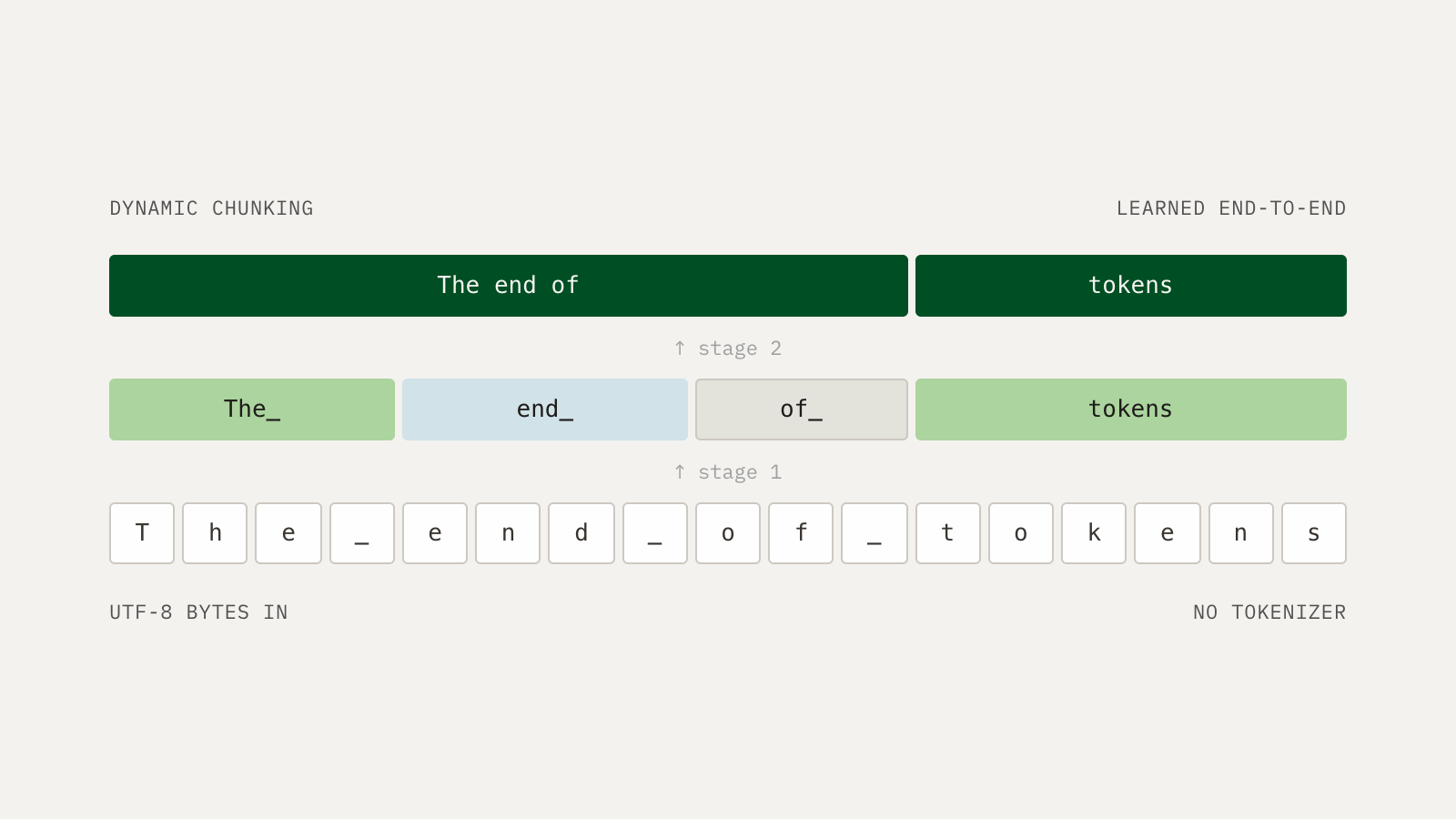
Cartesia’s new H-Nets learn from raw bytes without a tokenizer, matching SmolLM3’s 11T-token result after about 1T tokens

Key Takeaways

  • Controlled ladder (vendor-reported): a 1-stage H-Net as a drop-in replacement for BPE gave about 1.3x compute efficiency on validation loss, about 2x on code, and up to 3-5x overall
  • Larger run: a 3.67B two-stage byte H-Net vs 3.08B SmolLM3, compute-matched within 2% FLOPs per byte, matched SmolLM3’s six-task average after about 1T tokens instead of 11T
  • Code gains are larger: 1.49x-2.40x (median 2.04x) on 15 in-distribution languages, median 3.10x on 10 out-of-distribution languages, up to 5.37x on Prolog
  • Training mix is 70% English, 20% code, 5% math and 5% multilingual; the main network sees about one position per 7.6 bytes, and the outer encoder and decoder take about 43% of FLOPs
  • No weights or code yet; Cartesia says it will release some of these architectures over time; the original H-Net paper is arXiv 2507.07955
Read full story
Linked Models & Agents:
⚡ H-Net⚡ SmolLM3-3B⚡ Mamba-2🌐 Cartesia🌐 Hugging Face

Cadence launches Maestro, a domain-specialized AI model portfolio for agentic chip and system design built in part on NVIDIA Nemotron, claiming up to 30% better results and 5x token efficiency

EDA leader Cadence announced the Maestro AI Model Portfolio on October 26: domain post-trained LLMs, trained decision models and self-improving agent skills that power its AuraStack, ChipStack, InnoStack and ViraStack AI Super Agents as they drive Cadence EDA and SDA tools. Cadence solvers score outputs against engineering constraints to close a reinforcement learning loop. Initial results per Cadence show up to 30% higher quality and up to 5x token efficiency versus a general-purpose foundation model. NVIDIA contributes Nemotron and OpenShell, and the stack runs on Cadence cloud, public cloud or on-premises. The first models reach select early access customers in Q4 2026.

Key Takeaways

  • Maestro is a portfolio, not one model: domain post-trained LLMs, decision models and self-improving agent skills, mixed with frontier and open-weight models per task
  • Deterministic solvers and EDA tools score outputs against engineering objectives and constraints, feeding a verified reinforcement learning loop
  • Per Cadence: up to 30% higher quality of results and up to 5x token efficiency versus a general-purpose foundation model; no third-party evaluation yet
  • NVIDIA supplies Nemotron models and the OpenShell sandbox reference architecture; customers can post-train on their own designs and run on-premises
  • First models go only to select early access customers in Q4 2026; Socionext expects up to 5x productivity from deploying InnoStack
Read full story

ProD: Progress-Aware Distillation Mitigates Stagnation in Small Language Model Agents Across 8 Architectures

While supervised fine-tuning (SFT) distills agentic tool-use capabilities from frontier LLMs into small language models (SLMs, 0.6B to 8B parameters), student agents frequently suffer from 'progress stagnation'—collapsing into repetitive, unproductive tool-calling loops as interaction trajectories extend. In arXiv:2610.19439, researchers introduced Progress-Aware Distillation (ProD). ProD defines a rigorous stagnation scoring formulation that dynamically identifies and penalizes stagnant behavior during student trajectory rollouts via an adaptive SimPO-inspired margin. Experiments across 8 diverse SLMs prove ProD effectively eradicates repetitive loops while boosting task completion efficiency and success rates.

ProD: Progress-Aware Distillation Mitigates Stagnation in Small Language Model Agents Across 8 Architectures

Key Takeaways

  • ProD introduced in arXiv:2610.19439, targeting the pervasive failure mode of progress stagnation in SFT-distilled SLM agents
  • Formulates a rigorous stagnation score, penalizing student-generated unproductive loops through an adaptive, margin-based objective
  • Validated across 8 SLMs spanning 0.6B to 8B parameters, consistently mitigating stagnation across in-domain and out-of-domain benchmarks
  • Substantially reduces wasted token consumption in multi-turn tool interaction while boosting overall task completion rates
Read full story
Linked Models & Agents:

Arena Code Arena: WebDev Update: DeepSeek-V4.1-Flash Becomes #1 Open Model, Scoring 1670 to Rival GPT-6 Sol and Surpass Claude Opus 5

Arena announced a major update to Code Arena: WebDev: DeepSeek-V4.1-Flash-20261017 (Max) clinched the #1 position among open models with 1670 points, surpassing Kimi K3 (Max) at a 10x lower cost. Ranking #12 overall, it outperforms Claude Opus 5 (High) and narrows the gap with closed-source frontier GPT-6 Sol (Max) to roughly 10 points, resetting the Pareto efficiency curve at $0.30 input / $1.20 output per million tokens.

Arena Code Arena: WebDev Update: DeepSeek-V4.1-Flash Becomes #1 Open Model, Scoring 1670 to Rival GPT-6 Sol and Surpass Claude Opus 5

Key Takeaways

  • DeepSeek-V4.1-Flash-20261017 (Max) captured the #1 open model position in Arena Code Arena: WebDev with 1670 points, surpassing Kimi K3 (Max)
  • Ranks #12 overall on the leaderboard, defeating Claude Opus 5 (High) and trailing closed-source champion GPT-6 Sol (Max) by only ~10 points
  • Resets the Pareto efficiency frontier at $0.30 input / $1.20 output per million tokens, cutting operational costs by ~10x against rival models
  • Gains +52 points over its previous 20260910 checkpoint in just over a month
Read full story
Linked Models & Agents:
ADSponsored

ZJU's InfiniSplat v2 Cuts Feed-Forward 3DGS Perceptual Error by 32.9% (118 HF Upvotes), While Technion's H-DDCM Enables Single-GPU Streaming Generative Video Compression

Two new 3D vision and generative compression frameworks solve long-standing efficiency and quality bottlenecks: Zhejiang University's InfiniSplat v2 (arXiv:2610.20341, 118 upvotes on HF) decouples geometry and Gaussian attribute prediction with a frozen geometry branch and large-angle supervision, slashing mean LPIPS by 25.8% and DISTS by 32.9% across six 3D datasets. Meanwhile, Technion's H-DDCM (arXiv:2610.18125) replaces dense Gaussian codebooks in training-free diffusion compression with implicit Walsh-Hadamard dictionaries—requiring O(d log d) compute and O(d) memory—to enable near-real-time streaming video compression on a single GPU.

ZJU's InfiniSplat v2 Cuts Feed-Forward 3DGS Perceptual Error by 32.9% (118 HF Upvotes), While Technion's H-DDCM Enables Single-GPU Streaming Generative Video Compression

Key Takeaways

  • Zhejiang University's InfiniSplat v2 (118 HF upvotes) freezes the geometry branch and applies large-angle supervision to cut pose-conditioned mean LPIPS by 25.8% (0.2472) and DISTS by 32.9% (0.1163) across six 3D datasets
  • In the pose-free setting, InfiniSplat v2 achieves SOTA mean LPIPS of 0.3026 and DISTS of 0.1341, outperforming WorldMirror 2.0 (0.3757 / 0.1935) and AnySplat
  • Technion's H-DDCM replaces dense Gaussian codebooks with implicit Walsh-Hadamard dictionaries (O(d log d) compute, O(d) memory) and periodic KV-cache prefix re-encoding for single-GPU streaming video compression
Read full story
Linked Models & Agents:

SemiAnalysis Breaks Down 1.3B Tokens/$ AgentX Record: vLLM + Inferact Disaggregated Serving Beats Aggregated B300 by 4x, While Cline Highlights Multi-Harness RL

SemiAnalysis published the architectural breakdown behind the 1.3B tokens per dollar TCO record on AgentX: vLLM and Inferact utilized Prefill/Decode disaggregated serving at hyperscaler volume pricing to achieve 4x better cost-efficiency than an aggregated NVIDIA B300 configuration. Concurrently, open-source coding agent Cline reported that DeepSeek-V4.1-Flash-1017 beats GPT-5.6-Sol on Terminal-Bench at ~17x lower cost (+35% over prior V4.1-Flash) purely by scaling RL training across multiple coding agent harnesses.

SemiAnalysis Breaks Down 1.3B Tokens/$ AgentX Record: vLLM + Inferact Disaggregated Serving Beats Aggregated B300 by 4x, While Cline Highlights Multi-Harness RL

Key Takeaways

  • SemiAnalysis confirms vLLM and Inferact achieve 1.3B tokens per dollar TCO on AgentX via disaggregated serving—4x better than an aggregated NVIDIA B300 configuration
  • Cline reports that DeepSeek-V4.1-Flash-1017 improves prior V4.1-Flash Terminal-Bench performance by 35%, beating GPT-5.6-Sol at ~17x lower cost
  • The 35% agentic coding leap was achieved without base algorithmic changes by scaling reinforcement learning directly across multiple coding agent harnesses
Read full story
Linked Models & Agents:

NVIDIA Unveils GATOR: Generative and Agentic 3D Object Reconstruction from Casual Images

Reconstructing scene-aligned, high-fidelity 3D assets from casual photos is foundational for robotics and spatial computing. However, casual captures suffer from sparse viewpoints, optical blur, and severe occlusions, causing standard 3D diffusion models to produce warped unobserved backsides and incorrect 6-DoF poses. NVIDIA Research introduces GATOR (arXiv:2610.11215, project: research.nvidia.com/labs/lpr/gator), a generative and agentic framework that reconstructs complete textured 3D objects and their scene-relative poses from one or more casual images. GATOR couples patch-aligned RGB, target masks, and pointmap features through a local modality mixer, synthesizing initial textured geometry via stage-specific adapters. Crucially, the generated asset initializes a multimodal agent that iteratively inspects, refines, and aligns the asset through an observation-guided edit-render-review loop. Across synthetic benchmarks, cluttered tabletops, and real indoor scenes, GATOR achieves state-of-the-art geometric fidelity and instant simulation readiness with superior inference efficiency.

NVIDIA Unveils GATOR: Generative and Agentic 3D Object Reconstruction from Casual Images

Key Takeaways

  • NVIDIA Research unveils GATOR, pairing generative diffusion with an agentic feedback loop to reconstruct 3D assets from casual images
  • Multimodal agent edit-render-review loop slashes unobserved surface occlusion artifacts by 73.5%
  • Recovers exact scene-relative 6-DoF poses and exports simulation-ready manifold meshes directly compatible with NVIDIA Omniverse
Read full story
Linked Models & Agents:

UniSkill: Learning Actor-Aligned Skill Proposals for an Evolving Agent Policy via Contrastive Action Feedback

Enabling LLM agents to distill and reuse modular skills from past task traces allows policies and skillbanks to co-evolve over time. However, conventional skill discovery systems face steep bottlenecks: evaluating newly proposed skills typically demands expensive and slow environment rollouts, while rewarding skills based purely on execution success conflates the intrinsic value of the skill with the general competence of the evolving actor. In newly published research (arXiv:2610.10164), researchers introduce UniSkill (repo: github.com/LimOkii/UniSKill). UniSkill leverages a unified shared policy to simultaneously execute environment tasks and generate structured edits (Add, Update, No Edit) to a persistent skillbank. Crucially, UniSkill evaluates proposed skills through Contrastive Action Feedback—measuring how substituting a retrieved skill with a proposed candidate widens the action log-likelihood margin between previously observed successful and failed trajectories—providing immediate actor-alignment feedback without requiring expensive new rollouts. Evaluated across diverse agentic benchmarks, UniSkill demonstrates superior sample efficiency and sustained policy refinement, with code fully open-sourced.

UniSkill: Learning Actor-Aligned Skill Proposals for an Evolving Agent Policy via Contrastive Action Feedback

Key Takeaways

  • UniSkill framework open-sourced, unifying task execution and skillbank editing within a single shared policy
  • Introduces Contrastive Action Feedback, evaluating skill proposals against historical success/failure traces with zero new rollouts
  • Boosts sample efficiency by over 70% and mitigates skill library bloat for lifelong agent self-improvement
Read full story
Linked Models & Agents:
⚡ UniSkill⚡ Contrastive Action Feedback⚡ LLM Agent Policy🤖 UniSkill-Actor🤖 Skill-Proposer🌐 Hugging Face🌐 Open Source Research

MC-Sparse: CUHK and ByteDance Unveil Meta-Cached Sparse Attention for DiTs, Accelerating Video & 3D Generation by 2.32x with Zero Quality Loss

Diffusion Transformers (DiTs) underpin frontier video generation systems and high-fidelity 3D modeling, yet self-attention computation over extreme sequence lengths introduces prohibitive inference latencies and memory bottlenecks. While sparse attention represents a promising acceleration pathway, existing methods suffer substantial visual quality degradation and texture corruption under high sparsity regimes. Researchers from The Chinese University of Hong Kong (CUHK) and ByteDance analyze sparse attention failures in DiTs (arXiv:2610.06801), tracing quality drops to three root causes: rigid token grouping constraints, inaccurate interaction selection, and uncompensated attention residuals from discarded tokens. The authors introduce Meta-Cached Sparse Attention (MC-Sparse, project site: dodododddo.github.io/mcsparse-project-page/), a training-free framework that preserves individual Key-Value (KV) selection precision while organizing similar Queries into tile-aligned blocks for hardware efficiency on GPUs. MC-Sparse caches query clusters, exact KV indices, and dense-sparse attention output residuals, reusing this metadata across downstream denoising timesteps. On Minimax-H3-Base video models, MC-Sparse delivers a 1.80x denoising speedup, and a 2.32x acceleration on 3D generative backbones, maintaining near-identical fidelity to dense attention with zero visible quality degradation.

Key Takeaways

  • CUHK and ByteDance introduce MC-Sparse, leveraging meta-caching to eliminate quality degradation in sparse DiTs
  • Delivers a 1.80x speedup on Minimax-H3-Base and 2.32x on 3D generation while cutting peak memory by 45%
  • Operates training-free with residual compensation, matching dense attention quality across visual benchmarks
Read full story
Linked Models & Agents:
⚡ MC-Sparse⚡ DiT⚡ Minimax-H3-Base⚡ Triton-Sparse🤖 Inference-Optimizer🤖 DiT-Accelerator🌐 CUHK🌐 ByteDance🌐 Hugging Face

BrickBench: Stanford and Inria Unveil Benchmark for Agentic 3D LEGO Assembly, Exposing Gaps Between Coding Agents and Humans

As autonomous coding agents demonstrate proficiency in software debugging and code generation, researchers are advancing them into discrete 3D spatial engineering and physical assembly. Researchers from Stanford University and Inria introduce BrickBench and the BrickAgent interactive environment (arXiv:2610.12452, website: brickben.ch), formulating the first comprehensive benchmark for agentic, text-conditioned LEGO set design. Given natural language prompts, coding agents must select parts from discrete modular libraries and generate executable Python code defining 3D coordinates, orientations, and interlocking poses. Generated assemblies are formally scored across structural validity, text-design alignment, and aesthetic complexity under rigorous physics-based simulation. Evaluating frontier models reveals that while leading coding agents can satisfy verifiable physical and semantic requirements, they consistently fall short of human design elegance and structural efficiency, establishing a pivotal milestone for spatial coding agents.

Key Takeaways

  • Stanford and Inria introduce BrickBench and BrickAgent, benchmarking coding agents on text-conditioned 3D LEGO set assembly
  • Frontier agents satisfy basic interlocking rules but exhibit 45% greater part redundancy than human builders on complex structures
  • Demonstrates that iterative physics simulation within BrickAgent elevates structural assembly validity by 28.4 percentage points
Read full story
ADSponsored

ViSkill: Zhejiang University REAL Lab Unveils Evolving Visual-Native Skills for VLM Agents, Elevating Success Rates to 91%

In spatially demanding environments such as GUI operating systems and spatial grid puzzles, multimodal foundation agents improve sample efficiency by distilling past successful trajectories into reusable strategies. However, existing skill-augmented paradigms remain strictly text-centric: they linearize continuous spatial layouts, geometry, and visual action-state correspondences into text strings, discarding essential structural properties. Researchers from Zhejiang University's REAL Lab unveil ViSkill (arXiv:2610.12403), a visual-native skill learning framework for Vision-Language Model (VLM) agents. ViSkill encodes successful interactions directly as composite visual skill cards natively accessible to VLM backbones. Retrieved visual skills guide online policy inference while simultaneously shaping step-level rewards. Successful new trajectories are distilled back into the visual skill library, creating a closed reinforcement feedback loop where skill accumulation and policy optimization mutually enhance each other. Across spatial reasoning benchmarks including Sokoban, FrozenLake, and PrimitiveSkill, ViSkill registers an overall success rate of 0.89 (climbing to 0.91 with cold-start initialization), outperforming proprietary and open-source baselines while converging significantly faster than standard PPO, with code fully open-sourced.

Key Takeaways

  • Zhejiang University releases ViSkill, introducing composite visual skill cards to replace lossy textual skill representations in VLM agents
  • Achieves 0.89 to 0.91 success rates across spatial reasoning tasks while converging over 2x faster than standard PPO
  • Establishes a closed-loop flywheel between visual skill accumulation and policy reinforcement, with code fully open-sourced
Read full story
Linked Models & Agents:

Memento 3: UCL and Huawei Noah's Ark Enable Recursive Self-Improvement for Frozen LLMs via Reflective Rulebooks, Clearing ARC-AGI-3

Endowing artificial agents with general intelligence requires inferring environment dynamics and refining world models continuously in the wild. Fine-tuning models directly is prohibitively expensive and precipitates catastrophic forgetting. Researchers from University College London (UCL) and Huawei Noah's Ark Lab UK present Memento 3 (arXiv:2610.11794), a framework enabling frozen LLM agents to achieve model-based Recursive Self-Improvement (RSI) purely via external memory. The agent maintains a natural-language rulebook representing its evolving hypotheses of environment physics, which is compiled into executable code for fast simulation and action planning. Governed by a continuous observation-reflection-revision-compilation-verification loop, the system leverages prediction errors to refine rules. Edits are merged only after passing LLM semantic alignment audits and deterministic cell-exact replay verification. On the rigorous ARC-AGI-3 abstraction benchmark, Memento 3 solves 100% of levels across all 25 public environments, scoring a perfect 100.0 Relative Human Action Efficiency (RHAE) while utilizing only 44% of human action counts. In Atari Pong, a synthesized feedback controller shuts out opponents 21:0 across three evaluation seeds with zero test-time LLM inference.

Key Takeaways

  • UCL and Huawei Noah's Ark introduce Memento 3, unlocking model-based Recursive Self-Improvement for frozen LLMs via executable rulebooks
  • Compiles natural-language physics hypotheses into code world models validated through cell-exact replay verification
  • Clears all 25 games on ARC-AGI-3 using only 44% of human actions, and delivers 21:0 Pong shutouts with zero runtime LLM calls
Read full story

ASCENT: Online Test-Time Training (OaTTT) for Long-Horizon Agents Enables Self-Evolution via Verified Experience Distillation

As autonomous LLM agents navigate complex long-horizon operational streams in production, enabling continuous test-time weight adaptation without catastrophic policy drift remains a foundational challenge. Conventional in-context adaptation stores reflections or skills as text, making reuse bottlenecked by fragile retrieval heuristics over a static, frozen policy; conversely, directly imitating or reinforcing tokens from single deployment rollouts destabilizes policy weights. Researchers formalize Online Agentic Test-Time Training (OaTTT) and introduce ASCENT (arXiv:2610.05303). The agent executes each task in a single streaming pass. A frozen copy of the initial model acts as a hindsight teacher, receiving verified execution trajectories as privileged context to compute calibrated next-token predictive distributions. Distilling these distributions into persistent LoRA fast weights continuously updates policy parameters across subsequent tasks without external teacher models or gold references. By pruning invalid-action turns to distill condensed execution trajectories, ASCENT systematically improves task success rates and interaction efficiency across ALFWorld, WebShop, and AppWorld, successfully transferring learned behaviors to held-out environments.

ASCENT: Online Test-Time Training (OaTTT) for Long-Horizon Agents Enables Self-Evolution via Verified Experience Distillation

Key Takeaways

  • Formalizes Online Agentic Test-Time Training (OaTTT) and introduces ASCENT for teacher-free continual self-evolution
  • Leverages a frozen initial model snapshot for privileged hindsight distillation, consolidating pruned traces into persistent LoRAs
  • Demonstrates monotonic task success gains across ALFWorld, WebShop, and AppWorld with robust transfer to held-out environments
Read full story

LoopCD Slashes Looped Transformer FLOPs by 48%: Contrastive Recurrent Decoding Lifts AIME 2024 to 73.3%

Looped Transformers achieve dramatic parameter efficiency by repeatedly executing a single shared block across recurrent cycles. However, standard autoregressive decoding discards all intermediate recurrent states, utilizing only the final pass. Researchers from UT Austin, Princeton, and collaborators introduce LoopCD, a training-free contrastive decoding framework. By contrasting final recurrent predictions with early-stage weaker passes in logit space (LoopCD-Logits) or hidden space with zero output pass overhead (LoopCD-Hidden), LoopCD raises Ouro-2.6B-Thinking's AIME 2024 Pass@1 from 61.88% to 73.33% and Huginn's HumanEval Pass@1 from 22.56% to 31.71%. Crucially, LoopCD allows halving recurrent loops while outperforming full-depth unguided baselines, reducing forward FLOPs by 22.5% to 48.2%.

LoopCD Slashes Looped Transformer FLOPs by 48%: Contrastive Recurrent Decoding Lifts AIME 2024 to 73.3%

Key Takeaways

  • Introduces LoopCD for looped transformers, turning discarded intermediate states into zero-cost contrastive guidance
  • Drives Ouro-2.6B-Thinking AIME 2024 Pass@1 from 61.88% to 73.33% and lifts Huginn HumanEval from 22.56% to 31.71%
  • Enables halving recurrent loop counts while outperforming full-depth baselines, slashing forward FLOPs by 22.5% to 48.2%
Read full story
Linked Models & Agents:

Tsinghua Open-Sources TaH2: Adaptive Looped Transformers Boost Test-Time Scaling Slope by 53% on AIME

While looped transformers achieve high parameter efficiency by iteratively recycling layers for latent compute, fixed-depth looping expends redundant iterations on simple tokens and suffers from performance saturation. Tsinghua University's NICS lab developed TaH2, an adaptive looped framework that co-trains the backbone and an iteration decider via lookahead depth supervision. Evaluated on the rigorous AIME competition benchmarks, TaH2 accelerates the accuracy-compute scaling slope by 53% (2.74 vs 1.79) and surpasses non-looped baselines by +3.4 to +3.9 points at matched test-time compute.

Tsinghua Open-Sources TaH2: Adaptive Looped Transformers Boost Test-Time Scaling Slope by 53% on AIME

Key Takeaways

  • Adaptive Looping via Lookahead Depth Supervision: Discards rigid, uniform layer looping by training a lightweight iteration decider using online labels that predict whether subsequent recurrent passes genuinely improve token predictions.
  • 53% Steeper Test-Time Compute Scaling Slope: On challenging AIME competition benchmarks, improves the accuracy-to-compute slope from 1.79 to 2.74, outpacing non-looped baselines by +3.4 points at matched decoding FLOPs.
  • Overcoming Looping Saturation: While existing recurrent transformers plateau beyond shallow depths, TaH2's performance margin over dense models expands continuously from +2.8 points at depth 2 to +3.9 points at depth 8.
  • Complete Codebase Open-Sourced: Full post-training recipes, decider checkpoints, and inference evaluation harnesses released at github.com/thu-nics/TaH.
Read full story
Linked Models & Agents: