AI Coding Live News

MCP reference servers v2.1.0 fix eight vulnerabilities: upgrade filesystem and everything to 2.0.1 and fetch to 2026.10.24

On Oct 25 (UTC) the official Model Context Protocol servers repo shipped v2.1.0, fixing eight vulnerabilities in three reference servers: symlink races, trailing quote/whitespace path bypasses and case-insensitive symlink bypasses in filesystem; cross-origin calls over HTTP/SSE in everything; and IDNA host-name and NAT64 internal-address reachability plus robots.txt not rechecked after redirects in fetch. The maintainers warn that npm users still on date versions (2025.x/2026.x) will not be offered the upgrade and must install 2.0.1 explicitly, and that the filesystem write issue is only partly fixed on Windows.

Key Takeaways

  • Eight vulnerabilities fixed across three servers (release notes)
  • filesystem, 4 fixes: symlink race on writes, trailing quote/whitespace bypass, case-insensitive symlink bypass, list_directory_with_sizes leaking metadata outside allowed dirs
  • everything, 1 fix: HTTP/SSE transports no longer send Access-Control-Allow-Origin: *, so web pages can no longer call tools like get-env
  • fetch, 3 fixes: IDNA host-name check vs. connection mismatch, NAT64-wrapped private IPv4, robots.txt not rechecked after redirects
  • Date-versioned npm installs must run npm install @modelcontextprotocol/[email protected] explicitly; Windows is only partly fixed
Read full story

Stanford & UC Berkeley Introduce Librarian Agents: Training LLMs to Proactively Curate Workspaces, Cutting Navigation Costs by 33.8%

Researchers from Stanford University and UC Berkeley introduced Librarian Agents (arXiv:2610.22273). To overcome the bottleneck of reactive RAG methods struggling with complex cross-document reasoning at query time, the framework uses reinforcement learning to train LLMs to perform anticipatory directed curation on messy long-context workspaces into structured synthetic filesystems. On BrowseComp+, it hits 55.86% accuracy while reducing navigation token consumption by 33.8% to 51%.

Stanford & UC Berkeley Introduce Librarian Agents: Training LLMs to Proactively Curate Workspaces, Cutting Navigation Costs by 33.8%

Key Takeaways

  • Stanford and UC Berkeley introduced Librarian Agents (arXiv:2610.22273), replacing reactive RAG with anticipatory directed workspace curation
  • Uses reinforcement learning to train builder agents to restructure raw documents into modular synthetic filesystems via CreateFile and MergeFiles
  • Achieves 55.86% accuracy on BrowseComp+ with only 3,635 navigation tokens, cutting navigation token costs by 51% compared to flattened workspaces
  • Reduces tokens per correct answer by 33.8% at 10 queries per corpus, establishing an amortized curation paradigm for repeatedly queried knowledge bases
Read full story
Linked Models & Agents:

ClawLoop Debuts: Harness-Native Self-Improving Training Loop Enables Teacher-Free Autonomous Agent Evolution

While LLM agents are rapidly deployed into sandbox workspaces with direct shell and filesystem access, post-training methods remain predominantly one-shot and bound by external teacher models. ClawLoop introduces a self-improving, harness-native training loop that operates without external teachers. Through a self-sustaining cycle of task synthesis with difficulty growth, SFT/RL training, and automated behavioral diagnosis, ClawLoop demonstrates consistent empirical gains across SkillsBench, Claw-Eval-Live, and ClawGym-Bench on Qwen3.6-27B, while successfully transferring data to 4B and 9B models.

ClawLoop Debuts: Harness-Native Self-Improving Training Loop Enables Teacher-Free Autonomous Agent Evolution

Key Takeaways

  • Harness-native self-improvement: couples task synthesis, SFT/RL, and behavioral diagnosis in a self-sustaining cycle for shell/sandbox agents
  • Diagnosis-conditioned difficulty growth: leverages failure analysis reports to progressively synthesize challenging yet verifiable workspace tasks
  • Cross-scale data transferability: boosts Qwen3.6-27B across SkillsBench and ClawGym-Bench, while transferring cleanly to 4B and 9B checkpoints
Read full story
Linked Models & Agents:

Web$hell Unifies Agentic Web Access: Bridging Search, Browser Interaction, and File Caching Cuts Deep Research Turns by 66%

As LLM agents are deployed on long-horizon, end-to-end open web tasks such as deep research, multi-vendor comparison, and cross-site navigation, existing web access paradigms suffer severe fragmentation: search-augmented agents discard interactive controls, browser-based agents incur prohibitive context token consumption, and filesystem-based tools (Fetch-then-Explore) lose crucial interaction contexts when selectively grepping text. Researchers from Yonsei University introduce Web$hell (arXiv:2610.13416), a unified interface standardizing web access. Anchored by WebContract (establishing consistent schemas for addresses, values, and associations), WebCompiler (deterministically transforming HTML semantics into operable information and action objects without LLM inference overhead), and WebCache (maintaining persistent, stateful page revision trees), Web$hell unifies passive discovery with active interaction. Evaluated across six benchmarks spanning Web Search (WideSearch, SealQA), Web Navigation (WebArena-Verified, WebWalkerQA), and Deep Research (DeepResearchBench, DeepWeb-Bench), Web$hell achieves state-of-the-art performance across all tasks. Crucially, it slashes Deep Research turns from 52.4 and 30.9 down to 17.6 (-43% to -66%), maintaining flat cost curves even when subjected to 400 injected distractor pages.

Key Takeaways

  • Web$hell unifies web search, interactive navigation, and file caching under a single interface for LLM agents
  • Employs WebContract, deterministic WebCompiler, and stateful WebCache to achieve SOTA across 6 web benchmarks
  • Cuts Deep Research interaction turns from 52.4/30.9 to 17.6 (-66%), demonstrating flat costs under 400 distractor pages
Read full story
ADSponsored

VideoLoop: Looped Working Memory Prevents Semantic Thrashing in Long-Form Video Agents, Pushing Gemini 3.1 Pro to 88.3%

Understanding long-form video requires multimodal agents to gather and synthesize temporal evidence across dozens of reasoning steps. However, existing architectures predominantly employ append-only working memory, resulting in 'semantic thrashing': as contexts expand, attention across critical facts collapses and the agent loses access to previously discovered clues. Researchers from the University of Rochester and Microsoft Research introduce VideoLoop, an agent architecture featuring two coupled loops: an outer reasoning loop coupled with an inner memory rewriting loop. After each step, the inner loop queries an unbounded filesystem of past observations and continuously rewrites a bounded working memory buffer. VideoLoop provides plug-and-play gains averaging 4.2 points across four major LVLM backbones, propelling Gemini 3.1 Pro to 88.3% on VideoMME (long) and 88.8% on VideoMMMU.

VideoLoop: Looped Working Memory Prevents Semantic Thrashing in Long-Form Video Agents, Pushing Gemini 3.1 Pro to 88.3%

Key Takeaways

  • Formalizing Semantic Thrashing: Mathematically establishes that append-only memory structures inevitably fail over long horizons without an explicit rewrite operator to prune accumulated observation noise.
  • Coupled Dual-Loop Memory Architecture: Combines an outer multimodal reasoning loop with an inner memory rewriting loop that selectively retrieves from an unbounded observation store into a compact, bounded working context.
  • 88.3% on VideoMME (Long) with Gemini 3.1 Pro: On the hardest quartile of VideoMME (long), blind evaluation accuracy leaps from 60.9% to 81.1%; paired with Gemini 3.1 Pro, achieves 88.3% on VideoMME and 88.8% on VideoMMMU.
Read full story

ControlScope: Benchmarking Workflow Revision and Repair Granularity in Autonomous LLM Agents

Investigating how deeply an agent should revise an interrupted workflow, ControlScope systematically isolates three repair granularities: continuing generated code (KEEP), patching only tool call arguments (ARG), and rewriting the unfinished workflow (FULL). Across filesystem benchmarks, ALFWorld, and AppWorld, the study reveals that unconstrained full-workflow revisions regularly interrupt viable execution paths with self-doubt. Enforcing nested permissions and a 5-call budget cap saves 19.4% of model output tokens without degrading task success.

ControlScope: Benchmarking Workflow Revision and Repair Granularity in Autonomous LLM Agents

Key Takeaways

  • The Revision Interruption Paradox: Demonstrates that unconstrained full-pipeline rewrites (FULL) frequently interrupt viable agent-written routines and trigger cascading logical regressions across multi-step environments.
  • Granular Repair Scoping: Comparing KEEP, ARG (argument-only patching), and FULL reveals that narrow argument intervention delivers the optimal balance between repair precision and execution stability.
  • 19.4% Output Token Savings: A 5-call protection mechanism eliminates redundant agent hallucination loops, slashing logged output tokens by 19.4% while maintaining high completion rates.
  • Nested Permission Boundaries: Recommends architectural firewalls separating the actions an agent can freely execute from the scope of workflow revisions it is permitted to initiate.
Read full story
Linked Models & Agents:

Docker Agent (cagent) 1.144.0: ACP v1 sessions/terminals/remote MCP; sandbox --cloud without local Docker

Docker Engineering shipped docker-agent/cagent v1.144.0 on 2026-09-25. It widens ACP v1 compatibility: session delete + elicitation, model reasoning/safety options via session/set_config_option, shell via client terminal/create, client-supplied Streamable HTTP/SSE MCP on session new/resume/load, host credential auth/logout, audio prompts with bounded history replay. Sandbox gains --cloud and v3 kit so sandboxes run without a local Docker dependency. Plus TUI render wins and sandbox/filesystem confinement fixes. Aimed at teams embedding agents in IDEs/gateways over ACP.

Docker Agent (cagent) 1.144.0: ACP v1 sessions/terminals/remote MCP; sandbox --cloud without local Docker

Key Takeaways

  • Shipped: v1.144.0 — docker agent / docker-agent binary
  • ACP: session delete, elicitation, set_config_option, client terminals, remote MCP, host creds, audio prompts
  • Sandbox: --cloud + v3 kit without local Docker; confinement fixes
  • Install: Docker Desktop 4.63+ or brew install docker-agent; docs at docker.github.io/docker-agent
  • See agentclientprotocol.com; MCP still first-class
Read full story

Gemini CLI stable hits v0.61.0: hardened sandbox boundaries and indirect prompt-injection defenses

Gemini CLI’s stable channel moved to v0.61.0 on 2026-09-23 (npm @google/[email protected]), bringing indirect prompt-injection defenses, hardened sandbox filesystem boundaries and isolated runtime state, AgentLoopContext preservation across object spreads, and correct handling of explicit versioned Flash model IDs.

Gemini CLI stable hits v0.61.0: hardened sandbox boundaries and indirect prompt-injection defenses

Key Takeaways

  • Install stable with npm install -g @google/gemini-cli (now 0.61.0); preview/nightly remain separate tags
  • Blocks indirect prompt injection via build-file edits and untrusted flags (#29250)
  • Hardens sandbox filesystem boundaries and isolates runtime state (#29214)
  • Preserves AgentLoopContext fields across object spreads (#29335)
  • Keeps explicit versioned Flash model IDs intact during routing (#29252)
Read full story
Linked Models & Agents:

GitHub Copilot app adds per-project local sandboxing for files, network, and credentials

GitHub Changelog (@GHchangelog) launched public-preview local sandboxing in the Copilot app: per-project limits on filesystem, outbound/local network, and Git/GitHub CLI credentials to reduce blast radius from unintended agent commands. Off by default; enable “Sandbox new sessions” or /sandbox on for an active session. Not for cloud/remote-host sessions; if the OS cannot enforce policy, the sandboxed shell errors instead of running unsandboxed.

Key Takeaways

  • Public preview: Copilot app local sandboxing sets per-project filesystem/network/credential policy.
  • Off by default; enable Sandbox new sessions or /sandbox on for one session.
  • If the OS cannot enforce policy, the sandboxed shell errors—no silent unsandboxed fallback.
  • Skips cloud/remote-host sessions; separate from Copilot CLI sandbox settings. Docs: configure local sandboxing.
Read full story

Agent Substrate opens env: no-code environment abstraction with built-in MCP fs and shell tools

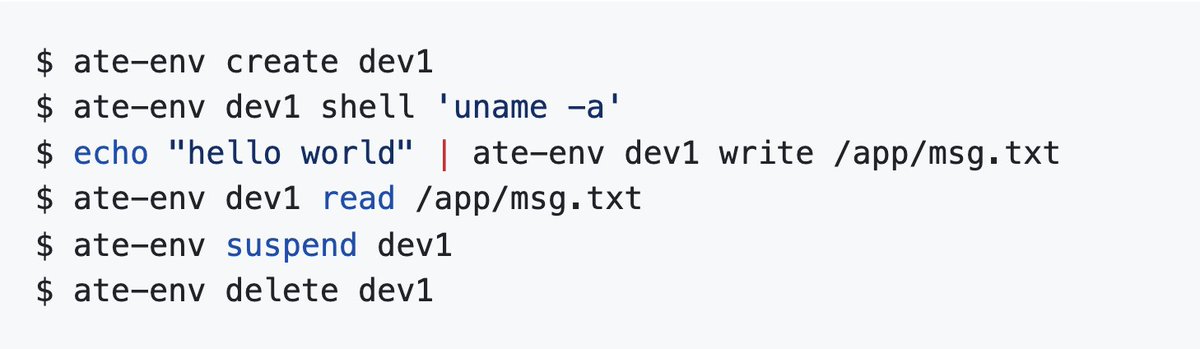
@rakyll (Jaana Dogan) announced github.com/agent-substrate/env (Apache-2.0): an isolated, snapshottable environment layer on Agent Substrate with ate-env CLI/API and guest daemon, plus a built-in MCP server exposing filesystem and shell tools so any MCP client can try Substrate without writing integration code first (API still alpha).

Agent Substrate opens env: no-code environment abstraction with built-in MCP fs and shell tools

Key Takeaways

  • Open-sourced agent-substrate/env: CLI, API, guest daemon, Go/Python clients.
  • Built-in MCP for filesystem and shell — try with any MCP client.
  • Substrate container actors: snapshot, schedule, multiplex idle envs; API still alpha.
Read full story
Linked Models & Agents:
ADSponsored

Clampdown open-sources a hardened container sandbox for Claude Code, Codex, and more

@DanKornas highlighted Clampdown (github.com/89luca89/clampdown), a hardened container sandbox for coding agents: Landlock filesystem rules before the binary starts, deny-by-default egress with an allowlist, real API keys held in a separate auth proxy while the agent gets a dummy key, OCI hooks for nested containers, plus launch helpers for Claude Code, Codex, OpenCode, and pi (GPL-3.0-only).

Key Takeaways

  • Landlock filesystem rules bind the agent to the project directory before start.
  • Real keys stay in an auth proxy; the agent gets a dummy key and deny-by-default egress.
  • Launch helpers for Claude Code, Codex, OpenCode, and pi; GPL-3.0-only.
Read full story

Google AI Studio launches Gemini API Managed Agents with Files and Credentials APIs

Google AI Studio launched an updated Managed Agents harness in the Gemini API. antigravity-preview-09-2026 is live in the Interactions API and AI Studio, giving agents isolated Linux execution, filesystem tools, web search, persistent environments, and MCP connectivity. The release also adds Files and Credentials APIs so developers can move artifacts between turns and connect external services without putting secrets in the model context.

Key Takeaways

  • antigravity-preview-09-2026 is live in the Interactions API and AI Studio, using Gemini 3.8 Flash by default with configurable models.
  • Managed agents run in persistent isolated Linux sandboxes with code execution, filesystem, web-search, and MCP tools.
  • Files handles artifact transfer while Credentials supports scoped bearer, environment-variable, and OAuth2 access without exposing plaintext secrets to the model.
Read full story

Mastra: Filesystem agent tools (read/write/list/grep) with no sandbox

Mastra (@mastra) announced Filesystem tools agents can call directly — read_file, write_file, list_files, and grep — with no sandbox required. Docs: mastra.ai/docs/sandbox/filesystem#direct-filesystem-access.

Key Takeaways

  • Capabilities: agents call read_file / write_file / list_files / grep directly.
  • Constraint: marketed as no-sandbox filesystem access.
  • Docs: official direct-filesystem-access page published.
Read full story
Linked Models & Agents:

Amazon Bedrock AgentCore harness is GA: declare model/tools/skills and run the managed loop

AWS announced Amazon Bedrock AgentCore harness is generally available: declare the model, tools, skills, and instructions, and AgentCore runs the orchestration loop with an isolated env, filesystem + shell, cross-session memory, skills catalog, and web browsing. Also shipping: Managed Knowledge Base, in-boundary Web Search, gateway Guardrails, plus recommendations and A/B testing from production traces.

Key Takeaways

  • AgentCore harness is GA: declare config and get a managed orchestration loop plus isolated runtime.
  • Also shipping: Managed Knowledge Base, in-boundary Web Search, and gateway Guardrails.
  • Recommendations and A/B testing turn production traces into prompt/tool fixes validated live.
Read full story
Linked Models & Agents:

LMArena: Meta Muse Spark 1.3 enters Agent/Code Arena; voting open, scores soon

Arena.ai (@arena) says Meta Muse Spark 1.3 is now in the Arena: Agent Arena measures long-horizon agentic tasks with web search, filesystem, and terminal tools via causal tracing vs the average model; it is also in Code Arena WebDev/Text/Vision/Document. Voting is open and scores are coming soon.

Key Takeaways

  • Muse Spark 1.3 is live in Agent Arena and Code Arena (including WebDev).
  • Agent Arena scores long-horizon tool-using workflows; leaderboard scores coming soon.
  • Voting is open so builders can stress-test prompts against frontier peers.
Read full story