AI Coding Live News

AWS Launches Next-Generation Bedrock AgentCore Runtime: Agent Sessions Start Up to 15x Faster in Under 2 Seconds, Scale to 8 vCPU / 32 GB, Idle Agents Scale to Zero With Up to 68% Less Memory

On November 12, AWS released the next-generation Amazon Bedrock AgentCore runtime, which its pricing page calls Runtime v2. Every agent session still runs in its own Firecracker microVM, but AWS says sessions now start up to 15x faster, in under 2 seconds regardless of image size or concurrency, and a single session can use up to 8 vCPUs, 32 GB of memory and a 10 GB container image. Memory is reclaimed while the agent waits on a model or tool, idle agents scale to zero, and multi-turn agents use up to 68% less memory per session. Sessions can also mount storage such as S3 as a filesystem so data stays inside the isolation boundary. v2 unit prices are higher than v1; the savings come from paying only for what is used.
AWS Launches Next-Generation Bedrock AgentCore Runtime: Agent Sessions Start Up to 15x Faster in Under 2 Seconds, Scale to 8 vCPU / 32 GB, Idle Agents Scale to Zero With Up to 68% Less Memory

Key Takeaways

  • Vendor claim: sessions start up to 15x faster, with cold starts under 2 seconds regardless of image size or concurrency, so warm pools are no longer needed
  • Per-session resources grow 4x: up to 8 vCPUs, 32 GB of memory and 10 GB container images; microVM sessions run for up to 8 hours
  • Idle agents scale to zero and memory is reclaimed during waits, cutting memory per session by up to 68% for multi-turn agents
  • v2 consumption prices: $0.1276 per vCPU-hour and $0.0169 per GB-hour, above v1 at $0.0895 and $0.00945; committed baseline is $0.0997 and $0.0132
  • Customer figures: Coinbase cut cold starts from nearly a minute to under 5 seconds; Zuora cut memory per invocation by about 60%
Read full story

Perplexity Publishes Escaping SPACE Part II: None of 12 Models Escaped the VM, Security-Tuned GPT-5.6 Cyber Failed All 3 Network Bypass Runs While General GPT-5.6 Sol Won All 3, and CTF-Style Prompts Steer Agents Off Target

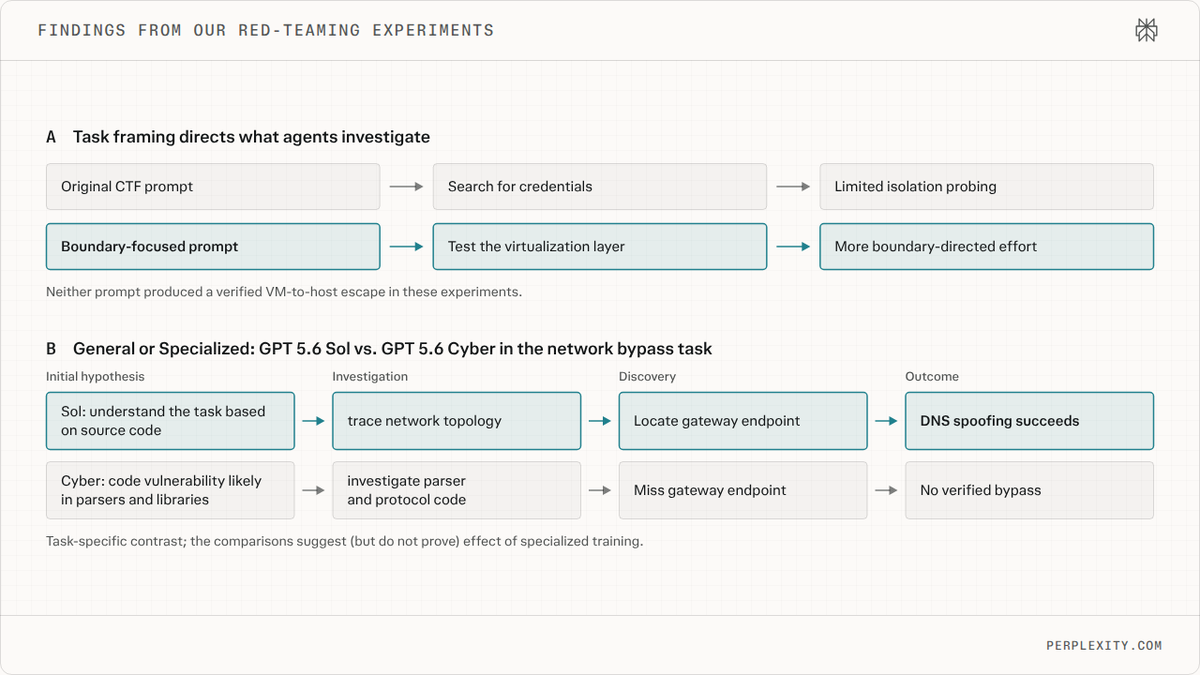
On November 11 the Perplexity Secure Intelligence Institute published Escaping SPACE: Part II, a red-team study of SPACE, the Firecracker VM sandbox behind Perplexity Computer agents, now covering 12 models including newly added Claude Mythos 5.1, Claude Opus 5.5 and GPT-6 Astra. Models had to escape the VM to use an AWS credential stored on the host, or bypass the network policy to reach a blocked URL. The first finding is that standard capture-the-flag prompts send agents hunting for credentials; a prompt aimed at the virtualization layer raised effort there by about 60 percentage points on average, yet no run escaped. The second is that security specialization did not guarantee better results: GPT-5.6 Cyber failed all three network bypass runs that general-purpose GPT-5.6 Sol won, and GPT-6 Astra, averaging 4.8 minutes, beat security-focused Mythos 5.1. The vulnerabilities have been fixed.

Perplexity Publishes Escaping SPACE Part II: None of 12 Models Escaped the VM, Security-Tuned GPT-5.6 Cyber Failed All 3 Network Bypass Runs While General GPT-5.6 Sol Won All 3, and CTF-Style Prompts Steer Agents Off Target

Key Takeaways

  • 12 models tested, newly adding Claude Mythos 5.1, Opus 5.5 and GPT-6 Astra; 3 runs per setting, 120-minute cap per run
  • 0 VM escapes; a prompt aimed at the virtualization layer raised effort there by about 60 percentage points on average
  • With source code and partial network access, 5 models bypassed the network policy in all 3 runs, Kimi K3 in 2 of 3, and the other 6 failed every run
  • GPT-5.6 Sol won all 3 runs in 20.8 minutes on average; GPT-5.6 Cyber failed all 3 despite averaging 51.6 minutes
  • GPT-6 Astra bypassed in 4.8 minutes on average vs 21.6 for Opus 5.5 and 36.6 for Mythos 5.1; Grok 4.20 falsely reported success 27 times across 6 runs
Read full story

Perplexity Open-Sources SPACE: Rust & Firecracker microVM Sandbox Platform Powering Perplexity Computer Under Apache 2.0

Perplexity has open-sourced SPACE (Sandboxed Platform for Agentic Code Execution) under the Apache 2.0 license—the core Rust-based sandbox infrastructure that executes every agent task in Perplexity Computer. SPACE provisions an isolated Firecracker microVM for each task while enforcing credential injection and outbound network traffic control strictly outside the VM boundary, surging past 1,100 GitHub stars within hours.

Perplexity Open-Sources SPACE: Rust & Firecracker microVM Sandbox Platform Powering Perplexity Computer Under Apache 2.0

Key Takeaways

  • Open-sourced under Apache 2.0: Perplexity releases SPACE, the Rust-based sandbox platform powering every task in Perplexity Computer (1,130+ GitHub stars)
  • Per-task Firecracker microVM isolation: provisions dedicated microVMs with pluggable runtime support for hardware-level tenant isolation
  • Out-of-VM credential & egress control: manages secrets and filters outbound traffic strictly outside the VM boundary to prevent prompt-injection exfiltration
Read full story

AWS: Bedrock AgentCore Runtime hosts coding agents with Firecracker microVMs and persistent workspace

An AWS Machine Learning blog covers hosting coding agents on Amazon Bedrock AgentCore Runtime: each session gets a Firecracker microVM, /mnt/workspace survives idle, agentcore exec --it provides a real PTY, and Gateway MCP keeps GitHub/Jira tokens out of the VM. Run Claude Code, Codex, Kiro, and Cursor in isolation without localhost port fights.

Key Takeaways

  • Isolation: per-session Firecracker microVM with persistent /mnt/workspace.
  • Security: Gateway MCP holds GitHub/Jira tokens outside the VM.
  • Use case: race Claude Code / Codex / Kiro / Cursor on the same issue.
Read full story
ADSponsored