AI Coding Live News

X Discussion: Theo Says LLMs Are "Still So Bad" at Building Tools for Agents, Opus Keeps Botching MCP Authentication, and Warns Not to Trust Agents on MCP "Best Practices"

Theo (@theo), CEO of T3 Chat and T3 Code and a well-known developer YouTuber, posted on November 8 that LLMs are "still SO bad at building tools for agents": every time he asks Opus to set up an MCP authentication path, it "makes horrible assumptions and builds something that straight up doesn't work." About two hours later he added that he is writing an "MCP the right way" guide for his own agents; when he had them draft a first version, they proposed rendering the MCP URL as a clickable link for users, and he warned people not to trust "ANYTHING" agents say about MCP, connection strategies and agent "best practices." At writing time the first post had about 880 likes, 136 replies and 65,000 views.

X Discussion: Theo Says LLMs Are "Still So Bad" at Building Tools for Agents, Opus Keeps Botching MCP Authentication, and Warns Not to Trust Agents on MCP "Best Practices"

Key Takeaways

  • Original post (@theo, November 8): when he asks Opus to set up an MCP authentication path it "makes horrible assumptions" and builds something that "straight up doesn't work"
  • Follow-up (@theo): an agent-drafted "MCP the right way" guide proposed rendering the MCP URL as a clickable link, and Theo called agents "CLUELESS" about MCP and connection strategies
  • Engagement (public X data at writing time): about 880 likes, 136 replies, 138 bookmarks and roughly 65,000 views on the first post; about 344 likes, 51 replies and 164 bookmarks on the follow-up
  • Context: MCP authorization builds on OAuth 2.1, requires clients to implement PKCE and references several standards including Protected Resource Metadata (RFC 9728) and Dynamic Client Registration (RFC 7591), while stdio transports skip it (MCP spec)
  • Replies: some say MCP auth changed several times within a year so training data lags; others suggest giving the model the exact spec plus one working request, and defaulting to the device authorization grant (RFC 8628) on headless servers
Read full story
Linked Models & Agents:

Google ReproBridge: Packaging One Successful Reproduction for the Next Coding Agent Lifts ML Experiment Reproduction from 76.4% to 92.6%

Google and the University of Waterloo posted ReproBridge on arXiv (2611.08452, 2026-11-05). It turns the code fixes, environment setup, launchers and guide an agent discovers while reproducing a paper into a standardized artifact. ReproBridge-Bench covers 36 papers, 387 experiments and 1,029 tasks. Author-reported: across Sonnet 4.6, Sonnet 5, Opus 5 and Gemini 3.8 Flash, mean success rises from 76.4% to 92.6% and API spend drops 19.7% on average.

Google ReproBridge: Packaging One Successful Reproduction for the Next Coding Agent Lifts ML Experiment Reproduction from 76.4% to 92.6%

Key Takeaways

  • Benchmark: 36 papers, 387 experiments, 1,029 tasks, each anchored by 5 human-verified reference scores
  • Author-reported: mean reproduction success 76.4% → 92.6% across 4 models; API spend down 19.7% on average
  • Cross-model spread narrows from 21.6 to 3.9 points; all four models exceed 90%
  • Gains range from 5.5pp (Opus 5) to 23.2pp (Gemini 3.8 Flash); removing code or environment hurts most in ablations
  • 24-hour wall-clock limit per paper on 8×H100; Codex serves as the primary Auditor
Read full story

Google DeepMind: Human-Guided AI Agents Speed Cryptanalysis; Two Weaknesses in Legacy 1024-bit RSA; 2048-bit+ Remains Safe

On 2026-11-06, Google DeepMind (@GoogleDeepMind) and VP Science Pushmeet Kohli published research: under human supervision, AI agents found two weaknesses in legacy 1024-bit RSA—signature padding adds no extra protection once an attacker controls about half the signed block (sandbox replay ~3.5× less CPU than prior), and a batch-factoring algorithm cuts average cost per additional same-size key by about 30×. Official caveat: modern 2048-bit and larger protocols remain unaffected.

Google DeepMind: Human-Guided AI Agents Speed Cryptanalysis; Two Weaknesses in Legacy 1024-bit RSA; 2048-bit+ Remains Safe

Key Takeaways

  • Source: @GoogleDeepMind post on 2026-11-06 + Pushmeet Kohli X Article; two technical PDFs (signatures / Batch NFS)
  • Scope: legacy 1024-bit RSA only; official statement that 2048-bit and larger remain secure
  • Signatures: once an attacker controls ~half the signed block, padding adds no protection; sandbox on a known 1024-bit benchmark key used ~3.5× less CPU and under 1/1000 of full break cost
  • Short fingerprints (e.g. 32-byte): theoretical estimate ~1600× better than prior best for 1024-bit keys
  • Batch factoring: for many same-size keys, average cost per additional key ~30× lower vs prior batch methods
Read full story

Cua + Scale AI Launch Cua Driver Bench: Background Desktop Agents vs Undisturbed Users; Vendor macOS Full-Pass ~58% for cua-driver

On 2026-11-06, Cua (@trycua) and Scale AI AgentEnv launched Cua Driver Bench (Bench v2): same Claude Sonnet 5.5, tasks, and limits with only the computer-use driver swapped, scoring task done, GUI-only, and eight undisturbed-user criteria. Scale macOS background full-pass: cua-driver ~58% (23/40), agent-desktop ~20%, browser-use ~3%; Cua-run Codex Computer Use ~33%. Tasks and trajectories are public to rerun.

Cua + Scale AI Launch Cua Driver Bench: Background Desktop Agents vs Undisturbed Users; Vendor macOS Full-Pass ~58% for cua-driver

Key Takeaways

  • Source: Cua official blog + @trycua thread on 2026-11-06; Scale ran macOS/Linux; Cua ran Windows and some controls
  • Method: 10 Bench v2 tasks; background keeps a simulated user typing; full pass = done + GUI-only + 8 undisturbed criteria
  • macOS background full-pass (Scale, vendor): cua-driver 58%, agent-desktop 20%, browser-use 3%; Codex CU (Cua-run) 33%
  • Foreground (Scale): cua-driver ~78%, agent-desktop 70%, browser-use 64%; gaps are mostly disturbance
  • Rerun: GitHub blog/libs/cua-driver-bench; HF Space/dataset earakely-scale/CuaDriverBench-AgentEnv
Read full story
ADSponsored

Hugging Face Ships Ultimate MoE Training Handbook: ~500k–800k GPU-Hours Distilled into a Megatron-LM Guide

On 2026-11-05 Hugging Face released the free Ultimate MoE Training Handbook. Co-founder Thomas Wolf cited ~800k GPU-hours, ~70k words and 55 interactive figures; author Nouamane Tazi separately cited ~500k GPU-hours. The Megatron-LM guide covers routing, expert sizing, communication and debugging via the official Space.

Hugging Face Ships Ultimate MoE Training Handbook: ~500k–800k GPU-Hours Distilled into a Megatron-LM Guide

Key Takeaways

  • Official: Hugging Face Space “The Ultimate MoE Training Handbook” (2026-11-05)
  • Thomas Wolf (HF co-founder) on X: ~800k GPU-hours, ~70k words, 55 interactive figures
  • Author Nouamane Tazi separately cited ~500k GPU-hours; prefer the Space body over a reconciled figure
  • Covers Megatron-LM: routing, expert sizing, all-to-all, aux vs loss-free bias, upcycling and serving
  • Free and open; small teams can follow the runbook flag-by-flag against logs
Read full story
Linked Models & Agents:
⚡ DeepSeek-V4 (Next-Gen MoE)⚡ Nemotron 3 Super⚡ Nemotron 3 Ultra🌐 Hugging Face🌐 NVIDIA

Stripe Opens Agent Data Analysis to All Users via MCP, Queries and Reports APIs; Queries Free Through Jan 31, 2027

On November 5 Stripe made agent access to Stripe analytics available to all users via the Stripe MCP or the Queries and Reports APIs directly. Compatible agents such as Claude and Cursor can answer natural-language questions about MRR, churn, fraud and reconciliation. The Reports API ships a modeled schema of 300+ tables with built-in guidance; Queries API is free through January 31, 2027 then usage-based, while Reports API stays free. Every analysis exposes the underlying SQL for verification.

Stripe Opens Agent Data Analysis to All Users via MCP, Queries and Reports APIs; Queries Free Through Jan 31, 2027

Key Takeaways

  • Availability: all Stripe users; connect via Stripe MCP or Queries/Reports APIs to Claude, Cursor and other compatible agents
  • Capabilities: natural-language MRR, expansion/contraction/churn, fraud, reconciliation and payments performance; can combine with tools like PostHog
  • Data model: Reports API includes 300+ modeled tables with usage guidance; every analysis exposes editable underlying SQL
  • Pricing (vendor): Queries API free through Jan 31, 2027 then per-credit with no monthly fee; Reports API remains free
  • Safety: read-only Data Metrics/Queries/Reports; do not paste secret keys into chat—use agent API keys or OAuth
Read full story

X Discussion: Vercel CEO Guillermo Rauch Says AI Will Rewrite All Human-Made Software, Sparking Debate on Formal Verification and Rewrite Risk

On November 5 Guillermo Rauch posted on X that most human-made software was slow, insecure and under-specified, and that AI will rewrite it all, many times, then formally verify, load test and harden it: "the true birth of software engineering." The post drew 3,000+ likes, 270+ reposts and nearly 100K views. Supporters cite from-scratch AI rewrites; critics warn that missing specs and human review still matter. This is a personal opinion, not a Vercel announcement.

Key Takeaways

  • Rauch's post (Nov 5, 02:22 UTC) had about 3,060 likes, 272 reposts, 681 bookmarks and ~99K views when fetched
  • Core claim: AI will rewrite human software "many times", formally verifying, load testing and hardening it, and replacing memory-unsafe foundations
  • An hour earlier he shared Vercel Security Review figures: 6,817 vulnerabilities found in 24 hours, 580 critical/high, 1,411 already patched by Agent (vendor-reported)
  • Pushback: rewriting under-specified code can just ship the same wrong behavior faster, and formal verification moves bugs up an abstraction level rather than eliminating them
  • This is an opinion thread, not an established fact or official roadmap
Read full story
Linked Models & Agents:

AMD Q3 2026: Data Center Revenue Up 97% to $8.5B, First Helios Racks Running for Anthropic and OpenAI, Q4 Guide About $17B

AMD reported Q3 2026 results on November 3. Total revenue was $13.377B, up 45% year over year, and the Data Center segment hit a record $8.546B, up 97% year over year and 27% sequentially, driven by EPYC server CPUs and the newly launched Instinct MI450 Series GPUs. AMD says Anthropic, Meta, Microsoft, OpenAI and Oracle Cloud Infrastructure are running models and workloads on the first Helios rack-scale systems. It guided Q4 revenue to about $17B, plus or minus 3%, roughly 66% year-over-year growth at the midpoint.

Key Takeaways

  • Data Center revenue was $8.546B, up 97% year over year and 27% sequentially, about 64% of total revenue versus roughly 47% a year ago; segment operating income was $2.882B at a 34% margin
  • The first Helios racks (Instinct MI450 Series GPUs plus 6th Gen EPYC) are running models for Anthropic, Meta, Microsoft, OpenAI and Oracle Cloud, and MI455X began volume shipments this quarter
  • Total revenue was $13.377B (+45%), with 56% non-GAAP gross margin and $2.09 non-GAAP EPS; GAAP net income of $2.428B includes a $1.097B fair-value change on customer warrants
  • Q4 guidance is about $17B plus or minus 3%, roughly +66% year over year and +27% sequentially at the midpoint, with about 55% non-GAAP gross margin
  • AMD also released ROCm 10 with ROCm.AI, introduced the Helion reference architecture for rack-scale agentic systems, and announced agreements to acquire World Labs and Taalas
Read full story

Google Turns Gemini and Search Off by Default for K-12 Student Accounts Until Admins Opt In, Launches Guided Learning in Classroom Globally

On November 3, Google VP and GM of Education Chris Phillips announced on the official Google blog that Gemini, Gemini Notebook, Gemini in Classroom and Google Search will be entirely off for K-12 student accounts until school administrators explicitly turn them on. Guided Learning is globally available in Google Classroom starting that day and is coming to Search for student accounts, with a pilot in select U.S. schools later this month. Because Search now includes AI Mode and AI Overviews, schools that want AI fully off also lose Search, which drew sharp backlash; Google later clarified on X that Search can be enabled on its own. EdWeek and AP report the change starts early next year; Google has given no exact date.

Google Turns Gemini and Search Off by Default for K-12 Student Accounts Until Admins Opt In, Launches Guided Learning in Classroom Globally

Key Takeaways

  • Off by default: Gemini, Gemini Notebook, Gemini in Classroom and Google Search are entirely off for K-12 student accounts until admins explicitly enable them (Google blog)
  • The controversy: Search now includes AI Mode and AI Overviews with no AI-free option, so student groups with AI fully off lose Search too (per EdWeek and NBC News)
  • Google clarified on X that schools can turn on Search without Gemini products, and that AI Mode and AI Overviews for students will guide them step by step instead of giving answers
  • Guided Learning is globally available in Google Classroom starting November 3; the Search version pilots in select U.S. schools later this month before wider expansion
  • Timeline: EdWeek and AP report the change starts early next year; Google only says it will share specifics in the coming months, with no exact date
Read full story
Linked Models & Agents:
⚡ Gemini🌐 Google

Tencent Releases Hy4: First Hy Model With Vision and Computer Use, Live on Tencent Cloud and OpenRouter, Open Weights Planned

On November 4, Tencent Hy published Hy4 on its official site. Versus Augusts Hy4 preview, Tencent says it scaled up pre-training and post-training, added vision for the first time, added computer use across CLI and GUI, and trained specifically on Blender, CAD and engines like Unreal, Unity and Godot. Hy4 is live on Tencent Cloud and OpenRouter (tencent/hy4, 1M context) at the same API price as the preview. Weights and a system card are promised soon, and a cheaper Hy4 flash is coming.

Key Takeaways

  • Official blog: Introducing Hy4, dated 2026-11-04; the Tencent Hy transparency center also lists V1.0 Hy4
  • Two firsts: vision (fine-grained image detail, complex charts, math visual reasoning) and computer use (CLI plus GUI, with targeted training on Blender, CAD and long cross-app workflows)
  • Tencent's own evals: on 579 real finance tasks rated by 213 finance professionals Hy4 scores 3.04, first among open-weight models (DeepSeek-V4.1-Flash-1017 2.97, Kimi K3.1 Pro 2.68, GLM-5.3 2.68); GameDev +19.1%, GameLogic +9.8%; internal search hallucination rate 15.76% to 5.45%
  • Same API price as the preview: $0.042 cached input, $0.834 input, $2.501 output per million tokens; the OpenRouter page currently shows 50% off ($0.417/$1.251), 1,048,576 context and up to 65,536 output tokens
  • Weights are not out yet: Tencent says it will open-source them with a full system card, working with vLLM and SGLang; Hy4 flash is due soon
Read full story
Linked Models & Agents:
⚡ Hy4⚡ Hy4 preview⚡ Hy4 flash🤖 CodeBuddy🤖 WorkBuddy🌐 Tencent
ADSponsored

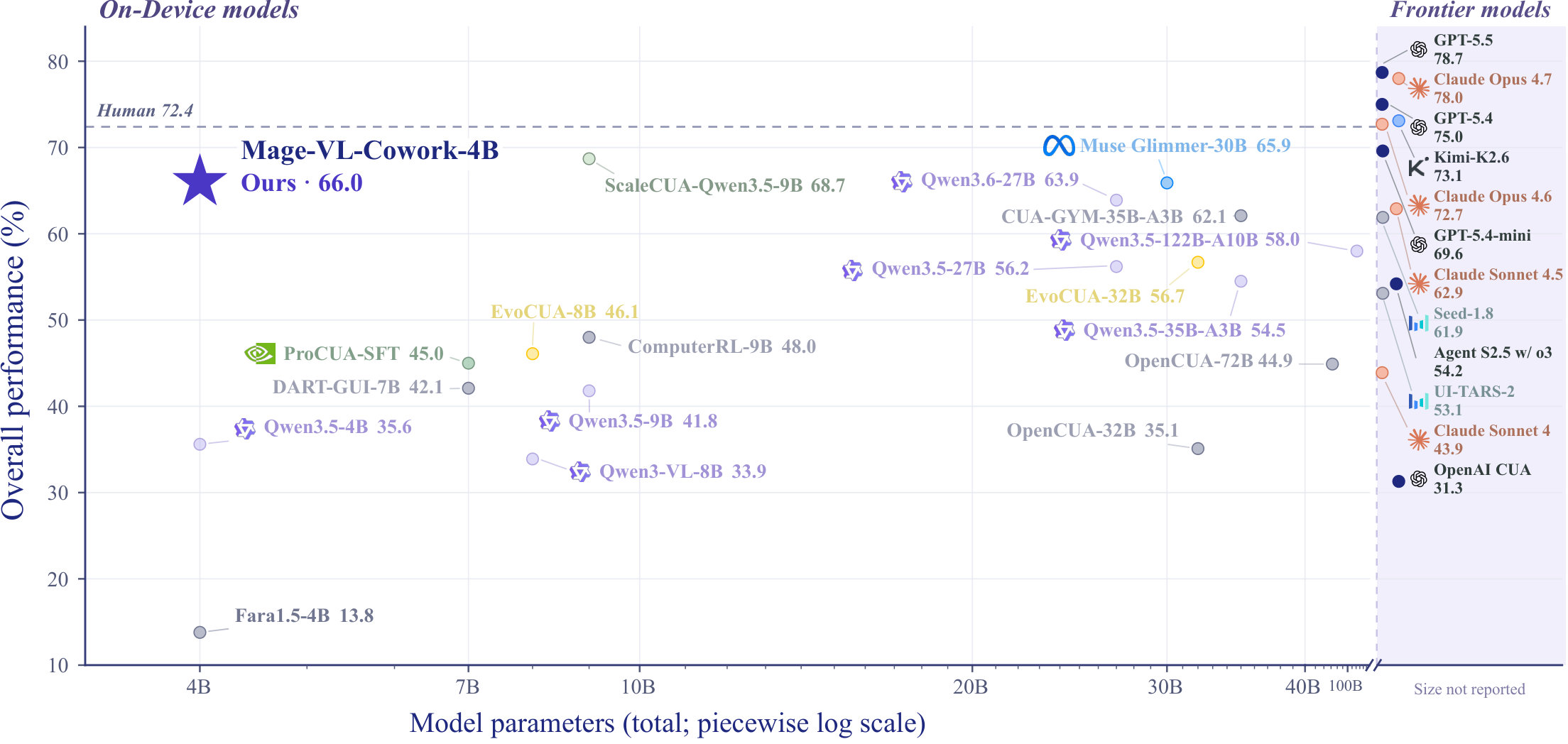
Microsoft Open-Sources Mage-VL-Cowork, a 4B Computer-Use Agent That Chooses Between Clicking the GUI and Running Bash, Scoring 66.0% on OSWorld-Verified

On October 30, Microsoft's Mage team released Mage-VL-Cowork on Hugging Face under Apache-2.0: a 4B multimodal computer-use agent in which a single model decides at every step whether to act through screenshots and GUI clicks (computer_use) or through bash and Python in a terminal, with no external orchestrator. Microsoft reports a two-run average of 66.0% on OSWorld-Verified (361 tasks, 50-step budget), above Qwen3.6-27B at 63.9% but below the 9B SCALECUA-Qwen3.5-9B at 68.7%.

Microsoft Open-Sources Mage-VL-Cowork, a 4B Computer-Use Agent That Chooses Between Clicking the GUI and Running Bash, Scoring 66.0% on OSWorld-Verified

Key Takeaways

  • 4B parameters, built on Mage-VL (Mage-ViT vision encoder plus Qwen3-4B-Instruct-2507); about 9.48 GB of bf16 weights under Apache-2.0.
  • On OSWorld-Verified, two independent runs scored 65.33% and 66.75% for a 66.0% average; 87.5% on operating-system tasks and 62.7% on multi-app workflows.
  • In Microsoft's side-by-side, a LibreOffice Calc chart task took 39 seconds (6 steps) via Python in the terminal, versus 9:56 (39 steps) for GUI-only Qwen3.6-27B.
  • Online RL adds 10.16 points over hybrid SFT while cutting mean model calls by 13.0% and output tokens by 25.4%.
  • Training data came from Mage-CUA-Forge, which synthesized about 294K desktop and web tasks across 6,915 skills and cut per-task generation cost from $0.906 to $0.158.
Read full story
Linked Models & Agents:
⚡ Mage-VL-Cowork⚡ Mage-VL⚡ Qwen3-4B⚡ Qwen3.6-27B🌐 Microsoft

X Discussion: Vercel CEO Guillermo Rauch Says "Own Your Intelligence," Urging Local Models to Keep Spreading and Developers to Own Their Agent Harness and Data

Vercel CEO Guillermo Rauch posted on X on November 1: "Own your intelligence. Anyone that opposes this has something to sell you (perhaps your own intelligence back to you.)" He argued that local models need to keep proliferating; since the biggest models may be out of reach locally for now, the best option is to keep your options open: own your harness, data, connections and runtime, meaning your agents, and embrace open source. Within about 12 hours the post drew about 2,500 likes, 128K views and over 100 quote posts, with debate centered on how to balance local and cloud AI.

Key Takeaways

  • This is Rauch's personal opinion post, not an official Vercel announcement or product release.
  • The original post (2026-11-01 21:08 UTC) had about 2,533 likes, 255 reposts, 266 replies, 107 quotes, 128K views and 581 bookmarks at fetch time.
  • Core claim: local models should keep spreading; until the biggest models can run locally, keep your options open by owning your harness, data, connections, runtime and agents, and embrace open source.
  • Mark (@marksuman), co-founder and CEO of Maple AI, replied in a quote post that it will be hybrid: cloud will always be more powerful, so local-first AI should be paired with private cloud.
  • Engineer Shantanu Goel (@shantanugoel) quoted it saying "Guillermo says the truth that most others won't!", drawing about 37 likes.
Read full story
Linked Models & Agents:

X discussion: FT chief data reporter John Burn-Murdoch says the US productivity jump "doesn't look like AI" and is mostly tech layoffs, while Gavin Baker argues it shows "ROI on AI"

On November 1, John Burn-Murdoch, a Financial Times columnist and chief data reporter, posted a long X thread with his FT piece arguing that the productivity rise in AI-adopting US sectors began in 2020, before AI agents existed, shows up only in the US, and comes mainly from tech layoffs and hiring pullbacks rather than AI. The thread opener has about 1,344 likes, 306 reposts and 186K views. Gavin Baker, managing partner and CIO of Atreides Management, quoted the FT charts and said it is hard not to see some evidence of "ROI on AI," citing a16z and EPB Research data; his post has about 793 likes and 102K views. Burn-Murdoch replied that he is "slightly on the fence" and that the data cannot rule out a role for AI. These are two readings of the same data, not a settled finding.

X discussion: FT chief data reporter John Burn-Murdoch says the US productivity jump "doesn't look like AI" and is mostly tech layoffs, while Gavin Baker argues it shows "ROI on AI"

Key Takeaways

  • Opener: John Burn-Murdoch's thread, posted 2026-11-01 15:04 UTC, with about 1,344 likes, 306 reposts and 186K views; his X bio says he is an FT columnist and chief data reporter
  • His core argument: the productivity rise in AI-adopting US sectors started in 2020, and even a 2022 re-acceleration is "too early to be AI. Back then it was chatbots, not agents"; other rich countries use AI just as widely but show no similar jump
  • Splitting productivity into output and headcount, he argues the US acceleration since 2022 is mainly a tech layoffs story: output stayed on trend while employment fell
  • Counterpoint: Gavin Baker's reply, with about 793 likes and 102K views; citing EPB Research, he says the 3 industries that adopted AI most went from 2.2% to 5% productivity growth, and that the US is 72% of Anthropic revenue (figures he cites from third parties; AICoder has not verified them)
  • Replying to Baker, Burn-Murdoch said he is "slightly on the fence": the "this looks like AI" case is overstated, but the data cannot rule out a role for AI either
Read full story
Linked Models & Agents:

Artificial Analysis releases AA-Omniscience v1.1: 3,000 refreshed questions and a calibrated 300-question public set, with Gemini 4 Carbon leading at a Net Score of 54

On October 31, independent evaluator Artificial Analysis released AA-Omniscience v1.1, its knowledge and hallucination benchmark and part of Intelligence Index v5. The question set shrinks from 6,000 to 3,000, dropping previously public and saturated questions, fixing errors and ambiguities, and adding new ones, and a new 300-question public set on Hugging Face is calibrated to the private set's difficulty, with 0.99 Pearson and Spearman correlation on Net Score. Gemini 4 Carbon (high) leads with a Net Score of 54, ahead of Claude Opus 5.5 at 48 and Claude Fable 5.1 at 46; Fable 5.1 has the highest accuracy (68%) and Gemini 4 Argon the lowest hallucination rate (4%). Models score about 1.9 points lower than on v1 on average, and MiniMax M3.1 Flash drops 22 points. All figures are as reported by Artificial Analysis.

Artificial Analysis releases AA-Omniscience v1.1: 3,000 refreshed questions and a calibrated 300-question public set, with Gemini 4 Carbon leading at a Net Score of 54

Key Takeaways

  • The question set shrinks from 6,000 to 3,000 across 6 domains and 42 topics: 600 each for science/engineering/math and software engineering, 450 each for finance, health, humanities/social sciences and law
  • A new 300-question public set is on Hugging Face, with 0.99 correlation to private-set Net Score and a median difference of 0.0 points
  • Net Score ranking: Gemini 4 Carbon (high) 54, Claude Opus 5.5 48, Claude Fable 5.1 46; the best open-weights model, Muse Spark Open, trails Gemini 4 Carbon by 28 points
  • Claude Fable 5.1 has the highest accuracy (68%), followed by Claude Opus 5.5 (66%); Gemini 4 Argon has the lowest hallucination rate (4%)
  • Rank order keeps a 0.98 Spearman correlation with v1, but scores are 1.9 points lower on average; MiniMax M3.1 Flash falls from 16 to -6 and MiMo V2.6 Pro from 8 to -5 (vendor-reported)
Read full story

X discussion: Shopify CEO Tobi Lütke backs the monorepo as a Shopify engineer calls it a boon for coding agents, while critics still prefer split repos

Shopify distinguished engineer Burke Libbey posted on November 1 that moving to a monorepo has been a boon for agents at Shopify; it needs thoughtful tooling and has downsides that take effort to mitigate, but he would not go back. He was replying to Darren Shepherd, who said a day earlier that he hates the idea that monorepos are great for agents. Shopify CEO Tobi Lütke then quoted Burke and recalled Mikhail Parakhin telling him that every engineer hates the idea of moving to a monorepo, yet once it is there no engineer would want to work somewhere without one. Tobi's post drew about 1,115 likes, 454 bookmarks and 89K views and set off a wide debate. These are practitioner opinions, not an official technical announcement.

Key Takeaways

  • Original post: @tobi, Nov 1, 15:39 UTC, about 1,115 likes, 454 bookmarks, 95 replies and 89K views at fetch time
  • Shopify distinguished engineer Burke Libbey wrote that moving to a monorepo has been a boon for agents at Shopify; it needs thoughtful tooling and its downsides take effort to mitigate, but he would not go back
  • On the other side, Darren Shepherd (Rancher and k3s background) posted on Oct 31 that he hates the idea that monorepos are great for agents and that the best way to scale is to avoid scaling
  • Mikhail Parakhin replied to Tobi's retelling: "True story! And now, with agents, it more true than ever."
  • Supporters in the quote posts say agents can see every caller at once and get cross-stack type checking and atomic changes; skeptics ask whether agents make independent, separately evolving repos more attractive
Read full story
Linked Models & Agents: