
AI Coding Live News

GitHub Agentic Workflows is generally available: write automation in Markdown, compile it to Actions YAML, run Copilot or your own coding agent, now with ARC self-hosting and micro-VM isolation

At Universe 2026 on Oct 28, GitHub made GitHub Agentic Workflows, an open source GitHub Next project, generally available on GitHub Free, Team and Enterprise. Developers describe tasks such as issue triage, CI failure analysis, documentation updates and test writing in natural-language Markdown, and gh aw compiles them into standard Actions YAML run by Copilot or a coding agent of their choice. GA adds self-hosted ARC runners with Docker-in-Docker, a non-experimental gh aw forecast cost estimate, per-workflow model providers and model routing, and Cloud Hypervisor or NVX micro-VM isolation.
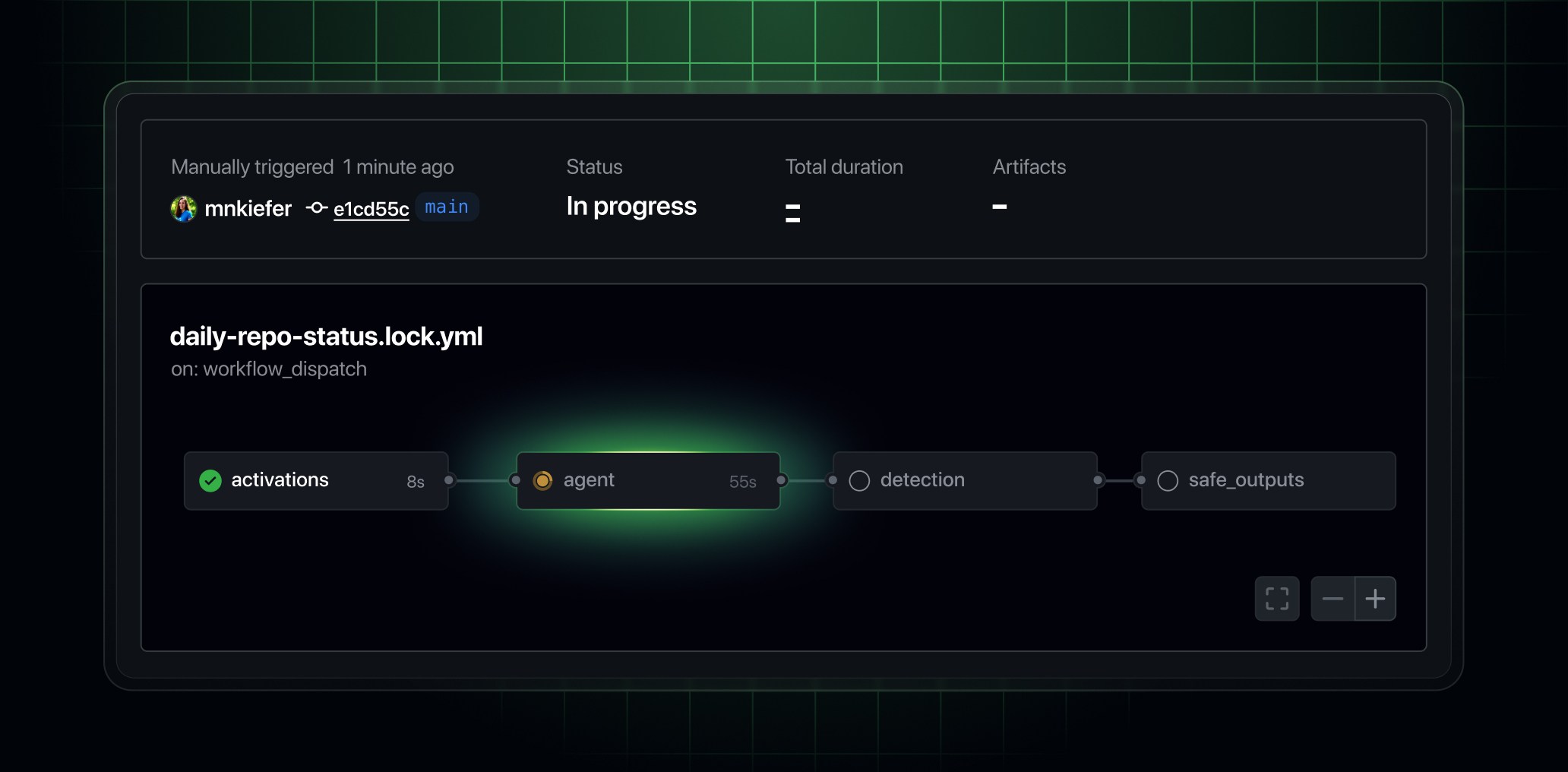
GitHub Agentic Workflows is generally available: write automation in Markdown, compile it to Actions YAML, run Copilot or your own coding agent, now with ARC self-hosting and micro-VM isolation

Key Takeaways

  • Availability: GitHub Free, Team and Enterprise on github.com; using the default Copilot CLI engine requires a Copilot license
  • How it works: requirements in Markdown, compiled to standard Actions YAML that reuses existing runner groups and policies; run with Copilot or your own coding agent
  • Safe defaults: read-only permissions, a sandboxed container behind the Agent Workflow Firewall, safe-outputs validation, and a threat detection job before changes are applied
  • New at GA: self-hosted ARC runners with Docker-in-Docker, gh aw forecast out of experimental (with threat detection credits and monthly ranges), per-workflow model providers, model routing, micro-VM isolation and cross-repo enclaves
  • Customer story (Accenture's figures): one lead saved about 29 hours a week, AI authors 91% of the team's commits, and production errors fell from about 11,000 a day to under 1,000
Read full story

GitHub Next Releases PDD Kit: Provable Specification Enforcement for Coding Agents to Eliminate Edge-Case Regressions

GitHub Next officially released PDD Kit (Property-Driven Development Kit), establishing a formal verification toolkit tailored for autonomous coding agents. Addressing the pervasive reliability gap where agent-generated code passes isolated unit tests but crashes on subtle edge cases, PDD Kit combines property-driven specifications with automated formal solvers. Instead of testing arbitrary sample inputs, PDD Kit mathematically proves that agent code adheres to rigorous invariant specifications across every possible input, preventing regressions and elevating coding agents from probabilistic generation to provable correctness.

GitHub Next Releases PDD Kit: Provable Specification Enforcement for Coding Agents to Eliminate Edge-Case Regressions

Key Takeaways

  • GitHub Next releases PDD Kit to eliminate edge-case flaws in agent-generated code via automated mathematical proofs
  • Pioneers 'proofs for every input', replacing fragile, underspecified unit test samples with comprehensive invariant verification
  • Eliminates deadlocks, boundary index out-of-bounds, and state desynchronization in agentic refactoring workflows
  • Provides an indispensable verification foundation for deploying autonomous coding agents into mission-critical production systems
Read full story

GitHub Agentic Workflows 0.90.0: friction cost in step summaries; two noop calls by default; five new trajectory graders

gh-aw v0.90.0 (2026-09-28) renders friction cost in step summaries, allows two noop safe-outputs by default, adds five trajectory graders with hardened generator contracts, and bumps gh-aw-mcpg to v0.4.27 / gh-aw-firewall to v0.28.27—shifting from 0.89.22’s sandbox focus toward observability and grading.

GitHub Agentic Workflows 0.90.0: friction cost in step summaries; two noop calls by default; five new trajectory graders

Key Takeaways

  • Release v0.90.0 after 0.89.22
  • Step summaries show friction cost (Cost Management)
  • Default max two noop safe-outputs—skip the AI engine with zero AI Credits when work is empty
  • Five new trajectory graders + hardened generator contracts
  • Infra: gh-aw-mcpg v0.4.27, gh-aw-firewall v0.28.27; upload-assets summary formatting fix
Read full story

GitHub Next opens LocalJev: local Jev-compatible decision API on oMLX

GitHub Next open-sourced LocalJev (github.com/githubnext/localjev): a morning build of a “poor man’s Jev” for teammates without TypeSafe Jev access. It exposes a Jev-compatible POST /v1/systemone API in Bun/TypeScript, defaults to oMLX-backed local models such as DiffusionGemma, and reports evals across DiffusionGemma, Qwen MoE, Gemma 4 MoE, and Gemma 4 e4b/e2b (benchmark report in-repo). The LocalJev server works with normal Jev client wrappers, but probabilities are model-reported rather than logit reads—calibrate before consequential use.

Key Takeaways

  • Open-sources LocalJev: a local Jev-compatible POST /v1/systemone decision API (Bun/TypeScript).
  • Defaults to oMLX-backed local models such as DiffusionGemma, with multi-model evals in-repo.
  • Works with normal Jev client wrappers; probabilities are model-reported, not logit reads—calibrate first.
Read full story
Linked Models & Agents:
⚡ diffusiongemma⚡ qwen⚡ Gemma 4🌐 github
ADSponsored

GitHub Next open-sources Chopin: real-time multiplayer agentic planning

GitHub Next (@GitHubNext) introduced Chopin, an early open-source prototype for real-time, multiplayer, visual agentic planning so teams can align on a plan before handing work to agents; more development is planned over the coming months.

Key Takeaways

  • Chopin is a real-time multiplayer visual planner for agent workflows.
  • It targets shared alignment before handing tasks to coding/execution agents.
  • Early open-source prototype at githubnext.com/projects/chopin/
Read full story
Linked Models & Agents: