AI Coding Live News

Google DeepMind expands Gemini-built PlanAssist to 15 English councils after pilots cut planning assessment time by up to 58%

On October 31, Google DeepMind said PlanAssist, a Gemini-built planning tool developed with the UK government, Google Cloud and Faculty, will be made available to 12 more local planning authorities in England, bringing the total to 15 for a 12-month Beta on live applications. In early pilots at Barnet, Camden and Dorset, DeepMind says the average officer time on householder assessment tasks fell by 58%, and more than 70% of the drafted reports were approved with no edits. Planning officers keep the final decision.

Google DeepMind expands Gemini-built PlanAssist to 15 English councils after pilots cut planning assessment time by up to 58%

Key Takeaways

  • Scale: from 3 pilot councils to 15; the 12 new ones join in three cohorts for a 12-month Beta (DeepMind blog)
  • Efficiency: average officer time on householder assessment tasks fell 58% in pilots (vendor-reported; DeepMind's X post says "up to 58%")
  • Quality: more than 70% of AI-drafted reports were approved by officers with no edits (vendor-reported)
  • The UK government says, together with new rules, routine householder processing can halve from eight weeks to four, and it aims to offer the tool to every council in England in 2027 (GOV.UK)
Read full story

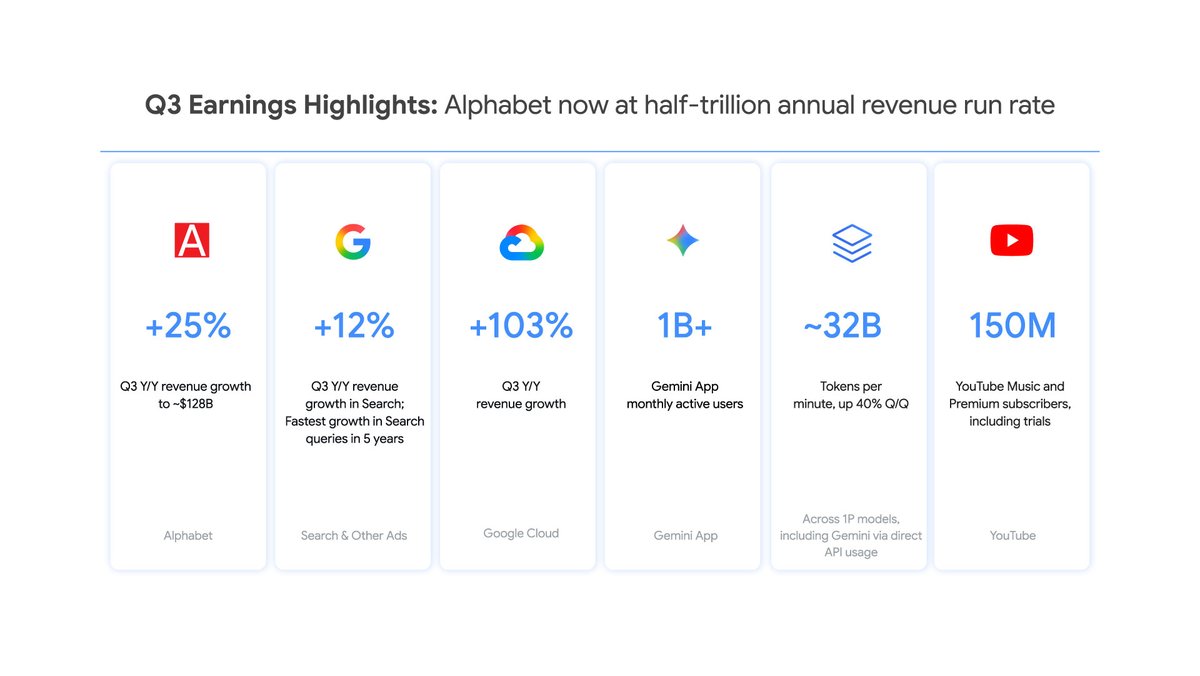
Alphabet Q3 2026: revenue up 25% to $127.6B, Google Cloud up 103%, first-party model APIs near 32B tokens per minute

After the US market close on Oct 28, Alphabet reported Q3 2026 results: revenue rose 25% to $127.6B, and Google Cloud revenue more than doubled, up 103% to $30.7B, which the company attributes to enterprise AI infrastructure, AI solutions and TPU system sales. In the release and on X, Sundar Pichai said first-party model APIs now process nearly 32B tokens per minute, more than four times a year ago, and that the Gemini app has reached one billion users. The cost: Q3 capital expenditures of $51.4B and free cash flow of negative $9.1B.

Alphabet Q3 2026: revenue up 25% to $127.6B, Google Cloud up 103%, first-party model APIs near 32B tokens per minute

Key Takeaways

  • Revenue of $127.58B, up 25% year over year and the 13th straight quarter of double-digit growth; Pichai says Alphabet is on a $500B annual revenue run rate
  • Google Cloud revenue of $30.71B versus $15.16B a year ago, up 103%; Cloud operating income of $11.12B versus $3.59B
  • First-party model APIs process nearly 32B tokens per minute, more than 4x a year ago; Pichai's X post puts quarter-over-quarter growth at 40%
  • The Gemini app reached one billion users, which Google calls the fastest-growing product in its history; Search query growth is the highest in five years
  • Q3 capex of $51.36B versus $23.95B a year ago, and free cash flow of negative $9.07B, the second negative quarter in a row
Read full story

Google brings Gemini Robotics ER 2, DeepMind's embodied reasoning model, to Google Cloud in public preview so enterprises can orchestrate VLA models and multi-robot teams

On Oct 27 Google Cloud announced that Gemini Robotics ER 2, Google DeepMind's embodied reasoning model, is in public preview on the Gemini platform via Model Garden, under the model ID gemini-robotics-er-2-preview and built on Gemini 3.5 Flash. It acts as a robot's high-level brain: it reasons over space and time in video, plans multi-step tasks, checks whether an action succeeded, and calls VLA models and navigation APIs as tools, including across teams of different robots. Google says it pinpoints key video frames with 91.3% accuracy.

Key Takeaways

  • Model ID gemini-robotics-er-2-preview, built on Gemini 3.5 Flash, takes text, image, video and audio input, with a 131,072-token input and 65,536-token output limit
  • The core pattern is declaring VLA models, navigation APIs or custom functions as tools, with ER 2 planning and orchestrating them while explaining itself and accepting redirection in natural language
  • It classifies task progress as binary, discrete or continuous scores; Google cites 91.3% accuracy and a 0.96-second mean frame distance for finding key moments in video
  • It reads values from more than 10 instrument types, including dials, sight glasses, digital displays and rulers
  • The enterprise version adds IAM, security controls and function calling; the Cloud preview supports GenerateContent but not the Live API, and Boston Dynamics and Arm are among early users
Read full story
Linked Models & Agents:

Google Cloud Open-Sources TorchTPU: Native PyTorch on Google TPU Hardware with Day-Zero vLLM and SGLang Support

Google Cloud officially open-sourced TorchTPU, enabling native, zero-compilation-barrier PyTorch execution directly on Google Cloud TPU hardware (TPU v5p and TPU v6e). Overcoming the legacy friction of PyTorch/XLA's rigid graph compilation and dynamic-shape stalls, TorchTPU supports native PyTorch eager execution and custom Triton/C++ kernels. Leading high-throughput serving engines vLLM and SGLang announced immediate Day-0 support. Concurrently, Google Cloud introduced OpenAI models and Codex into its Vertex Model Garden, becoming the first hyperscaler to offer all three top frontier closed models.

Google Cloud Open-Sources TorchTPU: Native PyTorch on Google TPU Hardware with Day-Zero vLLM and SGLang Support

Key Takeaways

  • Google Cloud open-sources TorchTPU, delivering native, compilation-free PyTorch execution on TPU v5p and TPU v6e hardware
  • Eliminates PyTorch/XLA graph-compilation overhead, natively supporting PyTorch eager mode and custom Triton/C++ kernels
  • vLLM and SGLang announce immediate Day-0 TorchTPU releases, unlocking substantial throughput boosts on TPU infrastructure
  • OpenAI frontier models and Codex join Google Cloud's Model Garden, solidifying Google Cloud as the premier multi-model hyperscaler
Read full story
ADSponsored

OpenAI frontier models and Codex are coming to Google Cloud: Model Garden access, bought via Marketplace against existing GCP commitments

On Oct 21, OpenAI and Google Cloud announced a partnership bringing OpenAI frontier models and Codex agentic workflows into Google Cloud Model Garden, transacted through Google Cloud Marketplace so enterprises can draw down existing GCP commitments. OpenAI models will also come to Google Antigravity and Gemini Agent soon. General availability is planned in the coming weeks, and Microsoft remains OpenAI's primary cloud partner. After AWS, this puts OpenAI models on all three major US clouds.

OpenAI frontier models and Codex are coming to Google Cloud: Model Garden access, bought via Marketplace against existing GCP commitments

Key Takeaways

  • Channel: OpenAI frontier models and Codex come to Google Cloud Model Garden, transacted through Google Cloud Marketplace (official)
  • Procurement: enterprises can draw down existing GCP commitments, no separate OpenAI contract or invoice
  • Ecosystem: OpenAI models are coming soon to Google Antigravity and Gemini Agent, selectable alongside Gemini
  • Timing: GA planned in the coming weeks, access requests open now; Microsoft remains the primary cloud partner
  • Landscape: after Microsoft exclusivity ended in April and AWS added OpenAI models, OpenAI is now on all three major US clouds (per Reuters/CNBC)
Read full story

llm-d 1.0 ships: the Kubernetes-native open-source distributed inference stack led by Red Hat, IBM and Google hits production readiness, with vendors reporting 3,000 self-hosted coding agents at 5-10x lower cost than commercial APIs

At PyTorch Conference North America on Oct 20, the CNCF Sandbox project llm-d released version 1.0. It turns inference engines such as vLLM and SGLang into one coordinated serving pool, and 1.0 adds multi-tenant priority and fairness scheduling (flow control), router high availability with zero-downtime rolling upgrades (DisaggregatedSet), a v1 configuration API, and agent-aware session routing with Responses API state. Founded in 2025 by Red Hat, IBM, Google Cloud, CoreWeave and NVIDIA, the project has 500+ contributors, and JetBrains, DigitalOcean and Mistral already run it in production.

llm-d 1.0 ships: the Kubernetes-native open-source distributed inference stack led by Red Hat, IBM and Google hits production readiness, with vendors reporting 3,000 self-hosted coding agents at 5-10x lower cost than commercial APIs

Key Takeaways

  • Scale (Red Hat press release, vendor-reported): GLM 5.2, roughly 753B parameters, on NVIDIA GPUs peaked at 6.6M output tokens per minute and served up to 3,000 concurrent coding agents with zero preemptions, 5-10x cheaper per token than equivalent commercial API pricing at cloud rental rates
  • Cache reuse: IBM says the prefix-aware router captured 97% of available cache reuse on an agentic coding workload; an IBM Research quantum error correction project saw ~98% prefix hits, ~$0.11 per million tokens, and 11.5x lower cost than an all-proprietary setup
  • Google Cloud figures: on Ironwood TPU, prefix-aware routing plus host memory offload cut median time-to-first-token by more than 85% and raised throughput 2.4x on an agentic coding workload; the Gemini platform doubled its prefix cache hit rate from 35% to 70%
  • New in 1.0: flow-control multi-tenant QoS, router hot-standby HA, DisaggregatedSet for coordinated prefill/decode rollouts, a v1 config API, and previous_response_id support in the Responses API
  • Ecosystem: 500+ contributors from 25+ organizations; JetBrains' free Junie Lite, DigitalOcean Serverless Inference and Mistral's tiered commercial traffic run on it; the GitHub v1.0.0 notes admit not every tracked goal shipped
Read full story

Claude Opus 5.5 fast mode leaves research preview and drops the waitlist: same model, up to 2.5x output speed at $8/$40 per MTok

On 2026-10-15 Anthropic moved Claude Opus 5.5 fast mode out of research preview and removed the waitlist: no access request and no fast-mode-2026-02-01 beta header needed, just speed: "fast". Same weights, up to 2.5x output tokens/sec per Anthropic, at 2x standard price ($8/$40 per MTok). Start/Build/Scale tiers get a default fast rate limit; it is live on Microsoft Foundry (Azure-hosted) with Google Cloud coming soon. Opus 5 and Opus 4.8 fast mode remain in research preview.

Key Takeaways

  • Pricing: Opus 5.5 fast is $8/$40 per MTok, 2x the $4/$20 standard; Opus 5/4.8 fast stay in preview at $10/$50 (docs)
  • Speed: up to 2.5x output tokens/sec per Anthropic; gains are OTPS, not TTFT; same weights
  • Access: no request and no beta header; default dedicated fast limits on Start/Build/Scale tiers (release notes)
  • Platforms: Claude API (incl. Managed Agents) and Microsoft Foundry Azure-hosted; Google Cloud coming soon; not on Batch API, Priority Tier, or Claude Platform on AWS
  • Gotchas: switching speeds invalidates the prompt cache; 429 on limit; check usage.speed
Read full story

Google Cloud AI Unveils Harness²: Two-Level Recursive Agent Harnessing Unlocks Self-Evolution in Open-World Tasks

An LLM agent's practical capabilities depend as much on its execution harness as on its underlying model. Deploying recursive self-improvement (RSI) in open worlds is hampered by the absence of ground-truth verifiers and poor generalization across novel domains. Google Cloud AI Research introduced Harness², a two-level recursive framework: task-level recursion refines task-specific harnesses via a contrastive Propose-Probe-Compose step without ground-truth verifiers, while harnessing-level recursion extracts continual adaptation experience. Harness² delivers up to +11.8% on LAB, +11.5 points on WorkBuddy-Bench, and +4.5 points on JobBench on GLM-5 and Gemini 3.5 Flash. Code is open-sourced on GitHub under Apache-2.0 (google-research/harness2), supporting OpenCode and Codex executors plus JobBench, LAB and WorkBuddy-Bench.

Google Cloud AI Unveils Harness²: Two-Level Recursive Agent Harnessing Unlocks Self-Evolution in Open-World Tasks

Key Takeaways

  • Two-level recursion architecture: disentangles task-level harness adaptation from continuous harnessing-level meta-learning without ground-truth verifiers
  • Propose-Probe-Compose mechanism: guides runtime harness modifications via contrastive probes, bypassing reliance on fixed unit tests in open-world tasks
  • Consistent cross-model gains: boosts GLM-5 and Gemini 3.5 Flash by +11.8% on LAB, +11.5 points on WorkBuddy-Bench, and +4.5 points on JobBench
Read full story

Google Cloud launches Gemini agent: universal work agent with Gemini+Claude routing, sub-agents and coworker identities, multi-day cloud persistence

At Gemini at Work 2026 (Oct 8) Google launched the Gemini agent: objectives from one prompt box spanning Q&A, knowledge work, media, and code; cloud-persistent memory with sub-agent/coworker orchestration and Gemini+Claude model choice. Private preview now.

Google Cloud launches Gemini agent: universal work agent with Gemini+Claude routing, sub-agents and coworker identities, multi-day cloud persistence

Key Takeaways

  • One universal work agent for Q&A, knowledge work, media, and coding from objectives not step lists
  • Sub-agents plus coworker agents with dedicated identity/@agents.company.com; multi-hour/day runs
  • Model choice decoupled: routes across Gemini family and Anthropic Claude today
  • Governance: Agent Identity, Gateway, sandbox, Smart Routing, per-project spend caps
  • Availability: private preview now; broader for select Workspace Business/Enterprise
Read full story

SHIFT: Dynamic Multi-Agent Harness Search Per-Query via Predictive MCTS Outperforms Static Baselines by 7.2%

Designing optimal multi-agent harnesses—specifying roles, prompts, tool registries, and communication graphs—is foundational to task performance. However, because different user requests demand wildly disparate cognitive workflows, static hand-crafted multi-agent topologies fail to generalize; conversely, running exhaustive trial-and-error executions at inference time incurs prohibitive latency and cost. Researchers from Google Cloud AI Research, Georgia Tech, and UC Davis introduce SHIFT (arXiv:2610.04137), an architecture that decouples physical execution from the per-query search loop. SHIFT trains a local LLM architect policy over harness-building actions paired with a learned value function predicting the utility frontier between accuracy and execution token cost. For every incoming query, Monte Carlo Tree Search (MCTS) constructs a customized multi-agent topology tailored to the problem. Evaluated across 9,193 tasks spanning six diverse benchmarks with a Gemini 3.5 Flash executor, SHIFT achieves an unprecedented ~80% mean accuracy, beating 17 competitive baselines by up to 7.2 percentage points while slashing execution tokens by 32%.

Key Takeaways

  • Introduces SHIFT, a framework dynamically generating tailored multi-agent harnesses per-query via predictive Monte Carlo Tree Search
  • Decouples execution from the search loop using an LLM architect policy and a learned value function balancing accuracy against token cost
  • Achieves ~80% mean accuracy across 9,193 tasks in six benchmarks with Gemini 3.5 Flash, outperforming 17 baselines while cutting execution tokens by 32%
Read full story
ADSponsored

Google pauses product-vulnerability payouts in its OSS VRP after a flood of automated AI submissions; $500–$7,500 band zeroed, update promised in Q1 2027

Google's Open Source Software Vulnerability Reward Program stopped accepting product-vulnerability reports on October 1, 2026, citing a significant rise in automated submissions that are mostly invalid. Commit f8bf23ad8 in google/bughunters (Sept 30) replaced the product-vulnerability reward bands ($500–$7,500 for flagship projects, $101–$3,133.7 for important ones) with dashes, while supply-chain compromise rewards stay at up to $31,337. Reports filed before Oct 1 are unaffected, some Google Cloud repos can route via Cloud VRP, and Google promises an update in Q1 2027.

Key Takeaways

  • Effective 2026-10-01: OSS VRP no longer accepts product vulnerabilities (rules)
  • Zeroed bands: $500–$7,500 (flagship) and $101–$3,133.7 (important) replaced with dashes in commit f8bf23ad8
  • Unchanged: supply-chain compromises still pay $3,133.7–$31,337 (OT0) and $1,337–$13,337 (OT1)
  • Pre-Oct 1 reports unaffected; some Google Cloud repos can go via Cloud VRP; Patch Rewards remains open
  • Google commits to an update on the product-vulnerability track in Q1 2027
Read full story
Linked Models & Agents:

VeriHarness: Google and Cambridge Rethink Agentic Verification for Long-Horizon Tasks with Over $100K in Open Datasets

As LLM agents tackle increasingly complex, long-horizon software engineering and workspace tasks, test-time output verification without ground-truth solutions or rubrics remains a critical bottleneck. Researchers from Google Cloud AI Research and the University of Cambridge uncover that classical consensus-based heuristics fail in deep multi-step workflows: disagreement frequently reveals correct alternative implementations, whereas consensus often masks shared blind spots. Motivated by this, they introduce VeriHarness (arXiv:2610.00972), transforming standard foundation models into agentic verifiers equipped with isolated workspaces, environmental execution tools, and modular verification skills. A disagreement resolver cross-checks competing claims against live environmental evidence, while a consensus challenger scrutinizes shared assertions for overlooked edge constraints. Guided by evidence-backed revisions, VeriHarness delivers substantial gains of +6.2 points on Gemini 3.5 Flash and +6.4 points on Claude Opus 4.8 across five workspace benchmarks, backed by an open-sourced pool of 26,000 rollouts produced at an evaluation cost exceeding $100,000.

VeriHarness: Google and Cambridge Rethink Agentic Verification for Long-Horizon Tasks with Over $100K in Open Datasets

Key Takeaways

  • Discovers that consensus heuristics fail in long-horizon agent tasks: disagreement reveals solutions while consensus masks errors
  • Introduces VeriHarness with sandbox-backed Disagreement Resolvers and Consensus Challengers, gaining +6.2 pts on Gemini and +6.4 pts on Claude
  • Releases a landmark dataset of 26,000 long-horizon rollouts produced at an evaluation cost exceeding $100,000 under Google Research
Read full story

Cline v4.1.21 Released: Refreshes Catalog to 6,386 Models Across 209 Providers, Defaults to Claude Opus 5.5

Open-source autonomous coding agent Cline (@cline_dev) shipped v4.1.21. The update refreshes Cline's model directory to 6,386 models across 209 providers, switching the resolved default to Anthropic's new Claude Opus 5.5 for 11 major providers (including GitHub Copilot and Google Cloud Vertex AI). It also introduces the Japanese open-weight provider ai& and patches a critical parser vulnerability in js-yaml.

Cline v4.1.21 Released: Refreshes Catalog to 6,386 Models Across 209 Providers, Defaults to Claude Opus 5.5

Key Takeaways

  • Expands provider coverage to 209 endpoints and 6,386 distinct models, the widest catalog among open-source coding agents.
  • Automatically updates the resolved default model to Claude Opus 5.5 across 11 major providers without user re-configuration.
  • Integrates OpenAI-compatible provider ai& to expand low-latency open-weight model serving in the Asia-Pacific region.
  • Upgrades core parser dependencies to js-yaml 4.3.2 to eradicate security vulnerabilities in untrusted config parsing.
Read full story

Google Home MCP early access: Claude, ChatGPT and other agents can control smart-home devices

Google Home opened early access to a Model Context Protocol (MCP) server for US Google Home Premium Advanced subscribers. Any MCP-capable agent—Claude, Hermes, OpenClaw, ChatGPT, Google Antigravity—can securely connect to the Home ecosystem: review camera summaries, monitor activity, control Nest doorbells/thermostats and Matter lights, and build custom dashboards. Setup means creating a Google Cloud project, configuring Home MCP, then handing the config to an agent for sign-in and permissions. It covers Google Home and Works with Google Home / Matter devices, rolling out over coming weeks.

Key Takeaways

  • US Premium Advanced early access: Home MCP lets MCP agents safely drive cameras, Nest, and Matter devices
  • Works with Claude, Hermes, OpenClaw, ChatGPT, Google Antigravity for summaries, monitoring, control, dashboards
  • Needs a Google Cloud project + Home MCP config; agent-guided sign-in; rolling out over weeks
Read full story
Linked Models & Agents:

Google Cloud and Inferact partner to make TPU first-class in vLLM with open-source serving work

Inferact (@inferact) announced a Google Cloud partnership to make TPU first-class in vLLM: one engineering roadmap for production serving/kernels, a native PyTorch path via TorchTPU, and day-0 frontier-model support, plus a community program with shared TPU capacity and maintainer review — all open source.

Key Takeaways

  • Google Cloud and Inferact are making TPU first-class in vLLM.
  • Roadmap covers production serving/kernels, TorchTPU, and day-0 frontier models.
  • Community shared TPU capacity; all collaboration work is open source.
Read full story
Linked Models & Agents: