AI Coding Live News

OpenAI Signs Four Abu Dhabi Agreements: ADNOC Becomes First Energy Company to Deploy Its Frontier Tech, Machine-Readable Government Pilot Already Live

On November 2, Abu Dhabi Crown Prince Sheikh Khaled met OpenAI CEO Sam Altman and witnessed four agreements: ADNOC, with G42 subsidiary Inception42, will deploy OpenAI frontier technology; the Abu Dhabi Government and OpenAI launched an AI-native Machine-Readable Government initiative whose first food-import compliance pilot is already in production; Mubadala will apply AI to investment analysis; and Inception42 and OpenAI signed a five-year partnership. Inference runs inside the UAE.

OpenAI Signs Four Abu Dhabi Agreements: ADNOC Becomes First Energy Company to Deploy Its Frontier Tech, Machine-Readable Government Pilot Already Live

Key Takeaways

  • Four agreements in one signing, spanning government, energy and investment, announced officially by the Abu Dhabi Media Office.
  • ADNOC becomes the first energy company globally to deploy OpenAI frontier technology, powered by GPT models on in-country UAE inference, with human experts keeping oversight of consequential decisions.
  • The Machine-Readable Government initiative turns a defined set of policies and regulations into machine-readable form to help officials with permit and certificate compliance checks, each traceable to the governing rule; its first pilot is already in production with ADAFSA on food imports.
  • Inception42 and OpenAI signed a five-year partnership for government, enterprise and education; Mubadala will use AI for investment analysis and risk assessment.
  • No deal value was disclosed.
Read full story

Meituan ships LongCat-2.5, a 1.6T-parameter (about 48B active) native multimodal agentic model, with API pricing of $0.30/$1.20 per 1M tokens

On Nov 2 Meituan's LongCat team listed LongCat-2.5 in its API platform change log as the full release of September 25's LongCat-2.5-Preview. The official technical blog says it has 1.6 trillion total parameters with about 48 billion activated per token, builds on LongCat-2.0 with stronger native visual understanding and agentic coding, and was trained and served with W4A4 inference on domestic AI accelerators. Vendor-reported scores include 88.4 on Terminal Bench v2.1, 38.5 on Terminal Bench v4.0, 91.9 on BrowseComp and 83.1 on MCP Atlas. The API speaks both OpenAI and Anthropic formats with a 1M-token context and up to 128K output tokens, at a limited-time price of $0.30 per 1M uncached input tokens, $0.006 cached input and $1.20 output.

Meituan ships LongCat-2.5, a 1.6T-parameter (about 48B active) native multimodal agentic model, with API pricing of $0.30/$1.20 per 1M tokens

Key Takeaways

  • Scale: a 1.6-trillion-parameter MoE with about 48B active per token, a 1M-token context and up to 128K output tokens (official blog, API docs)
  • Code agents (vendor-reported): Terminal Bench v2.1 88.4 (Claude Opus 5 89.1, GPT-5.6-Sol 88.8), Terminal Bench v4.0 38.5 (GPT-5.6-Sol 37.3, Claude Opus 5 53.9), DeepSWE v1.1 64.6
  • General agents (vendor-reported): BrowseComp 91.9, MCP Atlas 83.1, AutomationBench v1.0.6 51.8, HLE with tools 63.1; AutomationBench jumps from 15.8 on LongCat-2.0
  • Pricing: limited-time $0.30 per 1M uncached input tokens, $0.006 cached input and $1.20 output (pricing page)
  • Engineering: W4A4 inference raises prefill throughput 43.3% and decode throughput 42.77% over a W8A8 baseline; FSDP gives 86% higher per-device throughput than DDP in long-sequence SFT
Read full story

SenseTime open-sources SenseNova-Loop-9B-Preview, a 9B looped Transformer with about 14.6B inference parameters for long-context and agentic work

On Oct 30, SenseTime released SenseNova-Loop-9B-Preview (Apache 2.0) on its official X account and Hugging Face. It runs layers 4 to 27 of a 32-layer decoder twice with the same weights, so each forward pass executes 56 layer computations while storing about 9B parameters, about 14.6B at inference, and it uses two-stream mHC (manifold-constrained hyper-connections) to manage the residual streams. It takes text and images, with training sequences up to 262,144 tokens. SenseTime charts show it beating Qwen3.5 and Qwen3.6 peers on BIRD-Dev, WorkBuddy Bench, and other agent and data tasks, while it still trails on Terminal Bench 2.1; the technical report is not out yet. The official launch post drew about 910 likes.

SenseTime open-sources SenseNova-Loop-9B-Preview, a 9B looped Transformer with about 14.6B inference parameters for long-context and agentic work

Key Takeaways

  • Structure: 32 distinct decoder layers, with layers 4 to 27 looped twice on shared weights for 56 layer computations per forward pass; about 9B stored and about 14.6B inference parameters (model card)
  • Vendor-reported scores: BIRD-Dev 71.38 (Qwen3.5-27B 69.84), WorkBuddy Bench 66.89 (Qwen3.6-35B-A3B 61.98), AutomationBench 13.72 (Qwen3.5-27B 10.17)
  • Weak spots from the same vendor chart: Terminal Bench 2.1 at 40.45, below Qwen3.6-27B at 47.19; tau3-Banking at 18.56, slightly below Qwen3.5-27B at 19.59
  • Training context up to 262,144 tokens; hybrid attention uses three linear-attention layers plus one full-attention layer per four-layer group; MTP speedup is available, DSpark and DFlash2 are still training
  • Apache 2.0, requires trust_remote_code=True; official examples cover Transformers 5.18.0, a 4-GPU LightLLM setup, and an SGLang PR, and the technical report is still to come
Read full story
Linked Models & Agents:
⚡ SenseNova-Loop-9B-Preview⚡ Qwen3.5-27B⚡ Qwen3.6-35B-A3B🌐 SenseTime

X discussion: Sam Altman calls DRAM sitting in personal PCs "quite terrible", and local-inference fans push back

On the Cheeky Pint podcast with Stripe co-founder John Collison, published October 29, Sam Altman discussed the memory shortage. He said many people assume open-source models and local inference solve the compute crunch, but from a global allocation perspective it is "quite terrible" for everyone to have scarce DRAM sitting in their own computer and being used about 5% of the time, and that a supply-constrained world wants maximum utilization in the cloud. A pubity post quoting him drew more than 26,000 likes and over 8 million views, and many users pushed back that PC memory is not only for AI and that local models matter for privacy and offline use. This is a summary of an X discussion, not a verified conclusion.

X discussion: Sam Altman calls DRAM sitting in personal PCs "quite terrible", and local-inference fans push back

Key Takeaways

  • Source: Sam Altman on the Cheeky Pint podcast, published October 29, with an official transcript that includes "being used 5% of the time"
  • Altman's argument: with DRAM supply tight, memory in personal computers sits mostly idle, while cloud data centers can serve many users continuously, so utilization should be maximized there
  • Engagement (X API, read Oct 31 13:06 SGT): the pubity post had 26,124 likes, 8,557 quotes, 5,210 replies and about 8.06 million views
  • Main pushback: PC memory also runs the OS, browsers and games; local models keep data on the device; some note the view matches OpenAI's cloud business model
  • Altman did not explain the 5% figure, and coverage suggests treating it as a rough estimate, not a measurement
Read full story
Linked Models & Agents:
ADSponsored

Google Project Suncatcher runs its first in-orbit TPU inference, with Gemma 4 writing a haiku

On Oct 30 Google CEO Sundar Pichai announced a "hello world" milestone for Project Suncatcher on X: the team sent a command to the prototype satellite in orbit, booted the TPU, ran a prompt and received the first complete response back on Earth, a haiku. TechCrunch reports the reply came from Gemma 4 preloaded on the satellite.

Google Project Suncatcher runs its first in-orbit TPU inference, with Gemma 4 writing a haiku

Key Takeaways

  • The prototype launched Oct 1 on SpaceX Transporter-18 and ran its first in-orbit inference after about three weeks of commissioning (commissioning time per TechCrunch)
  • Per TechCrunch the onboard model is Google DeepMind's Gemma 4, and the first prompt asked for a haiku about being in space
  • TechCrunch says the satellite generates up to about 1 kW and the TPU can run only about 20 minutes at a time; TPU count differs by source (Google's earlier X post said four, TechCrunch says one)
  • Next step is two more satellites in 2027 to test higher power and inter-satellite optical links; Google has published no throughput or benchmark numbers
Read full story

OpenAI launches Private Intelligence for enterprises: Zero Data Retention, Private Inference preview and agent approval controls

On Oct 30 OpenAI introduced Private Intelligence, a business privacy offering that bundles Zero Data Retention, a Private Inference confidential-computing preview for the API, agent access and approval controls, encryption and compliance certifications across ChatGPT, Codex and the API, built with some of its largest customers.

OpenAI launches Private Intelligence for enterprises: Zero Data Retention, Private Inference preview and agent approval controls

Key Takeaways

  • Covers three product lines, ChatGPT, Codex and the API, with per-product controls documented by OpenAI
  • Private Inference ships as an API preview that OpenAI describes as confidential computing with strict, verifiable controls
  • Businesses set agent data access, available tools, permitted actions and required approvals before agents act
  • OpenAI lists SOC 2 Type 2, ISO certifications, HIPAA BAAs and FedRAMP support; no benchmarks or pricing were published
Read full story

LM Studio Bionic 1.1.10 adds the oMLX engine, bringing RAM-plus-SSD KV caching and MLX speculative decoding to local models on Macs

LM Studio posted on X at 15:32 UTC on Oct 29 that users can now download a new oMLX engine inside LM Studio and run it with MLX models they already have. The official changelog lists it in Bionic 1.1.10, alongside speculative decoding for MLX models and an in-app terminal. oMLX is an open-source Apple Silicon inference server maintained by developer jundot (Apache 2.0, about 23,000 GitHub stars) built around continuous batching and a two-tier RAM and SSD KV cache. LM Studio has not published speed comparisons for the engine.

LM Studio Bionic 1.1.10 adds the oMLX engine, bringing RAM-plus-SSD KV caching and MLX speculative decoding to local models on Macs

Key Takeaways

  • LM Studio says the oMLX engine can now be downloaded inside the app and used with existing MLX models; the post has about 540 likes (post)
  • The Bionic 1.1.10 changelog (Oct 29) also lists speculative decoding for MLX models, a public in-app terminal and llama.cpp 2.66.0 extension packs (changelog)
  • oMLX is Apache 2.0 open source with about 23,000 GitHub stars and needs macOS 15+ on Apple Silicon M1 to M5 (GitHub)
  • Its core is a two-tier KV cache: hot blocks stay in RAM, overflow is written to SSD as safetensors, and matching prefixes are restored from disk even after a restart
  • LM Studio has published no speed comparison with its existing MLX engine; one user reported that restart-to-update failed after launch and LM Studio is investigating
Read full story

Anthropic details Claude self-assessment for misuse detection: 78% recall at 1% false positives for under 2% extra compute

On Oct 29 Anthropic introduced self-assessment on X: after each response, Claude produces a structured preliminary safety assessment of the whole conversation for offline review. Anthropic's Safeguards blog says that on Claude Fable 5, at a 1% false-positive rate, it flags 78% of the conversations a stronger prompted classifier flags and 94% of high-priority ones. Because the conversation is already in the KV cache, it adds about 10 output tokens on average and an estimated under 2% of inference compute. It has run in production since June, but Anthropic says it is not robust against an attacker who targets it directly and is only one layer of defense in depth.

Anthropic details Claude self-assessment for misuse detection: 78% recall at 1% false positives for under 2% extra compute

Key Takeaways

  • On Claude Fable 5, at a 1% false-positive rate it recalls 78% of what the prompted classifier flags and 94% of high-priority (7+) conversations (vendor figures, Safeguards blog)
  • It reuses the KV cache, adding about 10 output tokens per assessment on average; Anthropic estimates under 2% extra inference compute and does not bill customers for it
  • Across four model sizes, recall at 1% false positives rises from about 16% to about 96% and AUC from 0.862 to 0.995
  • As a real-time blocker it is weak: attack success on 24 cyber tasks only drops from 79% to 54%, versus 25% with a prompted classifier
  • In August it raised over 100k child sexual abuse flags from a single API customer, reported to NCMEC; about a third of flags fall outside the existing taxonomy
Read full story
Linked Models & Agents:

Mistral launches its Responses API in public preview: OpenAI Responses-compatible, returning the answer, reasoning and tool calls as separate items for building agents

Mistral AI announced on X on Oct 28 that its Responses API is in public preview, positioned as the interface for building agents on Mistral. The official docs say it uses the OpenAI Responses format, and each response's output array carries the models messages, its reasoning and its function calls as separate items, which is easier to handle step by step than Chat Completions. The preview is stateless, so the app keeps the conversation history and sends it back; it supports text, image and file input, JSON Schema structured output, streaming events, client-executed function calls, reasoning.effort, and token counting via POST /v1/responses/input_tokens. It is served in the EU and US on Mistral AI Cloud Inference. The same thread says Mistral now also serves DeepSeek V4.1 Flash (public preview) and GLM 5.3 Flash (generally available).

Key Takeaways

  • The Responses API is in public preview and uses the OpenAI Responses format, so existing Responses integrations can move to Mistral more easily
  • Each response splits the answer, reasoning and function calls into separate output items, which suits step-by-step agent loops
  • The preview is stateless: the app keeps the history and sends earlier output items back along with function_call_output results
  • It supports image and file input, JSON Schema structured output, streaming, function calling (including namespaces), reasoning.effort and token counting via /v1/responses/input_tokens
  • It is served in the EU and US on Mistral AI Cloud Inference; Mistral also added DeepSeek V4.1 Flash (preview) and GLM 5.3 Flash (GA)
Read full story

Anthropic study: 50 professional data analysts working with Claude Code followed the agent's secretly assigned lean on 86% of key judgment calls

On Oct 27 Anthropic's Alignment team published a randomized controlled trial, "How AI agents shape experts' judgment calls", shared on X by researcher Alex Tamkin. Fifty analysts experienced in causal inference used Claude Code (Claude Opus 4.8) to evaluate a program for a fictional farming cooperative, and on each analytical decision the agent's lean was set by coin flip without the analyst being told. Their choices matched the agent's lean 86% of the time (about 50% would mean no effect), and 77% later repeated the agent's arguments while only 15% credited the agent.

Anthropic study: 50 professional data analysts working with Claude Code followed the agent's secretly assigned lean on 86% of key judgment calls

Key Takeaways

  • Agreement with the agent's lean was 92%, 82%, 81% and 90% on the four analytical decisions, 86% overall; the final rollout recommendation shifted too (54% recommended rollout when the agent leaned that way vs 36% when it leaned against)
  • In 38 cases where analysts stated a preference first, they switched 60% of the time when the agent disagreed vs 6% when it agreed (small sample; 95% CI 24 to 82 percentage points)
  • The four coin-flip leans alone let a statistical model predict 82% of final recommendations (61% baseline); none of 10 traits such as experience, education or trust in AI reliably predicted who deferred
  • 52% of analysts called the final recommendation more their own than the agent's, and their confidence was about the same as everyone else's (71 vs 73)
  • 6 of 11 analysts who skipped the agent made serious methodological errors vs 3 of 50 who used it, though the groups differed in experience; the study covers one task and one model, with the agent's lean deliberately strengthened
Read full story
ADSponsored

Cache Engineering for Agents: Tsinghua and CUHK Introduce AKV Paradigm Cutting Inference Costs by 27.7%

Researchers from Tsinghua University and CUHK introduced a breakthrough paper titled 'Cache Engineering for Agents' (arXiv:2610.28577) alongside the open-source AKV serving engine (thu-nics/AKV). While multi-turn agents rely on traditional 'context engineering' (text trimming and summarization) that invalidates prefix KV-caches and incurs punishing re-prefilling overhead, cache engineering empowers agents to directly manipulate KV-cache states via 'drop' and 'repos' primitives. Coupled with AKV's drop-aware radix-tree engine, the framework slashes agent inference costs by 27.7%, accelerates P95 latency by 1.5x, and boosts benchmark solve scores by 1.7 points.

Cache Engineering for Agents: Tsinghua and CUHK Introduce AKV Paradigm Cutting Inference Costs by 27.7%

Key Takeaways

  • Tsinghua and CUHK researchers formalize 'Cache Engineering' in arXiv:2610.28577 for multi-turn autonomous agents
  • Demonstrates how traditional prompt trimming destroys prefix cache reuse, causing massive latency and redundant re-prefilling
  • Introduces 'drop' (selective cache eviction) and 'repos' (RoPE position alignment) primitives directly on GPU KV-caches
  • Open-sources the AKV stateful serving engine (thu-nics/AKV), slashing agent serving costs by 27.7% while accelerating P95 latency by 1.5x
Read full story

NVIDIA launches OpenShell Reference Architecture at GTC Berlin: Vera Rubin, Vera CPUs and BlueField-4 Sentry for hardware-enforced safe AI agents

At GTC Berlin on Oct 21, NVIDIA announced the OpenShell Reference Architecture: building on the open-source OpenShell secure runtime, it pairs Vera Rubin for inference, Vera CPUs for agent harnesses, and BlueField-4 DPUs running NVIDIA Sentry for in-silicon policy enforcement, so enterprises can build, contain, observe and govern agents on-prem and at the edge. NVIDIA says it is available now; partners named include Anthropic, OpenAI, Meta, Microsoft and ServiceNow. The software is Apache 2.0.

NVIDIA launches OpenShell Reference Architecture at GTC Berlin: Vera Rubin, Vera CPUs and BlueField-4 Sentry for hardware-enforced safe AI agents

Key Takeaways

  • Full stack: Vera Rubin for model inference, Vera CPUs for agent harnesses/tool use, BlueField-4 + Sentry for in-silicon policy and quarantine (vendor claims)
  • Vendor claims: Vera Rubin NVL72 about 30x throughput per megawatt on agentic workloads; Sentry can quarantine a boundary-breaking agent in milliseconds and boost agent capacity by up to 20%
  • Runtime: deny-by-default, enforcement outside the agent process; sandboxes have no direct network, syscalls are filtered in-kernel, credentials are injected only onto allowed requests
  • Stated agent paths include Claude Code, Codex, GitHub Copilot CLI, OpenCode, OpenClaw, LangChain Deep Agents; deploy with Docker, Podman or Kubernetes via Helm
  • Start: curl install script then openshell sandbox create; docs at docs.nvidia.com/openshell; GitHub NVIDIA/OpenShell (Apache 2.0) and PyPI package openshell
Read full story

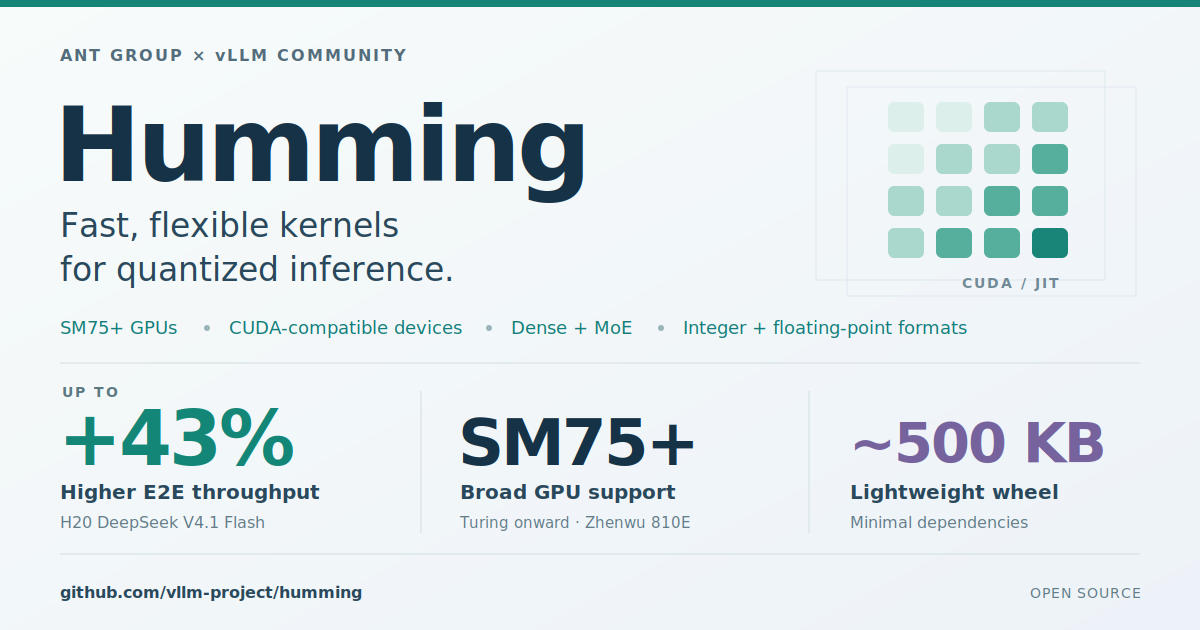
vLLM and Ant Group open-source Humming, one quantized-inference kernel library for many formats and every NVIDIA GPU since Turing, lifting DeepSeek-V4.1-Flash end-to-end throughput by 14-43%

On Oct 21 the vLLM community and Ant Group open-sourced Humming (Apache 2.0), a quantized-inference library that JIT-compiles GEMM kernels on demand. It supports every NVIDIA architecture from Turing on plus T-Head's Zhenwu 810E, and covers weight and activation combinations from INT1-INT8 and FP4-FP8 for dense and MoE workloads. In vLLM's microbenchmarks it runs 2-5x faster than vLLM Marlin, FlashInfer or DeepGEMM in some cases; on 8 H20 GPUs, switching DeepSeek-V4.1-Flash MoE from Marlin W4A16 to Humming W4A8 raised throughput 14-43%. vLLM 0.29.0 ships it built in.

vLLM and Ant Group open-source Humming, one quantized-inference kernel library for many formats and every NVIDIA GPU since Turing, lifting DeepSeek-V4.1-Flash end-to-end throughput by 14-43%

Key Takeaways

  • One JIT kernel framework instead of a hand-written kernel per format: WNA16, W8A8, W4A8, W4A4, INT1-INT8 and FP4-FP8 weights, dense and MoE
  • Hardware: every NVIDIA GPU from Turing (SM75) on, including Blackwell SM100/103/120/121, plus T-Head Zhenwu 810E
  • End to end: DeepSeek-V4.1-Flash on 8x H20 at TP=8, Humming W4A8 beats Marlin W4A16 by 14-43% in throughput and cuts mean TTFT 25-32%; at concurrency 64 output goes from 442 to 634 tok/s
  • Microbenchmarks run by the vLLM community: W4A8-MXFP4 on H200 is about 4.5x DeepGEMM W8A8, and the B300 MoE Grouped path is about 5x Marlin; one W4A16 kernel compiles in 1.82 s versus 23.35 s for CUTLASS
  • Use: pip install humming-kernels (about a 500 KB wheel); built into vLLM 0.29.0+, enable with --linear-backend humming --moe-backend humming
Read full story

Eagle releases EAGLE-4, a speculative-decoding drafter that adapts to batch size and hardware; it reports 961.6 tok/s on Qwen3.8-27B for a single request

On Oct 20, inference company Eagle released EAGLE-4, the fourth generation of the EAGLE speculative-decoding family. One drafter resizes its speculative tree for the batch size, hardware and workload while keeping the target model's output distribution. Eagle reports 961.6 tokens/s for one request on Qwen3.8-27B with 4x B300. The code ships as eagle-harness v0.1.0 with plugins for SGLang, vLLM and an experimental TokenSpeed backend. Many reposts call it open source, but the official license is source-available, not OSI open source.

Eagle releases EAGLE-4, a speculative-decoding drafter that adapts to batch size and hardware; it reports 961.6 tok/s on Qwen3.8-27B for a single request

Key Takeaways

  • Vendor figure: 961.6 tokens/s on Qwen3.8-27B with TokenSpeed, BF16, 4x B300, TP4, one request, T=0 (paper Figure 1(a))
  • Repo measurements: vLLM on 4x B300 goes from 241.6 to 722.8 tok/s at concurrency 1 (2.99x) and 1.70x at concurrency 8; SGLang gets 1.91x at concurrency 8 and 1.35x at 64
  • AMD numbers too: SGLang on one MI355X gets 2.07x at concurrency 8 and 1.56x at 32 (ROCm 7.2)
  • Design: sliding-window draft layer, low-rank candidate head and append-only draft cache; the harness calibrates verify latency offline and grows the tree while gain per cost stays high
  • License: Eagle 4 Source-Available; free for noncommercial use, commercial use only under $20M trailing 12-month revenue and outside competing offerings
Read full story

Perplexity Computer Launches Natively on macOS: Full On-Device Model and Agent Execution Without Cloud Roundtrips

Perplexity officially unveiled that Perplexity Computer now operates 100% locally on macOS through the native desktop application. Breaking away from cloud-dependent computer-use paradigms that ship continuous video feeds across the internet, Perplexity Computer executes both the underlying inference model and the agent orchestration runtime directly on local Mac silicon. By interfacing natively with macOS Accessibility APIs, the system eliminates network latency, guarantees complete screen privacy, and empowers autonomous desktop copilots to orchestrate multi-application workflows entirely offline.

Perplexity Computer Launches Natively on macOS: Full On-Device Model and Agent Execution Without Cloud Roundtrips

Key Takeaways

  • Perplexity launched Perplexity Computer inside the native macOS app, hosting both model inference and agent loops locally
  • Eliminates privacy vulnerabilities of cloud-based GUI agents by keeping all screen frames and keystrokes strictly on-device
  • Achieves near-instantaneous interaction latency leveraging Apple Silicon unified memory and the Neural Engine
  • Seamlessly interfaces with native macOS Accessibility APIs and app sandboxes for cross-application workflow automation
Read full story