AI Coding Live News

LeCun and Balestriero turn the Platonic Representation Hypothesis into a theorem: a 109M text JEPA aligns with vision models better than 72B LLMs

On October 29, Randall Balestriero and Yann LeCun posted "Proving and Improving the Platonic Representation Hypothesis with JEPAs" (arXiv 2610.39302), affiliated with Brown University, NYU and AMI Labs. The paper proves that JEPAs trained separately on different modalities learn the same representation up to one rotation whenever their positive pairs are two observations of one scene ("good views"), and argues that next-token prediction is a JEPA with "bad views", which is why language models only align with vision through scale. The authors report that good views need 42x fewer training samples than next-token prediction to reach the same alignment, and that a 109M text JEPA scores 0.184 alignment with DINOv2 versus 0.154 for Qwen2.5-72B (author-reported). Code and a live demo are public; Balestriero's announcement post has about 1,054 likes and 72K views.

LeCun and Balestriero turn the Platonic Representation Hypothesis into a theorem: a 109M text JEPA aligns with vision models better than 72B LLMs

Key Takeaways

  • Paper: arXiv 2610.39302, submitted 2026-10-29 by Randall Balestriero and Yann LeCun (Brown University / NYU / AMI Labs)
  • On the PRH benchmark, the 109M text JEPA scores 0.184 alignment with DINOv2, versus 0.154 for Qwen2.5-72B and 0.151 for Llama-3-70B; with the CLIP image encoder it reaches 0.23 against a previous best of 0.21 (author-reported)
  • Good views reach the same alignment with 42x fewer training samples than next-token prediction; the authors pre-registered predictions from their alignment scaling law, trained 85 new runs, and the law was as accurate as rerunning with another seed
  • A single rotation turns separately trained encoders into an image captioner with CIDEr 0.838 on COCO; on a pair-free benchmark it hits 64% top-5 on ImageNet-100 versus at most 56% for language models up to 8B
  • Code (galilai-group/prh-proof) and a live demo are public; Balestriero's announcement post has about 1,054 likes and 180 reposts
Read full story
Linked Models & Agents:

RSI-Anything Open-Sourced: Unlocking Domain-General Recursive Self-Improvement for AI Agents with World Models

Empowering AI agents to autonomously achieve Recursive Self-Improvement (RSI) through ongoing environmental interaction is a cornerstone of artificial general intelligence. However, practical RSI pipelines are severely constrained by two fundamental bottlenecks: scarce and expensive ground-truth feedback, and the degradation of predictive world models as evolving policies induce out-of-distribution drift. Researchers from HKUST, Shanghai AI Laboratory, Peking University, and CUHK introduce RSI-Anything (arXiv:2610.13912, code: github.com/Gen-Verse/RSI-Anything), a domain-general framework unlocking recursive self-improvement via predictive world models. Built upon the JEPA-Anything architecture, RSI-Anything establishes a disciplined six-stage paradigm: Propose → Predict → Select → Evaluate → Learn → Retain. By enforcing rigorous compatibility and safety gates governing policy-world model retention, the system continuously converts interaction logs into persistent capability upgrades. Across diverse domains, RSI-Anything drives substantial performance gains: boosting automated code repair success from a 26.3% baseline to 31.2% (+4.9 points), reducing GUI navigation action footprints by 39.4%, more than doubling laboratory planning scores from 21.80% to 46.01% over five iterations, and achieving a 96.15% chemical yield, with codebase fully open-sourced.

RSI-Anything Open-Sourced: Unlocking Domain-General Recursive Self-Improvement for AI Agents with World Models

Key Takeaways

  • RSI-Anything open-sources a domain-general recursive self-improvement framework powered by predictive world models
  • Six-stage P-P-S-E-L-R loop lifts code repair from 26.3% to 31.2% and cuts GUI navigation action footprints by 39.4%
  • Doubles laboratory planning scores across 5 rounds (21.80% to 46.01%) and achieves 96.15% chemical yield over Bayesian optimization
Read full story
A
AMI Labs / H-JEPA@kevinghst/H-JEPA·
👀146
🔥88

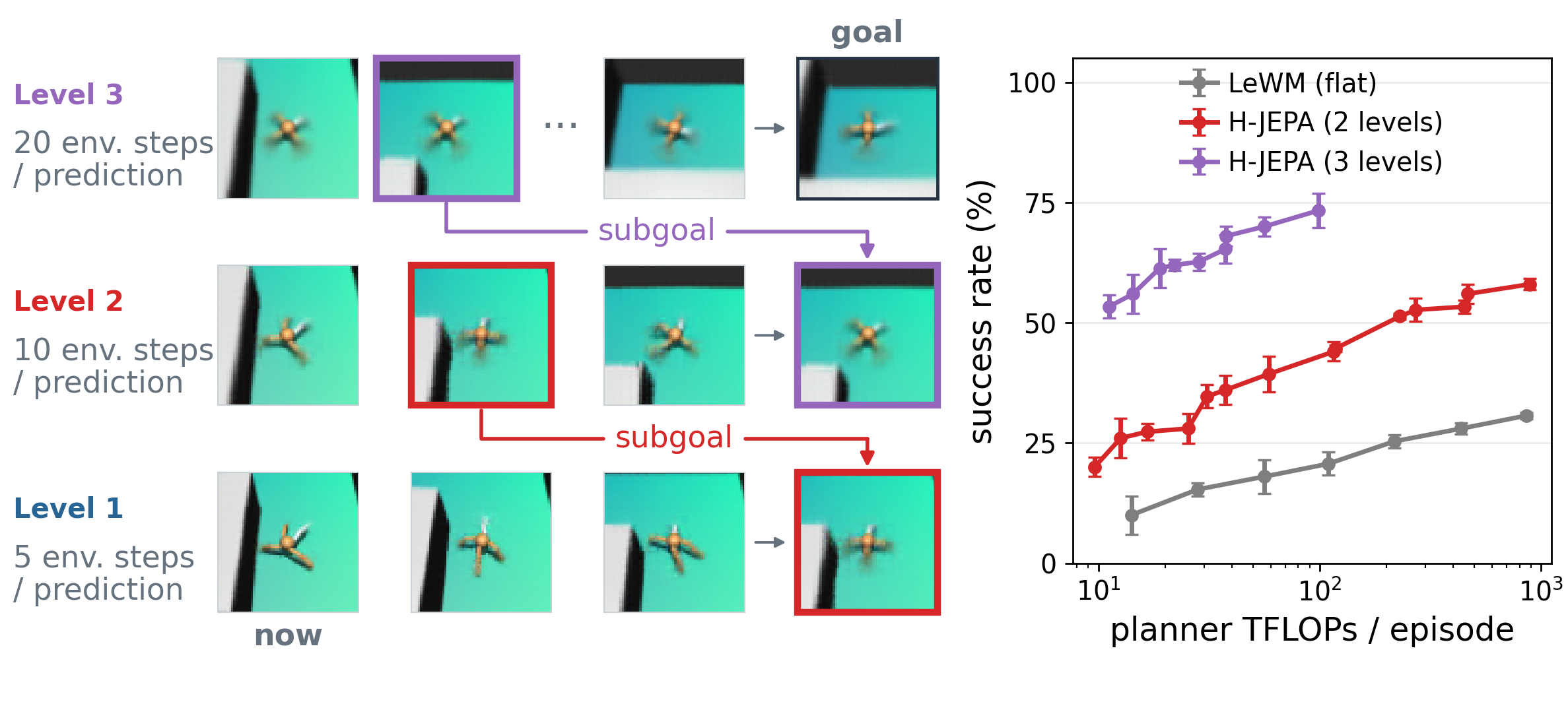
AMI Labs open-sources H-JEPA: a hierarchical JEPA world model lifts Visual AntMaze planning success from 18% to 73%

AMI Labs (Yann LeCun's Advanced Machine Intelligence) with NYU, INRIA Paris and Brown released H-JEPA (arXiv 2610.06805), an end-to-end recipe for a stack of action-conditioned JEPA world models, each predicting farther ahead in its own latent space and planning top-down via subgoals. Paper-reported: a three-level model reaches 73.3% success on Visual AntMaze vs 18.0% for flat LeWM, with less planner compute. MIT-licensed code plus 93 checkpoints are public on GitHub and Hugging Face.

AMI Labs open-sources H-JEPA: a hierarchical JEPA world model lifts Visual AntMaze planning success from 18% to 73%

Key Takeaways

  • Visual AntMaze: three-level H-JEPA 73.3%±3.5 vs flat LeWM 18.0%±3.5 (paper-reported, 3 seeds) at lower planner FLOPs
  • FourRoom Distractors: 96.0% for three-level H-JEPA vs 40.7% for flat LeWM; on AntMaze nearly 2x the shared-latent HWM baseline
  • Subgoal-tracking cost monotonicity 0.89–1.00 vs 0.48–0.75 for the full-horizon goal cost
  • Limits: three levels fail on Push-T (only 58% of LeWM's training clips); DROID needs an inverse-dynamics loss or the encoder collapses to zero score
  • MIT code plus 93 checkpoints (~12.4 GB) on Hugging Face across AntMaze, FourRoom, Cube, Push-T and DROID
Read full story
Linked Models & Agents:
⚡ H-JEPA⚡ LeWorldModel (LeWM)⚡ V-JEPA 2🌐 AMI Labs🌐 NYU🌐 INRIA🌐 Brown University