AI Coding Live News

Alibaba Cloud opens a Netherlands region at its first international Apsara Conference, plans agentic AI services, and JetBrains explores Qwen for Junie

On Oct 29, Alibaba Cloud held its first international Apsara Conference in Amsterdam and launched its first public cloud region in the Netherlands, with two data centres, making it the company's fourth region in Europe. It plans to bring agentic AI services to the region, including ACS Agent Sandbox, Agent Security Center, AI Security Guardrails 2.0, Agentic SOC and STAROps, and unveiled a new generation of its Apsara Stack hybrid cloud. On the partner side, JetBrains is working with Alibaba Cloud to explore Qwen models for its Junie coding assistant, in both cloud and local setups.

Alibaba Cloud opens a Netherlands region at its first international Apsara Conference, plans agentic AI services, and JetBrains explores Qwen for Junie

Key Takeaways

  • The Netherlands region has 2 data centres and is Alibaba Cloud's 4th in Europe after Frankfurt, London and Paris; the global footprint is now 32 regions and 109 availability zones (company figures)
  • Five agentic AI services are planned for the region: ACS Agent Sandbox (hardware-level isolation), Agent Security Center, AI Security Guardrails 2.0, Agentic SOC and STAROps
  • The new Apsara Stack offers 80+ cloud and AI products; Alibaba says AI-driven operations reach 92.5% accuracy and a 70% automation rate
  • JetBrains is exploring Qwen models for Junie, running either in-region in the cloud or fully local; orq.ai, Monks, Magnific and Idea.ai also integrate Alibaba models
  • Over the next 12 months Alibaba plans its first region in Finland and more data centre capacity in Germany and France, as part of its previously announced US$53B AI and cloud investment
Read full story
Linked Models & Agents:

Android Studio Rabbit 2 goes stable with Bring Your Own Agent: 40+ coding agents including Claude Agent, Codex and Antigravity via the open ACP

On Oct 28, the day of Android Dev Summit, Google shipped Android Studio Rabbit 2 (2026.2.2) to the stable channel. The headline change is that Bring Your Own Agent (BYOA) moves from its September Canary preview to a stable feature: developers can plug any Agent Client Protocol (ACP) compatible coding agent into the IDE agent window. Google says more than 40 are available, including Anthropic Claude Agent, OpenAI Codex, JetBrains Junie and Google Antigravity, and users can sign in with personal or enterprise plans. The release also adds an agent skills manager, AI Change Review and agent-assisted LeakCanary fixes.

Android Studio Rabbit 2 goes stable with Bring Your Own Agent: 40+ coding agents including Claude Agent, Codex and Antigravity via the open ACP

Key Takeaways

  • Version 2026.2.2 reached the Stable channel on Oct 28; BYOA first appeared in preview with the Rabbit 2 Canary in September
  • Google says 40+ ACP-compatible agents are available; Claude Agent, Codex and Antigravity are the defaults, and others install from the registry under Settings > Tools > AI > Agents
  • Agents get IDE tools: the project graph and build diagnostics, Android SDK tools, terminal execution, emulator control, Logcat and Compose Preview
  • Sign in with personal API keys or consumer and enterprise subscriptions; the built-in Android Studio agent stays free
  • Also new: a skills manager preloaded with Android and Firebase skills, AI Change Review from three entry points, and agent-assisted LeakCanary fixes; Google's Mishaal Rahman said Android CLI users grew 10x
Read full story

llm-d 1.0 ships: the Kubernetes-native open-source distributed inference stack led by Red Hat, IBM and Google hits production readiness, with vendors reporting 3,000 self-hosted coding agents at 5-10x lower cost than commercial APIs

At PyTorch Conference North America on Oct 20, the CNCF Sandbox project llm-d released version 1.0. It turns inference engines such as vLLM and SGLang into one coordinated serving pool, and 1.0 adds multi-tenant priority and fairness scheduling (flow control), router high availability with zero-downtime rolling upgrades (DisaggregatedSet), a v1 configuration API, and agent-aware session routing with Responses API state. Founded in 2025 by Red Hat, IBM, Google Cloud, CoreWeave and NVIDIA, the project has 500+ contributors, and JetBrains, DigitalOcean and Mistral already run it in production.

llm-d 1.0 ships: the Kubernetes-native open-source distributed inference stack led by Red Hat, IBM and Google hits production readiness, with vendors reporting 3,000 self-hosted coding agents at 5-10x lower cost than commercial APIs

Key Takeaways

  • Scale (Red Hat press release, vendor-reported): GLM 5.2, roughly 753B parameters, on NVIDIA GPUs peaked at 6.6M output tokens per minute and served up to 3,000 concurrent coding agents with zero preemptions, 5-10x cheaper per token than equivalent commercial API pricing at cloud rental rates
  • Cache reuse: IBM says the prefix-aware router captured 97% of available cache reuse on an agentic coding workload; an IBM Research quantum error correction project saw ~98% prefix hits, ~$0.11 per million tokens, and 11.5x lower cost than an all-proprietary setup
  • Google Cloud figures: on Ironwood TPU, prefix-aware routing plus host memory offload cut median time-to-first-token by more than 85% and raised throughput 2.4x on an agentic coding workload; the Gemini platform doubled its prefix cache hit rate from 35% to 70%
  • New in 1.0: flow-control multi-tenant QoS, router hot-standby HA, DisaggregatedSet for coordinated prefill/decode rollouts, a v1 config API, and previous_response_id support in the Responses API
  • Ecosystem: 500+ contributors from 25+ organizations; JetBrains' free Junie Lite, DigitalOcean Serverless Inference and Mistral's tiered commercial traffic run on it; the GitHub v1.0.0 notes admit not every tracked goal shipped
Read full story

Figma Config India: Code Layers and Specs enter open beta, and agents can read and write specs and code layers through the Figma MCP server

At Config India on 2026-10-15 Figma launched agent-oriented features: Code Layers (running code on the canvas) in open beta on all plans, Specs (collaborative Markdown spec containers) in open beta on paid plans, Guidelines in open beta and Code Sources in closed beta. The Figma MCP server can now generate code layers and read/write Specs, with 20 new MCP partner integrations including OpenCode and JetBrains Junie.

Figma Config India: Code Layers and Specs enter open beta, and agents can read and write specs and code layers through the Figma MCP server

Key Takeaways

  • Code Layers: open beta on all plans, created from designs, local folders, GitHub, MCP or Chrome-extension page capture; uses AI credits, free on paid plans through 2026-11-04
  • Specs: open beta on Professional/Organization/Enterprise across web, desktop and mobile; pasting a Spec link into a coding agent carries Markdown, frame references, code layers and Code Connect snippets
  • MCP: the figma-spec skill lets agents read, create and update Specs; use_figma canvas writes remain a free beta with up to 20 KB output per call
  • Design systems: Guidelines open beta and Code Sources closed beta (import from a GitHub repo or npm package) on paid plans; Payload lands in Figma Make, with downloads up 6x in 12 months per Figma
  • Ecosystem: 20 new MCP partner integrations including OpenCode, Dia, JetBrains Junie and Meta Muse; the Figma agent is generally available
Read full story
ADSponsored

JetBrains Unveils SWE-TaskFlow: Aligning Coding Agent Benchmarks with Real Developer IDE Workflows

Mainstream coding agent benchmarks like SWE-bench frame evaluation around issue-derived tasks: feeding an agent a bug description and expecting an end-to-end patch. But does this reflect genuine developer practices? JetBrains Research analyzes 4,782 production sessions of professional software engineers inside JetBrains IDEs (arXiv:2610.09633). For long interactive sessions (>=3 turns, comprising 33% of production traffic), user requests span a diverse mix of intent types—project codebase Q&A, strategic planning, code review, refactoring, and test execution—with users frequently transitioning between types mid-session. To align benchmarks with real developer task flows, JetBrains introduces SWE-TaskFlow, an approach that transforms issue-based benchmarks via prompt-splitting and verifiable repository QA into calibrated multi-stage workflows guided by a TaskFlow Alignment Score (TFAS). A pilot study across 700 SWE-Bench Pro tasks demonstrates that sequential multi-step interaction protocols nearly double agent inference expenditure without stable improvements in resolve rates, proving that the interaction protocol itself is a critical, previously unmeasured dimension of agent evaluation.

JetBrains Unveils SWE-TaskFlow: Aligning Coding Agent Benchmarks with Real Developer IDE Workflows

Key Takeaways

  • JetBrains analyzes 4,782 production IDE sessions, proving real software engineers navigate dynamic multi-intent task flows
  • Introduces SWE-TaskFlow and TFAS to transform issue benchmarks into realistic multi-turn developer interaction protocols
  • Pilot across 700 SWE-Bench Pro tasks reveals multi-turn protocols double token costs without stable success gains
Read full story
Linked Models & Agents:

JetBrains ships Mellum2.1: 12B MoE (2.5B active) open coding-agent model, SWE-bench Verified jumps 2.0→47.0

On Oct 8 JetBrains released Mellum2.1 Thinking: same 12B MoE / 2.5B active / 131K / Apache 2.0 architecture, with gains almost entirely from large-scale RL in real sandboxes. Self-reported same-pipeline scores: SWE-bench Verified 47.0 (vs Mellum2 2.0), LiveCodeBench v6 82.0. On Hugging Face; vLLM serve now; GGUF/MTP coming soon.

Key Takeaways

  • Spec: 12B MoE / 2.5B active, 131K context, Apache 2.0; architecture unchanged vs Mellum2 (HF card)
  • Agentic jump (same pipeline): SWE-bench Verified 2.0→47.0, SWE-bench Pro 0.0→28.0, Terminal-Bench 2.1 0.6→17.4 (Pi v0.73.1)
  • Coding: LiveCodeBench v6 82.0 (leads Qwen3.5-9B 75.4), HumanEval+ 91.5, BFCL v4 62.3
  • Speed: fastest under load in JetBrains’ group; MTP ~1.6× single-request; still trails Qwen3.5-9B on SWE Verified 50.0 / Pro 38.0
  • Ship: vllm serve JetBrains/Mellum2.1-12B-A2.5B-Thinking --reasoning-parser qwen3; GGUF/Ollama/LM Studio/MTP head coming (blog)
Read full story
Linked Models & Agents:
⚡ Mellum2.1⚡ Mellum2⚡ Qwen3.5-9B⚡ Gemma 4 E4B🤖 Pi🌐 JetBrains
A
AICoder Editorial@aicoder·
👀79
🔥90

Developer 'A vs B' comparison intent surges: Sonnet 5.5, Sol, Argon, Air, and Copilot Computer Use collide in one week

Over ~7 days, Claude Sonnet 5.5, GPT-6.1 Sol, Gemini 4 Argon, JetBrains Air in IDEs EAP, and GitHub Copilot Computer Use landed in the same window. Search and HN discourse shifted from single-release chase to pairwise selection on price bands, terminal agents, IDE harnesses, and computer-use. Meta industry brief for readers without X.

Key Takeaways

  • Same-week cascade: Sonnet 5.5 in Copilot (09-28) → Sol in Copilot (09-29) → Argon Fairwind preview (09-30) → Air EAP + Copilot Computer Use (10-01)
  • Hot pairs: Sonnet↔Opus, Sonnet↔Sol, Argon↔Opus/Astra, Air↔Cursor, Copilot CU↔Claude CU, Codex↔Claude Code, Sol↔Astra same-family economics
  • Selection axes: price band × terminal harness × IDE orchestration (Air ACP BYO) × computer-use for GUI-only legacy
  • Compliance caveat: Anthropic subscription auth ToS constrains third-party harnesses; Air docs allow Claude subscription via terminal full-screen tab only
  • Argon still Fairwind-gated (not GA); no public developer GA date—label comparison pages as preview-gated
Read full story

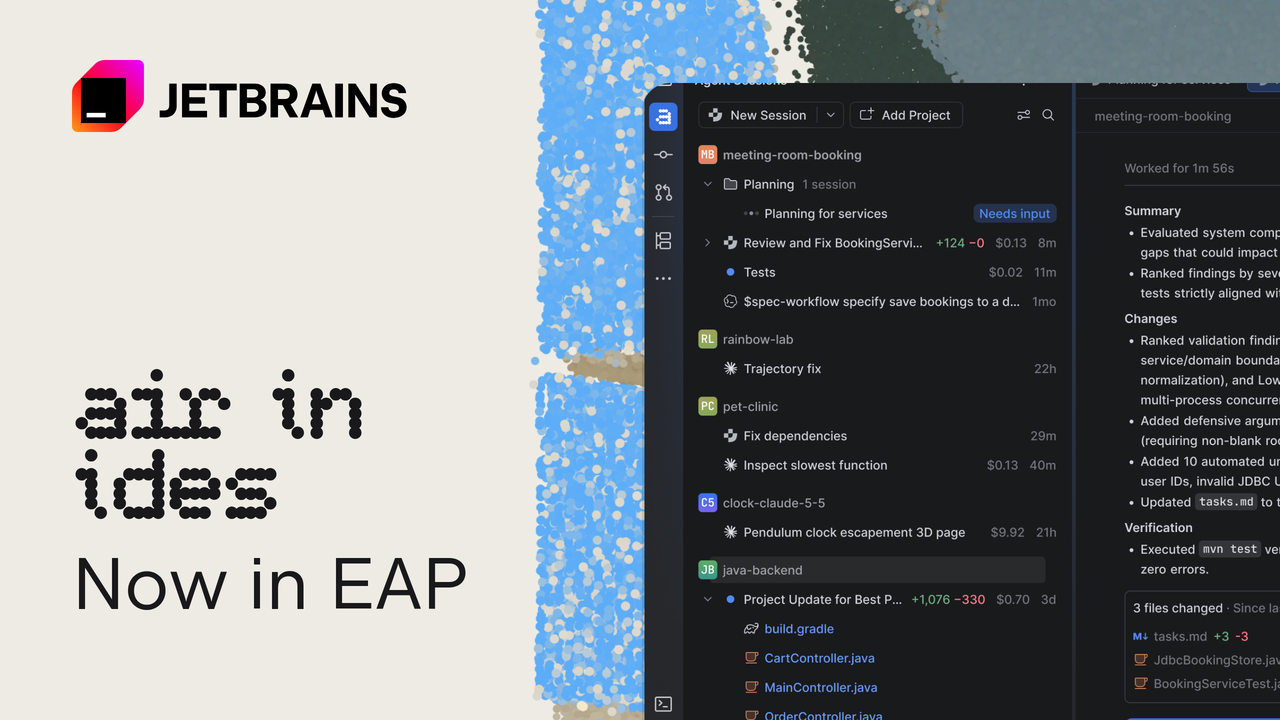
JetBrains Air in IDEs EAP: Marketplace/2026.3 native, free Junie Lite, ACP for Codex·Copilot·Claude·Cursor

On 2026-10-01 JetBrains opened the Air in IDEs EAP: an agentic session workspace via Marketplace plugin #33314 or native 2026.3 EAP builds. Ships with no agents; detects local ACP-compatible agents (Codex, Copilot, Claude, Junie, Cursor, …); free Junie Lite with JetBrains Account. Not an AI provider—third-party traffic goes to your vendor.

JetBrains Air in IDEs EAP: Marketplace/2026.3 native, free Junie Lite, ACP for Codex·Copilot·Claude·Cursor

Key Takeaways

Read full story

Kilo Code 7.8.1: Agent Manager browser for public HTTPS/CDN previews; CycloneDX SBOM on every artifact

Kilo-Org shipped open-source coding agent platform Kilo Code v7.8.1 (includes 7.8.0) on 2026-09-25. 7.8.0 brings a high-resolution streamed Agent Manager browser for public HTTPS pages and CDN assets in localhost previews, with install/retry/settings guidance, native cross-origin checks, ordered clipboard, and stalled-session cleanup; plus close-task commands and a stoppable session-cleanup pass. 7.8.1 publishes CycloneDX SBOMs for every CLI archive, npm package, container image, VS Code extension, and JetBrains plugin—SHA-256 bound and GitHub-attestation signed. Azure Entra ID accepts resource name or full endpoint URL.

Kilo Code 7.8.1: Agent Manager browser for public HTTPS/CDN previews; CycloneDX SBOM on every artifact

Key Takeaways

  • Shipped: v7.8.1 / @kilocode/[email protected]
  • 7.8.0: Agent Manager browser for public HTTPS/CDN; close-task cmds; stoppable session cleanup
  • 7.8.1: CycloneDX SBOM + SHA-256 + GitHub attestation on every artifact
  • Azure Entra ID: resource name or full endpoint; block nested var refs in project MCP headers
  • Install: VS Code Marketplace / CLI / JetBrains; docs at kilo.ai/docs
Read full story

JetBrains launches Air: an open agentic product system for developers, teams, and governance

JetBrains (@jetbrains) announced JetBrains Air, an open product system for agentic software development that connects IDE-side agent orchestration, team workflows, and organizational governance (formerly JetBrains Central). Air is multi-vendor: steer Claude, Codex, Gemini CLI, and JetBrains Junie inside JetBrains IDEs, and plug in other harnesses via the Agent Client Protocol (ACP). The company blog also outlines Air Teams and Air Governance.

JetBrains launches Air: an open agentic product system for developers, teams, and governance

Key Takeaways

  • Air unifies IDE agent UX, team workflows, and org governance as one open system.
  • Orchestrate multi-vendor agents (including Junie) in JetBrains IDEs; ACP for compatible harnesses.
  • Air Governance (ex-Central) covers policy, visibility, audit, and AI cost control.
Read full story
Linked Models & Agents:
ADSponsored

GitHub Copilot for JetBrains 1.18: assisted approvals, org skills, Codex plan mode

GitHub Changelog (@GHchangelog) announced Copilot for JetBrains 1.18.0: public-preview AI-assisted tool approvals auto-approve low-risk calls; organization and enterprise shared skills/instructions; and plan mode for the Codex agent so you can review a plan before implementation. You can also re-edit earlier messages (rewinding chat and file edits) and chat alongside sessions.

Key Takeaways

  • Assisted approvals (public preview) auto-approve low-risk tool calls.
  • Org/enterprise skills and custom instructions work in local and agent sessions.
  • Codex agent gains plan mode; re-edit earlier messages to rewind chat and file edits.
Read full story

JetBrains 2026.2.2 Ships AI Agent Setup Widget with Deep Model Context Protocol Support

JetBrains released Rider and ReSharper 2026.2.2 featuring a dedicated AI Agent Setup widget. Developers can visually discover, configure, and authenticate MCP-compliant external tools, databases, and agent skills directly within the IDE.

Key Takeaways

  • Out-of-the-box AI Agent Setup widget embedded in Rider and ReSharper
  • Native Model Context Protocol (MCP) support for seamless tool and agent linking
  • Granular permission management and audit logging for enterprise codebases
Read full story
Linked Models & Agents:

GitHub Copilot adds Gemini 3.8 Flash to the model picker, including Pro seats

Gemini 3.8 Flash is now in the GitHub Copilot model picker across Pro, Pro+, Max, Business, and Enterprise—on VS Code, Visual Studio, Copilot CLI, cloud agent, Copilot app, JetBrains, Xcode, and Eclipse. Unlike GPT-6 Astra, Flash is available on plain Pro; introductory usage-based provider pricing runs through 2026-12-31.

Key Takeaways

  • Gemini 3.8 Flash is in Copilot's model picker, including plain Pro.
  • Surfaces: VS Code, Visual Studio, Copilot CLI, cloud agent, JetBrains, and more.
  • Introductory usage-based provider pricing through 2026-12-31; Biz/Enterprise still auto-enable new models unless policy is off.
Read full story

GitHub Copilot: GPT-6 Astra generally available for long-horizon autonomous coding

GitHub says OpenAI GPT-6 Astra is generally available in GitHub Copilot for long-horizon, autonomous coding and agentic work. Internal testing highlights plan-and-validate loops, batched diagnosis with verification, and self-confirmation before task completion—stronger long-horizon coding with fewer steps than prior OpenAI models. Available to Copilot Pro+, Max, Business, and Enterprise in VS Code, Visual Studio, Copilot CLI, coding agent, Copilot app, github.com, Mobile, JetBrains, Xcode, and Eclipse; billed at provider list pricing under usage-based billing, with admin model-policy controls.

Key Takeaways

  • Availability: Copilot Pro+/Max/Business/Enterprise can pick Astra in IDE, CLI, coding agent, and Copilot app.
  • Behavior: plan-and-validate loops with batched diagnosis cut steps on long-horizon coding.
  • Billing/governance: provider list pricing under usage-based billing; admins control access via model policy.
Read full story
Linked Models & Agents:

JetBrains launches Junie AI with deep IDE core integration, leveraging IntelliJ & PyCharm AST compiler verification

JetBrains announced a major upgrade to its autonomous coding agent Junie. By directly interfacing with IntelliJ and PyCharm compiler frontends, Junie performs in-memory AST and type verification during generation, eliminating 99% of undefined symbol errors and syntax violations before code is even written to disk.

Key Takeaways

  • Directly hooks into IntelliJ / PyCharm compiler frontends and static analyzers.
  • Pre-validates types and ASTs during streaming generation to prevent hallucinated symbols.
  • Supports complex multi-file refactoring across Java, Kotlin, Python, and TypeScript.
Read full story
Linked Models & Agents: