AI Coding Live News

X discussion: Anthropic's head of platform engineering says a team with no Rust developers had Claude port the whole Messages API to Rust, cutting CPU by roughly 40-50%

Katelyn Lesse, Anthropic's head of platform engineering, said on the Latent Space podcast (published Oct 27) that a Rust version of the Messages API fully rolled out the previous week. The old system was a CPU-hungry Python monolith, the team started with "not a single Rust developer", humans designed and verified the system, Claude wrote the implementation, and shadow traffic compared outputs between the old and new versions. Her ballpark figures are roughly 40-50% less CPU and 10-20% better time to first token. A clip posted by Somi (@somi_ai) drew 1,000+ likes and about 140K views on X and was quoted by swyx and others, with the debate centered on whether "never do the big rewrite" is now outdated advice. These are X discussion views and spoken estimates; Anthropic has not published a written engineering report.

X discussion: Anthropic's head of platform engineering says a team with no Rust developers had Claude port the whole Messages API to Rust, cutting CPU by roughly 40-50%

Key Takeaways

  • The first-hand source is Katelyn Lesse speaking on the Latent Space episode "How Anthropic ships Claude with Claude", in the "56:05 Rebuilding the Messages API in Rust" segment
  • Lesse said the move was driven by CPU becoming a bottleneck as usage surged; CPU now has to be capacity-planned in advance, and research sandboxes, product sandboxes and CI all draw from the same pool inside Anthropic
  • The team forked the entire API in Rust in one go, ran shadow traffic to confirm the Python and Rust outputs matched, then turned it on gradually, deliberately adding no new features during the port
  • Her ballpark is about 40-50% CPU savings and 10-20% better time to first token, with larger gains on longer-running workloads; these are spoken estimates from the podcast, not a formal benchmark
  • On X, Somi called "never do the big rewrite" dead advice and swyx said Anthropic "vibecoded their entire backend to Rust"; the latter is an exaggeration, since Lesse only discussed the Messages API
Read full story
Linked Models & Agents:

Latent World Action Model for GUI Agents: Slashing Inference Latency by 98.9% While Boosting Task Success by 40.6%

Pixel-space world models for GUI agents require predicting future screen images prior to action selection. However, full-screen pixel reconstruction suffers from extreme latency and frequently triggers identity shortcuts, where generated screens merely copy the past rather than reflecting action-induced mutations. Researchers from KAIST introduced the first Latent World Action Model for GUI agents, shifting predictive objectives from pixel generation to action-conditioned transitions in latent space. Featuring shared multimodal representations with decoupled action and transition heads alongside action-aware contrastive losses, the framework achieves up to a 40.6% relative gain in online task success while reducing inference latency by 98.9%.

Latent World Action Model for GUI Agents: Slashing Inference Latency by 98.9% While Boosting Task Success by 40.6%

Key Takeaways

  • Eliminating pixel reconstruction overhead: shifts future-state modeling from costly pixel diffusion to action-conditioned latent transitions, bypassing the identity shortcut
  • Decoupled dual-head with contrastive alignment: leverages shared multimodal representations with specialized action and transition heads to isolate action-induced deltas
  • Dramatic efficiency leap: delivers up to a 40.6% boost in online GUI success rate while reducing inference latency by 98.9% for real-time desktop execution
Read full story
Linked Models & Agents:
⚡ Latent-WAM⚡ Pixel-World-Model⚡ Claude 3.5 Computer Use🤖 GUI Agents🤖 Desktop OS Agents🌐 KAIST🌐 Yonsei University
A
AMI Labs / H-JEPA@kevinghst/H-JEPA·
👀157
🔥88

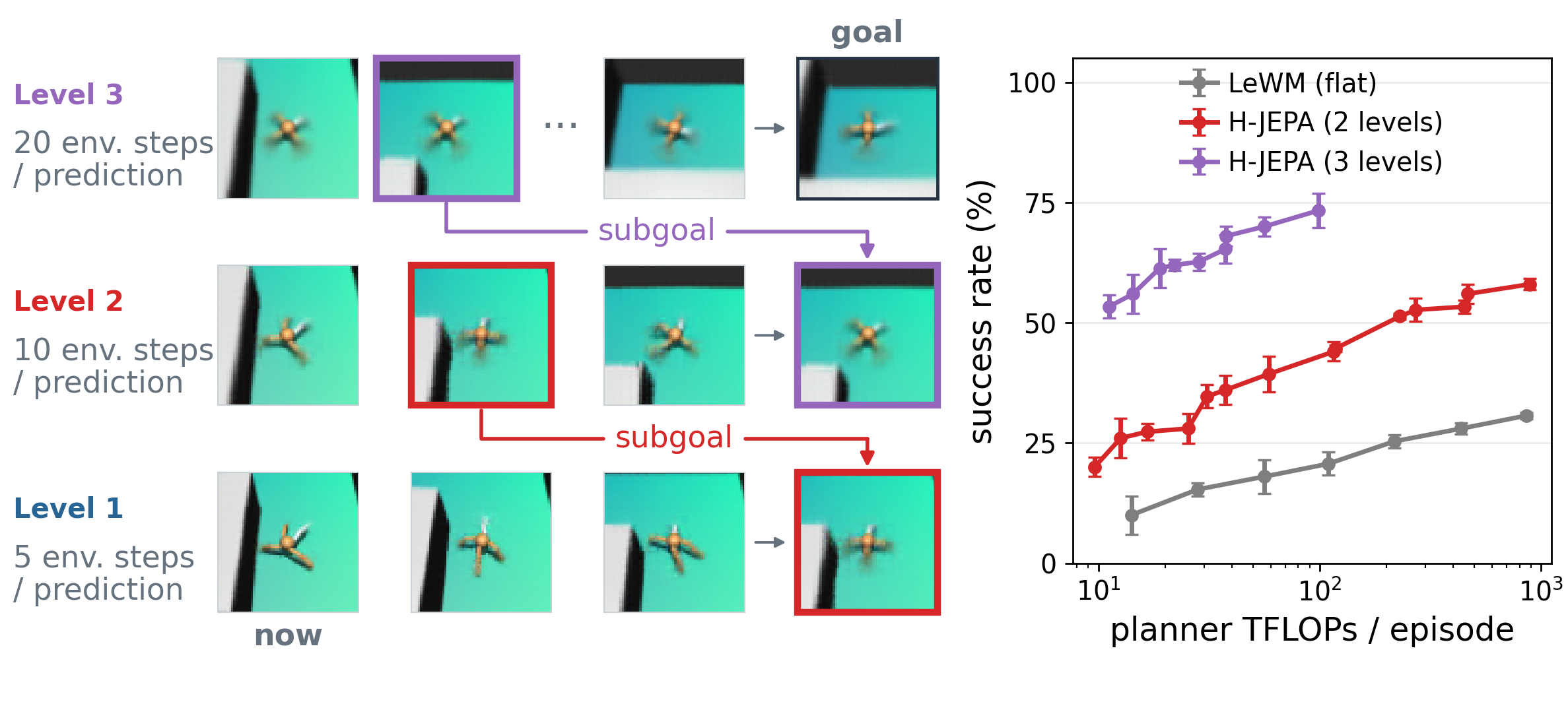
AMI Labs open-sources H-JEPA: a hierarchical JEPA world model lifts Visual AntMaze planning success from 18% to 73%

AMI Labs (Yann LeCun's Advanced Machine Intelligence) with NYU, INRIA Paris and Brown released H-JEPA (arXiv 2610.06805), an end-to-end recipe for a stack of action-conditioned JEPA world models, each predicting farther ahead in its own latent space and planning top-down via subgoals. Paper-reported: a three-level model reaches 73.3% success on Visual AntMaze vs 18.0% for flat LeWM, with less planner compute. MIT-licensed code plus 93 checkpoints are public on GitHub and Hugging Face.

AMI Labs open-sources H-JEPA: a hierarchical JEPA world model lifts Visual AntMaze planning success from 18% to 73%

Key Takeaways

  • Visual AntMaze: three-level H-JEPA 73.3%±3.5 vs flat LeWM 18.0%±3.5 (paper-reported, 3 seeds) at lower planner FLOPs
  • FourRoom Distractors: 96.0% for three-level H-JEPA vs 40.7% for flat LeWM; on AntMaze nearly 2x the shared-latent HWM baseline
  • Subgoal-tracking cost monotonicity 0.89–1.00 vs 0.48–0.75 for the full-horizon goal cost
  • Limits: three levels fail on Push-T (only 58% of LeWM's training clips); DROID needs an inverse-dynamics loss or the encoder collapses to zero score
  • MIT code plus 93 checkpoints (~12.4 GB) on Hugging Face across AntMaze, FourRoom, Cube, Push-T and DROID
Read full story
Linked Models & Agents:
⚡ H-JEPA⚡ LeWorldModel (LeWM)⚡ V-JEPA 2🌐 AMI Labs🌐 NYU🌐 INRIA🌐 Brown University

Your Transformer Can Hold Two Thoughts at Once: Evidence of Linear Superposition in LLMs Enables Single-Pass Dual Generation

While Large Language Models rely on deep non-linear activation layers, a groundbreaking mechanistic study titled 'Your Transformer Can Hold Two Thoughts at Once' (arXiv:2609.29845) demonstrates that transformer architectures exhibit fundamental linear superposition. When inputs from two distinct textual contexts are linearly combined in latent space, the model outputs a superposition of the individual next-token probability distributions. The authors reveal this superposition is an intrinsic architectural property that decays during pretraining but can be restored via lightweight fine-tuning. Furthermore, the team introduces a guided decoding procedure that cleanly disentangles superposed representations, enabling the simultaneous generation of two coherent, independent continuations from a single forward pass.

Your Transformer Can Hold Two Thoughts at Once: Evidence of Linear Superposition in LLMs Enables Single-Pass Dual Generation

Key Takeaways

  • Formulates and verifies the Superposition Linearity Hypothesis, proving transformers inherently superpose text streams
  • Demonstrates lightweight fine-tuning eliminates divergence between superposed predictions and averaged distributions
  • Introduces guided decoding to generate two distinct, fully coherent textual continuations from a single forward pass
Read full story
ADSponsored

University of Pisa Studies SAE Latent Spaces: Parts-of-Speech Emerge in Compact Sparse Clusters, Not Monosemantic Latents

Researchers from the Computational Linguistics Laboratory (CoLingLab) at the University of Pisa published an empirical breakthrough on mechanistic interpretability for LLMs, open-sourcing their findings and codebase on GitHub (arXiv:2609.29362). Using Part-of-Speech (PoS) morpho-syntactic categories as a controlled testbed, the study investigates whether grammatical structure in Sparse Autoencoders (SAEs) resides in isolated monosemantic latents or distributed feature geometries. Findings reveal that while PoS categories are readily recoverable from SAE activations and cannot be reduced to lexical memorization, they do not map 1:1 to single latents. Instead, categories are localized in compact, stable clusters of sparse latents with distinct behavior between open and closed classes.

University of Pisa Studies SAE Latent Spaces: Parts-of-Speech Emerge in Compact Sparse Clusters, Not Monosemantic Latents

Key Takeaways

  • Refuting 1:1 monosemanticity: proves morpho-syntactic categories do not map to isolated single latents in Sparse Autoencoders
  • Compact latent clusters: categories are collectively represented by compact, structured groups of sparse latents with clear open/closed class divergence
  • Beyond lexical memorization: controlled counter-experiments confirm high recovery rates stem from true structural abstraction rather than word memorization
  • Out-of-distribution stability: identified PoS feature clusters remain robustly predictive across held-out corpora with interpretable category overlaps
  • Open-source evaluation suite: full extraction pipelines, linear probing tools, and latent visualization scripts published on GitHub
Read full story
Linked Models & Agents:

Latent Space: 20B+ tokens on Astra show full AI-eng workflows under ~$6/hour

Latent Space says it spent over 20B tokens putting GPT-6 Astra through real AI-engineering work—model selection/training, labeling and active learning, keeping pipelines saturated, instrumentation/logs, one-shot deploy-and-debug, and commanding/evaling subagents—claiming serious workflows at under about $6 per hour, beyond Blender demos and games.

Key Takeaways

  • Covers train/select models, labeling/active learning, saturated pipelines, logs, and one-shot deploy/debug.
  • Can fan out and eval subagents (including agents on other models) with multi-billion-token coherence.
  • Cost claim: serious AI-eng load at under ~$6/hour; longform at latent.space/p/astra.
Read full story
Linked Models & Agents:

Swyx Analyzes Evolution of Agentic Coding Muscle Memory: From Inline FIM to Terminal Subagent Harnesses

Latent Space host Swyx publishes an in-depth analysis on the dramatic shift in developer muscle memory. As compound AI systems and MCP mature in 2026, top engineers are shifting from inline tab autocompletion to terminal subagent harnesses with autonomous TDD verification.

Key Takeaways

  • Swyx explores the shift from inline autocomplete to terminal subagent delegation;
  • Compound AI Systems replace single-prompt workflows in enterprise engineering;
  • Multi-agent test-driven verification becomes the gold standard for developer velocity.
Read full story