
AI Coding Live News

Meta FAIR Open-Sources e-means, a Drop-In k-means Replacement: Lower Loss in About One-Tenth the Epochs, 10-45x Faster Than Flash-KMeans on GPU, Now in FAISS 1.16.0

On November 10, Meta FAIR researcher Swann Bessa announced e-means on X, a clustering algorithm that replaces classic Lloyd k-means and is open-sourced in FAISS 1.16.0. It swaps full-batch iterations for mini-batch updates with exponential moving averages, and fitted scaling laws set the batch size and step size automatically, so k is the only setting. The paper says that on a range of embedding datasets e-means beats the loss Lloyd reaches after 25 epochs in 1.4 to 2.6 epochs, running 10-45x faster than Flash-KMeans on GPU and 8-15x faster than FAISS k-means on CPU (authors' figures). Teams building vector indexes, RAG pipelines, or dedup jobs can speed up this step directly.
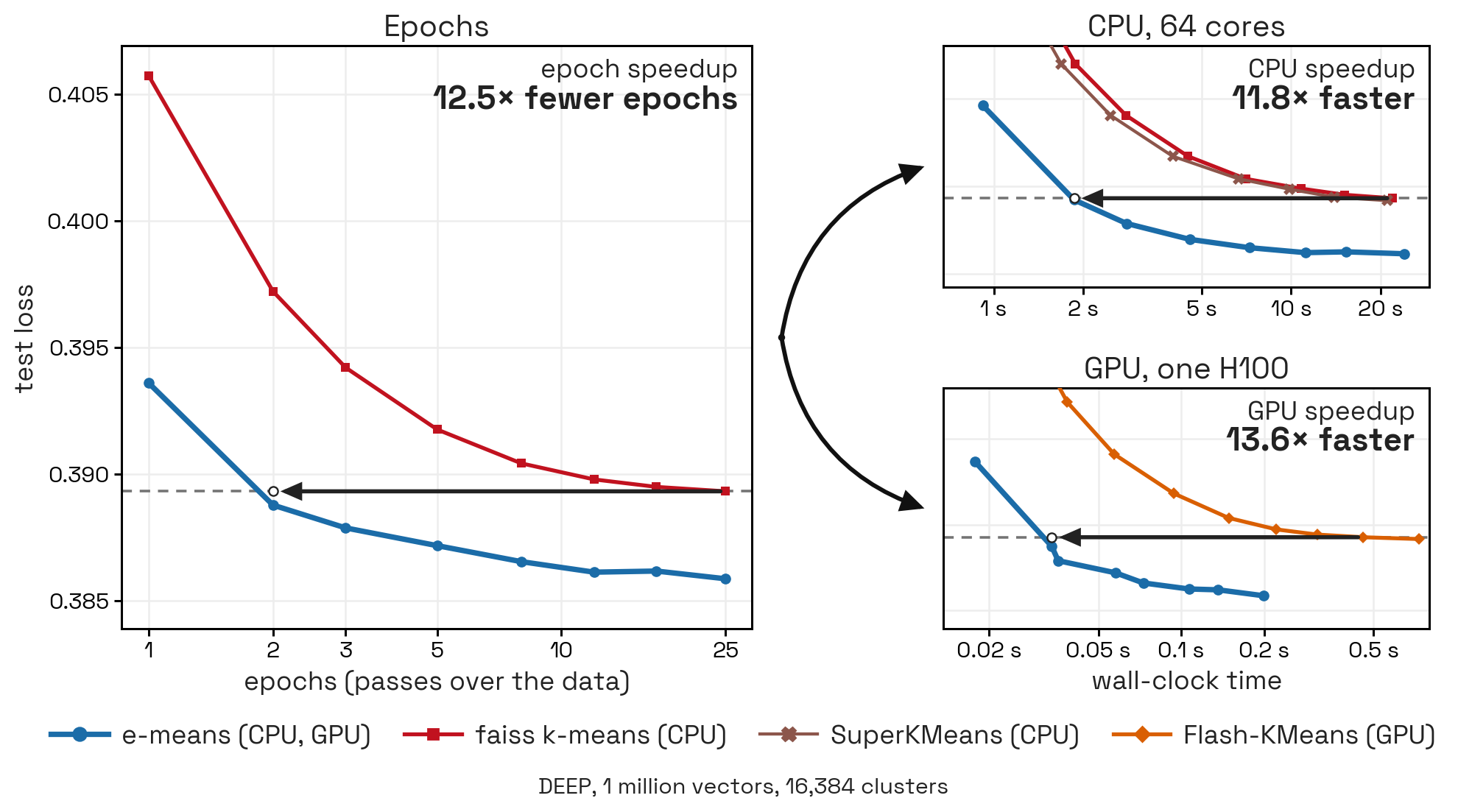
Meta FAIR Open-Sources e-means, a Drop-In k-means Replacement: Lower Loss in About One-Tenth the Epochs, 10-45x Faster Than Flash-KMeans on GPU, Now in FAISS 1.16.0

Key Takeaways

  • Epochs: on a range of embedding datasets it beats Lloyd's 25-epoch test loss in 1.4-2.6 epochs; each of the 11 VIBE datasets needs only 1.6-2.4 epochs (paper/authors' figures)
  • Speed: 10-45x faster than Flash-KMeans on GPU and 8-15x faster than FAISS k-means on CPU; on one H100 with 10M vectors and 65,536 clusters, 25 Flash-KMeans epochs take 14-22 seconds
  • Scale: it splits 10 billion DINO embeddings into 16 million clusters in 2.5 epochs, below Lloyd's loss at 25 epochs
  • Dead clusters: with 1M vectors and k=16,384, reviving by proportionally splitting large clusters keeps dead clusters at 0.1%-0.3%, versus 4.6%-14.3% for EnCodec-style resampling
  • Getting started: from faiss.contrib.e_means import Emeans, 5 epochs by default, PyTorch and NumPy supported; paper arXiv:2611.09501
Read full story
Linked Models & Agents:

ProWAM: Meta FAIR and SJTU Advance World Action Modeling with Progressive Sparse Sub-Goal Visual Planning

World Action Models (WAMs) represent a foundational robotic paradigm by predicting future visual dynamics and Cartesian actions directly from initial observations. However, existing WAMs struggle with long-horizon execution: synthesizing dense video rollouts incurs prohibitive computational overhead and temporal drift, while predicting single terminal frames deprives the policy of progressive visual guidance. Meta FAIR and Shanghai Jiao Tong University introduce ProWAM (arXiv:2610.02508), an efficient architecture that jointly predicts actions and an ordered sequence of sparse visual sub-goals. Sub-goal prediction scales naturally by learning from large-scale action-free video datasets, decoupling complex visual foresight from low-level policy control. ProWAM executes a single video-backbone forward pass to cache sparse sub-goal features, enabling rapid closed-loop replanning through lightweight action denoising without full video re-generation. Evaluated across extensive robotic benchmarks, ProWAM sets SOTA records on LIBERO-Plus (85.8%, +35.9% relative gain) and randomized RoboTwin (75.7%). In real-world zero-shot physical manipulator trials, ProWAM achieves a 70.0% success rate in unseen environments, outpacing the strongest baseline by +15.0 percentage points (+27.3% relative gain).

ProWAM: Meta FAIR and SJTU Advance World Action Modeling with Progressive Sparse Sub-Goal Visual Planning

Key Takeaways

  • Introduces ProWAM, replacing dense video rollouts with progressive sparse visual sub-goals for robust robotic foresight
  • Executes a single video forward pass to cache sub-goal features, enabling rapid closed-loop action replanning
  • Reaches 85.8% success on LIBERO-Plus (+35.9% relative gain) and lifts zero-shot physical robot success from 55% to 70%
Read full story

UW & Meta FAIR Introduce Context Language Models (CLMs): Managing Context as Editable Files Boosts Agent Swarms by 65%

As autonomous software engineering agents operate across multi-hour and multi-day horizons, context management becomes a decisive bottleneck. Prevailing paradigms treat context as an external append-only log, managed through rigid heuristic pruning outside the model's awareness. Researchers from the University of Washington, Meta FAIR, and Ai2 introduce Context Language Models (CLMs), where language models natively manage their own context by treating it as an editable file subject to unrestricted in-situ read/write operations. Zero-shot CLMs decisively outperform state-of-the-art context management: scoring 5% higher with 59% fewer FLOPs on 12-hour EdgeBench, and delivering a 65% improvement at matched compute on a 24-hour multi-repository agent-swarm task. Co-designed with SGLang, a novel Suffix Cache Reuse serving mechanism reduces inference compute by 35%, charting a scalable path for autonomous long-horizon multi-agent systems.

UW & Meta FAIR Introduce Context Language Models (CLMs): Managing Context as Editable Files Boosts Agent Swarms by 65%

Key Takeaways

  • Intrinsic In-Situ Context Management: Replaces brittle external heuristic pruning with native model-controlled read, write, and patch primitives over an editable virtual context file.
  • Dramatic Efficiency Gains in Multi-Agent Swarms: Boosts performance by 65% at matched compute over 24-hour multi-repo agent swarms, while achieving 5% higher accuracy with 59% fewer FLOPs on 12-hour EdgeBench.
  • 35% Serving Speedup via Suffix Cache Reuse: Co-designed with SGLang, a novel KV cache reuse mechanism handles non-prefix edits to reduce inference computation by 35% at identical accuracy.
Read full story