AI Coding Live News

Microsoft Foundry Partners with fal: Kling, LTX, and MiniMax Video Models in Public Preview as First-Party Azure Service

On 2026-11-05 Microsoft and fal put Kling v3 Pro, LTX-2.5 Fast/Pro, and MiniMax H3 Max/Turbo into Foundry public preview as a first-party Azure service (@Azure amplified 2026-11-06). Vendor: US hosting and first US-hosted Kling endpoint, with per-second pricing; more models and pricing-page listings planned in coming weeks.

Microsoft Foundry Partners with fal: Kling, LTX, and MiniMax Video Models in Public Preview as First-Party Azure Service

Key Takeaways

  • Source: Microsoft Tech Community post (2026-11-05) + @Azure amplify 2026-11-06
  • Portfolio (preview): Kling v3 Pro, LTX-2.5 Fast/Pro, MiniMax H3 Max/Turbo via fal as first-party Azure Foundry service
  • Hosting: vendor US-hosted claim and first US-hosted Kling endpoint (still review each model's data terms)
  • Pricing (official USD/sec): H3 Max 1080p $0.16; Turbo $0.08; LTX Fast $0.13; LTX Pro $0.17; Kling audio off/on/voice ~$0.1232/$0.1848/$0.2156
  • Status: public preview; more models and pricing-page listings planned in coming weeks; no GA date
Read full story
Linked Models & Agents:
⚡ Kling v3 Pro⚡ LTX-2.5⚡ MiniMax H3 Max🌐 Microsoft Azure AI🌐 fal

Together AI Launches Together Compiler: Agents Continually Optimize Production Inference, Up to 2.6x Higher TPS

On November 4 Together AI launched Together Compiler (TKCC), which pairs a swarm of AI agents with a persistent inference engine to keep rewriting inference kernels for real traffic, models and hardware, as part of what it calls Polymorphic Inference. The company says that within 24 hours it reached up to 2.6x higher TPS on models such as Kimi K3, GLM 5.3, MiniMax M3.1-Flash and DeepSeek v4.1-Flash, up to 50% faster on customer workloads, and it already serves trillions of tokens a day in production.

Key Takeaways

  • Together Compiler recasts inference optimization from a classic compiler problem into an agentic search: agents propose kernel changes, a persistent engine checks speed and correctness, and only verified changes reach production
  • Together says that within 24 hours it reached up to 2.6x higher TPS on Kimi K3, GLM 5.3, MiniMax M3.1-Flash and DeepSeek v4.1-Flash, and up to 50% faster on customer workloads
  • On InferenceX low-latency batch size 1 it reports 1,111 TPS on MiniMax M3.1-Flash and 1,205 TPS on DeepSeek v4.1-Flash (company-reported); SemiAnalysis said it validated one of the results
  • The persistent engine hot-reloads candidate forward passes, cutting time to serving to 9 seconds versus 467 seconds for restarting an engine, with 252x higher experiment throughput than baseline agentic optimization systems
  • It already serves trillions of tokens a day in Together's production stack, where 40+ models are now optimized by agents
Read full story

Pruna Open-Sources P-H3-Image: MiniMax-H3 Video Model Turned Into an Image Generation and Editing Model, 8 Steps, 5x Faster, 7x Smaller

On November 3, model-compression company Pruna AI open-sourced P-H3-Image, which turns MiniMax-H3, the open-weights video model MiniMax released this summer, into a text-to-image and image-editing model. Per Pruna: sampling drops from 50 to 8 steps, a 4 MP image on one B200 goes from 12.4 s to 2.6 s, the 4-bit set is a 20 GB download (vs 143 GB for H3), and peak VRAM at 8 MP is about 21 GB. It renders 2 to 16 MP and edits with multiple reference images. Weights are on Hugging Face with native ComfyUI support. It keeps the MiniMax H3 Community License, which by default excludes the EU, UK, South Korea and the US.

Pruna Open-Sources P-H3-Image: MiniMax-H3 Video Model Turned Into an Image Generation and Editing Model, 8 Steps, 5x Faster, 7x Smaller

Key Takeaways

  • Speed (Pruna figures): 8 steps instead of 50; on one B200 a 4 MP image goes from 12.4 s to 2.6 s and 8 MP from 30.6 s to 5.8 s; the 4-bit set does 4 MP in about 6.3 s on an L40S
  • Size: the transformer shrinks from 33B to 20B parameters and the text encoder is distilled from 32B to 4B (67 GB to 9 GB); downloads are 55 GB in bf16 and 20 GB in 4-bit vs 143 GB for H3
  • Memory: peak VRAM at 8 MP is about 56 GB in bf16 and 21 GB in 4-bit; the bf16 diffusers pipeline with the prompt upsampler needs about 100 GB
  • Capabilities: renders 2 to 16 MP, strongest at photorealistic and documentary photography, film stills, anime and graphics with short text; supports multi-reference editing (8 images per the X post, 9 per the blog)
  • License: MiniMax H3 Community License; the EU, UK, South Korea and US need a separate license from MiniMax, and products must show "Powered by MiniMax H3"
Read full story
Linked Models & Agents:
⚡ P-H3-Image⚡ MiniMax-H3⚡ Qwen3.5-9B🌐 Pruna AI🌐 MiniMax🌐 Hugging Face🌐 ComfyUI

Artificial Analysis releases AA-Omniscience v1.1: 3,000 refreshed questions and a calibrated 300-question public set, with Gemini 4 Carbon leading at a Net Score of 54

On October 31, independent evaluator Artificial Analysis released AA-Omniscience v1.1, its knowledge and hallucination benchmark and part of Intelligence Index v5. The question set shrinks from 6,000 to 3,000, dropping previously public and saturated questions, fixing errors and ambiguities, and adding new ones, and a new 300-question public set on Hugging Face is calibrated to the private set's difficulty, with 0.99 Pearson and Spearman correlation on Net Score. Gemini 4 Carbon (high) leads with a Net Score of 54, ahead of Claude Opus 5.5 at 48 and Claude Fable 5.1 at 46; Fable 5.1 has the highest accuracy (68%) and Gemini 4 Argon the lowest hallucination rate (4%). Models score about 1.9 points lower than on v1 on average, and MiniMax M3.1 Flash drops 22 points. All figures are as reported by Artificial Analysis.

Artificial Analysis releases AA-Omniscience v1.1: 3,000 refreshed questions and a calibrated 300-question public set, with Gemini 4 Carbon leading at a Net Score of 54

Key Takeaways

  • The question set shrinks from 6,000 to 3,000 across 6 domains and 42 topics: 600 each for science/engineering/math and software engineering, 450 each for finance, health, humanities/social sciences and law
  • A new 300-question public set is on Hugging Face, with 0.99 correlation to private-set Net Score and a median difference of 0.0 points
  • Net Score ranking: Gemini 4 Carbon (high) 54, Claude Opus 5.5 48, Claude Fable 5.1 46; the best open-weights model, Muse Spark Open, trails Gemini 4 Carbon by 28 points
  • Claude Fable 5.1 has the highest accuracy (68%), followed by Claude Opus 5.5 (66%); Gemini 4 Argon has the lowest hallucination rate (4%)
  • Rank order keeps a 0.98 Spearman correlation with v1, but scores are 1.9 points lower on average; MiniMax M3.1 Flash falls from 16 to -6 and MiMo V2.6 Pro from 8 to -5 (vendor-reported)
Read full story
ADSponsored

Pika releases open-weight video model Pika H3 Flex: post-trained on MiniMax H3, six-step sampling, five audio stems, API from $0.01 per second

On October 29 Pika released Pika H3 Flex, a joint audio-video generator post-trained on MiniMax H3, with weights on Hugging Face, code on GitHub, and ComfyUI and Diffusers support. Pika says it distilled sampling from 50 denoising steps to six, averages about 1.8x faster DiT denoising than Fal H3 Max at 768p, and can produce a 15-second clip with soundtrack in as little as about 7 seconds; the hosted API adds 1080p to 4K upscaling and five exportable audio stems (dialogue, score, SFX, foley, ambience). All speed and quality figures are vendor-reported.

Pika releases open-weight video model Pika H3 Flex: post-trained on MiniMax H3, six-step sampling, five audio stems, API from $0.01 per second

Key Takeaways

  • Pricing (vendor figures): text/image-to-video from $0.01 per output second, reference-to-video from $0.03/s; Pika's comparison table lists MiniMax H3 at $0.08/s and Seedance 2.5 at $0.103/s
  • Speed (vendor figures): six-step sampling, about 1.8x faster DiT denoising than Fal H3 Max at 768p on average and about 2x for 10–15 s text/image-to-video; 1.60x faster end-to-end 5 s 768p generation on eight B300 GPUs
  • Ranking: Pika's product page says it scores 1293 and ranks #7 on DesignArena's text-to-video board, the highest open-weight model there
  • Release form: the Hugging Face repo is tagged as an adapter on MiniMax-H3 under an 'other' license; local inference natively supports 480p/768p with mixed stereo audio, while 4K upscaling and audio stems are hosted-API only
  • Accepts up to 12 reference inputs (image, audio, video, sketch and more) and supports style transfer, motion transfer, character swap and targeted edits
Read full story
Linked Models & Agents:
⚡ Pika H3 Flex⚡ MiniMax H3⚡ Fal H3 Max⚡ HeyGen Video⚡ Gemini Omni 1.1 Flash🌐 Pika🌐 MiniMax

SolarRenderer Breaks Generative Video: 4-Step Denoising on Greyboxes and Depths for Real-Time 768p World Synthesis

Researchers from NUS and CUHKSZ have introduced SolarRenderer (arXiv:2610.28630), a structure-conditioned generative reference rendering framework. Converting game engine grey-boxes, pose skeletons, semantic maps, and depth passes into photorealistic video, SolarRenderer adapts a frozen MiniMax-H3 33B backbone via lightweight control and 4-step generation LoRAs. Using structure-guided distribution matching, it renders stylized video in just 4 denoising steps (~12.3x faster than 50-step diffusion) and introduces a block-causal variant for real-time 768p streaming synthesis in generative game engines.

SolarRenderer Breaks Generative Video: 4-Step Denoising on Greyboxes and Depths for Real-Time 768p World Synthesis

Key Takeaways

  • SolarRenderer (arXiv:2610.28630) enables high-fidelity video rendering directly from coarse 3D geometry (grey-boxes, skeletons, depth, meshes)
  • Adapts a frozen MiniMax-H3 33B backbone with lightweight Control and 4-step LoRA modules, preserving visual priors
  • Requires only 4 denoising steps via structure-guided distribution matching, achieving a 12.3x acceleration over 50-step baselines
  • Block-causal streaming variant achieves real-time continuous 768p video generation for next-generation generative gaming engines
Read full story
Linked Models & Agents:
⚡ MiniMax-H3⚡ SolarRenderer

Hao AI Lab open-sources FastH3 Omni: MiniMax H3 distilled to 8 steps for reference-guided video and audio, with 5.6-11.9x lower end-to-end latency

On Oct 20, the FastVideo team at UCSD's Hao AI Lab open-sourced FastH3 Omni, a distilled version of MiniMax H3's reference-to-video-and-audio (Ref2VA) model that generates video with synchronized stereo audio from text plus up to nine images, video clips and voice references. Sampling drops from 50 steps to eight transformer evaluations, cutting end-to-end latency 5.6-11.9x on eight GB200s by the team's measurements. Training code is open, with NVFP4 weights for DGX Spark and RTX 5090 and ComfyUI support.

Hao AI Lab open-sources FastH3 Omni: MiniMax H3 distilled to 8 steps for reference-guided video and audio, with 5.6-11.9x lower end-to-end latency

Key Takeaways

  • Steps: eight transformer evaluations versus 50 for base MiniMax H3, via PDD plus DMD distillation
  • Speed (team figures): 5.6-11.9x lower end-to-end latency across 27 matched workloads on 8x GB200; a 15-second single-image request drops from 139.69s to 14.14s
  • Inputs: up to nine images, three videos and three audio clips, at most 12 references; output is 24 FPS video with 32 kHz stereo audio
  • Local: NVFP4 QAD weights for DGX Spark (128 GB) and RTX 5090 (32 GB), 480p by default; FP8 weights for RTX 4090
  • License: MiniMax-H3 Community License, not Apache or MIT
Read full story
Linked Models & Agents:

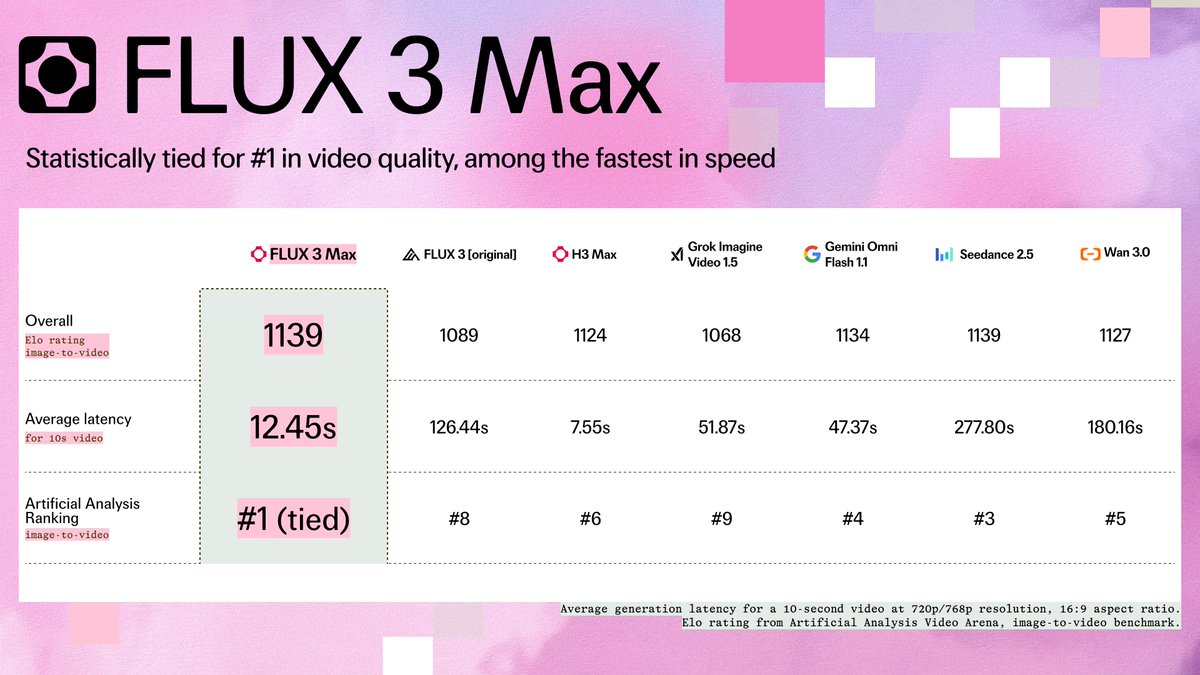
fal and Black Forest Labs launch FLUX 3 Max video model: tied #1 in image-to-video quality, a 10-second clip in about 12 seconds, roughly 22x faster than Seedance 2.5

On Oct 19 (UTC) fal released FLUX 3 Max, a video model built by fal Research with Black Forest Labs through post-training, reinforcement learning and inference optimization on top of the FLUX 3 foundation model. It handles text-to-video, image-to-video and keyframes, up to 20 seconds, at 720p or 1080p, with audio on by default. On Artificial Analysis's preliminary image-to-video arena it scores 1,139 Elo, level with Seedance 2.5 and within the confidence interval of leader MiniMax H3 (1,141), and fal says a 10-second clip takes about 12.45 seconds. A 75% launch discount runs until Nov 7, putting 720p at $0.0425 per second.

fal and Black Forest Labs launch FLUX 3 Max video model: tied #1 in image-to-video quality, a 10-second clip in about 12 seconds, roughly 22x faster than Seedance 2.5

Key Takeaways

  • Artificial Analysis AA-Video-I2V v1.1 (preliminary): FLUX 3 Max at 1,139 Elo, level with Seedance 2.5 and just under MiniMax H3 at 1,141; "tied #1" rests on overlapping confidence intervals
  • Speed (fal-reported, 10-second 16:9 at 720p): FLUX 3 Max 12.45s, Gemini Omni Flash 1.1 47.37s, Seedance 2.5 277.80s; the press release quotes 10.95s instead
  • Versus the original FLUX 3: Elo up from 1,089 to 1,139 (+50) and a 10-second clip down from 126.44s to about 12s (11.5x per the press release, about 10x per the product page)
  • Pricing: promotional $0.0425/s at 720p and $0.0725/s at 1080p until Nov 7, then $0.17/s and $0.29/s, billed per output second
  • API options: 5-20 second duration, multiple aspect ratios, reasoning_level (low/high), generate_audio on by default; model IDs blackforestlabs/flux-3-max/*
Read full story
Linked Models & Agents:
⚡ FLUX 3 Max⚡ FLUX 3⚡ Seedance 2.5⚡ MiniMax H3🌐 fal🌐 Black Forest Labs🌐 Artificial Analysis

vLLM-Omni Integrates PhysisServe: Accelerating Video Diffusion & Physical-World AI with 4.1ms Chunk Output

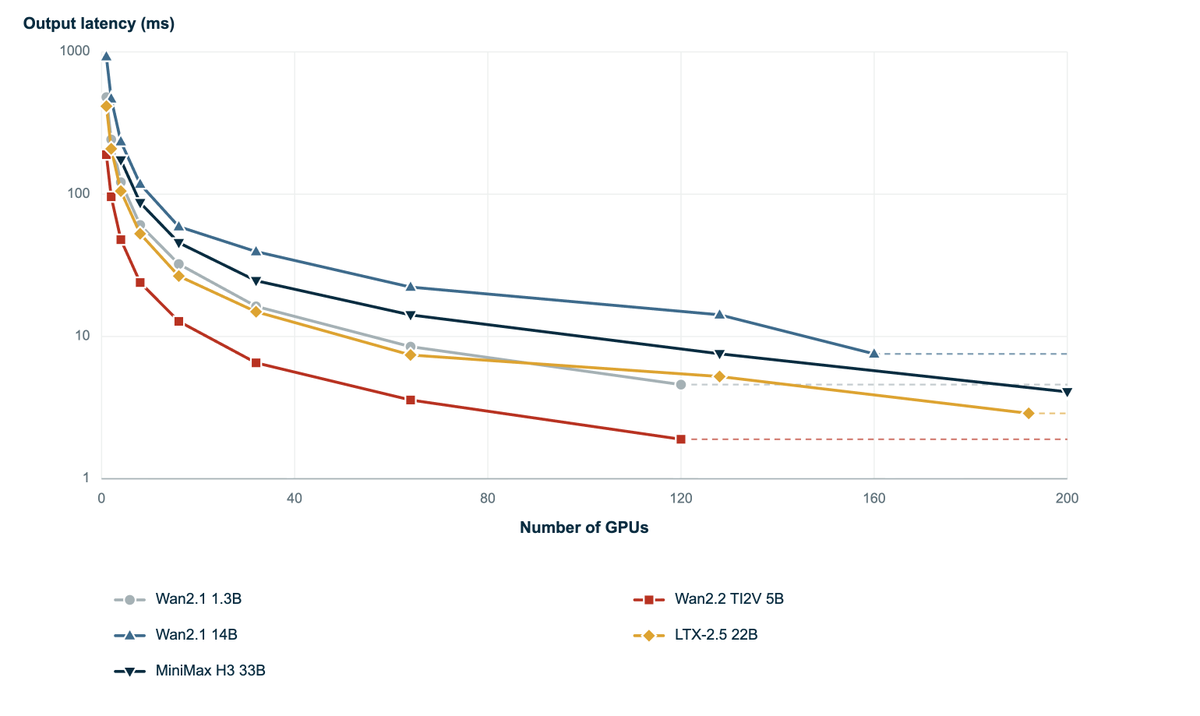
The vLLM Project officially announced that PhysisServe's core physical-world serving techniques are being integrated into vLLM-Omni. Addressing the severe memory bottlenecks and latency spikes of multi-step video diffusion and physical AI generation, PhysisServe introduces cross-denoising-step pipeline parallelism across Transformer blocks, time-shared batching, and virtual-rank joint scheduling. Benchmarked on MiniMax H3 33B across 200 GPUs, it generates a chunk every 4.1 ms (~1,000 FPS without VAE decoding), while cutting single-GPU latency for Wan2.2 5B from 173 ms down to 98 ms.

vLLM-Omni Integrates PhysisServe: Accelerating Video Diffusion & Physical-World AI with 4.1ms Chunk Output

Key Takeaways

  • The vLLM project announced the upstream integration of PhysisServe's serving architecture into vLLM-Omni for physical AI and video models
  • Introduces cross-timestep block pipelining and time-shared batching to eliminate GPU communication bubbles in multi-step diffusion
  • Generates a video chunk every 4.1 ms on MiniMax H3 33B across 200 GPUs (~1,000 FPS), cutting Wan2.2 5B single-card latency to 98 ms
  • Expands 24-GPU serving concurrency by 1.7x to 3.3x, with full open-source code merging into the vLLM-Omni mainline
Read full story
Linked Models & Agents:

MiniMax Releases M3.1 Flash: 1M Context Window, $0.15/M Token Pricing, Surging +106 Points in WebDev Code Arena

MiniMax officially announced M3.1 Flash, its next-generation lightweight frontier model (previously dominating leaderboards as the secret model Space Bunny across 200T+ tokens). Featuring a native 1M context window, flat-rate API pricing of $0.15 / $0.60 per 1M input/output tokens ($0.015 cache reads), and 3x faster inference at 1/3 the cost of M3. It surged +106 points to 1588 on LMSYS Code Arena: WebDev (#12 among open models), with full weights set for open release on October 23.

MiniMax Releases M3.1 Flash: 1M Context Window, $0.15/M Token Pricing, Surging +106 Points in WebDev Code Arena

Key Takeaways

  • MiniMax officially launched M3.1 Flash, unveiling that it was the mystery model Space Bunny evaluated across 200T+ tokens
  • Features native 1M context with flat-rate API pricing of $0.15/$0.60 per 1M tokens ($0.015 cache reads), offering 3x speed at 1/3 cost of M3
  • Debuts on LMSYS Code Arena: WebDev at 1588 Elo (+106 pts over M3), ranking #12 among open models with major leaps in Gaming (+179) and Reference Design (+155)
  • Artificial Analysis benchmark confirms Intelligence Index of 42 and HLE of 48% at half the token consumption of rivals; weights release on Oct 23
Read full story
Linked Models & Agents:
ADSponsored

MiniMax M3.1 Flash weights now open on Hugging Face: 428B-total / 23B-active MoE, $0.15 input and $0.60 output per million tokens, 73.7% on DeepSWE

MiniMax confirmed that Space Bunny, the anonymous model that led usage rankings on OpenRouter and elsewhere, was an early version of M3.1 Flash, and launched it on its API on October 19. Pay-as-you-go pricing is $0.15 input, $0.60 output and $0.015 cache read per million tokens, with a 1M context, text, image and video input, and an effort setting for thinking depth. Per MiniMax, it costs one third of M3 and runs 3x faster, scoring 73.7% on DeepSWE and 62.2% on Automation-Bench; the weights went live on Hugging Face on schedule on October 23 (MiniMax Community license, MXFP8), with day-0 support from Together, Inferact (vLLM) and LightSeek TokenSpeed.

MiniMax M3.1 Flash weights now open on Hugging Face: 428B-total / 23B-active MoE, $0.15 input and $0.60 output per million tokens, 73.7% on DeepSWE

Key Takeaways

  • Official pay-as-you-go pricing: $0.15 input / $0.60 output / $0.015 cache read per million tokens; per token that is half of M3 ($0.30/$1.20), and MiniMax does not explain how it gets one third of the cost.
  • Vendor benchmarks: DeepSWE v1.1 73.7% (Opus 5: 74.0%), Automation-Bench 62.2%, BabyVision with tools 91.0%, Terminal Bench 4.0 38.1% (Opus 5: 51.8%).
  • 1M context, text/image/video input, five effort levels from low to max, default max, thinking cannot be turned off.
  • Weights opened October 23 at Hugging Face MiniMaxAI/MiniMax-M3.1-Flash: ungated, MiniMax Community license (not MIT/Apache), MXFP8 quantized, native multimodal MoE with about 428B total and 23B active parameters per token, plus a DSpark speculative-decoding draft head.
  • Migration: M2.5 and M2.7 closed to new users on October 19 and retire on November 18; M Plan and Token Plan requests now route to M3.1 Flash automatically.
  • Day-0 serving: Together AI runs it fully managed, MiniMax is partnering with Inferact to contribute production-inference improvements back to vLLM, and LightSeek's TokenSpeed added day-0 support.
Read full story

vLLM adds NVIDIA Vera Rubin NVL72 support: up to 7.84x per-GPU throughput over GB200 on AgentX with MiniMax M3

On Oct 9 the vLLM team, with Inferact, Red Hat and NVIDIA, shipped early Vera Rubin NVL72 support: CUDA 13.4 nightly images already serve DeepSeek, Kimi, GLM and MiniMax. Vendor-reported results: up to 7.84x per-GPU throughput vs GB200 on SemiAnalysis AgentX (MiniMax M3, matched interactivity) and up to 3.7x vs GB300 NVL72 on the MLPerf Inference v6.1 VLM benchmark (Qwen3-VL-235B-A22B).

vLLM adds NVIDIA Vera Rubin NVL72 support: up to 7.84x per-GPU throughput over GB200 on AgentX with MiniMax M3

Key Takeaways

  • Versus GB200 NVL72: 5x NVFP4 FLOPS, ~2.4x HBM4 bandwidth, 1.7x bidirectional NVLink, 2–4x faster softmax exponentials (vLLM blog)
  • AgentX with MiniMax M3: up to 7.84x per-GPU throughput at matched interactivity, 5.18x under a 150 TPS cap (vendor-reported, early)
  • MLPerf Inference v6.1: Qwen3-VL-235B-A22B on vLLM + Dynamo, up to 3.7x vs GB300 NVL72
  • CUDA 13.4 locality domains split MoE weights for ~1.2x average MoE-layer speedup in small-token decode
  • Image: vllm/vllm-openai:cu134-nightly (CUDA 13.4 + PyTorch 2.15)
Read full story

WorldGuide: MBZUAI and ANU Introduce Goal-Directed Closed-Loop Video World Model for Procedural Task Execution

Modern video foundation models synthesize photorealistic visual dynamics, yet struggle on long-horizon procedural tasks requiring sequential causal execution—such as equipment maintenance, cooking, or laboratory experiments. Current architectures rely on open-loop generation that cannot adapt to intermediate video outputs, resulting in disordered task sequences, hallucinated progress, and premature task termination. Researchers from MBZUAI and the Australian National University introduce WorldGuide (arXiv:2610.12459, repository: github.com/mbzuai-oryx/WorldGuide, site: mbzuai-oryx.github.io/WorldGuide/), formalizing procedural video generation as closed-loop task execution in visual world space. Given solely an initial image and a high-level task goal, WorldGuide iteratively predicts the next atomic action, generates the corresponding visual video clip, and inspects the synthesized state to dynamically route subsequent actions or determine task completion. A hierarchical visual memory maintains state history under bounded token footprints. To bridge supervision gaps, the authors release WorldGuide-Bench comprising approximately 59K step-annotated videos across 245 tasks and 27 procedural categories. WorldGuide achieves 33.33% Task Success on WorldGuide-Bench, outscoring the strong MiniMax-H3 model (29.90%) even when MiniMax-H3 is provided with reference plans, and surges to 47.69% on VideoCraft-Bench compared to 32.73% for MiniMax-H3 under goal-only conditioning.

Key Takeaways

  • MBZUAI and ANU introduce WorldGuide, formalizing procedural video generation as closed-loop task execution in world space
  • Achieves 33.33% Task Success on WorldGuide-Bench and 47.69% on VideoCraft-Bench, decisively outperforming MiniMax-H3
  • Open-sources WorldGuide-Bench with ~59K step-annotated videos, reducing procedural ordering errors from 62% to under 4%
Read full story
Linked Models & Agents:

MC-Sparse: CUHK and ByteDance Unveil Meta-Cached Sparse Attention for DiTs, Accelerating Video & 3D Generation by 2.32x with Zero Quality Loss

Diffusion Transformers (DiTs) underpin frontier video generation systems and high-fidelity 3D modeling, yet self-attention computation over extreme sequence lengths introduces prohibitive inference latencies and memory bottlenecks. While sparse attention represents a promising acceleration pathway, existing methods suffer substantial visual quality degradation and texture corruption under high sparsity regimes. Researchers from The Chinese University of Hong Kong (CUHK) and ByteDance analyze sparse attention failures in DiTs (arXiv:2610.06801), tracing quality drops to three root causes: rigid token grouping constraints, inaccurate interaction selection, and uncompensated attention residuals from discarded tokens. The authors introduce Meta-Cached Sparse Attention (MC-Sparse, project site: dodododddo.github.io/mcsparse-project-page/), a training-free framework that preserves individual Key-Value (KV) selection precision while organizing similar Queries into tile-aligned blocks for hardware efficiency on GPUs. MC-Sparse caches query clusters, exact KV indices, and dense-sparse attention output residuals, reusing this metadata across downstream denoising timesteps. On Minimax-H3-Base video models, MC-Sparse delivers a 1.80x denoising speedup, and a 2.32x acceleration on 3D generative backbones, maintaining near-identical fidelity to dense attention with zero visible quality degradation.

Key Takeaways

  • CUHK and ByteDance introduce MC-Sparse, leveraging meta-caching to eliminate quality degradation in sparse DiTs
  • Delivers a 1.80x speedup on Minimax-H3-Base and 2.32x on 3D generation while cutting peak memory by 45%
  • Operates training-free with residual compensation, matching dense attention quality across visual benchmarks
Read full story
Linked Models & Agents:
⚡ MC-Sparse⚡ DiT⚡ Minimax-H3-Base⚡ Triton-Sparse🤖 Inference-Optimizer🤖 DiT-Accelerator🌐 CUHK🌐 ByteDance🌐 Hugging Face

Unsloth v0.1.900-beta: local Laya Decision models + Skills editor; ~4.5× LTX-2.3 clips and up to 6.3× faster VAE decode

Unsloth shipped v0.1.900-beta on 2026-09-28 (PyPI unsloth 2026.9.12): Desktop runs Laya Decision models locally via a Jev-compatible /v1/systemone endpoint, adds a Skills CRUD editor and Library viewers for PDF/Office, and improves Apple Silicon with batched serving, structured outputs, and TurboQuant KV. Media pipelines claim ~4.5× LTX-2.3 clips, 1.7–6.3× VAE decode, and up to ~1 minute faster MiniMax-H3 first render with 25–29 GiB lower peak VRAM.

Unsloth v0.1.900-beta: local Laya Decision models + Skills editor; ~4.5× LTX-2.3 clips and up to 6.3× faster VAE decode

Key Takeaways

  • Shipped v0.1.900-beta — local Laya Decision API + Skills editor + Library viewers
  • LTX-2.3 ~4.5×; VAE decode 1.7–6.3×; MiniMax-H3 first render up to ~1 min faster, −25–29 GiB peak VRAM
  • Apple Silicon: batched serving, structured outputs, TurboQuant KV; ModelScope downloads
  • Docs: docs.unsloth.ai
Read full story
Linked Models & Agents:
⚡ Laya⚡ LTX-2.3⚡ MiniMax-H3⚡ Gemma-4🤖 Unsloth-Studio🌐 Unsloth