
AI Coding Live News

Anthropic Publishes a Claude Model Selection Guide: Start Most Coding on Opus 5.5 at Medium, Tune Effort Before Switching Models, Put Subagents on Haiku 5.5

On November 9, Anthropic's developer blog claude.dev published a selection guide by Addy Osmani, "Which Claude model should you build with?"; the ClaudeDevs post drew about 9,200 likes and 12,000 bookmarks. The core advice: start most coding and knowledge work on Opus 5.5 at medium effort (the Claude Code default); drop to Sonnet 5.5 for well-scoped bug fixes and spec-driven work; use Haiku 5.5 for classification, routing, extraction, and log-reading subagents; and move up to Fable 5.2 for major refactors, migrations, and deep research. Before switching models, tune effort and give the model a way to verify its own work. The guide also lists prices, default effort levels, and compatibility differences that can trigger 400 errors when migrating.
Anthropic Publishes a Claude Model Selection Guide: Start Most Coding on Opus 5.5 at Medium, Tune Effort Before Switching Models, Put Subagents on Haiku 5.5

Key Takeaways

  • Prices (vendor figures, per million input/output tokens): Haiku 5.5 $0.10/$0.50 ($0.50/$2.50 above 100K), Sonnet 5.5 $2/$10, Opus 5.5 $4/$20, Fable 5.2 $8/$40; all four have a 1M context window and 128K max output
  • Anthropic's own FrontierCode 2.0 runs: Fable 5.2 at high scores 45.3% vs Opus 5.5 at max 45.5% for roughly half the cost per task, so test Fable before pushing Opus past high
  • On a SWE-bench Pro subset, running Opus 5.5 at low and re-running failures at high passed about 97% at about $0.17 per task, versus 95.3% at $0.29 with everything at high
  • An Opus 5.5 lead over up to 25 parallel Sonnet 5.5 workers searching about 22 million tokens of code cost about a third less than Opus alone, with a similar score
  • Migration traps: Fable 5.2 enables preserved thinking on all API accounts, so editing earlier context returns a 400; tool_choice any/tool also returns 400 on Sonnet 5.5, Opus 5.5, and Fable 5.2
Read full story

GitHub Universe 2026: Copilot Fusion is generally available, routing and orchestrating models automatically, with Fusion Max scoring 60 on the Artificial Analysis Coding Agent Index at about half the cost of Claude Code with Opus 5.5 Max

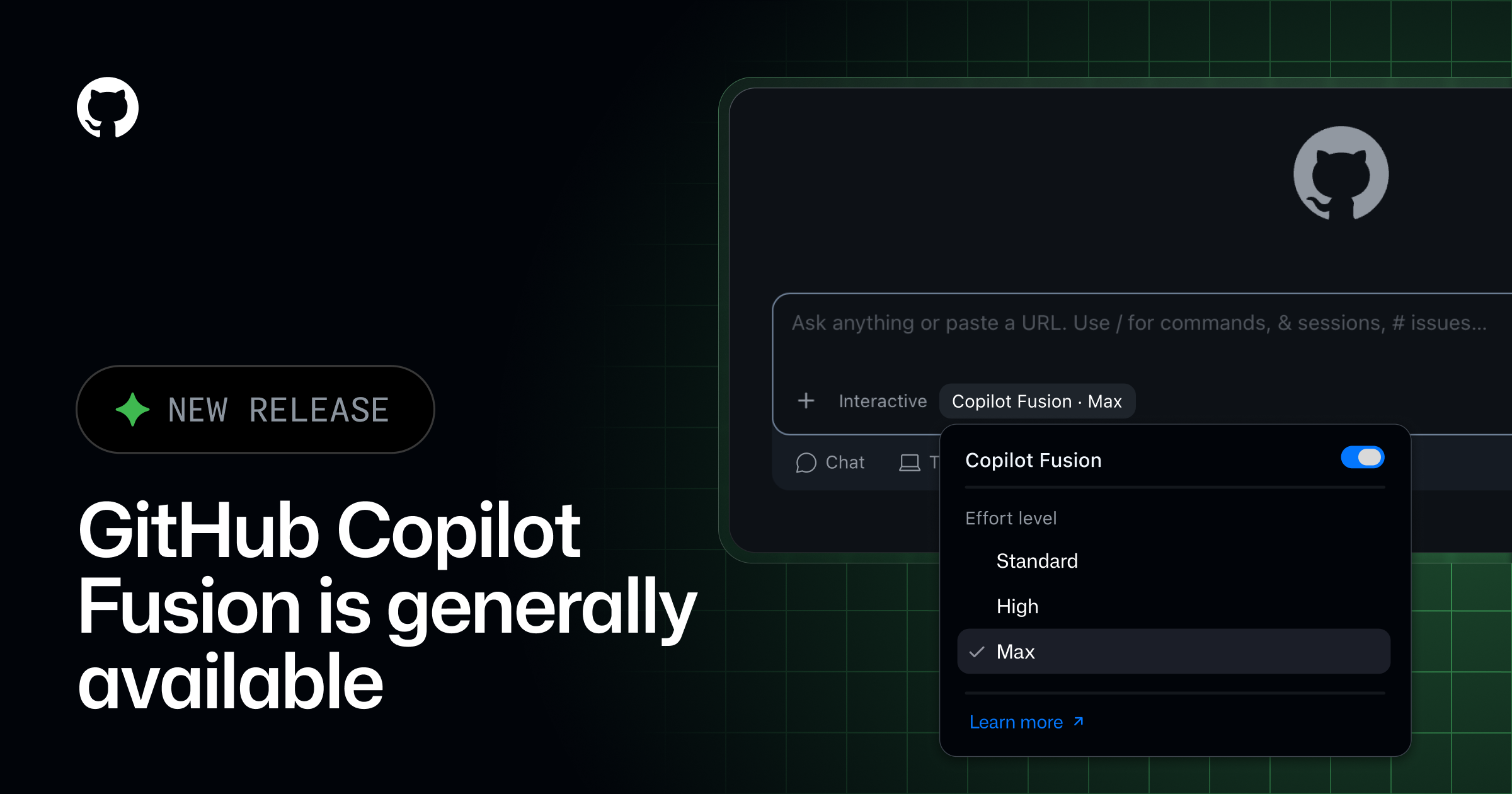
At GitHub Universe 2026 on Oct 28, GitHub made Copilot Fusion generally available. It merges the multi-model orchestration of the Project HydraFusion research preview with Copilot auto model selection: users pick Copilot Fusion and an effort level (Standard, High or Max) in the model picker, and the system decides which models to use and whether to run a Single, Cascade or Critique workflow. GitHub says Fusion Max scored 60 on the Artificial Analysis Coding Agent Index, two points below Claude Code with Opus 5.5 Max, at about half the API cost per task, about half the tokens and about 40% less time. Each underlying model is billed at its standard rate, and paid plans get 30% off through Nov 30.

GitHub Universe 2026: Copilot Fusion is generally available, routing and orchestrating models automatically, with Fusion Max scoring 60 on the Artificial Analysis Coding Agent Index at about half the cost of Claude Code with Opus 5.5 Max

Key Takeaways

  • Scores (Artificial Analysis Coding Agent Index v2.0): Fusion Max 60 versus 62 for Claude Code with Opus 5.5 Max; $5.59 per task versus $11.42, while the Devin Fusion pairing scores 62 at $8.00
  • Breakdown: a slight lead on Terminal-Bench 4.0 at 71, third on FrontierCode at 51 (Claude Code 56, Devin Fusion 54), and a weaker 57 on SWE-Atlas-QnA-AA
  • Efficiency: about 7.2M tokens per task, roughly half of Claude Code with Opus 5.5 and 30% fewer than Devin Fusion; GitHub reports about 40% less time per task
  • The pool includes Claude Opus 5.5, Claude Sonnet 5.5, GPT-6 Astra and GPT-6 Sol; admins can disable individual models for Fusion only and set Fusion as the default
  • Availability: all Copilot plans in VS Code, the Copilot app, Copilot CLI and JetBrains IDEs; existing auto, HydraFusion and HydraFusion Max selections migrate to matching effort levels
Read full story

NVIDIA and UC Berkeley Unveil Post-Training Performance Predictors for Coding Agents from Base Checkpoints

Agentic post-training (scaling multi-turn RL and SFT) requires massive GPU investments, but AI labs lack reliable heuristics to predict which base model checkpoint possesses the highest potential before committing to multi-million-dollar post-training runs. Cold-start zero-shot evaluations on SWE-bench fail because unaligned base checkpoints cannot emit formatted tool invocations, while single-turn patch benchmarks ignore multi-step state management. Researchers from NVIDIA and UC Berkeley (including Bryan Catanzaro and Ashish Vaswani) present a lookahead evaluation framework (arXiv:2610.10478). By replaying successful post-trained trajectories and rerunning unit tests after every edit, they isolate the 'decisive step' that flips a repository from failing to passing. They introduce three lightweight evaluation screens at this decisive step that require zero cold-start tool calling: Decisive-Action Bits Per Byte (BPB), Patch MCQ, and prefix-conditioned pass@K. Across ten pairs of public base and post-trained models, these screens rank candidate checkpoints in tight agreement with final post-trained SWE-bench Verified pass@1 scores, establishing a low-cost lookahead methodology for model selection.

Key Takeaways

  • NVIDIA and UC Berkeley introduce lookahead screens to predict post-training coding agent performance from base checkpoints
  • Isolates the 'decisive step' that flips test suites to passing, introducing Decisive-Action BPB, Patch MCQ, and prefix-pass@K
  • Ranks base model potential in tight agreement with post-trained SWE-bench Verified pass@1 across 10 model pairs
Read full story
Linked Models & Agents:

GitHub Copilot Auto adds efficiency, balance, and intelligence cost/quality tiers

GitHub staffer Pierce Boggan (@pierceboggan) announced Copilot Auto model selection now offers three tiers—efficiency (cost-first), balance (cost/quality/latency), and intelligence (quality-first). Auto still picks a model per prompt; usage is billed on the selected model, and paid subscribers keep a 10% Auto usage discount. Rolling out in VS Code, Copilot CLI, and the GitHub Copilot app (changelog 2026-09-14).

Key Takeaways

  • Copilot Auto adds efficiency, balance, and intelligence cost/quality tiers.
  • Still selects per prompt; billed on the chosen model with a 10% Auto discount for paid plans.
  • Rolling out in VS Code, Copilot CLI, and the GitHub Copilot app.
Read full story
ADSponsored

Artificial Analysis Intelligence Index v4.2: Fable 5.1 leads, Astra second

Artificial Analysis shipped Intelligence Index v4.2: adds private agentic knowledge-work eval AA-Briefcase and long-document GDP.pdf, doubles held-out weighting, upgrades grading, and drops saturated GPQA Diamond. Claude Fable 5.1 leads; GPT-6 Astra is second with ~4pt gain over GPT-5.6 Sol and strong output-token Pareto efficiency. A major interim benchmark refresh for model selection and cost/quality tradeoffs.

Key Takeaways

  • Bench: v4.2 adds AA-Briefcase and GDP.pdf; held-out weight ~40%.
  • Leaderboard: Claude Fable 5.1 first, GPT-6 Astra second (~+4 vs Sol).
  • Efficiency: Astra stands out on the output-token Pareto frontier.
Read full story
Linked Models & Agents:

Latent Space: 20B+ tokens on Astra show full AI-eng workflows under ~$6/hour

Latent Space says it spent over 20B tokens putting GPT-6 Astra through real AI-engineering work—model selection/training, labeling and active learning, keeping pipelines saturated, instrumentation/logs, one-shot deploy-and-debug, and commanding/evaling subagents—claiming serious workflows at under about $6 per hour, beyond Blender demos and games.

Key Takeaways

  • Covers train/select models, labeling/active learning, saturated pipelines, logs, and one-shot deploy/debug.
  • Can fan out and eval subagents (including agents on other models) with multi-billion-token coherence.
  • Cost claim: serious AI-eng load at under ~$6/hour; longform at latent.space/p/astra.
Read full story
Linked Models & Agents:

Cline says half of Qwen3.8-Max traffic runs on ClinePass at ~5x vs direct API

Cline said about half of Qwen3.8-Max usage on the product already flows through ClinePass, which it prices at roughly 5x cheaper than the direct API. For developers who standardized on Qwen3.8-Max inside the coding agent, the routing choice now dominates unit economics. Cline is pushing ClinePass as the default path, splitting model selection from the billing lane so an open-source agent can cut long-session cost without leaving the model.

Key Takeaways

  • About half of Qwen3.8-Max usage in Cline already goes through ClinePass.
  • Cline quotes roughly 5x cheaper access versus the direct API.
  • The billing lane is now a first-class cost lever alongside model choice.
Read full story

Replit Introduces Intelligent Model Routing: Automatic Model Selection Cuts Agent Costs by Up to 65%

Replit launched Intelligent Model Routing for Replit Agent, automatically picking the best model per task with an auto toggle, cutting development costs by up to 65% while maintaining output quality.

Key Takeaways

  • Abstracts model selection into infrastructure, eliminating tedious manual switching between models;
  • Delivers matched output quality at up to 65% lower total expenditure compared to previous Max Mode;
  • Enterprise controls allow administrators to restrict routing within security-approved model whitelists.
Read full story
Linked Models & Agents: