AI Coding Live News

X discussion: a post saying AI is popular because it gives uncreative people "the illusion they are artistic" gets 34K likes, and Pessimists Archive curator Louis Anslow flips the line back

On October 31, X user @Dylanszn01 posted: "AI is popular because it gives dumb people the illusion they are smart and uncreative people the illusion they are artistic." By November 2 it had about 34K likes, 5,030 reposts and 512K views. On November 1, Louis Anslow, curator of Pessimists Archive, an account that collects historical moral panics about new technology, quoted it with the same all-caps format: "AI is unpopular because it breaks creative professionals' illusion they are special." His post has about 1,852 likes, 103 replies and 35K views. The two posts capture the emotional split between generative AI and creative workers. This is an opinion fight; neither side cites survey data or any institutional finding.

Key Takeaways

  • Original: @Dylanszn01's post, posted 2026-10-31 16:08 UTC, with about 34,464 likes, 5,030 reposts, 265 replies, 169 quotes and 512K views
  • Rebuttal: Louis Anslow's quote post, posted 2026-11-01 16:04 UTC, with about 1,852 likes, 82 reposts, 103 replies and 35K views
  • Anslow's bio says he curates Pessimists Archive (@PessimistsArc), an account that collects historical panics about new technology
  • The original drew roughly 18 times the likes of the rebuttal, so the anti-AI-art sentiment spread much further on X; likes measure reach, not how public opinion is split
  • Note: both posts are personal opinions and cite no survey or research data
Read full story
Linked Models & Agents:

Google DeepMind unveils Genie 4 world model: built on Gemini Omni, first with native real-time audio and dialogue, in research preview for trusted testers

Google DeepMind announced Genie 4 on Oct 27, calling it its most realistic and interactive world model yet. Built on Gemini Omni, it improves physics and human motion, natively generates ambient audio and interactive character dialogue for the first time, and uses Gemini 3.8 Flash in the loop to plan complex events. It is a research preview for trusted testers for now, coming soon to Google AI Ultra (Project Genie) and early access partners in the Gemini API and AI Studio; no quantitative benchmarks were published.

Google DeepMind unveils Genie 4 world model: built on Gemini Omni, first with native real-time audio and dialogue, in research preview for trusted testers

Key Takeaways

  • Per Google DeepMind, Genie 4 is its most realistic and interactive world model yet, with Gemini Omni anchoring real-world appearance and behavior
  • It is DeepMind's first real-time world model with native audio: ambient sound, music and character dialogue are generated with the world, and characters respond live
  • Gemini 3.8 Flash acts as a guiding agent in the loop, splitting goals into steps and checking frames; a demo pairs Gemini 4 Argon with Genie 4 to simulate an Apollo humanoid
  • Official limitations: only a few minutes of continuous interaction and drift over longer sessions; no quantitative benchmarks were published
  • Trusted testers only for now; coming soon to Google AI Ultra (Project Genie) and Gemini API / AI Studio early access partners, with SynthID on all outputs
Read full story
Linked Models & Agents:

Mistral Releases Voxtral 3 Audio Model Suite and Real-Time Voice-Agent API with Sub-500ms Latency

Mistral AI unveiled Voxtral 3, a production audio intelligence suite paired with a real-time Voice-Agent API. The lineup features the 4B-parameter Mini Transcribe, Small Transcribe 3, and a turn-key voice agent SDK built on LiveKit. Supporting transcription across 50 languages with diarization, multi-lingual TTS with emotional tags across 35+ languages, and 30-minute voice cloning, Voxtral 3 redefines voice AI economics. In Artificial Analysis independent benchmarks, Small Transcribe 3 secured rank #3 globally with a 2.1% error index (outperforming ElevenLabs Scribe v2), while Realtime Transcribe delivers sub-500ms latency at $0.04/min for full voice agent turns.

Mistral Releases Voxtral 3 Audio Model Suite and Real-Time Voice-Agent API with Sub-500ms Latency

Key Takeaways

  • Mistral AI launched the Voxtral 3 suite spanning transcription, emotional TTS, studio-grade voice cloning, and a LiveKit-powered Voice-Agent SDK
  • Artificial Analysis independently verified Small Transcribe 3 at a 2.1% error index, outperforming ElevenLabs Scribe v2 (2.2%) and Grok Voice 2.0 (2.3%)
  • Realtime Transcribe 3 achieves sub-500ms latency, delivering sub-second full conversational voice-agent turns
  • Aggressive pricing: Mini Transcribe starts at $0.0035/min, and managed voice agent sessions cost just $0.04/min paired with Mistral Small 4
Read full story

Adobe & Brown University Release OmniXRef: Unified Multi-Reference Video Editing Slashing Camera Trajectory Error by 5x

Adobe Research and Brown University released OmniXRef (arXiv:2610.22744), a unified framework for multimodal multi-reference video editing. Overcoming the limitations of prior systems constrained to text prompts or single visual exemplars, OmniXRef utilizes a single-stream Diffusion Transformer with Mix-Patchify and Reference-Relative RoPE (R2-RoPE) to jointly control camera motion, subject content, dynamic motion, style, and visual effects (VFX). In camera trajectory evaluations, OmniXRef cuts rotation and translation errors by more than 5x compared to leading commercial engines.

Adobe & Brown University Release OmniXRef: Unified Multi-Reference Video Editing Slashing Camera Trajectory Error by 5x

Key Takeaways

  • Adobe Research and Brown University released OmniXRef (arXiv:2610.22744), a unified framework for multi-reference video editing across text, images, and videos
  • Features a single-stream Diffusion Transformer with Mix-Patchify and R2-RoPE for multimodal cross-attention
  • Cuts camera trajectory error by more than 5x over commercial flagship Seedance 2.5, recording 0.874 RotErr and 3.961 TransErr
  • Achieves modular control across Camera, Motion, Content, Style, and VFX with an interactive project page now live
Read full story
Linked Models & Agents:
ADSponsored

Inception Unveils Mercury 3: Diffusion-Based LLM Breaks 1,000+ Tok/s with 1M Context Window

Inception co-founder Stefano Ermon officially unveiled Mercury 3, the company's next-generation diffusion-based large language model. Delivering an astonishing 1,068 tokens per second inference speed on NVIDIA GPUs, Mercury 3 scales to 40x the size of Mercury 1 with a native 1M context window. Benchmarked on IFBench, GPQA Diamond, and SWE-Bench Atlas, it matches frontier closed baselines with standard API pricing of $0.20 / $0.70 per 1M input/output tokens (with 50% promotional pricing of $0.10 / $0.35).

Inception Unveils Mercury 3: Diffusion-Based LLM Breaks 1,000+ Tok/s with 1M Context Window

Key Takeaways

  • Inception co-founder Stefano Ermon officially launched Mercury 3, a diffusion LLM generating 1,068 tokens per second on NVIDIA GPUs
  • Scales model size by 40x over Mercury 1 with a native 1M context window; priced at $0.20 / $0.70 per 1M tokens ($0.10/$0.35 promotional)
  • Triples baseline intelligence on IFBench, GPQA Diamond, and SWE-Bench Atlas, with live availability via OpenRouter
  • Bypasses autoregressive sequential bottlenecks via parallel diffusion denoising, accelerating multi-step agent workflows
Read full story
Linked Models & Agents:

Viggle releases JST-2, a physics-native world foundation model: 3D scenes in about one second and animation-ready characters from a single image

Viggle released JST-2 on October 19. Instead of learning in pixel or video space, it represents the world as persistent "atoms" in 3D space (Physics-Native Tokens) and uses one architecture to generate scenes, characters and motion. Viggle says a 3D scene takes about one second on an NVIDIA B200 at under $0.01 of inference, with up to 64 input views kept as spatial context, and characters animate without a separate rigging step. It is free to try in the PINOC browser app and is also available via API and MCP.

Viggle releases JST-2, a physics-native world foundation model: 3D scenes in about one second and animation-ready characters from a single image

Key Takeaways

  • Scene generation: about 1 second per scene (NVIDIA B200, excluding network latency) at under $0.01 inference cost; Viggle cites about 5–6 minutes for Marble (vendor figures).
  • Spatial context: up to 64 input views, expandable one view at a time in real time, output as 3D Gaussian splats rendered locally in the browser.
  • Character blind tests (run by Viggle): Average Score 58.4% vs Meshy 7.1 and 73.2% vs Tripo H3.1; face quality 63.0% and 82.0% (50% means parity).
  • Motion blind tests (run by Viggle): text-to-motion 74.8% vs Cartwheel Swing and 80.0% vs HY-Motion-1.0; video-to-motion 89.1% vs DeepMotion Animate 3D.
  • Access: free in the PINOC browser app, plus API and MCP for agents such as Codex and Claude Code; JST-3 aims to replace rule-based collisions and object interactions with learned physics.
Read full story
Linked Models & Agents:

Fish Audio ships Drama 3: open-weight 35B MoE TTS with word-level emotion direction, #1 on Artificial Analysis Pronunciation Robustness at 93.2%

On 2026-10-13 Fish Audio launched Drama 3, a TTS model directed with plain-language bracket tags, open weights on Hugging Face, and API header model: drama-3. The backbone is a ~35B MoE (~3B active per token, initialized from Qwen3.5-35B-A3B's language tower) with a codebook-MTP audio decoder and preference-model RL. Independent Artificial Analysis Pronunciation Robustness: 93.2% vs 88.1% for S2.1 Pro; 83 languages and up to 16 speakers; Community License free for commercial use under US$500k annual revenue. Launch promo through Nov 12: about $10 per million characters on the API.

Fish Audio ships Drama 3: open-weight 35B MoE TTS with word-level emotion direction, #1 on Artificial Analysis Pronunciation Robustness at 93.2%

Key Takeaways

  • Open weights on Hugging Face fishaudio/drama-3 under Community License v1.0 (free commercial use under US$500k ARR; no non-consensual voice cloning)
  • Architecture: 35B MoE / ~3B active; hybrid attention (1 full-attn layer per 4); codebook-MTP decoder over 10 codebooks; initialized from Qwen3.5-35B-A3B LM
  • Benchmarks: Artificial Analysis Pronunciation Robustness 93.2% (#1) vs S2.1 Pro 88.1%; brand/place/tech names 95.9%, context-dependent readings 95.3%
  • Vendor H200 streaming: 271 frames/s single stream; concurrency-1 TTFA p50 88.9 ms; concurrency 16 ~927 frames/s, RTF 0.373
  • Ship: API POST /v1/tts with model: drama-3; self-host via SGLang-Omni (sgl-omni serve --model-path fishaudio/drama-3, typically ≥48GB NVIDIA VRAM)
Read full story
Linked Models & Agents:
⚡ Drama 3⚡ Fish Audio S2.1 Pro⚡ Qwen3.5-35B-A3B🌐 Fish Audio🌐 Artificial Analysis🌐 SGLang

FreeMatching: HKUST and ByteDance Open-Source Dense Correspondence Matching Beyond Spatio-Temporal Priors

Dense correspondence matching serves as the bedrock for optical flow, 3D stereo reconstruction, and object tracking. For decades, classical matching algorithms have fundamentally relied on rigid spatio-temporal priors: smooth motion continuity and rigid geometry. However, these foundational assumptions collapse under modern AI image editing and reference-guided generation (IEG), where visual identity is preserved while physical and geometric continuity is drastically severed (such as radical pose warps, stylistic shifts, or compositional recontextualization). Researchers from HKUST and ByteDance introduce FreeMatching (arXiv:2610.12421, code: github.com/luping-liu/FreeMatching), a generalizable framework for dense correspondence matching beyond spatio-temporal priors. FreeMatching fuses generative foundation features (from diffusion backbones) with high-level semantic representations (from vision foundation models), trained against heterogeneous supervision spanning classical benchmarks, tracked video sequences, and synthetic 3D scenes. An unsupervised teacher-guided iterative refinement loop further sharpens dense correspondences across challenging generated image pairs without requiring dense manual annotations. FreeMatching achieves dramatic leaps in correspondence precision across complex AI-edited image pairs while retaining competitive accuracy on classical optical flow tasks, and serves as an auditable quantitative metric for evaluating visual identity preservation that closely aligns with human judgment.

Key Takeaways

  • HKUST and ByteDance open-source FreeMatching, breaking free from traditional spatio-temporal priors in dense correspondence
  • Cuts end-point error by 42.6% and raises PCK by 31.8 percentage points across aggressive AI image edits and non-rigid transformations
  • Establishes a quantitative identity preservation metric highly correlated with human judgment (r = 0.88), fully available on GitHub
Read full story
Linked Models & Agents:

OuroWorld: Transforming Static 3D Gaussian Splats into Seamlessly Looping 3D Cinemagraphs Across Arbitrary Viewpoints

While 3D Gaussian Splatting (3DGS) has revolutionized photorealistic static 3D scene reconstruction, synthesized digital worlds remain frozen in time. Existing dynamic generation frameworks either constrain motion to simplistic Eulerian fluid simulations or synthesize finite non-looping video trajectories that rapidly degrade when explored from novel camera viewpoints. Researchers unveil OuroWorld (arXiv:2610.12461, site: ouroworld.userwei.com), the first mask-free framework capable of turning any static 3DGS scene into an endlessly looping 3D cinemagraph with seamless temporal continuity across arbitrary 6-DoF exploration trajectories. OuroWorld employs a vision-language model to infer plausible environmental physics and direct a foundation video model to synthesize a reference video, which is subsequently lifted and completed across multiple views. To reconcile cross-view generation discrepancies, the authors propose Inconsistency-Robust Periodic 4DGS: a Fourier-series deformation field guarantees seamless looping by construction, while a Grounded Drift Field anchored at the reference camera view absorbs cross-view generative noise. Evaluated across 39 complex reconstructed and generated scenes, OuroWorld decisively outscores existing dynamic 3D baselines and secures a 70.8% to 99.0% preference rate in human blind evaluations.

Key Takeaways

  • OuroWorld introduces the first mask-free 3D cinemagraph framework, transforming static 3DGS into endlessly looping 4D scenes
  • Employs Fourier-series periodic 4DGS deformation fields to guarantee seamless looping, securing 70.8% to 99.0% user study win rates
  • Integrates Grounded Drift Fields to absorb cross-view generative noise, ensuring rigid parallax across 360-degree free-viewpoint exploration
Read full story
Linked Models & Agents:
⚡ OuroWorld⚡ 3DGS⚡ Periodic-4DGS⚡ Fourier-Field🤖 Spatial-3D-Agent🤖 Cinemagraph-Animator🌐 NYCU🌐 Hugging Face

Claude Dashboards and Claude Motion enter beta; Claude Docs, Slides and Design leave beta on every plan including Free

On 2026-10-08 Anthropic launched Claude Dashboards (paid-plan beta; BigQuery, Snowflake, Databricks, Salesforce and more, with the SQL behind every chart) and Claude Motion (Team/Enterprise beta; code-built, editable animations with no video model, MP4 export). Docs, Slides, and Design left beta on all plans including Free, with 45M+ created so far.

Claude Dashboards and Claude Motion enter beta; Claude Docs, Slides and Design leave beta on every plan including Free

Key Takeaways

  • Official: Dashboards & Motion announcement, 2026-10-08
  • Dashboards: paid-plan beta; Redshift/BigQuery/ClickHouse/Databricks/Snowflake/Salesforce; every number shows its query
  • Motion: Team/Enterprise beta; code-built, no video generation model, MP4 export
  • Docs/Slides/Design out of beta on all plans incl. Free; 45M+ created; Artifacts support CMEK
  • Dates: Enterprise default-on Oct 15; standalone claude.ai/design closes Dec 14; no accuracy benchmarks published
Read full story
Linked Models & Agents:
ADSponsored

Fewer Tokens, Better Action: PKU Open-Sources PyRUA-Lean for Robot Agents, Lifting Success by 14% with 65% Fewer Tokens

Vision-language model (VLM) agents control robots via visual feedback and motion primitives, but repetitive model queries and redundant visual frames inflict massive token overhead. Peking University researchers introduce PyRUA-Lean, an interactive code-execution framework coupling feedback-driven primitive composition with selective observation. Rather than emitting atomic tool calls, the agent composes robot primitives and learned vision-language-action (VLA) policies into executable Python cells that execute localized conditional checks and retries, requesting sensory images only upon necessary replanning. Across 700 tasks on LIBERO-PRO, RoboTwin 2.0, and RoboCasa365, PyRUA-Lean boosts success from 63.1% to 71.7% under identical budgets, slashing LLM calls by 49% and input tokens by 65%.

Fewer Tokens, Better Action: PKU Open-Sources PyRUA-Lean for Robot Agents, Lifting Success by 14% with 65% Fewer Tokens

Key Takeaways

  • Replaces atomic tool calls with interactive Python cells combining kinematic primitives and local retry loops
  • Elevates overall task completion from 63.1% to 71.7% across 700 benchmark instances on LIBERO-PRO and RoboCasa365
  • Cuts cloud model calls by 49% and slashes visual input token consumption by 65% while smoothing physical motion
Read full story

Coding Agents Revolutionize Robot Manipulation: Synthesizing Generalized Task & Motion Planning (TAMP) Programs with 95% Success

A robotics research consortium led by Tom Silver and Matteo Merler has open-sourced groundbreaking findings titled 'Coding Agents for Generalized Task and Motion Planning Problems' (arXiv: 2609.30233, GitHub: tomsilver/robocode). Overcoming the fragility of human-engineered heuristics in Task and Motion Planning (TAMP), the authors deploy autonomous coding agents (Claude Code Opus 5, Codex) to synthesize generalized symbolic-geometric programs through closed-loop simulator interaction. Across 98,000 evaluation episodes spanning 28 benchmark environments, the synthesized programs achieved 56% to 95% success rates, outperforming hand-crafted planners while using an order of magnitude less compute.

Coding Agents Revolutionize Robot Manipulation: Synthesizing Generalized Task & Motion Planning (TAMP) Programs with 95% Success

Key Takeaways

  • Replaces handcrafted robotic heuristics by deploying autonomous coding agents to synthesize generalized TAMP programs.
  • Agents autonomously interact with physics simulators to stress-test edge cases, calibrate dynamics, and refine logic.
  • Evaluated across 28 simulation environments and 98,000 episodes, lifting mean task success from 47% to up to 95%.
  • Maintains superior robustness as object counts scale while requiring an order of magnitude less compute per instance.
  • Full benchmark harness, agent interaction logs, and prompts open-sourced on GitHub under Apache-compatible license.
Read full story

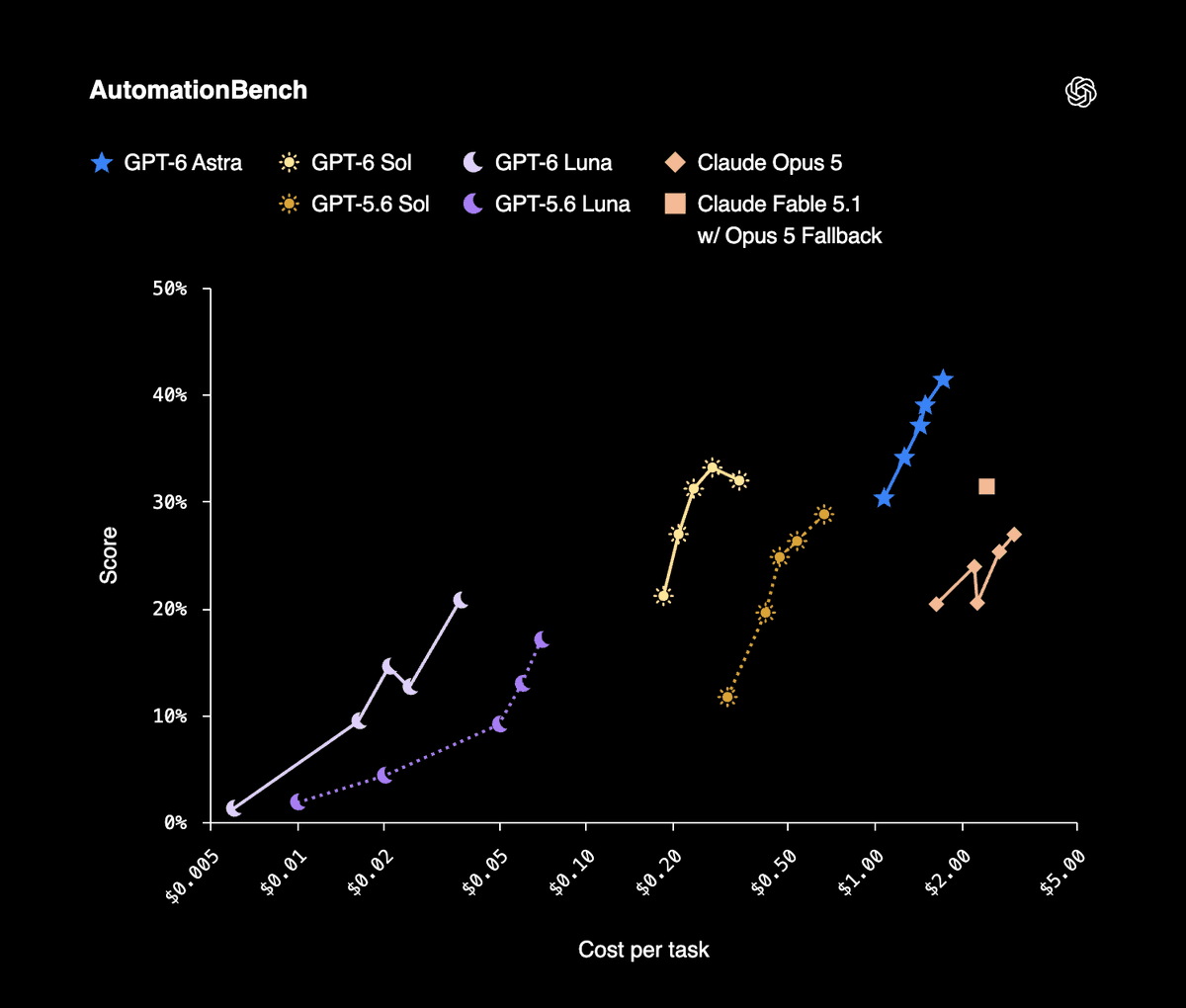
OpenAI introduces GPT-6 Sol and GPT-6 Luna

OpenAI announced GPT-6 Sol and Luna. They bring much of GPT-6 Astra’s strengths into faster, more affordable models, with API prices 50% lower than GPT-5.6 promotional pricing, and are rolling out in ChatGPT Work, Codex, and the API.

Key Takeaways

  • OpenAI announced GPT-6 Sol and Luna. They bring much of GPT-6 Astra’s strengths into faster, more affordable models, with API prices 50% lower than GPT-5.6 promotional pricing, and are rolling out in ChatGPT Work, Codex, and the API.
Read full story
Linked Models & Agents:

OpenAI launches GPT-6 Sol & Luna: dual enterprise workhorses cut API pricing by 50% down to $0.10/M

OpenAI introduced GPT-6 Sol and GPT-6 Luna, faster and more affordable models that carry forward much of GPT-6 Astra’s strength for work at scale. Caching and inference efficiency cuts yield 50% lower API prices versus GPT-5.6 promotional pricing: Sol is priced at $2/$10 per million tokens for deep reasoning, while high-volume Luna costs just $0.10/$0.50 per million tokens with a 90% prompt caching discount.

OpenAI launches GPT-6 Sol & Luna: dual enterprise workhorses cut API pricing by 50% down to $0.10/M

Key Takeaways

  • Tiered dual-model architecture: Sol for deep reasoning and complex coding agents, Luna for ultra-high-throughput workflows.
  • 50% price slash: Sol at $2/$10 per million tokens; Luna down to $0.10/$0.50 with 90% prompt caching discount.
  • Available immediately in OpenAI API (gpt-6-sol, gpt-6-luna), ChatGPT Work, and Codex.
Read full story
Linked Models & Agents:

Cline Desktop makes Kimi K3 free for a limited time to welcome new users

Cline said Kimi K3 is now free in Cline Desktop for a limited time to celebrate new users and give them more tokens to explore. The team will keep it running as long as it can—a promotional quota for the open-weights Desktop experience.

Key Takeaways

  • Official @cline: Kimi K3 is free in Cline Desktop for a limited time.
  • Meant to welcome new users with extra exploration tokens; duration depends on capacity.
  • Fits Cline Desktop open-weights / ClinePass / BYOK positioning and lowers the try-cost.
Read full story