AI Coding Live News

OpenCode team ships Hex 3.0 stable: local voice dictation for Mac, Windows and Linux, built for talking to coding agents

Anomaly, the company behind open-source coding agent OpenCode, shipped Hex 3.0 stable: hold a shortcut, speak, and the text is pasted at your cursor. Recognition runs on-device, local model memory drops from about 900 MB to about 160 MB, and it adds vocabulary hints, a hex CLI and optional OpenCode rewriting.
OpenCode team ships Hex 3.0 stable: local voice dictation for Mac, Windows and Linux, built for talking to coding agents

Key Takeaways

  • Hex v3.0.0 was released on GitHub at 00:38 UTC on Oct 31; it is MIT-licensed, written in Rust, and the repo has about 1,557 stars (release notes)
  • Vendor figures: local model memory drops from about 900 MB to about 160 MB; since 2.3.0 it streams, so a 2-minute dictation finishes about 0.1 s after release on an RTX 5070 Ti
  • Runs on macOS 15+ (Apple silicon), Windows x64/ARM64 and Linux x64/ARM64, with new .deb and .rpm packages on Linux
  • 3.0 does not auto-update from 2.3.1 and starts fresh, so settings, History and models must be set up again; Voice Action and spoken commands are removed
  • The @opencode launch post drew about 2,400 likes, 1,600 bookmarks and 100k+ views (post)
Read full story
Linked Models & Agents:
⚡ Parakeet⚡ Whisper🤖 OpenCode🤖 Hex🌐 Anomaly

Wiz "Black October" report: at least nine AI developer platforms breached in October, with stolen API keys feeding an LLMjacking resale market

Cloud security firm Wiz published research on October 30 saying at least nine AI developer platforms disclosed incidents this month: Fireworks AI, Andromeda, Zeabur, Lightning AI, OpenCode, Railway, Warp, CommandCode and Northflank. Attackers hunted stored environment variables, especially keys for paid AI models; Wiz traced two stolen enterprise keys to roughly 800,000 and 1.7 million Amazon Bedrock calls, which it estimates likely ran over $100k at list price in those two cases alone.

Wiz "Black October" report: at least nine AI developer platforms breached in October, with stolen API keys feeding an LLMjacking resale market

Key Takeaways

  • Scale: between October 6 and 30, at least nine AI developer platforms disclosed incidents, and Zeabur is shutting down as a result (Wiz blog)
  • Methods: Fireworks, OpenCode and Warp reported signs of an "agent swarm" attack, and OpenCode and CommandCode attributed theirs to "distillation" attempts; the common thread is hunting stored environment variables that grant AI access
  • Case A: one stolen key drove about 800k Bedrock calls over 30 hours, about 90% successful, with Opus models making up three quarters (Wiz figures)
  • Case B: a single address made about 1.7 million calls in 13 hours, over a million successful; the two cases together likely exceeded $100k at list price
  • Resale chain: Wiz identified two sites selling discounted frontier-model access and saw both test the stolen keys
Read full story

Microsoft Research and UC Berkeley open-source TokenEconomizer, a plugin that cuts Claude Code and Codex costs by 18.4–30.9% on SWE-Bench without changing the agent

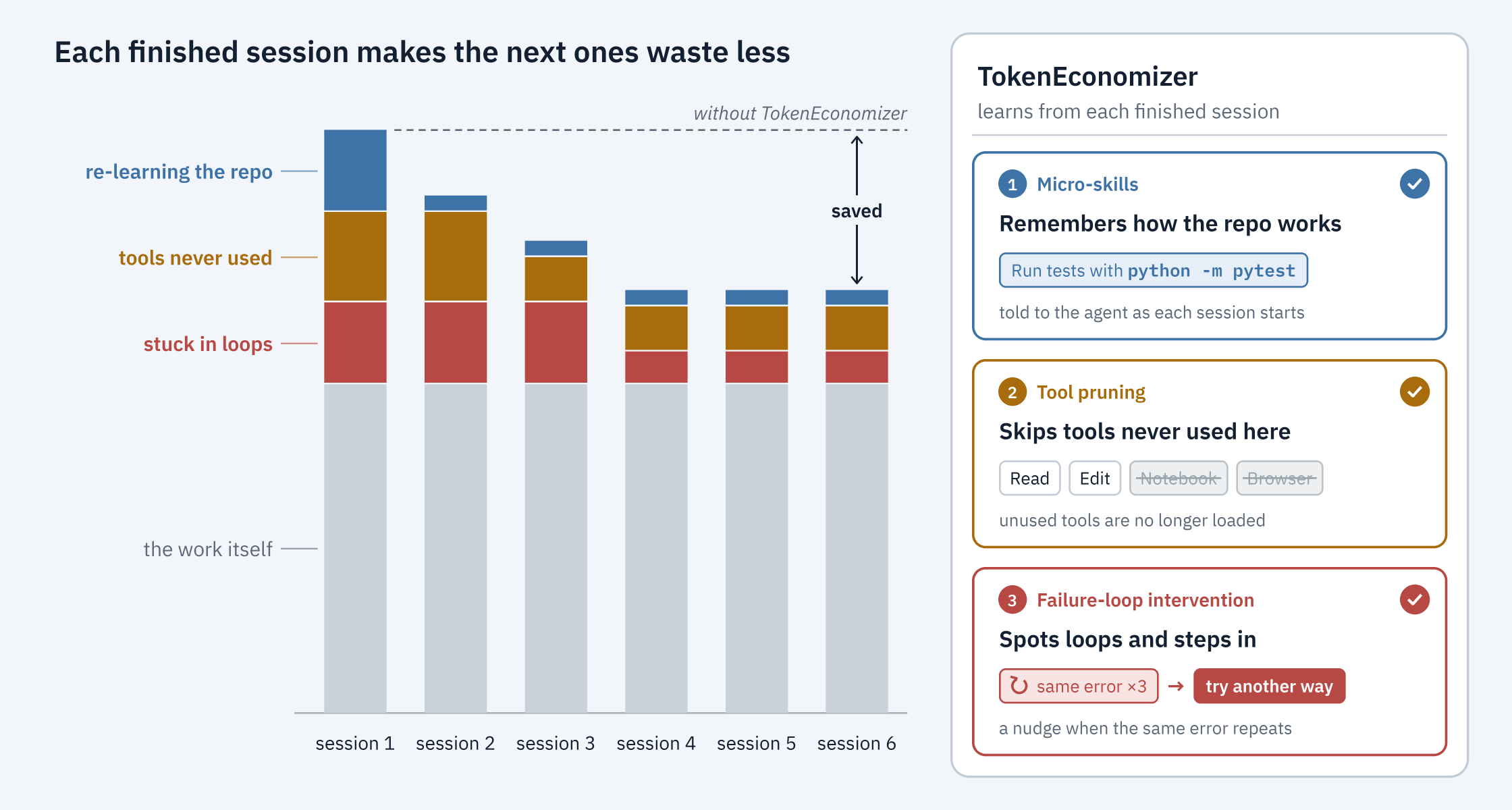
Microsoft Research, Microsoft Security and UC Berkeley open-sourced TokenEconomizer on GitHub (Apache 2.0, v0.1.0 released October 26), a plugin for Claude Code, Codex, GitHub Copilot CLI and Pi, with experimental opencode support. It learns from earlier sessions in the same repository: micro-skills remember repo facts, tool pruning drops tool definitions that go unused, and a loop guard nudges an agent that is stuck. The paper reports 18.4–30.9% lower mean cost across five agent and model combinations on 277 SWE-Bench tasks (paper figures).

Microsoft Research and UC Berkeley open-source TokenEconomizer, a plugin that cuts Claude Code and Codex costs by 18.4–30.9% on SWE-Bench without changing the agent

Key Takeaways

  • Cost: on 277 SWE-Bench tasks across 6 repositories and 5 agent and model combinations, mean cost fell 18.4–30.9%, and all 30 repository-by-combination cells got cheaper (paper figures, including the plugin's own model calls)
  • Success rate: Pass@1 rose in 4 of 5 combinations, e.g. Copilot CLI with Sonnet 5 cost 18.4% less with Pass@1 +2.6, while Claude Code with Opus 4.8 cost 30.9% less with Pass@1 -1.0
  • Three mechanisms: micro-skills (repo facts stated only after three sessions confirm them), tool pruning (by default a tool unused over 10 prompts across 2 sessions is left out), and a failure-loop guard (one redirect when a judge is at least 0.7 confident, never stopping a turn itself)
  • Generalization: 16–21% lower cost on Web-Bench and 6–20% lower on two security-auditing benchmarks where every task is a new repository
  • Deployment: Apache 2.0, Python 3.10+, no API key of its own, and learned experience stays local in ~/.tokeneconomizer
Read full story

OpenCode 2.2.3 adds a built-in Claude Agent provider that runs Claude models through your own Claude Code login, subscriptions included

OpenCode, the open-source coding agent, shipped v2.2.3 at 09:55 UTC on Oct 30 with a built-in "Claude Agent" provider. After installing Claude Code and running claude auth login, users pick Claude Agent in /connect and can call Claude models through their own Claude Code login, whether that is a subscription, an API key or a cloud account. It runs the user's local claude program through Anthropic's public Claude Agent SDK, but turns off Claude Code's built-in tools and uses OpenCode's own tools and permission system instead. Hours earlier, OpenCode team member dax (@thdxr) teased on X "what if you could use your claude subscription in opencode", drawing about 2,300 likes.

Key Takeaways

  • v2.2.3 shipped at 09:55 UTC on Oct 30; its first highlight is "Use Claude Code in OpenCode", from PR #58782 (release notes)
  • Setup is three steps: install Claude Code, run claude auth login, and pick Claude Agent in /connect; OPENCODE_CLAUDE_PATH overrides the claude binary
  • The design spec says it uses only the public SDK, never reads Claude Code's saved login and never intercepts or changes its requests; subscription, API key and cloud logins all work (spec)
  • Claude Code's built-in tools, CLAUDE.md, hooks, MCP servers, skills, auto compaction and auto memory are all off; OpenCode's tools, permissions and compaction apply, with one claude process per session that stops after 5 idle minutes
  • dax's (@thdxr) teaser post drew about 2,300 likes and 280 replies (post); no performance comparison has been published
Read full story
ADSponsored

Factory launches Droid 1.0: programmatic tool calling by default, hundreds of tool calls per model request, leads native harnesses on its own Terminal-Bench 4 runs

AI coding agent company Factory announced Droid 1.0 on X and its blog at 22:31 UTC on Oct 29, calling it the largest update yet to its agent harness. The key change makes programmatic tool calling (PTC) the default: the model writes a JavaScript program that runs up to hundreds of tool calls in a sandbox in one model request. In Factorys own Terminal-Bench 4 runs, Droid scored 57.6% with GPT-6.1 Sol ($0.79 per passed task) and 65.2% with Claude Opus 5.5 ($4.73), ahead of Codex, Claude Code, Cursor, OpenCode and Devin on the same models.

Factory launches Droid 1.0: programmatic tool calling by default, hundreds of tool calls per model request, leads native harnesses on its own Terminal-Bench 4 runs

Key Takeaways

  • Programmatic tool calling is now the default: the model writes JavaScript that runs in a sandbox with no file, network or system access of its own, making up to hundreds of tool calls per request, with independent calls run concurrently
  • Factory example: moving and verifying 151 Linear issues took 312 tool calls; direct calls needed about 36 requests and 3.1M input tokens, a Script needed 2 requests and 61K tokens
  • Terminal-Bench 4 (Factory runs, Oct 23-28, three trials per task): with GPT-6.1 Sol, Droid 57.6% vs Codex 54.0%, OpenCode 51.0%, Devin 45.0%; with Opus 5.5, Droid 65.2% vs Cursor and OpenCode 62.1%, Devin 59.6%, Claude Code 57.6%
  • The first request shrank from 20,887 to 13,055 tokens (-37%) and up-front tool definitions went from 11 to 2; newly loaded MCP tools are appended to keep the prompt cache intact, and a typical production request reads 98% of input from cache
  • Available now as a macOS and Windows desktop app, a terminal UI and the Droid SDK (@factory/droid-sdk); the benchmarks are vendor-run with no third-party reproduction yet
Read full story

Vercel open-sources durable-harness: Claude Code, Codex, OpenCode and Pi agents resume from a durable log after crashes instead of starting over

On Oct 20, Vercel released durable-harness, an open-source package (Apache 2.0, npm 0.0.1-beta.6, marked experimental). It adds durability from the outside to existing coding-agent harnesses such as Pi, OpenCode, Codex and Claude Code: every model and tool call is logged before and after it runs in a Workflow SDK World, and if a function times out or crashes, a queue hands the turn to a new function that resumes from the log, so finished model calls are not billed twice. It runs on Vercel, on local files, or on self-hosted Postgres and other backends.

Vercel open-sources durable-harness: Claude Code, Codex, OpenCode and Pi agents resume from a durable log after crashes instead of starting over

Key Takeaways

  • Supports 5 harnesses: Pi, OpenCode, Codex, Claude Code and libfx's fx (eve and fx are already durable on their own)
  • Mechanism: an intent is recorded before each model or tool call and the outcome after it; each turn is backstopped by a queue message so a new function resumes from the log
  • Finished model calls are read back from the log, so Vercel says you never pay twice for the same call's tokens; only tools marked replay: 'safe' are rerun
  • Swappable backends: Vercel World, local files, Postgres, plus MongoDB, Redis and Turso; two environment variables move it to Postgres
  • Status: Apache 2.0, npm 0.0.1-beta.6, and the README marks it experimental with an API that may change
Read full story

Ollama Cloud Launches US/EU Zero-Data-Retention Hosting for DeepSeek-V4.1-Flash-1017 with Claude Code CLI, While SemiAnalysis Reveals GLM-5.3 Was Built 100% via Post-Training

Ollama launched US- and EU-hosted Ollama Cloud with strict zero data retention and zero training, adding immediate support for DeepSeek-V4.1-Flash-1017 via one-line launch commands for Claude Code and OpenCode alongside Ollama v0.40.6. Meanwhile, SemiAnalysis revealed that GLM-5.3 was built entirely by post-training the previous GLM-5.2 base model without pretraining from scratch, achieving a 'night and day difference' in cybersecurity and agentic capabilities.

Ollama Cloud Launches US/EU Zero-Data-Retention Hosting for DeepSeek-V4.1-Flash-1017 with Claude Code CLI, While SemiAnalysis Reveals GLM-5.3 Was Built 100% via Post-Training

Key Takeaways

  • Ollama Cloud launches US- and EU-hosted zero-data-retention serving for DeepSeek-V4.1-Flash-1017 with one-line ollama launch integrations for Claude Code and OpenCode
  • Ollama v0.40.6 adds GGUF q2_0 tensor support, clef cloud integration, and fixes orphaned runner processes on Windows
  • SemiAnalysis reveals GLM-5.3 was built entirely by post-training the previous model without pretraining from scratch, delivering a 'night and day difference' in cyber capabilities over GLM-5.2
Read full story
Linked Models & Agents:

OpenCode confirms breach: distillation-linked incident hit ~1.4% of Console users; remediating with OpenAI, Anthropic, Google

On 2026-10-17 OpenCode disclosed an overnight breach tied to a large-scale distillation attack affecting about 1.4% of Console users. Affected accounts were emailed; no email means not impacted; only users with external providers linked. Remediation is ongoing with Anthropic, OpenAI and Google. No official blog or GitHub advisory yet; the status page listed no dedicated security incident.

Key Takeaways

  • Official: ~1.4% of Console users; no email means not impacted
  • Scope: subset with external providers linked
  • Remediating with Anthropic, OpenAI, Google; details limited
  • If keys were saved in Console, rotate at each vendor and review usage
  • No official key count, root cause, or confirmed abuse published
Read full story

OpenCode Makes GLM 5.3 Flash and 1M-Context Reflection Beam Free in Its Open-Source Coding Agent, Drawing 1.92M+ Views

OpenCode (@opencode), the wildly popular open-source terminal coding agent, announced free access to both Zhipu AI's high-speed GLM 5.3 Flash and Reflection AI's newly released 501B/23B MoE model Beam with a full 1M-token context window. The GLM 5.3 Flash announcement alone surged past 1.92 million views and 17,500 likes on X within hours.

OpenCode Makes GLM 5.3 Flash and 1M-Context Reflection Beam Free in Its Open-Source Coding Agent, Drawing 1.92M+ Views

Key Takeaways

  • Viral 1.92M-view developer launch: OpenCode's free GLM 5.3 Flash rollout drew 1.92M+ views and 17.5K likes on X
  • 1M-context Reflection Beam added for free: integrates the 501B/23B MoE model (80.1% on Terminal-Bench 2.1) with a full 1M-token context window
  • Zero-cost dual coding workflow: pairs ultra-fast GLM 5.3 Flash tool loops with 1M-context whole-repo reasoning inside the open-source OpenCode CLI
Read full story

Figma Config India: Code Layers and Specs enter open beta, and agents can read and write specs and code layers through the Figma MCP server

At Config India on 2026-10-15 Figma launched agent-oriented features: Code Layers (running code on the canvas) in open beta on all plans, Specs (collaborative Markdown spec containers) in open beta on paid plans, Guidelines in open beta and Code Sources in closed beta. The Figma MCP server can now generate code layers and read/write Specs, with 20 new MCP partner integrations including OpenCode and JetBrains Junie.

Figma Config India: Code Layers and Specs enter open beta, and agents can read and write specs and code layers through the Figma MCP server

Key Takeaways

  • Code Layers: open beta on all plans, created from designs, local folders, GitHub, MCP or Chrome-extension page capture; uses AI credits, free on paid plans through 2026-11-04
  • Specs: open beta on Professional/Organization/Enterprise across web, desktop and mobile; pasting a Spec link into a coding agent carries Markdown, frame references, code layers and Code Connect snippets
  • MCP: the figma-spec skill lets agents read, create and update Specs; use_figma canvas writes remain a free beta with up to 20 KB output per call
  • Design systems: Guidelines open beta and Code Sources closed beta (import from a GitHub repo or npm package) on paid plans; Payload lands in Figma Make, with downloads up 6x in 12 months per Figma
  • Ecosystem: 20 new MCP partner integrations including OpenCode, Dia, JetBrains Junie and Meta Muse; the Figma agent is generally available
Read full story
ADSponsored

Google Cloud AI Unveils Harness²: Two-Level Recursive Agent Harnessing Unlocks Self-Evolution in Open-World Tasks

An LLM agent's practical capabilities depend as much on its execution harness as on its underlying model. Deploying recursive self-improvement (RSI) in open worlds is hampered by the absence of ground-truth verifiers and poor generalization across novel domains. Google Cloud AI Research introduced Harness², a two-level recursive framework: task-level recursion refines task-specific harnesses via a contrastive Propose-Probe-Compose step without ground-truth verifiers, while harnessing-level recursion extracts continual adaptation experience. Harness² delivers up to +11.8% on LAB, +11.5 points on WorkBuddy-Bench, and +4.5 points on JobBench on GLM-5 and Gemini 3.5 Flash. Code is open-sourced on GitHub under Apache-2.0 (google-research/harness2), supporting OpenCode and Codex executors plus JobBench, LAB and WorkBuddy-Bench.

Google Cloud AI Unveils Harness²: Two-Level Recursive Agent Harnessing Unlocks Self-Evolution in Open-World Tasks

Key Takeaways

  • Two-level recursion architecture: disentangles task-level harness adaptation from continuous harnessing-level meta-learning without ground-truth verifiers
  • Propose-Probe-Compose mechanism: guides runtime harness modifications via contrastive probes, bypassing reliance on fixed unit tests in open-world tasks
  • Consistent cross-model gains: boosts GLM-5 and Gemini 3.5 Flash by +11.8% on LAB, +11.5 points on WorkBuddy-Bench, and +4.5 points on JobBench
Read full story

Deconstructing Overconfident Failures in Code LLMs: Instruction Tuning Inflates Confidence on Failing Code

Researchers have conducted the first systematic empirical study characterizing overconfident failures in code LLMs across HumanEval+, MBPP+, and BigCodeBench. Analyzing CodeLlama, DeepSeek-Coder, Qwen2.5-Coder, and OpenCoder, the paper reveals that instruction tuning significantly inflates confidence on erroneous code without improving discrimination between correct and failing programs.

Key Takeaways

  • Disconnect between confidence and execution correctness: erroneous programs exhibit token- and program-level confidence comparable to correct code
  • Side effects of instruction tuning: post-training inflates certainty on failing generations without improving discriminative calibration
  • Latent representations hold hidden signals: exploratory internal state probing shows hidden layers encode correctness indicators suppressed at the output level
Read full story
Linked Models & Agents:
⚡ CodeLlama⚡ DeepSeek-Coder⚡ Qwen2.5-Coder⚡ OpenCoder🤖 Code Generation🤖 Autonomous Programming🌐 Open Source Research🌐 arXiv

LightOn open-sources ColGrep-Agent-2B: local 2B code-search agent cuts Claude Code API tokens ~34% and cache-aware cost ~40%

On 2026-10-12 LightOn AI released ColGrep-Agent-2B (fine-tuned from MiniCPM5-2B, Apache-2.0): a local 2B code-localization agent that searches with ColGrep multi-vector retrieval plus a read-only terminal, then returns file paths and line ranges to a frontier coding agent. On 52 code-search questions across 13 unseen repos (624 Claude Code / Sonnet 5.5 sessions), delegating search cut API tokens ~34.3% and cache-aware cost ~40% vs grep, with 80.8% vs 83.3% accuracy (not statistically significant). On SWE-bench Lite localization it posted 19.92 line F1—best among models evaluated in the same ColGrep harness, including several >10× larger. Ships brew/cargo/GGUF installers and hooks for Claude Code, Codex, and OpenCode.

LightOn open-sources ColGrep-Agent-2B: local 2B code-search agent cuts Claude Code API tokens ~34% and cache-aware cost ~40%

Key Takeaways

  • Official: HF Blog — ColGrep-Agent (2026-10-12); model lightonai/colgrep-agent-2B; repo lightonai/next-plaid
  • Vendor Claude Code + Sonnet 5.5 study (52×3): −34.3% tokens vs grep (95% CI 28–40), ~−40% cache-aware cost (7.3¢→4.4¢/q); accuracy 80.8% vs 83.3%
  • Localization: SWE-bench Lite file F1 76.18 / line F1 19.92; Multi-SWE-bench Flash file F1 62.57 / line F1 15.93 (5-seed avg)
  • Train: MiniCPM5-2B → SFT (Qwen3.5-27B teacher) → GRPO 500 steps; tools: colgrep / read-only terminal / finish; 10-turn budget
  • Install: brew install lightonai/tap/colgrep && colgrep --install-agent; default GGUF ~2.5GB; hooks for Claude Code / Codex / OpenCode
Read full story

OpenCode 2.0 ships: one background service for TUI, web and desktop, Code Mode for all MCP servers, background subagents, and @opencode/sdk

Anomaly published the OpenCode 2.0 launch note on Oct 12: a single auto-started local service shared by the TUI, web and desktop apps; a rewritten server API with the new @opencode/client; @opencode/codemode, which turns MCP servers and OpenAPI endpoints into functions the model composes in scripts (all MCP servers opt into Code Mode by default); background subagents and background shell commands; 80+ internal features rebuilt as hot-reloadable plugins; and @opencode/sdk for embedding the same engine as a library. V1 plugins and the old server API are not compatible.

OpenCode 2.0 ships: one background service for TUI, web and desktop, Code Mode for all MCP servers, background subagents, and @opencode/sdk

Key Takeaways

  • Architecture: one auto-started local background service shared by TUI, web, desktop and @opencode/client scripts; opencode pair connects other hosts
  • Code Mode: @opencode/codemode converts MCP servers and OpenAPI endpoints into script-callable functions; every MCP server defaults to Code Mode (codemode: false opts out)
  • Orchestration: background subagents (background: true, default nesting depth 1) and background shell commands with no default timeout; Ctrl+B moves running work to the background
  • Extensibility: 80+ features implemented as internal plugins, TUI plugins now stable and hot-reloadable; @opencode/sdk is the same code as the CLI
  • Migration: three breaking areas (plugin API, server API/clients, tui.json to global cli.json); upgrade with opencode upgrade --major
Read full story
Linked Models & Agents:

OpenCode 1.19.0 opens the upgrade path to OpenCode 2: new plugin and server APIs, auto-updates now manual

OpenCode v1.19.0 (Oct 11) adds opencode upgrade --major and a TUI /update command to move 1.x installs to OpenCode 2 (tagged up to v2.0.26), stops auto-installing updates, and hardens PTY connection validation. The official V2 migration guide lists three intentional breaking changes: plugin API, server API/clients, and terminal client config.

Key Takeaways

  • v1.19.0 shipped 2026-10-11: opencode upgrade --major or TUI /update moves to OpenCode 2; updates are no longer auto-installed
  • OpenCode 2 tags run from v2.0.0 (2026-09-11) to v2.0.26 (2026-10-08); the repo has ~212K GitHub stars
  • Three intentional breaking changes: new plugin API, new server API and clients (@opencode/client), and layered tui.json replaced by one global cli.json
  • V1 plugin implementations do not run on V2 and must be ported; existing agents, commands, skills and opencode.json keep working
  • V2 accepts lsp config but no longer runs language servers or LSP diagnostics; use lint/typecheck/compile commands instead
Read full story
Linked Models & Agents: