AI Coding Live News

DeepSeek Harness Launches Creator Mode: Describe a Plugin in Chat and the Agent Builds It, With 7 Official Demo Prompts

DeepSeek Harness, DeepSeek's open-source, MIT-licensed agent app, announced Creator Mode on its official X account on November 2: users describe the plugin they want in plain language, and the agent turns it into a plugin they can use. Demos include a 3D landmark gallery, a 3D Transformer visualizer, a video editing workbench and a paper reader. DeepSeek also published seven bilingual demo prompts on cdn.deepseek.com, cautioning that some plugins took several rounds of conversation, so a single prompt may not reproduce the video exactly. The post drew about 20,000 likes and 1.69 million views. No benchmarks were published.
DeepSeek Harness Launches Creator Mode: Describe a Plugin in Chat and the Agent Builds It, With 7 Official Demo Prompts

Key Takeaways

  • Creator Mode: describe the plugin you want in natural language and the agent turns it into a usable plugin, from a design workspace to a sandbox game or a 3D LLM visualizer.
  • DeepSeek published 7 demo prompts: a 3D landmark gallery, a 3D Transformer demo, a five-style app theme switcher, a poster workbench, a video editor, a paper reader and a token-usage statistics plugin.
  • The entry point shipped in v0.2.1-rc.5 (Oct 30 pre-release): plugin management gained a "Let Agent create a plugin" button that opens Creator mode and keeps the draft.
  • The GitHub repo has about 270,000 stars under the MIT license; Harness is still in preview.
  • No benchmarks or success rates were published; the announcement drew about 20,000 likes and 1.69 million views.
Read full story
Linked Models & Agents:

Microsoft Research and UC Berkeley open-source TokenEconomizer, a plugin that cuts Claude Code and Codex costs by 18.4–30.9% on SWE-Bench without changing the agent

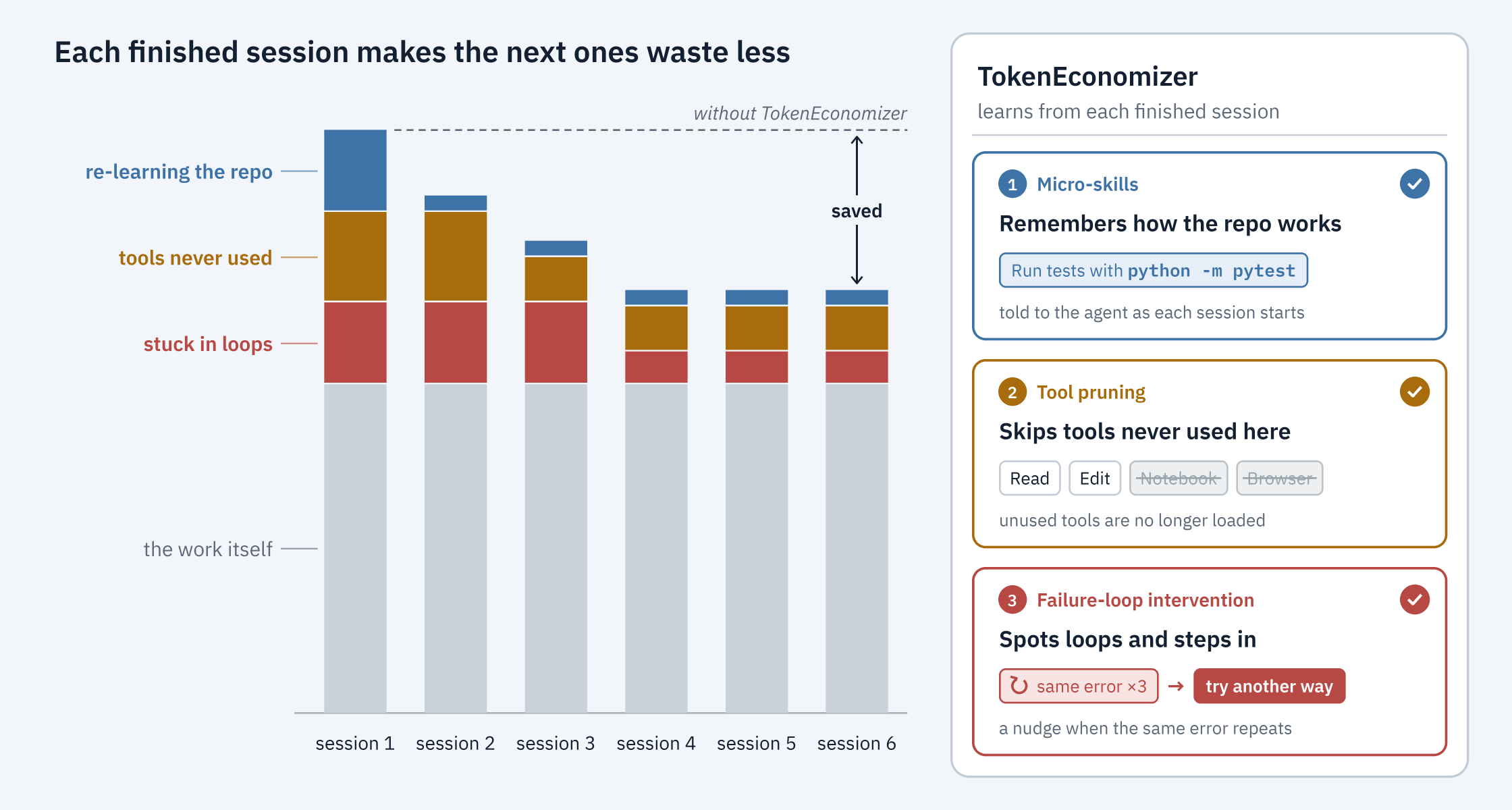
Microsoft Research, Microsoft Security and UC Berkeley open-sourced TokenEconomizer on GitHub (Apache 2.0, v0.1.0 released October 26), a plugin for Claude Code, Codex, GitHub Copilot CLI and Pi, with experimental opencode support. It learns from earlier sessions in the same repository: micro-skills remember repo facts, tool pruning drops tool definitions that go unused, and a loop guard nudges an agent that is stuck. The paper reports 18.4–30.9% lower mean cost across five agent and model combinations on 277 SWE-Bench tasks (paper figures).

Microsoft Research and UC Berkeley open-source TokenEconomizer, a plugin that cuts Claude Code and Codex costs by 18.4–30.9% on SWE-Bench without changing the agent

Key Takeaways

  • Cost: on 277 SWE-Bench tasks across 6 repositories and 5 agent and model combinations, mean cost fell 18.4–30.9%, and all 30 repository-by-combination cells got cheaper (paper figures, including the plugin's own model calls)
  • Success rate: Pass@1 rose in 4 of 5 combinations, e.g. Copilot CLI with Sonnet 5 cost 18.4% less with Pass@1 +2.6, while Claude Code with Opus 4.8 cost 30.9% less with Pass@1 -1.0
  • Three mechanisms: micro-skills (repo facts stated only after three sessions confirm them), tool pruning (by default a tool unused over 10 prompts across 2 sessions is left out), and a failure-loop guard (one redirect when a judge is at least 0.7 confident, never stopping a turn itself)
  • Generalization: 16–21% lower cost on Web-Bench and 6–20% lower on two security-auditing benchmarks where every task is a new repository
  • Deployment: Apache 2.0, Python 3.10+, no API key of its own, and learned experience stays local in ~/.tokeneconomizer
Read full story

Kimi launches 3D Make: K3.1 Pro drives Blender, CAD tools and Unreal, Unity and Godot to build models, scenes and games

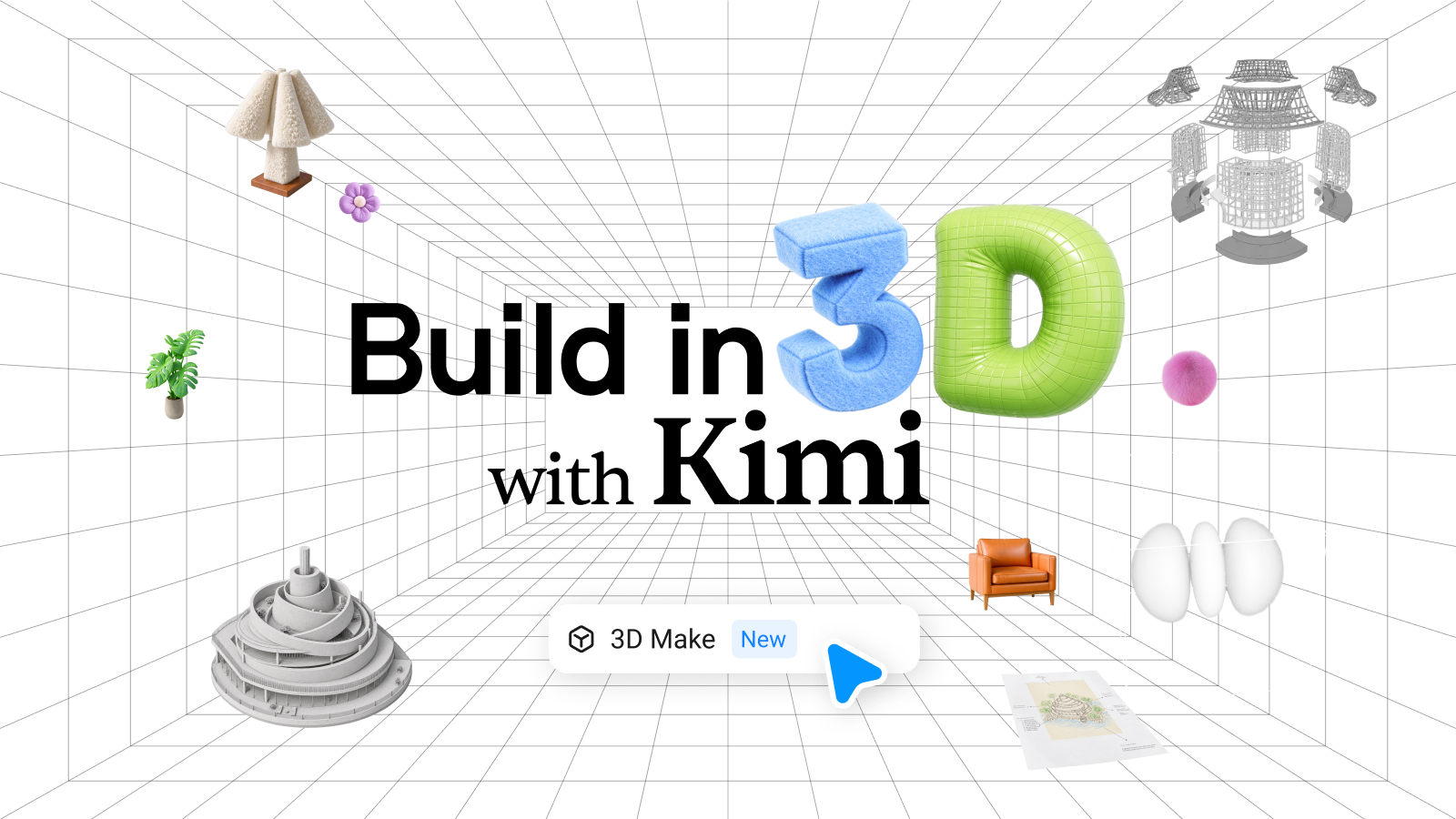
Moonshot AI's official Kimi account announced 3D Make at 03:14 UTC on Oct 30, saying Kimi connects to tools such as Blender and CAD software to create models, assemble scenes and develop games, available now on kimi.ai and Kimi Work. The companion 3D guide says K3.1 Pro was specifically trained to drive 3D software through Python scripts, so specialized tools without MCP support can join the workflow, while meshes such as people and animals are handed to diffusion services like Tripo. Plugins that need locally installed software work only in Kimi Work.

Kimi launches 3D Make: K3.1 Pro drives Blender, CAD tools and Unreal, Unity and Godot to build models, scenes and games

Key Takeaways

  • Availability: 3D Make is live on kimi.ai and Kimi Work; plugins that need locally installed software are Kimi Work only
  • Two modeling routes: parametric models (furniture, mechanical parts, buildings) via Python scripts written by K3.1 Pro, and meshes via services such as Tripo, Meshy and Hyper3D
  • Engines: Kimi says it is adapted to Unreal Engine, Unity and Godot to import models, assemble scenes and build gameplay step by step
  • Showcase: the celestial palace in the K3.1 Pro launch video was built in Unreal Engine 5.8 from source models totaling 36 million triangles, rendered with Nanite and Lumen
  • Benchmarks: no 3D benchmarks were published; the guide admits some tasks need several rounds, and rigging and complex materials remain weak spots
Read full story

ChatGPT adds iCloud Mail and iCloud Calendar plugins on all plans, connected with an Apple app-specific password

On Oct 27 the official ChatGPT account announced that iCloud Mail and iCloud Calendar plugins are available in ChatGPT on all plans across web, desktop and iOS, rolling out globally. Users can ask ChatGPT to find an email, catch up on their inbox, check what is next or update a calendar event. The two plugins are installed separately, both connect with an Apple app-specific password, and both include read-only contact lookup; standalone Contacts and Reminders plugins are not part of this launch.

ChatGPT adds iCloud Mail and iCloud Calendar plugins on all plans, connected with an Apple app-specific password

Key Takeaways

  • Available on every ChatGPT plan, including Free, on web, desktop and iOS, rolling out globally and subject to workspace app controls
  • Found under Settings > Plugins; iCloud Mail and iCloud Calendar are installed and connected separately
  • Both connect with an Apple app-specific password, which requires two-factor authentication; never use the main Apple password or paste it into a chat
  • Mail only works with @icloud.com, @me.com and @mac.com addresses, while Calendar uses the primary Apple Account email, which may differ
  • Disconnecting in ChatGPT does not revoke the app-specific password at Apple; that has to be done separately at account.apple.com
Read full story
Linked Models & Agents:
ADSponsored

Anthropic releases a Claude for Nonprofits plugin with fundraising, marketing and hiring skills built with ~30 organizations

On Oct 26 Anthropic released the Claude for Nonprofits plugin, a set of skills and connectors built with about 30 nonprofits. It covers the full fundraising cycle (finding funders, breaking down RFPs, drafting proposals and reports, donor stewardship), marketing, hiring and board work, and starts by having Claude map where the organization keeps its records and answer questions against the organization's own AI policy. It is installed automatically at no extra cost for verified nonprofits on Team and Enterprise plans. Anthropic says more than 25,000 nonprofits use Claude, and over 75% of them have fewer than 10 seats.

Anthropic releases a Claude for Nonprofits plugin with fundraising, marketing and hiring skills built with ~30 organizations

Key Takeaways

  • Scale (vendor-reported): more than 25,000 nonprofits use Claude, and over 75% of them have fewer than 10 seats, per the official article
  • How it was built: about 30 design-partner organizations, including the IRC, the Gates Foundation and International Justice Mission, tested early skills on real work and fed back changes
  • Pricing: the plugin is installed automatically at no extra cost on nonprofit Team and Enterprise plans; nonprofit discounts reach 75%, and about 90% in low- and middle-income countries, bringing Team seats to $3/user/month, with Claude Code included
  • Talent: Claude Corps is placing 1,000 early-career fellows in at least 400 US nonprofits, and Anthropic plans to extend it with Taproot for shorter pro bono projects
  • Onboarding: two official webinars run on Nov 10 (admins, data handling and AI policy) and Nov 12 (staff, day-one use)
Read full story

CapCut announces a ChatGPT plugin is coming soon, bringing its video generation and editing tools inside ChatGPT with drafts that move to the CapCut web editor

At 18:34 UTC on 2026-10-24, during its CapCut World event in Los Angeles, ByteDance's CapCut announced from its official account (@capcutapp) that a new CapCut plugin is coming soon to ChatGPT (post). According to CapCut, the plugin brings its video editing and generation tools inside ChatGPT: users can start with an idea in ChatGPT, create it with the plugin right in the chat, then move the draft to the CapCut web editor to refine and publish. When we pulled it, the post had about 3,646 likes, 319 reposts, 504 replies and 450K views. The event site lists OpenAI's Head of Partnerships Mahak Sharma and Head of Creator Product Sam Yam as speakers. Many creator posts on X say the plugin is already in early access on ChatGPT desktop with mobile and web around mid-November, but CapCut's own post still says coming soon, so timing and pricing should be taken from CapCut's later announcements.

Key Takeaways

  • Official source: CapCut's post on X, published 18:34 UTC on 10-24, with about 3,646 likes, 319 reposts, 216 quotes, 504 replies and 450K views when we pulled it
  • What it does: CapCut's video editing and generation tools inside ChatGPT, so a chat idea can become a video draft directly
  • Workflow: drafts made with the plugin can move to the CapCut web editor for further editing, sharing and publishing
  • OpenAI involvement: the CapCut World Los Angeles site lists OpenAI's Mahak Sharma (Head of Partnerships) and Sam Yam (Head of Creator Product) as speakers
  • Status: CapCut says coming soon; creator claims of desktop early access now and mobile and web in mid-November are not confirmed by CapCut, and pricing is not announced
Read full story

Eagle releases EAGLE-4, a speculative-decoding drafter that adapts to batch size and hardware; it reports 961.6 tok/s on Qwen3.8-27B for a single request

On Oct 20, inference company Eagle released EAGLE-4, the fourth generation of the EAGLE speculative-decoding family. One drafter resizes its speculative tree for the batch size, hardware and workload while keeping the target model's output distribution. Eagle reports 961.6 tokens/s for one request on Qwen3.8-27B with 4x B300. The code ships as eagle-harness v0.1.0 with plugins for SGLang, vLLM and an experimental TokenSpeed backend. Many reposts call it open source, but the official license is source-available, not OSI open source.

Eagle releases EAGLE-4, a speculative-decoding drafter that adapts to batch size and hardware; it reports 961.6 tok/s on Qwen3.8-27B for a single request

Key Takeaways

  • Vendor figure: 961.6 tokens/s on Qwen3.8-27B with TokenSpeed, BF16, 4x B300, TP4, one request, T=0 (paper Figure 1(a))
  • Repo measurements: vLLM on 4x B300 goes from 241.6 to 722.8 tok/s at concurrency 1 (2.99x) and 1.70x at concurrency 8; SGLang gets 1.91x at concurrency 8 and 1.35x at 64
  • AMD numbers too: SGLang on one MI355X gets 2.07x at concurrency 8 and 1.56x at 32 (ROCm 7.2)
  • Design: sliding-window draft layer, low-rank candidate head and append-only draft cache; the harness calibrates verify latency offline and grows the tree while gain per cost stays high
  • License: Eagle 4 Source-Available; free for noncommercial use, commercial use only under $20M trailing 12-month revenue and outside competing offerings
Read full story

OpenAI Upgrades GPT-6 Astra Pro in ChatGPT with Parallel Multi-Agent Execution and Showcases Always-On 'dots' Triaging 3 AM Incidents via Codex

OpenAI announced a major upgrade to GPT-6 Astra Pro in ChatGPT for Pro users, introducing faster response times, stronger plugin and tool orchestration, and native parallel multi-agent execution where multiple agents tackle different parts of a complex task simultaneously. Concurrently, OpenAI Developers showcased how internal engineers put always-on 'dots' agents on call to autonomously triage 3 AM production incidents, launch Codex debugging threads, and clear codebase maintenance backlogs.

OpenAI Upgrades GPT-6 Astra Pro in ChatGPT with Parallel Multi-Agent Execution and Showcases Always-On 'dots' Triaging 3 AM Incidents via Codex

Key Takeaways

  • Parallel multi-agent execution in GPT-6 Astra Pro: upgrades speed and tool use while enabling multiple agents to work on different task components concurrently in ChatGPT Pro
  • Always-on 'dots' on-call incident triage: autonomously investigates 3 AM production alerts and initiates Codex coding threads before waking the engineer
  • Mobile steering & backlog automation: engineers supervise Codex fixes from the ChatGPT mobile app and deploy Codex to continuously clear repository maintenance backlogs
Read full story
Linked Models & Agents:

Hermes Agent v0.22.0: keyless guided onboarding, one-click local llama.cpp models, Gmail/Linear/Notion connectors and a 600-plugin catalog

Nous Research shipped Hermes Agent v0.22.0, "The Threshold Release", on Oct 14 (UTC). Fresh desktop installs open a guided setup chat on a free trial model (nous/welcome) with no API key, connectors reach Gmail, Linear and Notion through the Nous tool gateway, a one-click llama.cpp runtime runs local models, installs now follow tested SemVer stable releases, and desktop builds are signed (including the Microsoft Store). The source tree shrank from about 1.06M to 698K lines (−34%).

Hermes Agent v0.22.0: keyless guided onboarding, one-click local llama.cpp models, Gmail/Linear/Notion connectors and a 600-plugin catalog

Key Takeaways

  • Scale since v0.21.0: ~24,200 commits, ~6,080 merged PRs, ~7,180 issues closed, ~2,520 contributors, about 2.5x the v0.21.0 cycle
  • Leaner: source went from ~1.06M to 698K lines (−34%); gateway/run.py from 34,847 to 5,512 lines; ~19 rarely used tools now load on demand, roughly halving the desktop tool schema, and ~2.1k tokens came off the fixed prompt
  • Local models: installs llama.cpp b11370 for CPU/CUDA/Metal/Vulkan/ROCm, recommends only models that fit fully in GPU memory; catalog includes Qwen3.8 27B, Qwen3.6 35B-A3B, DeepSeek V4 Flash and any Hugging Face GGUF
  • 600-plugin catalog, each pinned to a reviewed commit; memory providers (Honcho, Mem0, Supermemory and others) moved out of core
  • Faster updates that rebuild only what changed: 16.5 s vs 32.5 s on macOS (vendor figure)
Read full story

Claude Code 2.1.299 adds idle compaction for 200K+ token sessions before cache expiry and fixes sandboxed writes into --plugin-dir

Anthropic released Claude Code 2.1.299 on Oct 14. A new default compacts a 200K+ token terminal conversation after about 54 idle minutes, before its one-hour prompt cache expires, so the next message doesn't reprocess everything; tune it with CLAUDE_CODE_IDLE_COMPACT_MIN_TOKENS or turn it off with "idleCompaction": false. The release also fixes sandboxed shell commands being able to write into a --plugin-dir folder whose code Claude Code reloads outside the sandbox, and adds --disallow-tools to claude plugin eval.

Claude Code 2.1.299 adds idle compaction for 200K+ token sessions before cache expiry and fixes sandboxed writes into --plugin-dir

Key Takeaways

  • Idle compaction: triggers at 200K+ tokens after ~54 idle minutes, before the one-hour prompt cache expires
  • Configurable: CLAUDE_CODE_IDLE_COMPACT_MIN_TOKENS changes the 200K floor; "idleCompaction": false in settings.json disables it
  • Security fix: sandboxed commands could write into a --plugin-dir folder whose code is reloaded and run outside the sandbox
  • Custom ANTHROPIC_BASE_URL streams now wait 300 s instead of 180 s with no data; gateway-specific model names no longer fail compaction near 200K tokens
  • claude plugin eval gains --disallow-tools and a disallowed_tools case field to keep built-ins such as Agent out of eval runs
Read full story
Linked Models & Agents:
ADSponsored

CONTRA Released: Selective Clarification Framework for Coding Agents Lifts F1 by 13.88% with Open-Source Claude Code Plugin

When software engineers interact with LLM coding agents, natural language requirements are frequently ambiguous, underspecified, or missing critical boundary rules. Existing coding agents face a difficult trade-off: silently hallucinating assumptions to produce syntactically valid but functionally flawed code, or incessantly asking trivial clarifying questions that disrupt developer focus and cause cognitive fatigue. Researchers from Peking University and Wuhan University introduce CONTRA (arXiv:2610.01769, repo: github.com/fangz-cs/Contra), a training-free framework for selective clarification in LLM code generation. CONTRA employs a three-tier pipeline: broad question discovery, semantic- and execution-based question qualification, and history-aware adaptive stopping. By executing candidate code variants in isolated environments conditioned on alternative answers, it verifies whether a question triggers stable, behavior-changing differences before prompting the user. On ClarifyCodeBench, CONTRA achieves macro-average question F1 of 41.20% and TKQR of 38.32%, outperforming leading baselines by 13.88 and 12.33 percentage points respectively. On GPT-5.5, it lifts recall from 15.12% to 36.72% while maintaining high precision. CONTRA is released as an open-source extension for Claude Code.

Key Takeaways

  • CONTRA framework published, leveraging execution-based behavior differential testing to stop agent hallucinations and fatigue
  • Achieves 41.20% macro-average F1 on ClarifyCodeBench, outperforming leading clarification baselines by 13.88 points
  • More than doubles key question recall on GPT-5.5 from 15.12% to 36.72%, with open-source plugin released for Claude Code
Read full story

OpenCode 2.0 ships: one background service for TUI, web and desktop, Code Mode for all MCP servers, background subagents, and @opencode/sdk

Anomaly published the OpenCode 2.0 launch note on Oct 12: a single auto-started local service shared by the TUI, web and desktop apps; a rewritten server API with the new @opencode/client; @opencode/codemode, which turns MCP servers and OpenAPI endpoints into functions the model composes in scripts (all MCP servers opt into Code Mode by default); background subagents and background shell commands; 80+ internal features rebuilt as hot-reloadable plugins; and @opencode/sdk for embedding the same engine as a library. V1 plugins and the old server API are not compatible.

OpenCode 2.0 ships: one background service for TUI, web and desktop, Code Mode for all MCP servers, background subagents, and @opencode/sdk

Key Takeaways

  • Architecture: one auto-started local background service shared by TUI, web, desktop and @opencode/client scripts; opencode pair connects other hosts
  • Code Mode: @opencode/codemode converts MCP servers and OpenAPI endpoints into script-callable functions; every MCP server defaults to Code Mode (codemode: false opts out)
  • Orchestration: background subagents (background: true, default nesting depth 1) and background shell commands with no default timeout; Ctrl+B moves running work to the background
  • Extensibility: 80+ features implemented as internal plugins, TUI plugins now stable and hot-reloadable; @opencode/sdk is the same code as the CLI
  • Migration: three breaking areas (plugin API, server API/clients, tui.json to global cli.json); upgrade with opencode upgrade --major
Read full story
Linked Models & Agents:

OpenCode 1.19.0 opens the upgrade path to OpenCode 2: new plugin and server APIs, auto-updates now manual

OpenCode v1.19.0 (Oct 11) adds opencode upgrade --major and a TUI /update command to move 1.x installs to OpenCode 2 (tagged up to v2.0.26), stops auto-installing updates, and hardens PTY connection validation. The official V2 migration guide lists three intentional breaking changes: plugin API, server API/clients, and terminal client config.

Key Takeaways

  • v1.19.0 shipped 2026-10-11: opencode upgrade --major or TUI /update moves to OpenCode 2; updates are no longer auto-installed
  • OpenCode 2 tags run from v2.0.0 (2026-09-11) to v2.0.26 (2026-10-08); the repo has ~212K GitHub stars
  • Three intentional breaking changes: new plugin API, new server API and clients (@opencode/client), and layered tui.json replaced by one global cli.json
  • V1 plugin implementations do not run on V2 and must be ported; existing agents, commands, skills and opencode.json keep working
  • V2 accepts lsp config but no longer runs language servers or LSP diagnostics; use lint/typecheck/compile commands instead
Read full story
Linked Models & Agents:

omdrop-owl: two-way AirDrop with iPhone on a Framework 13 Linux laptop via OWL, with Wi-Fi staying connected

On 2026-10-09 developer t4t5 open-sourced omdrop-owl, a radio backend for the Omarchy plugin omdrop that gives two-way AirDrop with an iPhone on the Framework 13's MediaTek MT7925 while Wi-Fi stays connected. It builds on Seemoo Lab's 2019 OWL/OpenDrop reverse engineering rather than a from-scratch effort. README self-tests: ~1.3 MB/s receive, ~490 kB/s send; the AP must be on channel 6/44/149.

omdrop-owl: two-way AirDrop with iPhone on a Framework 13 Linux laptop via OWL, with Wi-Fi staying connected

Key Takeaways

  • Project: omdrop-owl, repo created 2026-10-08; 416 stars / 24 forks at ingest (GitHub API); no license declared
  • Hardware: only MediaTek MT7925 (Framework 13) tested; two-way transfer with Wi-Fi staying connected
  • Speed (author's README self-test): ~1.3 MB/s receive, ~490 kB/s send; start/stop about 2 s
  • Limits: AP must be on channel 6/44/149; station may stop receiving 3–165 s after monitor teardown, so it reconnects
  • Lineage: builds on Seemoo Lab's 2019 OWL/OpenDrop; omdrop PR #25 still open
Read full story

DeepSeek Harness v0.2.1: desktop apps plus experimental Claude Code Mods compatibility

GitHub dsh-v0.2.1-alpha.1 (2026-10-03T06:42:19Z) adds an experimental Claude Code Mods compatibility layer to MIT DeepSeek Harness (~243k stars)—explicitly to test that Mods APIs are broadly a subset of dsh plugins, not full compatibility—continuing v0.2 desktop apps. Get it at deepseek.com/harness or npx @deepseek-ai/dsh web.

Key Takeaways

  • Sources: dsh-v0.2.1-alpha.1 (2026-10-03), deepseek-ai/deepseek-harness (~243k★), deepseek.com/harness
  • Experimental Claude Code Mods layer = subset validation, not full compatibility
  • v0.2 desktop: macOS Apple silicon + Windows x64 with bundled dsh command
  • Everything-is-a-plugin on Cordis; OpenAI-compatible providers supported
  • Developer preview with breaking changes—sandbox before production
Read full story