AI Coding Live News

X Discussion: Elon Musk Says Grok Bot Serving Costs Were Unsustainably High Relative to Revenue; Replit CEO Amjad Masad Warns Subsidized AI Subscriptions Face a Rug Pull

After users on X complained that their Grok Bot usage ran out early this cycle, Elon Musk replied that "the cost of serving Grok Bot was unsustainably high relative to revenue", a reply with about 13K likes and 5.5M views. Replit CEO Amjad Masad then quoted the news, saying people enjoying subsidized AI subscriptions should "get ready to get rug pulled", sparking a debate over whether flat-rate AI plans can last. This is an X discussion with personal views; xAI has not published a formal pricing or limit announcement.

Key Takeaways

  • Trigger: user @DogecoinNorway said their Grok Bot usage hit 100% with 4 days left until reset, a post with about 1.24M views.
  • Musk replied that the cost of serving Grok Bot was unsustainably high relative to revenue, with about 13.2K likes, 5.51M views and 1,900+ quotes.
  • Amjad Masad (Replit CEO) quoted it, warning subsidized AI subscriptions are about to get rug pulled, with about 2,347 likes and 146K views; in replies he said Replit never subsidized.
  • xAI has not published a formal limit or pricing change; rely on official notices for specifics.
Read full story

Meituan ships LongCat-2.5, a 1.6T-parameter (about 48B active) native multimodal agentic model, with API pricing of $0.30/$1.20 per 1M tokens

On Nov 2 Meituan's LongCat team listed LongCat-2.5 in its API platform change log as the full release of September 25's LongCat-2.5-Preview. The official technical blog says it has 1.6 trillion total parameters with about 48 billion activated per token, builds on LongCat-2.0 with stronger native visual understanding and agentic coding, and was trained and served with W4A4 inference on domestic AI accelerators. Vendor-reported scores include 88.4 on Terminal Bench v2.1, 38.5 on Terminal Bench v4.0, 91.9 on BrowseComp and 83.1 on MCP Atlas. The API speaks both OpenAI and Anthropic formats with a 1M-token context and up to 128K output tokens, at a limited-time price of $0.30 per 1M uncached input tokens, $0.006 cached input and $1.20 output.

Meituan ships LongCat-2.5, a 1.6T-parameter (about 48B active) native multimodal agentic model, with API pricing of $0.30/$1.20 per 1M tokens

Key Takeaways

  • Scale: a 1.6-trillion-parameter MoE with about 48B active per token, a 1M-token context and up to 128K output tokens (official blog, API docs)
  • Code agents (vendor-reported): Terminal Bench v2.1 88.4 (Claude Opus 5 89.1, GPT-5.6-Sol 88.8), Terminal Bench v4.0 38.5 (GPT-5.6-Sol 37.3, Claude Opus 5 53.9), DeepSWE v1.1 64.6
  • General agents (vendor-reported): BrowseComp 91.9, MCP Atlas 83.1, AutomationBench v1.0.6 51.8, HLE with tools 63.1; AutomationBench jumps from 15.8 on LongCat-2.0
  • Pricing: limited-time $0.30 per 1M uncached input tokens, $0.006 cached input and $1.20 output (pricing page)
  • Engineering: W4A4 inference raises prefill throughput 43.3% and decode throughput 42.77% over a W8A8 baseline; FSDP gives 86% higher per-device throughput than DDP in long-sequence SFT
Read full story

Cartesia launches Managed Agents voice agent platform: #1 of 30 on Speech Agent Arena, $0.03 per minute at launch

Voice model company Cartesia launched Managed Agents on Oct 29, an end-to-end voice agent platform for enterprise phone calls that tunes its own speech-to-text and text-to-speech models together with the agent harness, and bundles telephony, knowledge bases, tool calls and outbound batches. Cartesia says it ranks #1 on Artificial Analysis's Speech Agent Arena with a 1115 Elo and scores 87.4% accuracy and 90.7% experience on ServiceNow's EVA-Bench (vendor-reported, with GPT-5.5 as the reasoning model). Launch pricing is 50% off at $0.03 per minute.

Cartesia launches Managed Agents voice agent platform: #1 of 30 on Speech Agent Arena, $0.03 per minute at launch

Key Takeaways

  • On Artificial Analysis's Speech Agent Arena blind preference test, Managed Agents ranks #1 of 30 agents with a 1115 Elo, ahead of Gemini 3.1 Flash Live Minimal (1099), Grok Voice 3.0 (1064) and GPT-Live-1 (1041) (Cartesia blog, as cited by the vendor)
  • First-attempt results on ServiceNow EVA-Bench across 200+ customer service, IT service and HR scenarios: 87.4% accuracy and 90.7% experience, versus 73.7%/71.2% for Grok Voice 3.0 and 59.0%/61.6% for GPT Realtime 2.1 (EVA-Bench)
  • All these benchmark runs use GPT-5.5 as the reasoning model; Cartesia's internal evaluation says 85% of calls had no turn-taking issues, versus 67% for other agents
  • Launch pricing is 50% off at $0.03 per minute; Cartesia says the platform has already handled tens of millions of conversations in finance, retail, hospitality and healthcare
  • It supports 44 languages; English, Spanish, Hindi, French and Japanese can switch mid-call today, with the rest coming soon
Read full story

OpenAI Daybreak Red (GPT-5.6 Cyber) arrives on Amazon Bedrock in AWS GovCloud (US-East) for vetted defenders, at $16.875 input and $101.25 output per 1M tokens

On Oct 30, AWS announced that Daybreak Red (GPT-5.6 Cyber, model ID openai.gpt-5.6-cyber), the OpenAI security model built for vulnerability research, is now on Amazon Bedrock in AWS GovCloud (US-East), after previously being offered only in US East (Ohio). Access still requires passing OpenAI Daybreak eligibility. GovCloud short-context pricing is $16.875 input and $101.25 output per 1M tokens, about 23% above Ohio at $13.75 and $82.50.

Key Takeaways

  • Regions: Daybreak Red can now be called In-Region in us-east-2 (Ohio) and us-gov-east-1 (GovCloud US-East); Geo and Global cross-Region inference are not supported (AWS announcement)
  • Eligibility: customers must first enroll in OpenAI Daybreak / Trusted Access for Cyber, then have their AWS account team enable access
  • Pricing: GovCloud short context (272K input tokens or fewer) is $16.875 input, $21.09375 for 30-minute cache writes, $1.6875 cache reads and $101.25 output per 1M tokens
  • Data: AWS says inference data is not used for training and Daybreak Red data does not need to be shared with OpenAI; it runs on an inference engine with zero-operator access enforced at the chip
  • API: served through the bedrock-mantle endpoint with OpenAI Responses and Chat Completions, and a 1,050,000-token context window
Read full story
ADSponsored

Google releases Gemini 4 Carbon two weeks after Argon: 59 and first place on the Artificial Analysis Intelligence Index v5, state-of-the-art cybersecurity and long-horizon coding, with early access for cyber defenders in the Fairwind program

Google DeepMind announced Gemini 4 Carbon on Oct 28, calling it its strongest model, just two weeks after Gemini 4 Argon. The official blog says it ranks first on v5.0 of the Artificial Analysis Intelligence Index at 59 and leads three cybersecurity evaluations: 88.2% on SEC-bench Pro for finding vulnerabilities, 54.8% on ExploitGym for exploitation and 71.0% on CWE-bench for patching; it also gains 89 points to rank fourth on WebDev Arena at 1769. Access starts this week for a subset of cyber defenders in the Fairwind program, with developers, businesses and consumers to follow. Introductory pricing matches Argon at $2 per million input tokens and $10 per million output tokens, rising to $4 and $20 afterwards.

Google releases Gemini 4 Carbon two weeks after Argon: 59 and first place on the Artificial Analysis Intelligence Index v5, state-of-the-art cybersecurity and long-horizon coding, with early access for cyber defenders in the Fairwind program

Key Takeaways

  • Positioning: Google calls it its strongest model, aimed at cybersecurity and long-horizon agentic work; internal teams saw it run for days to root-cause and patch subtle bugs across large codebases and low-level systems
  • Official scores (evaluated without guardrails): 88.2% on SEC-bench Pro, 54.8% on ExploitGym and 71.0% on Collinear's CWE-bench; 59 and first place on the Artificial Analysis Intelligence Index v5.0; +89 to fourth place on WebDev Arena at 1769
  • Safety and alignment: successful cheating on Terminal-Bench 4.0 fell to 0.0% with a 0.4% attempt rate, high-severity misalignment alerts in internal live coding dropped by almost 80%, unsupported claims are about half of Argon's, and the Gray Swan indirect prompt injection attack success rate fell from Argon's 0.7% to 0.0%
  • Internal examples: more than 2x Argon's success rate at generating secure code, and the Chrome team reports more than 10x better high-quality patches than another lab's large frontier model
  • Rollout: a subset of cyber defenders in the Fairwind program first, alongside the U.S. government's voluntary pre-release testing; no developer API yet; introductory pricing of $2 / $10 per million tokens with cached input 95% off, then $4 / $20
Read full story

X discussion: Greg Isenberg says SaaS is becoming free, give away the CRM and dashboard and charge for the agent that does the work

On Oct 27, Greg Isenberg (@gregisenberg, about 752K followers), founder and CEO of Late Checkout, posted on X: "saas is becoming free: give away the crm, give away the dashboard, give away the app, and charge for the agent that does the work." Within about seven hours the post had about 109K views, 1,526 likes, 277 replies and 37 quotes, with many founders debating whether per-seat pricing can really give way to pricing for the work an agent completes. This is a discussion of an opinion, not a pricing announcement from any company.

X discussion: Greg Isenberg says SaaS is becoming free, give away the CRM and dashboard and charge for the agent that does the work

Key Takeaways

  • Engagement (as of 2026-10-28 03:10 UTC, public X API data): about 109K views, 1,526 likes, 746 bookmarks, 277 replies, 37 quotes
  • The claim: the CRM, dashboard and app become free, and the paid product is the AI agent that does the work for the user
  • The most common pushback: charging for "work" means defining in writing what done means, who checks it, and a monthly cap, or it cannot be billed
  • Another camp says companies will keep paying for the system of record, while SaaS vendors give away MCP access so outside agents can read and write
  • This is a founder opinion under discussion, not a pricing change by any company
Read full story
Linked Models & Agents:

X discussion: Dario Amodei says some Claude tokens are worth cents and others tens of millions, floating pay-for-results AI pricing

On Oct 26, investor Guillermo Flor (@guilleflorvs) shared a video clip of Anthropic CEO Dario Amodei on X. Amodei says Claude has told people to restart their Mac about 10 million times, which is worth a dollar or less, while telling a pharma company to move an aromatic ring to the other end of a molecule could be worth tens of millions of dollars. He expects pay-for-results pricing, or labor-like hourly pricing, to emerge. The post has about 1.11M views and 2,600+ likes, and has been widely quoted by AI builders and analysts over the past day. This is a discussion of the CEO's view, not an Anthropic pricing change.

X discussion: Dario Amodei says some Claude tokens are worth cents and others tens of millions, floating pay-for-results AI pricing

Key Takeaways

  • Engagement (as of 2026-10-28 01:11 UTC, public X API metrics): about 1.11M views, 2,611 likes, 1,779 bookmarks, 364 replies and 326 quotes
  • Source of the view: a video clip of Anthropic CEO Dario Amodei, posted with a summary by investor Guillermo Flor; the post does not say where the clip is from, and it is not an Anthropic announcement
  • Amodei's two examples: saying 'restart your Mac' about 10 million times is worth a dollar or less, while a molecule-change suggestion to a pharma team could be worth tens of millions of dollars
  • He expects pay-for-results pricing or labor-like hourly pricing, and says many pricing models will be tried because this is a new industry
  • Reality check: per Anthropic's S-1 as cited in the post, usage-based pricing was about 80% of H1 2026 revenue and subscriptions about 20%; much of the debate is that value pricing needs a measurable cost baseline first
Read full story
Linked Models & Agents:

Microsoft makes MAI-Image-2.6 and MAI-Image-2.6-Flash generally available in Foundry as MAI-Image-2.7-Preview reaches #3 in Image Edit Arena

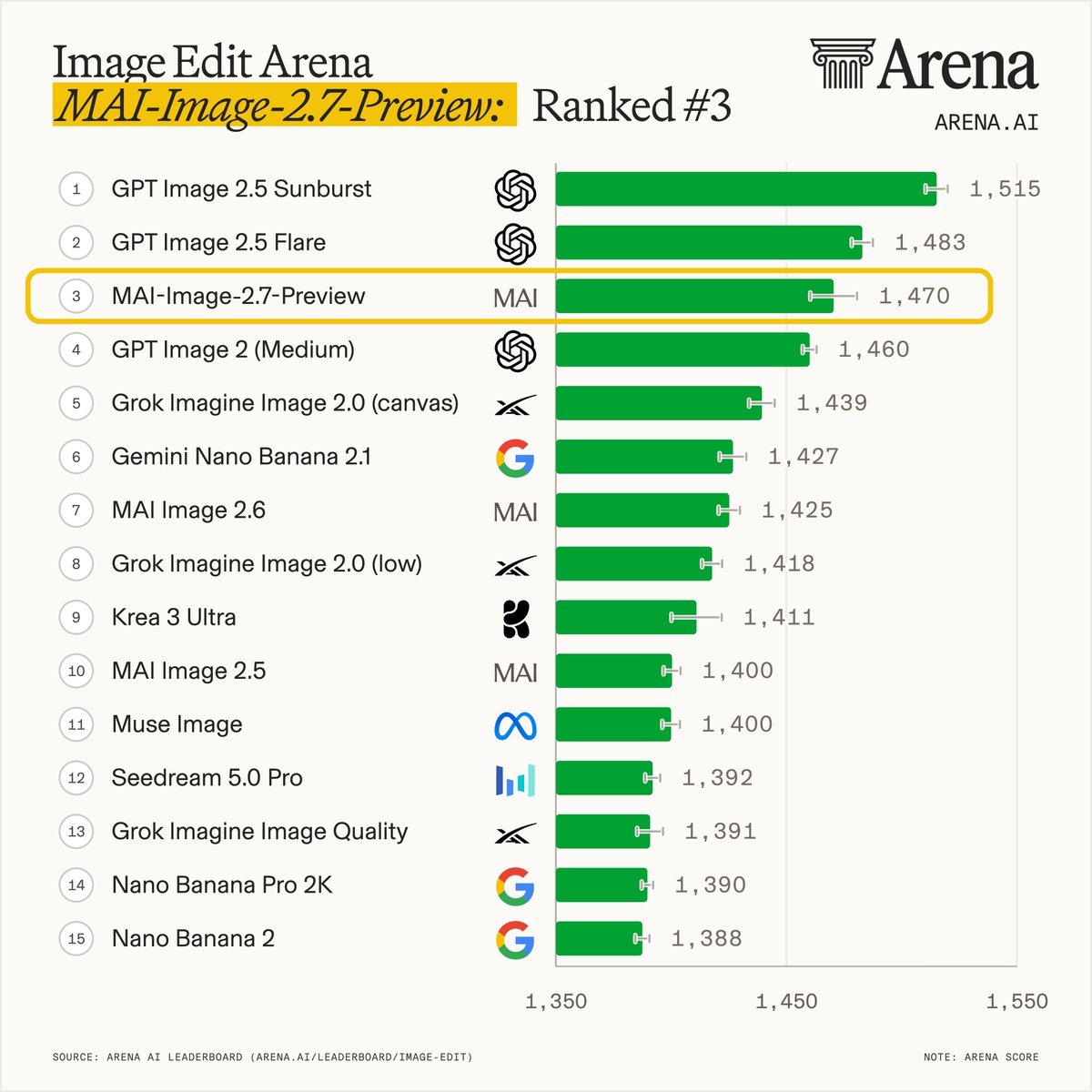
Microsoft AI announced on Oct 27 that MAI-Image-2.6 and MAI-Image-2.6-Flash are generally available in Microsoft Foundry, with multi-reference editing from up to five images, Bing web grounding, output up to 1.5K and published per-token pricing. The same day its next image editing model, MAI-Image-2.7-Preview, reached #3 overall in Arena's Image Edit leaderboard at 1470 points, 45 points above 2.6; for now it is available only for editing in MAI Playground.

Microsoft makes MAI-Image-2.6 and MAI-Image-2.6-Flash generally available in Foundry as MAI-Image-2.7-Preview reaches #3 in Image Edit Arena

Key Takeaways

  • MAI-Image-2.6 and MAI-Image-2.6-Flash are generally available in Microsoft Foundry, and Microsoft says 2.6 is coming soon to Adobe Firefly
  • Official pricing: 2.6 costs $5 text input, $8 image input and $38 image output per 1M tokens; Flash costs $1.75, $2.50 and $19
  • 2.6 supports multi-reference editing with up to five images, Bing web grounding, dynamic aspect ratios and output up to 1.5K
  • Per Arena, MAI-Image-2.7-Preview is #3 overall in Image Edit Arena at 1470 points, 45 points above 2.6 (#7), putting Microsoft AI #2 among labs
  • Per Artificial Analysis, 2.7-Preview is #2 on AA-Image-Editing v2.1 and beats 2.6 on all 7 editing actions, ranking #1 on 4 of them
Read full story
Linked Models & Agents:
⚡ MAI-Image-2.6⚡ MAI-Image-2.6-Flash⚡ MAI-Image-2.7-Preview🌐 Microsoft🌐 Microsoft AI

Apple Creator Studio adds AI assistants built on Apple models and OpenAI to Logic Pro, Keynote, Pages and Numbers, plus MCP support so external agents can edit iWork documents

On October 27 Apple announced a major Apple Creator Studio update: Logic Pro for Mac plus Keynote, Pages and Numbers gain beta intelligent assistants that Apple says are powered by a combination of Apple-built models and OpenAI and understand document context. Keynote, Pages and Numbers also add Model Context Protocol (MCP) support, letting external AI agents read content, make edits and run automated actions inside the apps. Pixelmator Pro adds natural-language Generate Fill, and Keynote introduces the open JSON-based .keyx format. The update ships free to existing subscribers on the App Store in November; pricing stays $12.99 per month or $129 per year.

Apple Creator Studio adds AI assistants built on Apple models and OpenAI to Logic Pro, Keynote, Pages and Numbers, plus MCP support so external agents can edit iWork documents

Key Takeaways

  • Logic Pro for Mac, Keynote, Pages and Numbers gain beta assistants that Apple says run on a combination of Apple-built models and OpenAI
  • Keynote, Pages and Numbers support MCP so external AI agents can read content, edit and automate actions (requires macOS 27 or later)
  • Keynote adds the open JSON-based Keynote Interchange Format (.keyx), designed to be readable by external tools and AI agents
  • Assistants are U.S. English only and need an Apple Intelligence-capable device on iOS, iPadOS or macOS 27; free update for subscribers in November
  • Pricing unchanged at $12.99 per month or $129 per year, $2.99 per month for education
Read full story

OpenAI launches GPT-6.1 Terra: fast, low-cost computer use at $1/$5 per million tokens, half the price of GPT-5.6 Terra and GPT-6.1 Sol

On Oct 26 OpenAI released GPT-6.1 Terra, an efficient model for visual reasoning, precise computer use and natural writing. It is rolling out today to Plus, Pro, Enterprise and Edu users in ChatGPT Work and Codex, and in the API as gpt-6.1-terra. Standard API pricing is $1 input, $0.05 cached input and $5 output per million tokens, which OpenAI says is 50% lower than GPT-5.6 Terra and GPT-6.1 Sol, with a 1,050,000-token context window. By OpenAI's figures it scores 15 points higher than GPT-5.6 Terra on Agents' Last Exam at medium effort for about a third of the cost, and solves 50.3% of Terminal-Bench 4.0 at max effort.

OpenAI launches GPT-6.1 Terra: fast, low-cost computer use at $1/$5 per million tokens, half the price of GPT-5.6 Terra and GPT-6.1 Sol

Key Takeaways

  • Pricing (official docs): $1 input, $0.05 cached input, $1.25 for 30-minute cache writes and $5 output per million tokens; requests over 272K input tokens are billed at 2x input and 1.5x output; Batch/Flex are half price and Fast mode is 2x
  • Specs: 1,050,000-token context, 922,000 max input and 128,000 max output tokens, Jun 1 2026 knowledge cutoff; reasoning.effort from none to max, and tool calling requires the Responses API
  • Computer use (OpenAI figures): on Agents' Last Exam at medium effort it beats GPT-5.6 Terra by 15 points at about one-third the cost, and matches GPT-6 Astra at one-tenth the price per token; it finishes tasks over 3x faster than GPT-6 Astra and GPT-6.1 Sol
  • Coding and factuality (OpenAI figures): 50.3% on Terminal-Bench 4.0 at max effort, more than double GPT-5.6 Terra's published 21.5%; error rate on an internal error-inducing prompt set fell from 53.6% to 16.7% at low effort
  • Safety: OpenAI says it meets the Critical cybersecurity threshold under its Preparedness Framework and keeps the safeguards built for GPT-6 Astra
Read full story
ADSponsored

Cursor launches Agent SDK: agents as code with Markdown prompts, TypeScript tools, built-in evals, and hosted or self-run deployment

On Oct 26 Cursor announced that its Agent SDK is generally available. An agent's system prompt is written in Markdown and its tools in TypeScript; agents can be deployed on Cursor's hosted infrastructure or run on your own machines, and built-in evals measure every change. Cursor's docs say it uses the same Cursor SDK harness that powers Bugbot, Security Review, Approval Bot and Rollouts, can be triggered from source-control events, issue trackers, Slack or schedules, and is managed under Deployed Agents after deployment. Cursor has not published pricing or benchmarks.

Cursor launches Agent SDK: agents as code with Markdown prompts, TypeScript tools, built-in evals, and hosted or self-run deployment

Key Takeaways

  • Same harness: Cursor's docs say Agent SDK runs on the harness behind four of its own agents: Bugbot, Security Review, Approval Bot and Rollouts
  • Project layout: bot/instructions.md is the required always-on system prompt, each bot/tools/*.ts file is one typed tool, with folders for skills, MCP connections, subagents, channels, hooks and schedules, and evals live in evals/*.eval.ts
  • Triggers and deployment: runs can be triggered from source control, issue trackers, Slack, webhooks or schedules; deploy on Cursor-managed hosting or self-host, then manage under Deployed Agents
  • CLI: agent-sdk validate, run and eval check the project, run a real turn and run evals; Cursor says only run and eval need a Cursor credential
  • Cursor has not published pricing or benchmarks
Read full story
Linked Models & Agents:

Oracle unveils the Fusion Claw runtime with 25 agentic apps at AI World, and Fusion Companion lets employees run ERP and HCM work from ChatGPT

At Oracle AI World in Las Vegas on Oct 26, Oracle announced Oracle Fusion Claw, a new execution runtime for agents, and 25 Claw-powered Agentic Applications now available across ERP, HCM, supply chain (SCM) and customer experience (CX). It also introduced Fusion Companion and Fusion Agentic Home: employees describe a goal in natural language in supported AI tools such as ChatGPT or in the native Fusion interface, and the system picks and coordinates the transactions, workflows, approvals and AI agents needed, within existing identity, permission and approval controls. Oracle has not published pricing, benchmarks or a detailed rollout schedule.

Oracle unveils the Fusion Claw runtime with 25 agentic apps at AI World, and Fusion Companion lets employees run ERP and HCM work from ChatGPT

Key Takeaways

  • Runtime: Fusion Claw is a new agent execution runtime that Oracle says supports larger-scale and longer-running work, continuous replanning, deterministic execution and governed autonomy (press release)
  • Scale: 25 Claw-powered Agentic Applications are available now across the ERP, HCM, SCM and CX suites, including Ledger, Workforce Orchestration, Payroll Activity Workspace and Procurement Spend
  • Access: Fusion Companion works through supported AI tools such as ChatGPT and customer- or partner-built interfaces, with Fusion Agentic Home as the native entry point (Fusion Companion release)
  • Governance: all execution stays within existing identity, permissions, policies and approval controls, and decisions needing human judgment are escalated
  • Not disclosed: Oracle has not published pricing, benchmarks or a per-app rollout schedule
Read full story

CapCut announces a ChatGPT plugin is coming soon, bringing its video generation and editing tools inside ChatGPT with drafts that move to the CapCut web editor

At 18:34 UTC on 2026-10-24, during its CapCut World event in Los Angeles, ByteDance's CapCut announced from its official account (@capcutapp) that a new CapCut plugin is coming soon to ChatGPT (post). According to CapCut, the plugin brings its video editing and generation tools inside ChatGPT: users can start with an idea in ChatGPT, create it with the plugin right in the chat, then move the draft to the CapCut web editor to refine and publish. When we pulled it, the post had about 3,646 likes, 319 reposts, 504 replies and 450K views. The event site lists OpenAI's Head of Partnerships Mahak Sharma and Head of Creator Product Sam Yam as speakers. Many creator posts on X say the plugin is already in early access on ChatGPT desktop with mobile and web around mid-November, but CapCut's own post still says coming soon, so timing and pricing should be taken from CapCut's later announcements.

Key Takeaways

  • Official source: CapCut's post on X, published 18:34 UTC on 10-24, with about 3,646 likes, 319 reposts, 216 quotes, 504 replies and 450K views when we pulled it
  • What it does: CapCut's video editing and generation tools inside ChatGPT, so a chat idea can become a video draft directly
  • Workflow: drafts made with the plugin can move to the CapCut web editor for further editing, sharing and publishing
  • OpenAI involvement: the CapCut World Los Angeles site lists OpenAI's Mahak Sharma (Head of Partnerships) and Sam Yam (Head of Creator Product) as speakers
  • Status: CapCut says coming soon; creator claims of desktop early access now and mobile and web in mid-November are not confirmed by CapCut, and pricing is not announced
Read full story

Moonshot launches Kimi K3.1 Pro: 2.8T-total / 104B-active open-weight MoE with 1M context, 65.7% on Terminal-Bench 4.0, API at $2/$10, weights by Nov 4

On 2026-10-23 (17:15 UTC) the official @Kimi_Moonshot account launched Kimi K3.1 Pro, alongside K3.1 Pro Highspeed (2-3x faster). Both are live on Kimi.ai, Kimi Work, Kimi Code and the Kimi API, and full weights are promised by 2026-11-04. The official tech blog describes it as a post-trained version of K3 with much larger multi-domain joint RL: a 2.8T-total / 104B-active MoE, 1M-token context, multimodal. Vendor-reported scores: 65.7% on Terminal-Bench 4.0 (GPT-6 Astra 58.2%, Claude Opus 5.5 66.4%) and 92.7% on BenchCAD with tools. The Kimi API pricing page lists kimi-k3.1-pro at $2 input, $10 output and $0.20 cached input per million tokens, down from K3 at $3/$15.

Moonshot launches Kimi K3.1 Pro: 2.8T-total / 104B-active open-weight MoE with 1M context, 65.7% on Terminal-Bench 4.0, API at $2/$10, weights by Nov 4

Key Takeaways

  • 2.8T-total / 104B-active MoE, 1M-token context, multimodal; full weights promised by 2026-11-04 (official blog)
  • Vendor-reported: 65.7% on Terminal-Bench 4.0, ahead of GPT-6 Astra (58.2%) and just behind Claude Opus 5.5 (66.4%); 61.2% on the internal Kimi Code Bench 3.0 Long-horizon (K3: 55.95%)
  • API pricing: kimi-k3.1-pro at $2 input / $10 output / $0.20 cached input per million tokens; Highspeed at $4 / $20 (pricing page)
  • On the internal Kimi Hallu Bench Hard stress test, claim-level hallucination fell from 23.4% (K3) to 8.3%; Moonshot notes this is not a daily-use error rate
  • Cyber-related data was removed from mid-training and RL for the open-weight release: xdev-bench-hard pass@3 drops from 90.5% (unmitigated checkpoint) to 81.0%
Read full story
Linked Models & Agents:

Inception Unveils Mercury 3: Diffusion-Based LLM Breaks 1,000+ Tok/s with 1M Context Window

Inception co-founder Stefano Ermon officially unveiled Mercury 3, the company's next-generation diffusion-based large language model. Delivering an astonishing 1,068 tokens per second inference speed on NVIDIA GPUs, Mercury 3 scales to 40x the size of Mercury 1 with a native 1M context window. Benchmarked on IFBench, GPQA Diamond, and SWE-Bench Atlas, it matches frontier closed baselines with standard API pricing of $0.20 / $0.70 per 1M input/output tokens (with 50% promotional pricing of $0.10 / $0.35).

Inception Unveils Mercury 3: Diffusion-Based LLM Breaks 1,000+ Tok/s with 1M Context Window

Key Takeaways

  • Inception co-founder Stefano Ermon officially launched Mercury 3, a diffusion LLM generating 1,068 tokens per second on NVIDIA GPUs
  • Scales model size by 40x over Mercury 1 with a native 1M context window; priced at $0.20 / $0.70 per 1M tokens ($0.10/$0.35 promotional)
  • Triples baseline intelligence on IFBench, GPQA Diamond, and SWE-Bench Atlas, with live availability via OpenRouter
  • Bypasses autoregressive sequential bottlenecks via parallel diffusion denoising, accelerating multi-step agent workflows
Read full story
Linked Models & Agents: