On November 2, MIT CSAIL PhD student Rikiya Takehi posted "Weight-Space Programming" on X: a team (Takehi, Jayden Teoh, Alex Zhang, Omar Khattab) had GPT-6 Astra read and edit neural network weights directly, with no gradients or training. Their blog says Astra changed only 131,072 weights (0.016%) of Qwen3.5-0.8B, fixed its thinking loops and raised MATH-500 from 7.9% to 48.1%. The post drew about 24K likes and 1.77M views, and Ethan Mollick quoted it saying it is a big deal pending replication. All results are self-reported by the authors and not yet independently reproduced.
Zoom
Key Takeaways
The original post (2026-11-02 17:51 UTC) had about 24,320 likes, 2,697 reposts, 2,284 quotes, 1.77M views and 15K bookmarks at fetch time; Wharton professor Ethan Mollick quoted it saying it is a pretty big deal pending replication (about 880 likes).
Experiment 8 (authors' figures): with a 50 forward-pass budget, Astra edited 131,072 weights (0.016%) of Qwen3.5-0.8B, raising MATH-500 from 7.9% to 48.1% and IFEval from 21.0% to 62.3%, while answers hitting the token limit fell from 93.0% to 33.1%.
Experiment 5 (authors' figures): with no data, gradients or tools, Astra wrote MinAtar policy networks in one shot that scored 517.4 on Breakout versus 15.8 for PPO at 100M steps and 25.3 at 500M steps; on Seaquest it scored 53.1, below the 88.9 of 500M-step PPO.
Limits the authors report: on Gemma 3 270M, which rarely loops, Astra's edits moved MATH-500 by no more than about a point; they conclude weight edits can remove an obstacle hiding an ability but cannot add one the model lacks.
Full experiment logs are public at RikiyaT/lm_understand-logs; so far there is only a blog post, with no peer-reviewed paper and no third-party replication.
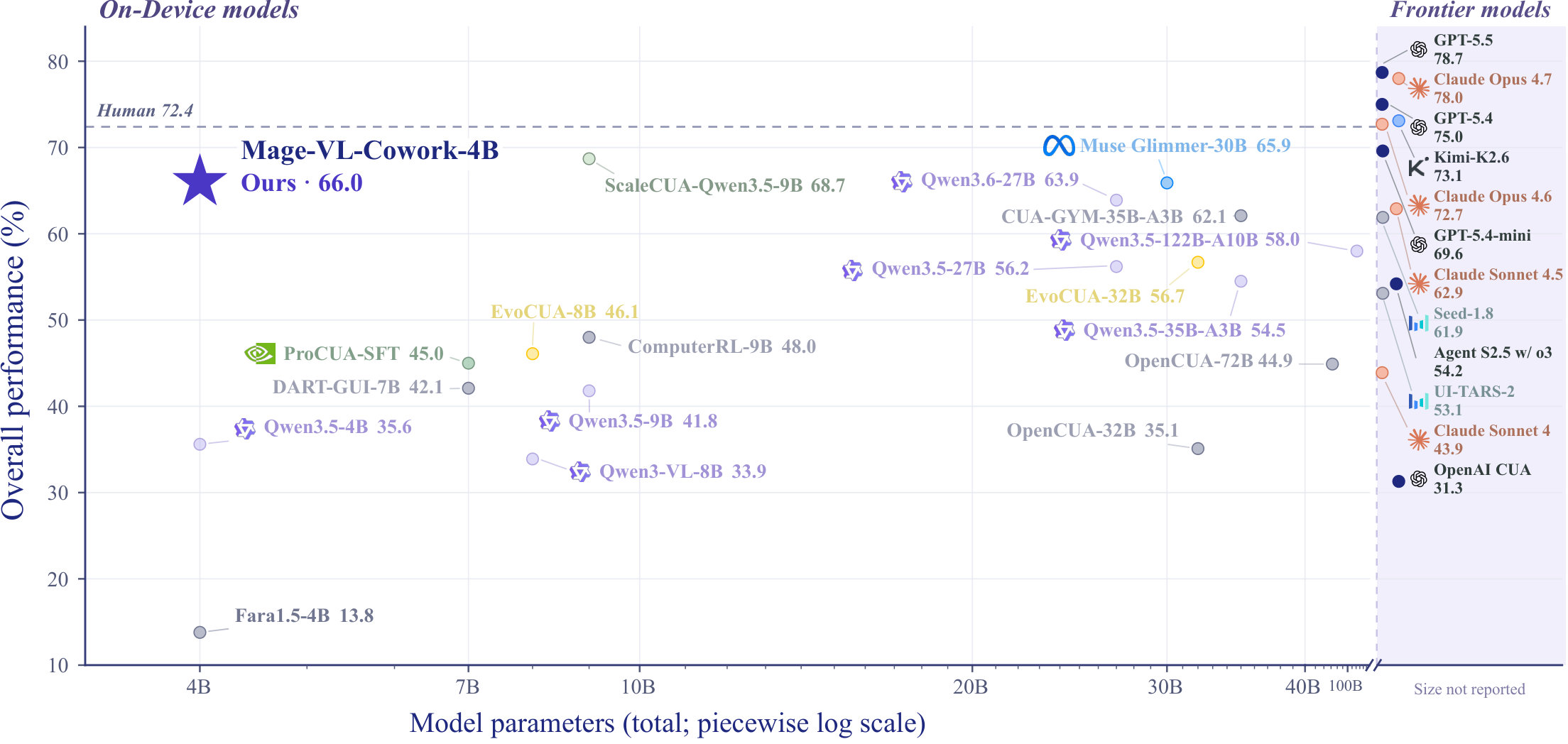
On October 30, Microsoft's Mage team released Mage-VL-Cowork on Hugging Face under Apache-2.0: a 4B multimodal computer-use agent in which a single model decides at every step whether to act through screenshots and GUI clicks (computer_use) or through bash and Python in a terminal, with no external orchestrator. Microsoft reports a two-run average of 66.0% on OSWorld-Verified (361 tasks, 50-step budget), above Qwen3.6-27B at 63.9% but below the 9B SCALECUA-Qwen3.5-9B at 68.7%.
Zoom
Key Takeaways
4B parameters, built on Mage-VL (Mage-ViT vision encoder plus Qwen3-4B-Instruct-2507); about 9.48 GB of bf16 weights under Apache-2.0.
On OSWorld-Verified, two independent runs scored 65.33% and 66.75% for a 66.0% average; 87.5% on operating-system tasks and 62.7% on multi-app workflows.
In Microsoft's side-by-side, a LibreOffice Calc chart task took 39 seconds (6 steps) via Python in the terminal, versus 9:56 (39 steps) for GUI-only Qwen3.6-27B.
Online RL adds 10.16 points over hybrid SFT while cutting mean model calls by 13.0% and output tokens by 25.4%.
Training data came from Mage-CUA-Forge, which synthesized about 294K desktop and web tasks across 6,915 skills and cut per-task generation cost from $0.906 to $0.158.
A widely discussed experiment on X: on Oct 31 indie developer div (@divagr1925) showed QwenPU, which compiles a 32-bit RISC-V CPU plus a vector unit directly into the weights of Qwen3.5-4B and runs Andrej Karpathy's 260K-parameter stories260K inside the model's own forward passes, matching a reference implementation token for token. None of the added weights are trained; a compiler computes them all. The post drew about 1,540 likes, 163 reposts and 85K views and became an X trending story. It is a personal, self-described work-in-progress project: the checkpoint is 26.7 GB and one story token takes about 16 seconds on an L4. This is a write-up of the discussion, not an official announcement from any company.
Zoom
Key Takeaways
Buzz: the @divagr1925 post has about 1,540 likes, 163 reposts, 71 quotes and 85K views (public X metrics as of Nov 1); the earlier Qwenputer post (Oct 28) has about 5,880 likes and was quote-posted by Shopify CEO Tobi Lutke
Method: 13 compiled computer layers (RV32IM + Zba + a bignum unit + the vector unit) sit in front of Qwen's 32 layers, widening the hidden size from 2560 to 5120 while Qwen's own weights stay unchanged (GitHub README)
Efficiency: trace tokens per story token drop from 2.43M for plain C to 53K; at about 3,300 trace tokens per second on an L4, one story token takes about 16 seconds (author-reported)
Verification: the story program runs free on a GPU executor for all 3,184,920 steps, checked against a reference CPU model at every step, which the author says is exact; no independent reproduction has been published yet
Open source: code is MIT and weights are Apache-2.0 as a modified Qwen3.5-4B, on Hugging Face and ModelScope; the 26.7 GB checkpoint needs a 40 GB or larger GPU
On Oct 30, SenseTime released SenseNova-Loop-9B-Preview (Apache 2.0) on its official X account and Hugging Face. It runs layers 4 to 27 of a 32-layer decoder twice with the same weights, so each forward pass executes 56 layer computations while storing about 9B parameters, about 14.6B at inference, and it uses two-stream mHC (manifold-constrained hyper-connections) to manage the residual streams. It takes text and images, with training sequences up to 262,144 tokens. SenseTime charts show it beating Qwen3.5 and Qwen3.6 peers on BIRD-Dev, WorkBuddy Bench, and other agent and data tasks, while it still trails on Terminal Bench 2.1; the technical report is not out yet. The official launch post drew about 910 likes.
Zoom
Key Takeaways
Structure: 32 distinct decoder layers, with layers 4 to 27 looped twice on shared weights for 56 layer computations per forward pass; about 9B stored and about 14.6B inference parameters (model card)
Weak spots from the same vendor chart: Terminal Bench 2.1 at 40.45, below Qwen3.6-27B at 47.19; tau3-Banking at 18.56, slightly below Qwen3.5-27B at 19.59
Training context up to 262,144 tokens; hybrid attention uses three linear-attention layers plus one full-attention layer per four-layer group; MTP speedup is available, DSpark and DFlash2 are still training
Apache 2.0, requires trust_remote_code=True; official examples cover Transformers 5.18.0, a 4-GPU LightLLM setup, and an SGLang PR, and the technical report is still to come
On 2026-10-23 (15:41 UTC) the official @NVIDIAAI account announced Nemotron 3.5 Bolt E4B 4GB, a small open model for local assistants, interactive characters and robots that can hold a conversation and use tools. The official Hugging Face model card says it is post-trained from Gemma-4-E4B-it, has 8B total parameters (4B effective), ships in Q4_K_M quantization, supports up to 64K input and 64K output tokens, and has a switchable thinking mode, plus a DFlash speculative-decoding drafter and a BF16 version. Weights, data and recipes are open under the OpenMDW-1.1 license, with commercial use allowed. On the model card the 4GB build scores 55.60 on MultiChallenge (Gemma4 E4B-it at the same quantization 39.36, Qwen3.5 4B 52.23), but trails Qwen3.5 4B on Tau2-Bench (52.32) and BFCL-v3 (67.31).
Zoom
Key Takeaways
NVIDIA officially released Nemotron 3.5 Bolt E4B 4GB for local assistants, interactive characters and robots
Post-trained from Gemma-4-E4B-it: 8B total parameters (4B effective), Q4_K_M quantization, 64K context, switchable thinking mode
Open weights, data and recipes under the OpenMDW-1.1 license with commercial use allowed, plus a DFlash speculative-decoding drafter
Model card results: 55.60 on MultiChallenge leads its size class, but it trails Qwen3.5 4B on Tau2-Bench and BFCL-v3
On Oct 21, Baseten's research team Base Labs released open decision models mammoth-1 (27B) and elephant-1 (9B), full fine-tunes of Qwen3.5 that skip text generation and return per-option probabilities in one forward pass for routing, classification and scoring. Per Baseten, mammoth-1 tops the Jev Decision Index 0.4 at 71.24 and elephant-1 ties for #1 on the Artificial Analysis Decision Index. Weights are on Hugging Face and the Baseten API is free through Oct 27.
Zoom
Key Takeaways
Benchmarks (vendor): mammoth-1 scores 71.24 on Jev Decision Index 0.4, #1 of 208 decision models; 65.9 on AA Decision Index
elephant-1 (9B): 62.6 on Jev, best 9B; 65.2 on AA Decision Index, tied #1 with d1-ultra
Training: full fine-tunes of Qwen3.5-27B / 9B on 6.21M decision examples incl. abstention and safety data
Mechanism: block-bidirectional attention plus shared-prefix caching, one forward pass for many questions; up to ~10x faster than a reasoning model (vendor claim)
Try it: Hugging Face weights (MIT); Baseten API free until Oct 27 11:59 PM PT with zero data retention
On Oct 20, NVIDIA's GEAR lab (Jim Fan's team) open-sourced Flora, a model suite that turns human and robot manipulation video into timestamped action captions, process rewards, outcome rewards and rubric scores. It includes Flora-Captioner 27B and Flora-Rewarder 27B (both on Qwen3.5-27B) and Flora-TempSeg 9B (a LoRA on Qwen3.5-9B), with weights on Hugging Face under an NVIDIA non-commercial license. NVIDIA says it is the in-house data engine used to train GR00T, labeling 200,000 hours of video a day on 512 GB300s, matching GPT-6 Astra on annotation quality at roughly 125x lower cost.
Zoom
Key Takeaways
Three models: TempSeg 9B segments actions, Captioner 27B writes one instruction per segment, and Rewarder 27B outputs dense process rewards and an episode success score
Cost (NVIDIA estimate): about $0.72 per hour of source video on eight GB300s at $10 per GPU-hour, versus about $88.49 for GPT-6 Astra at maximum effort, a 122-125x gap
Quality (NVIDIA 50-episode internal eval): 57.1% for Flora versus 53.7% for GPT-6 Astra; failure recall on DenseRewardBench is 53.3% while frontier API models mostly score under 1%
Scale: NVIDIA says Flora labels 200,000 hours of video a day on 512 GB300s to train GR00T-2
License: NVIDIA OneWay Noncommercial, research only, with commercial and production use explicitly unsupported
Multimodal LLMs excel at holistic image captioning but struggle with pixel-level spatial grounding due to lack of spatial supervision. Xiaomi AI Lab unveiled Xiaomi-Lens-0 (arXiv:2610.23279), a 4B MLLM based on Qwen3.5 that natively predicts pixel masks. A lightweight decoder integrates patch embeddings, visual latents, and mask-token activations, driving RefCOCO comprehension (REC [email protected]: 94.6% / 92.1% / 92.5%) and segmentation (RES cIoU: 83.4% / 79.9% / 81.1%) past Florence-2 and LISA-7B while preserving a 69.7% MME-RW score.
Zoom
Key Takeaways
Xiaomi AI Lab released Xiaomi-Lens-0 (arXiv:2610.23279), a 4B MLLM based on Qwen3.5 that natively generates pixel-level masks
Outperforms Florence-2 and Grounding-DINO-L on RefCOCO/RefCOCO+/RefCOCOg REC benchmarks with 94.6%, 92.1%, and 92.5% [email protected]
Achieves 83.4% / 79.9% / 81.1% cIoU on RES segmentation, substantially surpassing 7B models like LISA and GSVA
Maintains superior general perception, scoring 69.7% on MME-RW-en and outperforming Qwen2.5-VL 7B
Tackling high latency and safety failures in spatial VLM and embodied VLA deployment, MJev-Spatial (arXiv:2610.22276, #1 on HF Daily Papers with 350 upvotes) reformulates spatial judgment as single-pass native Q/K attention matching with zero added parameters—achieving 65.64% across 12 benchmarks while running 5.6x faster than its Qwen3.5-4B base—while CUHK JIA-Lab's CarryOn (arXiv:2610.21453) wraps frozen VLA policies in a dual-loop harness that cuts safety violations from 52.6% to 6.1% and raises physical recovery success from 13% to 80%.
Zoom
Key Takeaways
MJev-Spatial reuses pretrained Q/K projections for single-pass spatial classification with zero generated tokens, running 5.6x faster than its Qwen3.5-4B base with a top 65.64% average across 12 benchmarks
Teacher-forced coarse-to-fine supervision and length-aware global batching boost MJev-Spatial training throughput by 30.8% across 12.3M spatial QA pairs
CUHK JIA-Lab's CarryOn dual-loop VLA harness cuts safety violations from 52.6% to 6.1% and raises physical failure recovery success from 13% to 80%
Two new frameworks re-architect how weak and strong models collaborate in long-horizon agents: SpecAgent (arXiv:2610.21463) lets a small model draft multi-step read-only tool trajectories grounded in real observations while holding environment-modifying actions, allowing the strong model to verify the entire segment in a single parallel prefill pass—halving wall-clock time and memory traffic on τ²-Bench. Complementarily, LEASH (arXiv:2610.22280) uses training-free latent-state uncertainty to escalate and supervise computer-use agents, reaching 73.66% on OSWorld with Qwen3.5-35B-A3B—beating always-on Claude Opus 5 (72.90%) while cutting inference cost by 19.2%.
Zoom
Key Takeaways
Trajectory-level speculative execution (SpecAgent): small model executes read-only tools and pauses at write barriers while the strong model verifies via a single parallel prefill pass
Halves wall-clock time and memory traffic: matches strong-model accuracy within 1 point on τ²-Bench while cutting strong-model token generation by >=50% on MCP-Atlas
LEASH beats always-on Claude Opus 5 on OSWorld: reaches 73.66% with Qwen3.5-35B-A3B vs. 72.90% for always-on Claude Opus 5 while saving 19.2% in cost
NVIDIA published Nemotron-Labs Dory1.0-4B on Hugging Face on Oct 16: a 20-layer shared block runs 1, 2 or 4 times at inference so one checkpoint serves several compute budgets. NVIDIA reports 61.8 on SWE-bench Verified at 4 loops, close to Qwen3.5-9B. BF16/MXFP8/NVFP4/GGUF under OpenMDW-1.1.
On 2026-10-13 Fish Audio launched Drama 3, a TTS model directed with plain-language bracket tags, open weights on Hugging Face, and API header model: drama-3. The backbone is a ~35B MoE (~3B active per token, initialized from Qwen3.5-35B-A3B's language tower) with a codebook-MTP audio decoder and preference-model RL. Independent Artificial Analysis Pronunciation Robustness: 93.2% vs 88.1% for S2.1 Pro; 83 languages and up to 16 speakers; Community License free for commercial use under US$500k annual revenue. Launch promo through Nov 12: about $10 per million characters on the API.
Zoom
Key Takeaways
Open weights on Hugging Face fishaudio/drama-3 under Community License v1.0 (free commercial use under US$500k ARR; no non-consensual voice cloning)
Architecture: 35B MoE / ~3B active; hybrid attention (1 full-attn layer per 4); codebook-MTP decoder over 10 codebooks; initialized from Qwen3.5-35B-A3B LM
Benchmarks: Artificial Analysis Pronunciation Robustness 93.2% (#1) vs S2.1 Pro 88.1%; brand/place/tech names 95.9%, context-dependent readings 95.3%
As autonomous software engineering agents and command-line assistants evolve from single-turn tool invocation toward complex, multi-stage delivery, the scarcity of high-quality, long-horizon terminal interaction data has emerged as a fundamental bottleneck. Researchers from USTC, Alibaba Group (AMAP), and SUSTech introduce TerminalHorizon (arXiv:2610.13166), a fully automated data synthesis engine for training long-horizon terminal agents. Addressing standard pitfalls where synthetic environments oversimplify core challenges and eliminate the need for exploration, TerminalHorizon extracts workflows from real-world tasks, pinpoints omitted steps through independent execution loops, dynamically reconstructs environments based on observed evidence, and organically scales task complexity across multiple stages under unified objectives. Synthesizing 1.5K environments and 2,852 trajectories averaging 52.8 turns, the authors train TerminalHorizon-27B (fine-tuned on Qwen3.5-27B). The model achieves 55.8% on Terminal-Bench 2.0 (+14.2 points over base Qwen3.5-27B), sweeping 12 benchmarks across coding agents, production environments, and reasoning with project datasets open-sourced.
On Oct 11 the vLLM Semantic Router (vllm-sr) team released the Decision 3.0 family (d3, d3-flash, d3-mini, d3-nano, d3-lite, d3-edge) on Hugging Face under Apache-2.0. Built on Qwen3.5/3.8, the models take text, images and video and return probabilities for choice, yes/no and score questions in one call without generating text. Vendor-reported: the 27B d3 scores 64.7 on Jev Decision Index 0.3.1, ahead of Perplexity Decider v1.1 (62.8) and Decision 2.0 (55.9), with a 55 ms median text latency on one AMD MI325X.
Zoom
Key Takeaways
Six sizes: d3-edge 0.59B, d3-lite 0.85B, d3-nano 2.2B, d3-mini 4.5B, d3-flash 8.4B, d3 26.1B, all Apache-2.0 (HF collection)
Vendor-reported Jev Decision Index 0.3.1: d3 64.7 vs Perplexity Decider v1.1 62.8, Jev 60.1, Decision 2.0 55.9
Vision Index 0.3.1: d3 71.6 vs Perplexity Decider v1.1 70.6 and JEV-27B-VL 69.6
Median latency on one AMD MI325X, batch 1: d3 55 ms text / 273 ms image / 553 ms 10-second video; d3-edge 6.7 ms text
No text generation: every option gets a probability, and several Choice / Yes-No / Score questions share one call
Indie developer Nandakishor M open-sourced Vega (pip package vegaml, Apache 2.0): a frozen Qwen3.5-0.8B (4B also available) only reads, while a 57 MB trained engine models each allowed answer as a valley and rolls a damped ball into one, returning calibrated probabilities, conformal answer sets and an abstain flag. 73,728-token context and image input. The author's own paired tests beat hosted Jev 1.13.0 on tasks like phishing screening, while admitting it trails on reranking and multi-step reasoning.
Zoom
Key Takeaways
Size: 0.8B engine is 14.3M params / 57 MB with a 0.84M-param task adapter; the 4B engine is 124 MB
Author-reported typed-decisions test (2,050 items): 0.763 (0.8B + adapter) and 0.803 (4B), at 22 ms / 28 ms per decision