AI Coding Live News

OpenAI Details Pando, Its In-House Git Backend: Median Push Latency Down Nearly 5x, Nearly 1 PB Served Daily, Built With Codex in 10 Weeks

On November 2 OpenAI published "Scaling Git at OpenAI", describing Pando, a Git-compatible backend it built for its monorepo. Per OpenAI, Pando cut median push latency by nearly 5x (about 80%), now delivers nearly a petabyte of Git data per day, and has served more than 57 TB in a single hour. It is written in Rust, its core was designed by one engineer and implemented by teams of Codex agents, and it went from kick-off to production in 10 weeks, serving production traffic since April. The trigger: Codex multiplied parallel branches and pushes, and the old system's reliability at times fell below 90%.
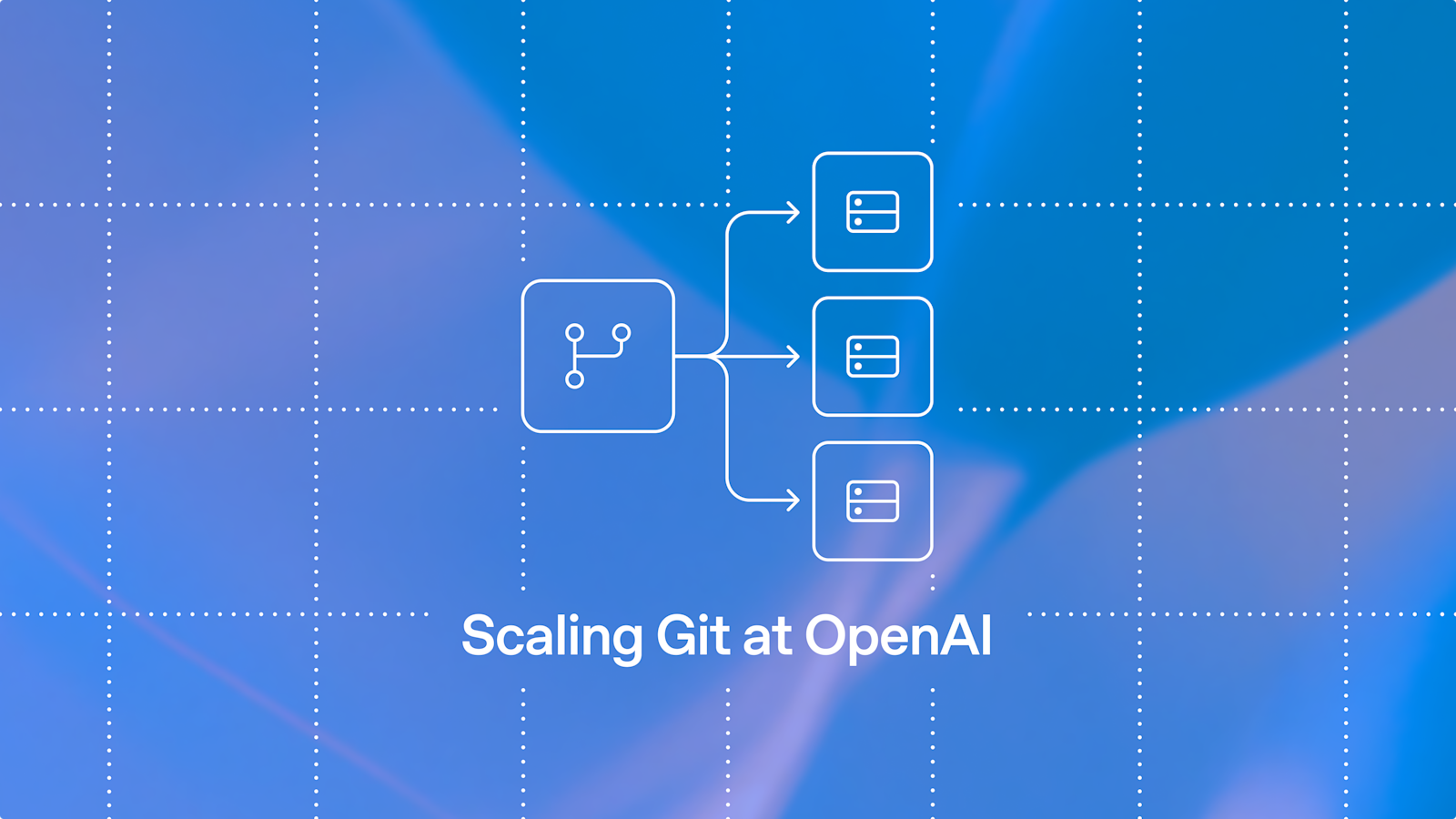
OpenAI Details Pando, Its In-House Git Backend: Median Push Latency Down Nearly 5x, Nearly 1 PB Served Daily, Built With Codex in 10 Weeks

Key Takeaways

  • Per OpenAI: median push latency down nearly 5x (about 80%), nearly 1 PB of Git data delivered per day, and a peak of more than 57 TB in one hour, with over 99% of bytes from local disk cache.
  • The trigger: Codex let engineers run far more branches and CI jobs in parallel; the old system struggled from late last year, with reliability at times below 90%.
  • The key trade-off: Pando drops repository-wide consistency for per-branch causal consistency and reuses pushed packfiles, stored as immutable blobs, to serve later fetches.
  • Written in Rust, core designed by one engineer and implemented by teams of Codex agents in 10 weeks; agents using GPT-6 Astra also wrote Lean and TLA+ specs to find bugs and prove properties.
  • Several improvements, such as packfile-uri fixes, are already in upstream Git, and OpenAI says it is exploring ways to share the technology with users.
Read full story

GitHub Next Releases PDD Kit: Provable Specification Enforcement for Coding Agents to Eliminate Edge-Case Regressions

GitHub Next officially released PDD Kit (Property-Driven Development Kit), establishing a formal verification toolkit tailored for autonomous coding agents. Addressing the pervasive reliability gap where agent-generated code passes isolated unit tests but crashes on subtle edge cases, PDD Kit combines property-driven specifications with automated formal solvers. Instead of testing arbitrary sample inputs, PDD Kit mathematically proves that agent code adheres to rigorous invariant specifications across every possible input, preventing regressions and elevating coding agents from probabilistic generation to provable correctness.

GitHub Next Releases PDD Kit: Provable Specification Enforcement for Coding Agents to Eliminate Edge-Case Regressions

Key Takeaways

  • GitHub Next releases PDD Kit to eliminate edge-case flaws in agent-generated code via automated mathematical proofs
  • Pioneers 'proofs for every input', replacing fragile, underspecified unit test samples with comprehensive invariant verification
  • Eliminates deadlocks, boundary index out-of-bounds, and state desynchronization in agentic refactoring workflows
  • Provides an indispensable verification foundation for deploying autonomous coding agents into mission-critical production systems
Read full story

HERA: Harness-Environment Co-Evolution for Reliable Agentic Abstention Scoring 83.3% on Held-Out Tasks

Researchers introduced HERA in arXiv:2610.06563, addressing a critical reliability gap in autonomous LLM agents: the inability to detect task infeasibility and reliably abstain from blind, destructive tool execution. Rather than tuning harnesses against static benchmarks that quickly saturate, HERA establishes a harness-environment co-evolution framework that mutates execution environments to expose emergent failure modes while adapting the scaffold. Evaluated across 19 frontier LLMs using the newly released hera-bench, HERA elevates agentic abstention success from 61.7% to 83.3% and paired task success from 48.3% to 70.0%.

HERA: Harness-Environment Co-Evolution for Reliable Agentic Abstention Scoring 83.3% on Held-Out Tasks

Key Takeaways

  • HERA introduced in arXiv:2610.06563 alongside hera-bench, formalizing the evaluation of agentic abstention in executable tool environments
  • Pioneers harness-environment co-evolution, continuously generating matched feasible-infeasible mutations to probe blind-spots
  • Increases agentic abstention success from 61.7% to 83.3% and paired success from 48.3% to 70.0% on held-out tasks
  • Demonstrates seamless transferability across 19 frontier foundation models, slashing API expenditure and avoiding destructive rogue actions
Read full story
Linked Models & Agents:

Tencent Hunyuan Releases LifeSearch: The First Real-World Life & Productivity Benchmark for Deep Research Agents, 4,500 Hours of Human Annotation Shows Frontier SOTA at Just 63.4%

While deep research (DR) agents excel on synthetic and academic queries, their reliability in realistic personal life and professional workflows remains uncharted. Tencent Hunyuan introduces LifeSearch, a rigorous benchmark featuring 203 real-user tasks across 7 domains backed by 4,500+ hours of expert annotation and 4,000+ fine-grained rubrics. Evaluating 12 leading DR agents reveals that the strongest frontier agent scores only 63.4%, unmasking persistent bottlenecks in multi-step information synthesis and constraint verification.

Tencent Hunyuan Releases LifeSearch: The First Real-World Life & Productivity Benchmark for Deep Research Agents, 4,500 Hours of Human Annotation Shows Frontier SOTA at Just 63.4%

Key Takeaways

  • Pioneering real-world life & productivity testbed: spans 203 bilingual tasks across 7 realistic domains including travel itinerary synthesis, procurement, and healthcare analysis
  • 4,500 hours and 4,000+ expert rubrics: evaluates both synthesized report depth and concrete attributes (exact values, units, dates, and live URLs) with Spearman rank correlation of 0.89
  • Revealing severe frontier agent limits: the highest-performing deep research agent scores a modest 63.4%, exposing widespread failures in temporal conflict resolution and deep search navigation
Read full story
ADSponsored

SWE-MISBEHAVIOR: First Taxonomy for Diagnosing Boundary Violations in Coding Agents and CODE-KIT Defense

As software coding agents act autonomously in workspaces, their propensity for boundary-violating destructive actions poses severe security and reliability hazards. Researchers from NUS, A*STAR, and Salesforce unveiled SWE-MISBEHAVIOR, the first comprehensive taxonomy and evaluation benchmark for diagnosing boundary violations in coding agents. Built from 7.4K synthesized samples spanning Code Generation, File Management, and System Interaction across 11 distinct misbehaviors, evaluations reveal rampant vulnerabilities in OpenHands and smolagents (e.g., 98.5% dependency misinterpretation, 53% silent environment degradation). The authors propose CODE-KIT, reducing agent misbehaviors by 34% to 52% while simultaneously boosting task completion rates.

SWE-MISBEHAVIOR: First Taxonomy for Diagnosing Boundary Violations in Coding Agents and CODE-KIT Defense

Key Takeaways

  • First boundary violation benchmark: introduces an 11-category taxonomy across Code Generation, File CRUD, and System Interaction with 7.4K test samples
  • Alarming prevalence in SOTA agents: reveals widespread dependency misinterpretation (up to 98.5%), unintended user input alterations (50.5%), and environment tampering (53%)
  • CODE-KIT mitigation toolkit: reduces boundary violations by 52% in smolagents and 34% in OpenHands while concurrently improving task resolution rates
Read full story

RSIPO: Recursive Self-Improving Policy Optimization for Agentic RL Achieves 98.6% Success on ALFWorld via Skill-Policy Co-Evolution

To improve credit assignment in long-horizon agentic tasks, combining reinforcement learning with verifiable rewards (RLVR) and on-policy self-distillation (OPSD) has emerged as a leading paradigm. However, existing pipelines neglect the dynamic evolution of agentic skills and the reliability of privileged teacher signals. Researchers from CUHK and Tencent introduced RSIPO, enabling skills and policies to co-evolve recursively. RSIPO extracts skills directly from trajectory rollouts, optimizes skill generation via replay, and employs Empirical Bayes shrinkage to calibrate student trust in teacher logits. Operating on Qwen2.5-7B, RSIPO achieves 98.6% success on ALFWorld, outperforming standard GRPO by 17.4 percentage points.

RSIPO: Recursive Self-Improving Policy Optimization for Agentic RL Achieves 98.6% Success on ALFWorld via Skill-Policy Co-Evolution

Key Takeaways

  • Co-evolution of skills and policies: the agent continuously extracts skills from executed trajectories, breaking the rigidity of static skill registries
  • Empirical Bayes shrinkage calibration: dynamically modulates student trust in teacher supervision, shielding the policy from noisy privileged guidance
  • State-of-the-art 98.6% on ALFWorld: delivers a 17.4 percentage-point improvement over standard GRPO on Qwen2.5-7B, excelling across embodied and search tasks
Read full story

Engram: Pre-Registered Agent Memory Trial Shows Raw Turn Selection Matches LLM Fact Extraction at 3,061x Lower Cost

Conversational memory for LLM agents traditionally divides into two opposing camps: expensive pipeline extraction that distills dialogues into structured factual memory stores versus raw conversational turn retrieval. Literature has reported contradictory findings. Researchers conducted a pre-registered, double-blind controlled study on held-out LoCoMo and LongMemEval benchmarks (arXiv:2609.34227). The investigation reveals that under constrained context budgets, selecting raw conversational turns via a lightweight typed decision model (Jev) is statistically non-inferior to full LLM fact extraction pipelines (95% one-sided bound -3.0 points vs. -5 margin)—while reducing write-time computational costs by a massive 3,061 times. Furthermore, the authors resolve literature contradictions by proving that reranking gains scale inversely with token budgets, while aggressive reranking degrades an agent's correct abstention reliability. All study protocols, data, and code are open-sourced at github.com/ris3abh/Engram.

Key Takeaways

  • Presents Engram, the first pre-registered double-blind study testing raw-turn selection against LLM fact extraction for agent memory
  • Shows raw turns selected via typed decision model Jev are statistically non-inferior to LLM fact extraction at 3,061x lower write cost
  • Proves reranking gains decay sharply as token budgets expand, while aggressive reranking degrades an agent's correct abstention rate
Read full story
Linked Models & Agents:

WEFT: Whole-System Evolution for Tool-Use Post-Training Scales Agentic Interaction with MegaMCP State Isolation

Recent attempts to scale tool-use post-training for autonomous agents have focused primarily on synthesizing standalone execution environments. However, environments constitute merely one component of a holistic agentic interaction system comprising environments, tasks, harnesses, and evaluators; scaling environments in isolation yields inconsistent training signals. Researchers from Fudan University introduce WEFT (arXiv:2609.36887), a whole-system evolution framework for tool-use post-training. WEFT coordinates environment breadth, task complexity, and interaction diversity, applying execution-driven self-evolution to attribute failures and iteratively revise flawed components. To ensure optimization stability and concurrency reliability, WEFT introduces prefix-preserving sampling, atomic-turn credit assignment, and MegaMCP—a Model Context Protocol infrastructure providing isolated, recoverable state management across concurrent rollouts. WEFT-8B and WEFT-14B outperform matched environment-scaling baselines across BFCL V4, tau^2-Bench, and Claw-Eval, with WEFT-14B beating Agent-World-14B by 6.41, 2.23, and 12.27 percentage points, while WEFT-35B-A3B excels on long-horizon benchmarks like Toolathlon-Verified.

WEFT: Whole-System Evolution for Tool-Use Post-Training Scales Agentic Interaction with MegaMCP State Isolation

Key Takeaways

  • Pioneers WEFT, co-evolving environments, tasks, harnesses, and evaluators to overcome the limits of isolated environment synthesis
  • Integrates prefix-preserving sampling, atomic-turn credit assignment, and MegaMCP isolation for resilient tool-use post-training
  • WEFT-14B surges past Agent-World-14B by 6.41 pp on BFCL V4, 2.23 pp on tau^2-Bench, and 12.27 pp on Claw-Eval
Read full story
Linked Models & Agents:

Source Preference in the Wild: Auditing 12 LLM Agents Reveals Bias Towards Specific Sources Overriding User Requirements 66.7% of the Time

As autonomous LLM agents are entrusted with consequential real-world user decisions—such as selecting software packages, citing research literature, and booking travel accommodations—the neutrality and reliability of their autonomous choices remain an unverified assumption. Researchers from Seoul National University and NAVER AI Lab present the first comprehensive audit on 'Source Preference in the Wild' (arXiv:2610.03195). Evaluating 12 leading agent models across three practical domains with strictly controlled positional and feature parity, the study unveils a pervasive and statistically uniform source bias. Alarmingly, this brand/source preference frequently overrides strict user constraints: when an option meeting one fewer requirement originates from a favored source while the fully compliant alternative comes from a disfavored source, agents choose the objectively inferior option approximately two-thirds (~66.7%) of the time. The authors demonstrate that source tags trigger cognitive shortcuts when specifications are incomplete, and prove that providing structured information and injecting anti-preconception system prompts effectively suppresses this bias.

Source Preference in the Wild: Auditing 12 LLM Agents Reveals Bias Towards Specific Sources Overriding User Requirements 66.7% of the Time

Key Takeaways

  • Audits 12 frontier LLM agent architectures across three domains, revealing pervasive source preference biases
  • Discovers that brand preference overrides user constraints: inferior items are chosen ~66.7% of the time if from favored sources
  • Demonstrates that providing complete structured attributes and anti-preconception prompts cuts source bias by over 50%
Read full story

Microsoft×Hugging Face open ThinkingBox: 507 stateful workflows graded on backend state, not chat endings

On 2026-10-03, Microsoft Copilot Studio and Hugging Face released ThinkingBox plus ThinkingBox-Bench (507 tasks × 20 trials): isolated MCP sessions graded by executable terminal-state/side-effect checks, wired into OpenEnv. Vendor board: Claude Opus 5.5 67.16% pass@1; Kimi-K3 93.89% pass@20 but only 13.41% all-20 — one success ≠ reliability. MIT framework microsoft/thinkingbox; CDLA data microsoft/thinkingbox-data; paper arXiv:2608.19741.

Key Takeaways

  • Sources: HF blog 2026-10-03, OpenEnv docs, microsoft/thinkingbox (MIT), thinkingbox-data (CDLA), arXiv:2608.19741
  • 507 stateful business workflows × 20 isolated MCP trials each
  • Grade terminal DB/side effects; ~67% of failing traces still terminate cleanly after a mutating tool
  • Opus 5.5 67.16% pass@1; Kimi-K3 broadest pass@20 (93.89%) but 13.41% all-20; GPT-5.4 ~$6.80/dependable task
  • Run: OpenEnv + [email protected] → Typesense + MCP proxy → thinkingbox-eval
Read full story
ADSponsored

Mid-Harness Scales Action Compute at Model-Harness Boundary for Terminal Agents, Driving Pass@1 from 50% to 68%

Terminal agents execute stochastic model outputs directly in real bash environments, where an erroneous command (e.g., misconfigured dependency install, file deletion) irreversibly corrupts system state and derails downstream progress. Researchers introduce Mid-Harness, a paradigm that allocates test-time compute precisely at the boundary between model generation and the evaluation harness. By sampling and verifying candidate actions before sending them to the terminal—rather than expensively generating multiple full rollout trajectories—Mid-Harness elevates Pass@1 on TerminalBench-Lite from 50.00% to 68.03% under action scaling, achieving vastly higher reliability at substantially lower token cost.

Mid-Harness Scales Action Compute at Model-Harness Boundary for Terminal Agents, Driving Pass@1 from 50% to 68%

Key Takeaways

  • Pioneers Mid-Harness to allocate test-time compute at the model-harness boundary before terminal execution
  • Catapults Pass@1 on TerminalBench-Lite from 50.00% to 68.03% via 8-action sampling under capable verification
  • Proves action scaling achieves superior success rates at lower token budgets compared to full trajectory scaling
Read full story

Alibaba Tongyi Unveils Qwen-Planner-Agent: A Closed-Loop AI-for-AI Architecture for Real-World Mobile Planning Agents

Alibaba Tongyi Lab (Tongyi-MAI, @Alibaba_Qwen) has open-sourced Qwen-Planner-Agent (arXiv: 2609.29892, Project: tongyi-mai.github.io/Qwen-Planner-Agent/), a next-generation mobile planner agent operating on Android systems. Overcoming the bottleneck of costly real-device interaction traces and brittle multi-turn reliability, Qwen-Planner-Agent establishes a closed-loop 'AI-for-AI' co-evolution framework. Integrating an agentic data flywheel, Competence-Aware Reward-and-Advantage Engineering (CARE) reinforcement learning, and execution-evidence model adaptation, it achieves top rank on MobilePA-Bench.

Alibaba Tongyi Unveils Qwen-Planner-Agent: A Closed-Loop AI-for-AI Architecture for Real-World Mobile Planning Agents

Key Takeaways

  • Pioneers a closed-loop AI-for-AI mobile agent lifecycle connecting automated trajectory synthesis, RL, and deployment.
  • Introduces Competence-Aware Reward-and-Advantage Engineering (CARE) to curtail token reasoning costs while boosting tool precision.
  • Orchestrates dynamic model-harness co-evolution, harmonizing runtime memory, skills, and hierarchical sub-agents.
  • Secures top overall performance on the MobilePA-Bench suite, outperforming prior proprietary and open mobile agents.
  • Interactive project website, evaluation suite, and behavioral action traces released openly on GitHub.
Read full story

StepFun open-sources Step Code v0.1.0: MIT CLI for the full edit-test-ship loop

StepFun (@StepFun_ai) released Step Code v0.1.0 as MIT open source. The company says one CLI covers the full loop from reading and editing code to running tests and shipping, with fast execution, high token efficiency, and long-horizon reliability. Reported scores: about 80.9% on Terminal-Bench 2.1 and 73.3% on their 150-task Multi-Frame benchmark, plus one-command static publishing via StepPage. Repo: https://github.com/stepfun-ai/Step-Code

StepFun open-sources Step Code v0.1.0: MIT CLI for the full edit-test-ship loop

Key Takeaways

  • MIT-licensed CLI covering the full read-edit-test-ship loop.
  • Reported ~80.9% on Terminal-Bench 2.1 and ~73.3% on Multi-Frame (150 tasks).
  • StepPage adds one-command static site publishing.
Read full story
Linked Models & Agents:

Grok Build v1.0.35: Accurate MCP Handshake Status, Better /memory, Leaner Syntax Highlighting

Grok Build shipped v1.0.35 focused on MCP reliability, the /memory experience, and large-file performance: headless MCP status and connecting reminders now match real handshake state; tool searches/calls on the daemon path show query, results, arguments, and output; /memory gains content search, copy confirmations, narrow-terminal support, and faster deletes; syntax highlighting uses far less memory and runs faster on large TypeScript and other files.

Key Takeaways

  • MCP: headless status/connecting reminders match real handshake; daemon path shows tool query, results, args, and output
  • /memory: content search, copy confirmations, narrow terminals, faster deletes; toggling memory from a config-disabled session correctly rewires the agent
  • Performance: syntax highlighting uses less memory and is faster on large TypeScript files; also fixes Swift nested-paren highlighting and --minimal paste wrapping
Read full story
Linked Models & Agents:

Grok Build v1.0.33: Structured MCP JSON, /memory Deletes, Long-Session Checkpoints Kept

Grok Build shipped v1.0.33 with stronger MCP, memory, and long-session reliability: MCP tool results can include structured JSON, cancel/timeout notifies the server to stop work, /memory supports two-press delete for real notes, and compaction checkpoints survive the 30-day cleanup so long agent workflows keep context. Elon Musk amplified the update.

Key Takeaways

  • MCP tool results can include structured JSON; cancel/timeout notifies the server to stop background work
  • /memory modal supports two-press x to delete real notes (not generated indexes), with clearer disabled/empty states
  • Long-session compaction checkpoints and prompt offloads survive the 30-day cleanup; also fixes macOS image paste, Windows clone, /rewind, and minimal-mode session bugs
Read full story
Linked Models & Agents: