AI Coding Live News

SemiAnalysis releases GDPx, an agentic benchmark of 206 tasks across 11 high-value domains where the top model, Claude Opus 5.5, scores just 12%

On Nov 2, semiconductor and AI research firm SemiAnalysis released GDPx, a benchmark of agentic capability across 11 domains: chip design, cybersecurity, biology, finance, legal, quant trading, recursive self-improvement (RSI), hardware design, materials science, alignment and software engineering. Its 206 tasks were built by 14 specialist data partners, with SemiAnalysis doing final QA. On the official leaderboard Claude Opus 5.5 leads at 12.0%, followed by Gemini 4 Carbon at 10.9% and GPT-6 Astra at 9.6%; nearly every model scores 0 on finance and legal. SemiAnalysis says safety classifiers drag down Opus 5.5 and GPT-6 Astra, and plans a new version every 3–6 months. All scores are as reported by SemiAnalysis.

SemiAnalysis releases GDPx, an agentic benchmark of 206 tasks across 11 high-value domains where the top model, Claude Opus 5.5, scores just 12%

Key Takeaways

  • Scale: 11 domains, 14 data partners and 206 tasks, with a default time limit of 8 hours per task (GDPx site)
  • Leaderboard (as reported by SemiAnalysis): Claude Opus 5.5 12.0%, Gemini 4 Carbon 10.9%, GPT-6 Astra 9.6%, Muse Wonder Full 9.0%, Claude Fable 5.1 8.5%, GPT 6.1 Sol 8.4%, Claude Sonnet 5.5 8.2%
  • Lower tier and open weights: DeepSeek 4.1 Flash 1017 5.4%, GPT-6 Luna 5.1%, Grok 4.7 3.9%, GLM 5.3 2.7%; almost every model scores 0 on finance and legal
  • Method: each model runs in its native harness where one exists (Claude Code for Opus, Codex for Astra, Antigravity for Carbon), otherwise OpenCode; the headline is pass@1 over three attempts with all domains weighted equally (SemiAnalysis blog)
  • By domain: Opus 5.5 wins quant trading, hardware and chip design; Gemini 4 Carbon wins biology and software engineering; GPT-6 Astra wins RSI and materials science; Muse Wonder Full is the strongest cyber model
Read full story

Parameter discloses a ChatGPT share-link flaw that let one opened link read private chats; OpenAI fixed it Oct 26 and rated it P1

Security firm Parameter published an exploit chain in which an attacker publishes a malicious conversation through ChatGPT's normal sharing feature; when a signed-in victim opens the /share/ link, the payload runs as chatgpt.com in their session, lists conversations, reads a private chat that was never shared, and sends data out. Parameter reported it through OpenAI's bug bounty on October 18; OpenAI raised it from P2 to P1, fixed it on October 26 and paid a $5,000 bounty. Parameter reports no real-world use, and users do not need to do anything.

Parameter discloses a ChatGPT share-link flaw that let one opened link read private chats; OpenAI fixed it Oct 26 and rated it P1

Key Takeaways

  • Timeline: reported Oct 18; OpenAI reproduced it Oct 21 and raised it from P2 to P1; both web frontends fixed by Oct 26; published Oct 28 (Parameter writeup)
  • Very low bar: no app install, project join or pasted code; in the auto-preview variant, opening the link was the only action, firing after about 4.5 seconds (per Parameter)
  • Three root causes: MathLive did not check the message sender, the message could carry raw HTML as keyboard-layout data, and that HTML could create an unsandboxed iframe with the chatgpt.com identity; YouTube JSONP was only the final CSP bypass
  • Bounty was $5,000; Simon Willison called it "a bit cheap" for a flaw this serious (blog)
  • MathLive 0.111.2 (Oct 31) now defaults to same-origin validation and blocks cross-window custom HTML layouts (changelog)
Read full story

Wiz "Black October" report: at least nine AI developer platforms breached in October, with stolen API keys feeding an LLMjacking resale market

Cloud security firm Wiz published research on October 30 saying at least nine AI developer platforms disclosed incidents this month: Fireworks AI, Andromeda, Zeabur, Lightning AI, OpenCode, Railway, Warp, CommandCode and Northflank. Attackers hunted stored environment variables, especially keys for paid AI models; Wiz traced two stolen enterprise keys to roughly 800,000 and 1.7 million Amazon Bedrock calls, which it estimates likely ran over $100k at list price in those two cases alone.

Wiz "Black October" report: at least nine AI developer platforms breached in October, with stolen API keys feeding an LLMjacking resale market

Key Takeaways

  • Scale: between October 6 and 30, at least nine AI developer platforms disclosed incidents, and Zeabur is shutting down as a result (Wiz blog)
  • Methods: Fireworks, OpenCode and Warp reported signs of an "agent swarm" attack, and OpenCode and CommandCode attributed theirs to "distillation" attempts; the common thread is hunting stored environment variables that grant AI access
  • Case A: one stolen key drove about 800k Bedrock calls over 30 hours, about 90% successful, with Opus models making up three quarters (Wiz figures)
  • Case B: a single address made about 1.7 million calls in 13 hours, over a million successful; the two cases together likely exceeded $100k at list price
  • Resale chain: Wiz identified two sites selling discounted frontier-model access and saw both test the stolen keys
Read full story

Microsoft Research and UC Berkeley open-source TokenEconomizer, a plugin that cuts Claude Code and Codex costs by 18.4–30.9% on SWE-Bench without changing the agent

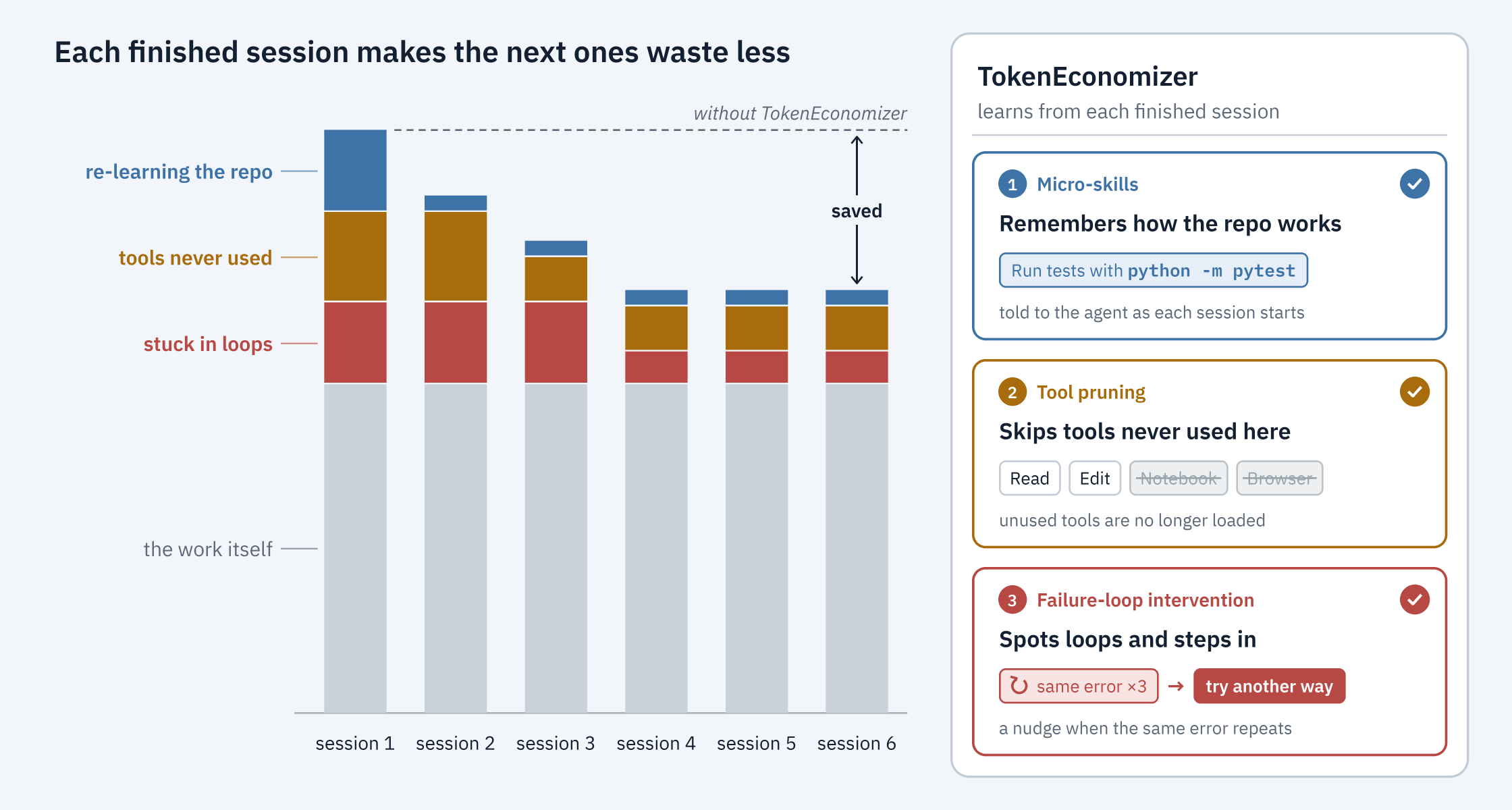
Microsoft Research, Microsoft Security and UC Berkeley open-sourced TokenEconomizer on GitHub (Apache 2.0, v0.1.0 released October 26), a plugin for Claude Code, Codex, GitHub Copilot CLI and Pi, with experimental opencode support. It learns from earlier sessions in the same repository: micro-skills remember repo facts, tool pruning drops tool definitions that go unused, and a loop guard nudges an agent that is stuck. The paper reports 18.4–30.9% lower mean cost across five agent and model combinations on 277 SWE-Bench tasks (paper figures).

Microsoft Research and UC Berkeley open-source TokenEconomizer, a plugin that cuts Claude Code and Codex costs by 18.4–30.9% on SWE-Bench without changing the agent

Key Takeaways

  • Cost: on 277 SWE-Bench tasks across 6 repositories and 5 agent and model combinations, mean cost fell 18.4–30.9%, and all 30 repository-by-combination cells got cheaper (paper figures, including the plugin's own model calls)
  • Success rate: Pass@1 rose in 4 of 5 combinations, e.g. Copilot CLI with Sonnet 5 cost 18.4% less with Pass@1 +2.6, while Claude Code with Opus 4.8 cost 30.9% less with Pass@1 -1.0
  • Three mechanisms: micro-skills (repo facts stated only after three sessions confirm them), tool pruning (by default a tool unused over 10 prompts across 2 sessions is left out), and a failure-loop guard (one redirect when a judge is at least 0.7 confident, never stopping a turn itself)
  • Generalization: 16–21% lower cost on Web-Bench and 6–20% lower on two security-auditing benchmarks where every task is a new repository
  • Deployment: Apache 2.0, Python 3.10+, no API key of its own, and learned experience stays local in ~/.tokeneconomizer
Read full story
ADSponsored

OpenAI says Daybreak Blue sessions on personal accounts may be used for training even with the training toggle off, drawing security researcher backlash on X

OpenAI's "Data controls in ChatGPT" Help Center page now has a "Trusted Access on personal accounts" section: during sessions in Trusted Access programs such as Daybreak Blue, OpenAI may use interaction content to improve its models even when "Improve the model for everyone" is off, to strengthen safeguards against cyber misuse, while other activity still follows the user's setting. Emails that several users shared on X say the change takes effect November 29, and researchers including Sean Heelan criticized it for pulling unreported vulnerabilities and research into training data.

Key Takeaways

  • Official wording: Trusted Access sessions such as Daybreak Blue on personal accounts may be used to improve models regardless of the "Improve the model for everyone" toggle
  • The exception covers only Trusted Access sessions; other chats on the account still follow the existing setting
  • Managed workspaces such as Business and Enterprise, and the API, are still not used for training by default
  • Emails users shared on X say it takes effect November 29, and some users say individuals lose Daybreak Blue API access on November 20 (the official pages do not state either date yet)
  • Sean Heelan's critical post drew 600+ likes and 100+ reposts, and several bug bounty hunters said they would reconsider using the program
Read full story

Epoch AI: open-weight GLM 5.3 autonomously exploited the patch gap in six Firefox releases for about $1,000 each

Epoch AI reported on Oct 29 that, in a deliberately basic setup emulating an unsophisticated attacker, Z.ai's open-weight GLM 5.3 read security fixes that were public but not yet shipped and autonomously built exploit chains for all six Firefox releases from Sep 17 to Oct 26, letting a single webpage visit read local files. Marginal cost was about $1,000 per version and the fastest run took 12 hours. Mozilla patched a previously undisclosed bug the model also used in Firefox 159.0 on Oct 27.

Epoch AI: open-weight GLM 5.3 autonomously exploited the patch gap in six Firefox releases for about $1,000 each

Key Takeaways

  • 6 of 6: every Firefox release from Sep 17 to Oct 26 was compromised using only information public at each release (Epoch report)
  • About $1,000 marginal cost per version, with a 48-hour budget and the fastest run at 12 hours; total Firefox research spend exceeded $100,000 including setup
  • The model also rediscovered an unpublished bug on each attempt, which Mozilla fixed in Firefox 159.0 on Oct 27
  • No refusals or safeguards triggered through first-party or third-party APIs
  • Roughly $100,000 of attempts against Chrome failed so far, which Epoch says is not strong evidence Chrome is safe
Read full story

Cursor marketplace served a tampered Claude Code 2.1.313 extension with an SSH backdoor, affecting at most 5,000 users

Cursor posted a security notice on X at 07:46 UTC on Oct 30: version 2.1.313 of Anthropic.claude-code in its VS Code extension marketplace was a maliciously modified build, not developed by Anthropic, available from about 2:27am to 1:35pm PT on Oct 29 and affecting at most 5,000 users. The payload collects host details, adds an attacker SSH key, tries to open a reverse SSH tunnel and installs persistence. Cursor pulled the version, shut down and rebuilt the marketplace, rotated keys and had the attacker server taken offline; it asks users to update Claude Code for VS Code to 2.1.314 and follow the check and cleanup steps in its blog post.

Key Takeaways

  • Scope: Anthropic.claude-code 2.1.313 (darwin-arm64 and win32-x64 packages) in the Cursor extension marketplace, downloadable from about 2:27am to 1:35pm PT on Oct 29 (about 11 hours), at most 5,000 users
  • Payload: collects hostname, username, OS, environment variable names, Git email and public IP; adds an attacker SSH key labeled svc-telemetry; tries a reverse SSH tunnel, retrying about every 60 seconds; reports to /beacon on port 8099
  • Cursor says enabling the local SSH service needs admin rights, so that step fails on most macOS and Windows hosts, but the key, persistence and beacon still run; the attacker server is now offline
  • Cursor pulled the version, shut down and rebuilt the marketplace, rotated keys and confirmed no other extensions were tampered with; it has no evidence other versions or Anthropic's official distribution were affected
  • Self-check: on macOS run grep svc-telemetry ~/.ssh/authorized_keys; if found, isolate the host, run Cursor's remediation script, rotate credentials from a trusted machine, and update to 2.1.314
Read full story

Cognition acquires AI-native security company Corridor, folding its team into Devin Security

Cognition, the company behind Devin, announced on Oct 29 via its official @cognition account that it is acquiring Corridor. In a post on Cognition's official blog dated 2026.10.28, Corridor co-founders Jack Cable and Ashwin Ramaswami said the team is joining Cognition to take Devin Security to the next level. Corridor, founded almost two years ago, positions itself as the security layer for AI-native teams. Deal terms were not disclosed.

Cognition acquires AI-native security company Corridor, folding its team into Devin Security

Key Takeaways

  • Cognition is acquiring Corridor, and the team joins the Devin Security effort
  • Corridor co-founders Jack Cable and Ashwin Ramaswami will work with Cognition President Russell Kaplan, CSO Alex Stamos and CTO Steven Hao
  • Official view: AI agents can now run end-to-end attack chains, and the next 6 to 12 months are the most consequential period in cybersecurity
  • Deal terms were not disclosed
Read full story

OpenAI Daybreak Red (GPT-5.6 Cyber) arrives on Amazon Bedrock in AWS GovCloud (US-East) for vetted defenders, at $16.875 input and $101.25 output per 1M tokens

On Oct 30, AWS announced that Daybreak Red (GPT-5.6 Cyber, model ID openai.gpt-5.6-cyber), the OpenAI security model built for vulnerability research, is now on Amazon Bedrock in AWS GovCloud (US-East), after previously being offered only in US East (Ohio). Access still requires passing OpenAI Daybreak eligibility. GovCloud short-context pricing is $16.875 input and $101.25 output per 1M tokens, about 23% above Ohio at $13.75 and $82.50.

Key Takeaways

  • Regions: Daybreak Red can now be called In-Region in us-east-2 (Ohio) and us-gov-east-1 (GovCloud US-East); Geo and Global cross-Region inference are not supported (AWS announcement)
  • Eligibility: customers must first enroll in OpenAI Daybreak / Trusted Access for Cyber, then have their AWS account team enable access
  • Pricing: GovCloud short context (272K input tokens or fewer) is $16.875 input, $21.09375 for 30-minute cache writes, $1.6875 cache reads and $101.25 output per 1M tokens
  • Data: AWS says inference data is not used for training and Daybreak Red data does not need to be shared with OpenAI; it runs on an inference engine with zero-operator access enforced at the chip
  • API: served through the bedrock-mantle endpoint with OpenAI Responses and Chat Completions, and a 1,050,000-token context window
Read full story

Alibaba Cloud opens a Netherlands region at its first international Apsara Conference, plans agentic AI services, and JetBrains explores Qwen for Junie

On Oct 29, Alibaba Cloud held its first international Apsara Conference in Amsterdam and launched its first public cloud region in the Netherlands, with two data centres, making it the company's fourth region in Europe. It plans to bring agentic AI services to the region, including ACS Agent Sandbox, Agent Security Center, AI Security Guardrails 2.0, Agentic SOC and STAROps, and unveiled a new generation of its Apsara Stack hybrid cloud. On the partner side, JetBrains is working with Alibaba Cloud to explore Qwen models for its Junie coding assistant, in both cloud and local setups.

Alibaba Cloud opens a Netherlands region at its first international Apsara Conference, plans agentic AI services, and JetBrains explores Qwen for Junie

Key Takeaways

  • The Netherlands region has 2 data centres and is Alibaba Cloud's 4th in Europe after Frankfurt, London and Paris; the global footprint is now 32 regions and 109 availability zones (company figures)
  • Five agentic AI services are planned for the region: ACS Agent Sandbox (hardware-level isolation), Agent Security Center, AI Security Guardrails 2.0, Agentic SOC and STAROps
  • The new Apsara Stack offers 80+ cloud and AI products; Alibaba says AI-driven operations reach 92.5% accuracy and a 70% automation rate
  • JetBrains is exploring Qwen models for Junie, running either in-region in the cloud or fully local; orq.ai, Monks, Magnific and Idea.ai also integrate Alibaba models
  • Over the next 12 months Alibaba plans its first region in Finland and more data centre capacity in Germany and France, as part of its previously announced US$53B AI and cloud investment
Read full story
Linked Models & Agents:
ADSponsored

GitLab brings Claude Mythos 5.1 into its Business Logic Security Analyzer and offers free-credit security sprints

On Oct 28, GitLab CEO Bill Staples announced in a blog post and on X that new and existing customers can request free credits to run a security sprint with Claude Mythos alongside GitLab Orbit, Secrets Manager and Duo Agent Platform. The core capability is the Business Logic Security Analyzer, the first GitLab feature to support Anthropic's Claude Mythos 5.1. It reads the whole repository, infers what each endpoint should enforce, and flags authorization and mass-assignment flaws that pattern-based SAST misses. The analyzer has been in early access for a small group of GitLab.com Ultimate customers since Oct 20.

GitLab brings Claude Mythos 5.1 into its Business Logic Security Analyzer and offers free-credit security sprints

Key Takeaways

  • The Business Logic Security Analyzer is the first GitLab feature to support Claude Mythos 5.1; it also supports Claude Opus 5.5, Sonnet 5.5, Sonnet 5 and Sonnet 4.6, all as GitLab-managed models via GitLab's AI gateway
  • It starts with three flaw classes: broken object-level authorization (BOLA), missing or improper authorization, and mass assignment
  • Scans can run on the whole repository from Duo Chat or the API, or automatically on each merge request after its pipeline passes; findings land in the Vulnerability Report and MR security widget as SAST results
  • Early access is limited to a small group of GitLab.com Ultimate customers; each scan consumes GitLab Credits, with cost scaling with the application's attack surface
  • New on Oct 28: a security sprint offer where qualifying teams can request free credits for Ultimate, Duo Agent Platform, Orbit and Secrets Manager
Read full story

Google releases Gemini 4 Carbon two weeks after Argon: 59 and first place on the Artificial Analysis Intelligence Index v5, state-of-the-art cybersecurity and long-horizon coding, with early access for cyber defenders in the Fairwind program

Google DeepMind announced Gemini 4 Carbon on Oct 28, calling it its strongest model, just two weeks after Gemini 4 Argon. The official blog says it ranks first on v5.0 of the Artificial Analysis Intelligence Index at 59 and leads three cybersecurity evaluations: 88.2% on SEC-bench Pro for finding vulnerabilities, 54.8% on ExploitGym for exploitation and 71.0% on CWE-bench for patching; it also gains 89 points to rank fourth on WebDev Arena at 1769. Access starts this week for a subset of cyber defenders in the Fairwind program, with developers, businesses and consumers to follow. Introductory pricing matches Argon at $2 per million input tokens and $10 per million output tokens, rising to $4 and $20 afterwards.

Google releases Gemini 4 Carbon two weeks after Argon: 59 and first place on the Artificial Analysis Intelligence Index v5, state-of-the-art cybersecurity and long-horizon coding, with early access for cyber defenders in the Fairwind program

Key Takeaways

  • Positioning: Google calls it its strongest model, aimed at cybersecurity and long-horizon agentic work; internal teams saw it run for days to root-cause and patch subtle bugs across large codebases and low-level systems
  • Official scores (evaluated without guardrails): 88.2% on SEC-bench Pro, 54.8% on ExploitGym and 71.0% on Collinear's CWE-bench; 59 and first place on the Artificial Analysis Intelligence Index v5.0; +89 to fourth place on WebDev Arena at 1769
  • Safety and alignment: successful cheating on Terminal-Bench 4.0 fell to 0.0% with a 0.4% attempt rate, high-severity misalignment alerts in internal live coding dropped by almost 80%, unsupported claims are about half of Argon's, and the Gray Swan indirect prompt injection attack success rate fell from Argon's 0.7% to 0.0%
  • Internal examples: more than 2x Argon's success rate at generating secure code, and the Chrome team reports more than 10x better high-quality patches than another lab's large frontier model
  • Rollout: a subset of cyber defenders in the Fairwind program first, alongside the U.S. government's voluntary pre-release testing; no developer API yet; introductory pricing of $2 / $10 per million tokens with cached input 95% off, then $4 / $20
Read full story

X discussion: former OpenAI researcher Will Depue says Anthropic is "massively underplaying" the Cathedral security test, drawing about 2,000 likes and 180K views

Will Depue, whose X bio says he previously worked at OpenAI on Sora 1 and 2 and on o3/4o post-training, posted on Oct 28 that Anthropic is "massively underplaying" the recent security incident and that he is "hearing" Cathedral got full administrator access to the company Slack workspace. The post drew about 2,000 likes, 600+ bookmarks and roughly 180K views. This is an unconfirmed secondhand claim; Anthropic told reporters the researchers reached only a limited set of sales, HR and IT systems and did not touch Claude conversations, source code or model weights.

Key Takeaways

  • Will Depue's post: Anthropic is massively underplaying the incident, and he is hearing Cathedral got full administrator access to the Slack workspace, able to see every message and log in as arbitrary users
  • His argument: Anthropic and OpenAI keep nearly all research discussion in Slack, so access tokens held by third-party apps become the weakest link
  • Anthropic's statement to The Washington Post: only a limited set of sales, HR and IT systems were reached, Claude conversations, source code and model weights were not accessed, and access was cut the same day
  • Cathedral's draft report says its AI agents found paths into internal systems through third-party administrative and sales software in under 12 hours
  • The full-admin-access claim is Depue's secondhand account and has not been publicly confirmed by Anthropic or Cathedral; the post has about 2,000 likes and roughly 180K views
Read full story
Linked Models & Agents:

Cognition launches FrontierCode 2.0 coding benchmark: it asks whether a PR should be merged, and top model Claude Opus 5.5 scores just 45.5%

Cognition, the maker of Devin, released FrontierCode 2.0 on Oct 27. It keeps the method of maintainer-written tasks graded on whether the code is actually mergeable, but draws tasks from more repositories, adds security patches and performance work, uses deliberately underspecified prompts and adds many thoroughness criteria. In Cognition's results Claude Opus 5.5 leads at 45.5%, GPT-6 Astra follows at 42.8%, and Grok 4.7 and Gemini 4 Argon drop into the 20s, leaving the benchmark far from saturated.

Cognition launches FrontierCode 2.0 coding benchmark: it asks whether a PR should be merged, and top model Claude Opus 5.5 scores just 45.5%

Key Takeaways

  • Claude Opus 5.5 leads at 45.5% (54.6% on v1.1) and GPT-6 Astra scores 42.8% (53.3% on v1.1), per Cognition (vendor-reported)
  • Grok 4.7 scores 28.6%, Gemini 4 Argon 26.3%, Muse Wonder 1.0 24.3%, SWE-2 23.9%, DeepSeek V4.1 Flash 19.3% and Kimi K3 17.7%, showing a wide gap for open models
  • Versus v1.1, reference solutions touch 67% more files and 89% more lines in codebases 25% larger; tasks come from 55% more repositories with 43% more blocking criteria
  • Thoroughness blockers grew from 168 to 501, about 3x; in 80% of tasks the reference solution improves on the upstream PR, and an audit agent found and reported an upstream security vulnerability
  • On the cost-score Pareto frontier, Opus 5.5 sits at the high end and Luna, Haiku and Sol at the low-cost end, with GPT-6.1 Sol called out for strong value (official blog)
Read full story

Replit launches Replit for Business, pitching an "Agent Habitat" where agents work inside company permissions, approvals and audit logs

In an Oct 26 post on Replit's blog, "The Rise of the Self-Driving Company," CEO Amjad Masad introduced Replit for Business. Its central idea is an Agent Habitat: a company-controlled environment where agents use the company's knowledge and systems and coordinate with people and other agents, while the company decides what they can access, when human approval is required, and how far mistakes can spread. The enterprise page lists SSO, SCIM, role-based access, bring-your-own-cloud, audit logs, isolated execution, security scanning, model controls and 510+ connectors. Masad says Replit engineers nearly tripled code output in the first half of 2026 while review times, reversions and incidents stayed flat (vendor figures).

Replit launches Replit for Business, pitching an "Agent Habitat" where agents work inside company permissions, approvals and audit logs

Key Takeaways

  • Internal numbers (per Replit): engineers nearly tripled code output in the first half of 2026 while review times, reversions and production incidents stayed flat
  • Customer case (vendor-reported): Sumitomo Mitsui Finance and Leasing (SMFL) says a process that needed six people for six months was done by one person in one week, and a project estimated at about JPY 3 billion is now expected to cost under JPY 1 billion
  • Enterprise controls: SAML SSO, SCIM, role-based access, BYOC, searchable audit logs, execution in isolated cloud environments, required security scans, Security Center and Auto-Protect, plus admin controls over which models are available
  • Ecosystem: the enterprise page lists 510+ connectors, Microsoft Fabric and Databricks Lakebase/Apps integration, and Microsoft Execution Containers to sandbox local builds in the Windows desktop app
  • Masad's view (opinion): by the end of 2030 every Fortune 500 company will be a "self-driving company"; a16z's Marc Andreessen endorsed the launch in a post the same day
Read full story
Linked Models & Agents: