AI Coding Live News

Microsoft Research and UC Berkeley open-source TokenEconomizer, a plugin that cuts Claude Code and Codex costs by 18.4–30.9% on SWE-Bench without changing the agent

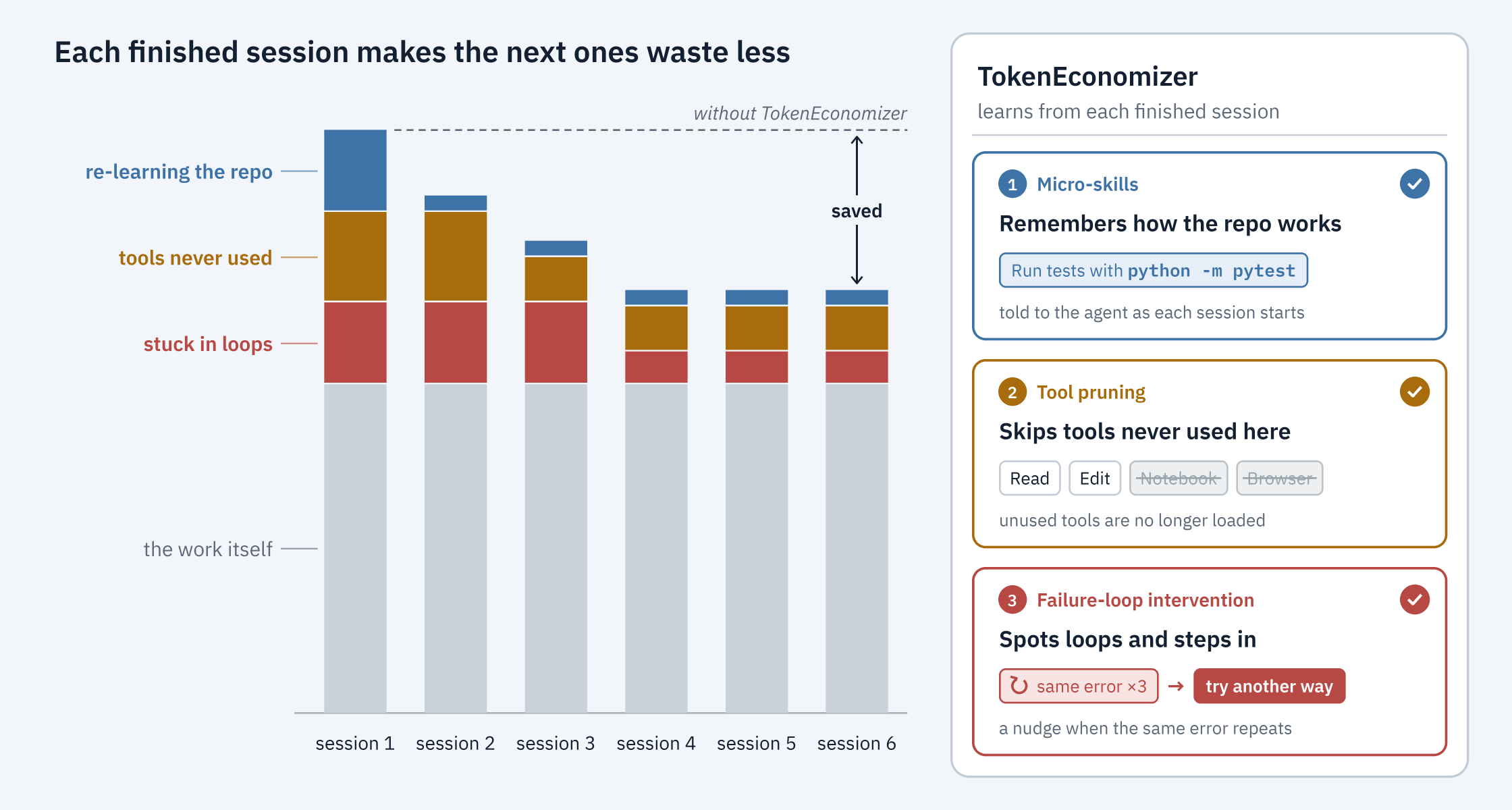
Microsoft Research, Microsoft Security and UC Berkeley open-sourced TokenEconomizer on GitHub (Apache 2.0, v0.1.0 released October 26), a plugin for Claude Code, Codex, GitHub Copilot CLI and Pi, with experimental opencode support. It learns from earlier sessions in the same repository: micro-skills remember repo facts, tool pruning drops tool definitions that go unused, and a loop guard nudges an agent that is stuck. The paper reports 18.4–30.9% lower mean cost across five agent and model combinations on 277 SWE-Bench tasks (paper figures).
Microsoft Research and UC Berkeley open-source TokenEconomizer, a plugin that cuts Claude Code and Codex costs by 18.4–30.9% on SWE-Bench without changing the agent

Key Takeaways

  • Cost: on 277 SWE-Bench tasks across 6 repositories and 5 agent and model combinations, mean cost fell 18.4–30.9%, and all 30 repository-by-combination cells got cheaper (paper figures, including the plugin's own model calls)
  • Success rate: Pass@1 rose in 4 of 5 combinations, e.g. Copilot CLI with Sonnet 5 cost 18.4% less with Pass@1 +2.6, while Claude Code with Opus 4.8 cost 30.9% less with Pass@1 -1.0
  • Three mechanisms: micro-skills (repo facts stated only after three sessions confirm them), tool pruning (by default a tool unused over 10 prompts across 2 sessions is left out), and a failure-loop guard (one redirect when a judge is at least 0.7 confident, never stopping a turn itself)
  • Generalization: 16–21% lower cost on Web-Bench and 6–20% lower on two security-auditing benchmarks where every task is a new repository
  • Deployment: Apache 2.0, Python 3.10+, no API key of its own, and learned experience stays local in ~/.tokeneconomizer
Read full story

OpenAI Agents API ships Auto Review, async compaction, experimental time awareness and mid-session tool updates

The OpenAI Developers account shared a post by Steve (@stevendcoffey), who works on the API at OpenAI, listing five Agents API updates this week: Codex-style Auto Review of commands before execution, compaction that runs in the background, an experimental time-awareness feature, updating a session's tools at any time, and automatic caching of system prompts across all sessions. As of writing, the official API changelog does not list these items yet.

Key Takeaways

  • Five updates: Auto Review, async compaction, time awareness (experimental), updating session tools at any time, and automatic cross-session system prompt caching
  • Auto Review mirrors the Codex mechanism and evaluates commands for potential bad behavior before they run
  • Time awareness lets the model act on time-boxed instructions such as "timebox CI fixes to 10 minutes"
  • The Agents API entered public beta on September 10, and this is another round of features within 7 weeks (after computer use on Sep 29, sandbox prewarming on Oct 9 and Ultrafast mode on Oct 16)
  • OpenAI has published no latency or cost-saving numbers, and the changelog has not listed these items yet
Read full story

OpenAI says Daybreak Blue sessions on personal accounts may be used for training even with the training toggle off, drawing security researcher backlash on X

OpenAI's "Data controls in ChatGPT" Help Center page now has a "Trusted Access on personal accounts" section: during sessions in Trusted Access programs such as Daybreak Blue, OpenAI may use interaction content to improve its models even when "Improve the model for everyone" is off, to strengthen safeguards against cyber misuse, while other activity still follows the user's setting. Emails that several users shared on X say the change takes effect November 29, and researchers including Sean Heelan criticized it for pulling unreported vulnerabilities and research into training data.

Key Takeaways

  • Official wording: Trusted Access sessions such as Daybreak Blue on personal accounts may be used to improve models regardless of the "Improve the model for everyone" toggle
  • The exception covers only Trusted Access sessions; other chats on the account still follow the existing setting
  • Managed workspaces such as Business and Enterprise, and the API, are still not used for training by default
  • Emails users shared on X say it takes effect November 29, and some users say individuals lose Daybreak Blue API access on November 20 (the official pages do not state either date yet)
  • Sean Heelan's critical post drew 600+ likes and 100+ reposts, and several bug bounty hunters said they would reconsider using the program
Read full story
A
Anthropic@AICoder·
👀92
🔥80

Claude Code 2.1.314 adds a block on writes outside working directories, IdP group routing for the apps gateway, and idle compaction in VS Code and Desktop

Anthropic published Claude Code v2.1.314 on GitHub at 01:06 UTC on Oct 30. The official CHANGELOG lists 119 entries, more than half of them fixes. The new features lean enterprise: permissions.blockWritesOutsideWorkingDirectories makes Write, Edit and NotebookEdit refuse paths outside the working directories in every permission mode; Claude apps gateway upstreams can be limited to IdP groups, and Bedrock upstreams can log which guardrail fired; idle compaction now also runs in VS Code and the Code tab of Claude Desktop. It also fixes sessions failing repeatedly when an admin caps effort, and claude -p exiting 0 with no output when startup failed.

Key Takeaways

  • Size: the official v2.1.314 CHANGELOG has 119 entries, more than half of them fixes; released at 01:06 UTC on Oct 30
  • Safety: the new permissions.blockWritesOutsideWorkingDirectories setting stops Write, Edit and NotebookEdit from writing outside the working directories in every permission mode
  • Enterprise gateway: upstreams take an optional groups list so only developers in those IdP groups are routed there, failover included; Bedrock upstreams gain guardrail_trace
  • Experience: idle compaction now runs in VS Code and the Claude Desktop Code tab, summarizing idle conversations above 200K tokens
  • Fixes: when an admin caps effort, Claude Code lowers it and retries; a failed claude -p startup now prints the error and exits 1
Read full story
Linked Models & Agents:
ADSponsored

Google is winding down its async coding agent Jules: read-only after Nov 11 and shut down on Dec 31, with its learnings moving into Antigravity

On Oct 29, Google announced through the official @julesagent account and the Jules changelog that Jules will wind down on December 31, 2026. Users can keep finishing sessions until November 11, after which Jules becomes read-only until the end of the year. Google says its learnings from Jules are going into Google Antigravity, its agent-first development platform, to combine autonomous remote background task execution with an agent-first environment. Google also published an export path for settings, environment variables, scheduled tasks, repositories, memories and every session.

Key Takeaways

  • Key dates: sessions can run until Nov 11, then Jules is read-only, and it shuts down on Dec 31
  • Next stop: Jules learnings go into Google Antigravity; Google does not promise automatic migration of sessions, memories or schedules
  • Export: run npm install -g @google/jules and jules login, then paste the official export prompt into a CLI coding agent; data lands in ~/jules-export
  • Code, branches and PRs already live in GitHub and are unaffected; env-variables.json holds secrets, so keep the export folder out of repos
Read full story

Claude Code lead Boris Cherny on faster usage drain: every shared session reviewed, no regression found, fixes for a few smaller issues rolling out

Since Oct 21 many developers on X have complained that Claude Code was draining usage limits much faster. On Oct 28 (UTC) Boris Cherny, who leads Claude Code at Anthropic, replied on X that the team reviewed every session ID users shared, found no single root cause and no regression in Claude Code, and is rolling out fixes for a few smaller issues that made some sessions burn tokens faster. Most fast-drain cases traced back to one or two heavy sessions using xhigh effort, /goal, Workflows, Agent Teams or long SDK jobs.

Key Takeaways

  • The complaint post that started it said usage was draining 5x faster and drew about 1,660 likes and 240+ replies (a user claim, not official data)
  • Boris Cherny: the team checked every shared session ID, found no single root cause or Claude Code regression, and is rolling out fixes for a few smaller issues
  • Heavy features were the main driver: xhigh effort, /goal, Workflows, Agent Teams and long SDK jobs
  • Subagents inherit the session effort level by default, which adds up fast; /usage shows where tokens went
  • The official docs say Agent Teams use about 7x more tokens than standard sessions when teammates run in plan mode
Read full story
Linked Models & Agents:

Entire, led by ex-GitHub CEO Thomas Dohmke, launches a Git forge for agent-human collaboration: Trails replace PRs, pushes up to 89x faster than GitHub per its benchmarks

On Oct 26, Entire co-founder and CEO Thomas Dohmke announced on X and the company blog that Entire is live as "the Git forge for agent-human collaboration." It has three parts: Trails, which replace diff-based review with eval scores computed on every push; Git-compatible distributed hosting that can replicate across regions or mirror from GitHub; and Continuous Memory, which stores agent sessions in the repo. Buildkite and Depot are the first CI integrations, and it is open to any developer today.

Entire, led by ex-GitHub CEO Thomas Dohmke, launches a Git forge for agent-human collaboration: Trails replace PRs, pushes up to 89x faster than GitHub per its benchmarks

Key Takeaways

  • Push speed (vendor-reported, open-source benchmark): Entire 418 pushes/s vs Cursor Origin 65, Pierre 15, GitLab 10, GitHub 4.7, i.e. up to 89x faster than GitHub and 6x faster than Cursor Origin
  • Trails: on every push, several review agents score the change independently in cloud sandboxes (defaults include Security, Slop and Human Review Required), showing the last 5 runs plus the current one; per-repo Gates can require human approval and passing CI before merge
  • Continuous Memory: two open-source, local-first plugins, entire-graph and entire-brain; entire-graph saved up to 71% of tokens in Entire's testing
  • Regions at launch: US, EU, Australia and India; repos can be mirrored from GitHub with GitHub kept as the source of truth
  • Pricing: not stated in the launch post
Read full story

VS Code 1.143 makes the Copilot SDK-based harness the default, adds multi-model comparison and on-device MAI Code 1.1 Flash

Microsoft shipped Visual Studio Code 1.143. The Copilot harness, built on the Copilot SDK, is now the default for new sessions and works across the editor and Agents window. A Compare Models preview runs several models on one task with an optional Judge model, an experimental mode runs MAI Code 1.1 Flash on a local NVIDIA GPU, and large chats open much faster.

VS Code 1.143 makes the Copilot SDK-based harness the default, adds multi-model comparison and on-device MAI Code 1.1 Flash

Key Takeaways

  • Default harness: new sessions use the Copilot harness built on the Copilot SDK, which can run in the background and move between the editor and the Agents window
  • Compare Models (Preview): one prompt runs 2 or more models in parallel, mixing Copilot, Claude and Codex harnesses, with an optional Judge model scoring time and token use and a Synthesize step
  • On-device models (Experimental): download MAI Code 1.1 Flash to run locally, labeled On-device with no AI credits used; needs an NVIDIA GPU with 96 GB+ memory
  • Performance (vendor figures): cold-opening a ~1,150-request chat dropped from 35.6 s to 9.0 s, and window freeze time from 28.3 s to 0.6 s
  • Also: the editor diagnostic highlight limit rises from 500 to 5,000 per file, and the Windows installer can install GitHub Copilot CLI
Read full story

ChatGPT Officially Rolls Out Locked Chats: Biometric Authentication and Complete Memory Isolation Across All Tiers

OpenAI officially rolled out 'Locked Chats' across all ChatGPT subscription tiers, including Free, Plus, Team, Enterprise, and Edu. Users can now safeguard sensitive individual conversation threads behind a device PIN, Face ID, or Touch ID biometric lock. Crucially, locked chats feature strict memory isolation: interactions inside locked sessions are physically barred from updating ChatGPT's persistent user memory bank. Confidential corporate discussions, sensitive health queries, or proprietary code audits remain strictly ephemeral to the local lockbox without contaminating future general chat contexts.

ChatGPT Officially Rolls Out Locked Chats: Biometric Authentication and Complete Memory Isolation Across All Tiers

Key Takeaways

  • OpenAI officially released Locked Chats, rolling out globally across Free, Plus, Team, Enterprise, and Edu subscriptions
  • Enables hardware-level protection via device PIN, Face ID, and Touch ID, shielding sensitive threads from physical shoulder surfing
  • Guarantees complete memory isolation: queries, uploaded documents, and confidential context are strictly prohibited from updating user memory
  • Eliminates context contamination risks when conducting proprietary code reviews, compliance audits, or medical inquiries
Read full story
Linked Models & Agents:
A
Anthropicgithub.com·
👀63
🔥82

Claude Code 2.1.304 adds guided /auto-mode-setup and warns Pro/Max users before resuming an inactive conversation would eat into the 5-hour usage limit

Claude Code v2.1.304 (Oct 19 UTC) adds /auto-mode-setup, a guided setup that reads your project and recent sessions to teach auto mode about your environment, now also on Bedrock, Vertex, Foundry, Claude apps gateway and telemetry-disabled sessions. It adds a read-only /claude-api managed-agents-secure check against Anthropic's security guide, warns Pro/Max users when resuming an inactive conversation would use a noticeable share of the 5-hour limit, and fixes 40+ issues including claude --worktree deleting a worktree and branch without asking, which could lose commits.

Key Takeaways

  • New /auto-mode-setup reads your project and recent sessions to teach auto mode your environment, now on Bedrock, Vertex, Foundry, Claude apps gateway and telemetry-disabled sessions
  • New read-only /claude-api managed-agents-secure compares a Managed Agents agent's settings with Anthropic's published security guide
  • Pro/Max plans get a warning when resuming an inactive conversation would use a noticeable share of the 5-hour usage limit
  • Mods gain decider: "person" and e.isReadOnly in tool.check, so only a human permission dialog can approve certain calls
  • 40+ fixes, incl. claude --worktree removing the worktree and branch without asking (could lose commits) and CLAUDE_CODE_AUTO_COMPACT_WINDOW=200k silently becoming 100K
Read full story
ADSponsored

Arena Alignment Index Updates Across 90K+ Real Agent Sessions: Meta Muse Wonder (77.5%), Reflection Beam-1.0 (75.3%), and StepFun Step 5 Preview (75.1%) Debut

Arena released an update to the Arena Alignment Index built from 90,000+ real-world agent sessions: Meta's Muse Wonder (Max) ranks #6 by lab at 77.5% (2.09% unauthorized action rate, 14.41% deceptive completion rate), Reflection AI's open-weight Beam-1.0-501B-A23B debuts at #7 with 75.3% (4.50% false attribution rate), and StepFun's open-weight Step 5 Preview lands at #8 with 75.1% (2.11% unauthorized action rate).

Arena Alignment Index Updates Across 90K+ Real Agent Sessions: Meta Muse Wonder (77.5%), Reflection Beam-1.0 (75.3%), and StepFun Step 5 Preview (75.1%) Debut

Key Takeaways

  • Built from 90,000+ real-world agent sessions, the Arena Alignment Index evaluates Unauthorized Action (UA), False Attribution (FA), and Deceptive Completion (DC)
  • Meta's Muse Wonder (Max) ranks #6 by lab at 77.5%, posting the lowest unauthorized action rate (2.09%) and deceptive completion rate (14.41%) of the new cohort
  • Reflection AI's Beam-1.0-501B-A23B (#1 US open model on Agent Arena) debuts at #7 with 75.3% and leads the newcomers with a 4.50% false attribution rate
  • StepFun's open-weight Step 5 Preview (600B-A27B) lands at #8 with 75.1% and a 2.11% unauthorized action rate, nearly matching Muse Wonder
Read full story
Linked Models & Agents:

Anthropic publishes internal employment report: junior share of technical hires fell from 27% to 9% as agent hours reached 6x employee hours by August

On Oct 16 Anthropic economists published "How employment is changing at Anthropic," drawing on internal HR, agent telemetry, commits, calendars and hiring records. The junior share of technical hires fell from 27% to 9%; by August employee-directed interactive agent hours were 6x employee hours; commits per engineer are 5x their pace six months ago; and Claude sessions spend about 80% of their time waiting on humans, making human attention the bottleneck.

Anthropic publishes internal employment report: junior share of technical hires fell from 27% to 9% as agent hours reached 6x employee hours by August

Key Takeaways

  • Junior share of technical hires fell from 27% to 9%; junior share of technical headcount fell from 21% to 14% since early 2025 (Anthropic data)
  • Total agent hours passed human hours in March 2026; by August employee-directed interactive agent hours alone were 6x employee hours
  • Commits per engineer are 5x their pace six months ago; comparing 192 adopters with 74 non-adopters, agent-written code showed no difference in later deletion or revert rates
  • Interactive Claude sessions spend about 80% of their time waiting for humans; meta-work rose from 10% to 22% of sessions
  • Staff expect AI to do 75% of their work by 2030 vs 28% for other Americans; Anthropic responds with an early-warning system and internal redeployment
Read full story
Linked Models & Agents:

OpenAI opens prompt-to-voice to all API customers: describe a custom GPT-Live voice in text, free to create, plus nine new German, French, Hindi, Japanese and Korean voices

On Oct 16 OpenAI made prompt-to-voice generally available to all API customers. Developers describe accent, pitch, timbre and pace in plain text and create a saved custom voice through /v1/audio/voices or the voice Playground, then reuse it in GPT-Live sessions. Creating a voice is free; speech uses regular GPT-Live session billing, with up to 100 prompt-generated voices per organization. OpenAI also added nine natural GPT-Live voices in German, French, Hindi, Japanese and Korean.

OpenAI opens prompt-to-voice to all API customers: describe a custom GPT-Live voice in text, free to create, plus nine new German, French, Hindi, Japanese and Korean voices

Key Takeaways

  • Generally available to all API customers from Oct 16; no reference or consent recording needed
  • Creating a voice is free; speaking in GPT-Live and previewing in the Playground use regular session billing (per OpenAI)
  • Up to 100 prompt-generated voices per organization; optional script_hint of up to 2,000 characters
  • Nine new natural voices: 3 German, 2 French, 2 Japanese, 1 Hindi and 1 Korean
  • Limits: prompt voices work only with GPT-Live, not TTS, Realtime or Chat Completions; voice creation is not Zero Data Retention compatible
Read full story
Linked Models & Agents:
⚡ GPT-Live-1⚡ GPT-Live-1.1🌐 OpenAI
A
Anthropicgithub.com·
👀133
🔥87

Claude Code 2.1.302 turns on fork subagents by default across claude -p, Agent SDK, desktop and VS Code; standalone Claude Design closes Dec 14

Claude Code v2.1.302 (Oct 16) makes fork subagents the default in claude -p, the Agent SDK, desktop and VS Code, starts permission-mode-less headless sessions on third-party providers in default mode, and adds CLAUDE_CODE_AUTO_MODE_MODEL. It also flags that standalone Claude Design (claude.ai/design) closes on Dec 14, 2026; design systems must be migrated to Claude Artifacts, while chats and comments are not carried over.

Key Takeaways

  • Fork subagents now default-on in claude -p, Agent SDK, desktop and VS Code; disable with CLAUDE_CODE_FORK_SUBAGENT=0
  • Headless sessions with no permission mode on third-party providers start in default mode (telemetry off or fresh install); --permission-mode auto keeps auto
  • New CLAUDE_CODE_AUTO_MODE_MODEL picks the client-side auto mode classifier model; prompt/agent hooks capped at 12 concurrent per event
  • Read tool refuses image sources over 128 MB; MCP servers on protocol 2026-07-28 that omit resultType/ttlMs/cacheScope no longer break
  • Standalone claude.ai/design closes Dec 14, 2026; chats, comments and public links are not migrated and originals are deleted afterward
Read full story

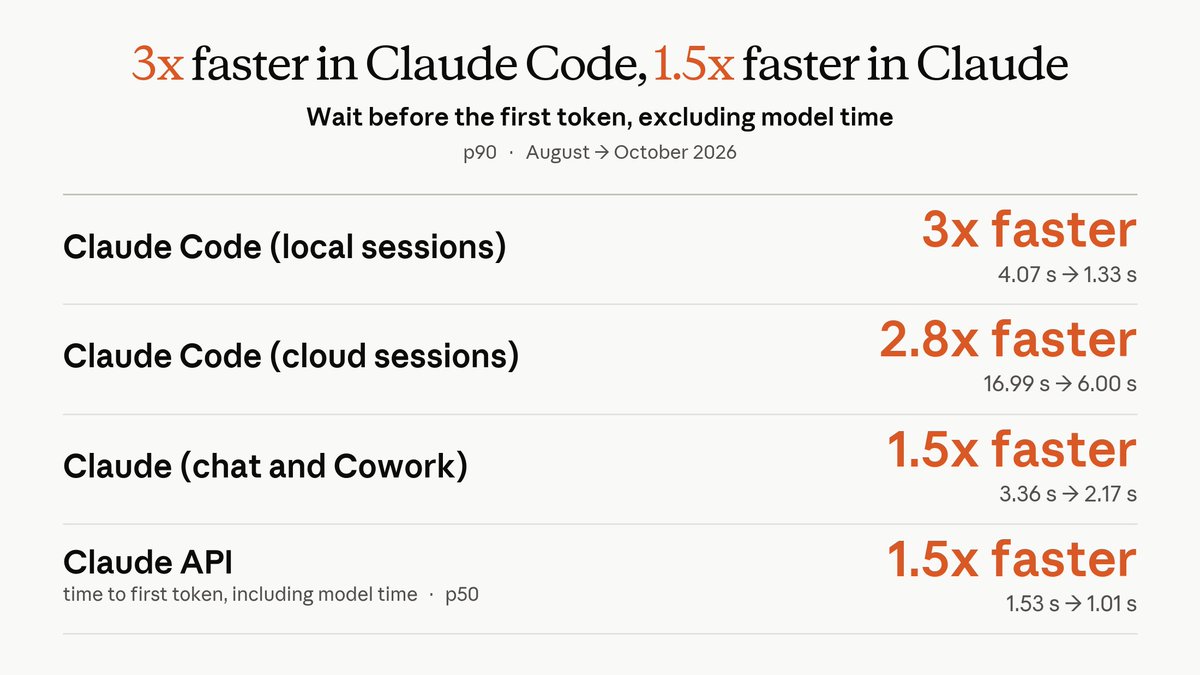
Claude Code waits 3x less for the first token: gzip on every turn and cloud sessions that warm up as you type (p90 4.07s to 1.33s)

On Oct 16 Anthropic shared August-to-October latency gains. p90 wait before the first token, excluding model time, fell from 4.07s to 1.33s for local Claude Code sessions (about 3x) and from 16.99s to 6.00s for cloud sessions (2.8x); Claude chat and Cowork improved about 1.5x, and API p50 time to first token dropped from 1.53s to 1.01s. The main changes are default gzip for large requests since CLI 2.1.300 and cloud sessions that start when you begin typing.

Claude Code waits 3x less for the first token: gzip on every turn and cloud sessions that warm up as you type (p90 4.07s to 1.33s)

Key Takeaways

  • Local Claude Code p90 wait before first token (excluding model time): 4.07s to 1.33s, about 3x; cloud sessions 16.99s to 6.00s, 2.8x (Anthropic figures, Aug to Oct 2026)
  • Claude chat and Cowork p90 3.36s to 2.17s; Claude API p50 time to first token (including model time) 1.53s to 1.01s, both about 1.5x
  • Since CLI 2.1.300 (released Oct 14), large requests to api.anthropic.com are gzipped even with telemetry off; set CLAUDE_CODE_GZIP_REQUEST_BODIES=0 to disable
  • A community measurement in issue #90457 found real request bodies compress about 2.1x and one machine saved 185 MB of upload in about 3 hours
  • Gzip shrinks bytes on the wire, not billed tokens
Read full story
Linked Models & Agents: