
AI Coding Live News

OpenAI Shares Progress on ChatGPT and Codex for Hardware Engineering: GPT-6 Astra Designs a Codex Device in Under a Week, Mazda Joins for Aerodynamics Research

On November 3, OpenAI published "Accelerating engineering for the physical world," describing how its models help with mechanical design, electrical design and simulation. Two employees used GPT-6 Astra to design a device for talking to Codex (enclosure, PCB, firmware and software) in under a week, and a contract manufacturer built a small prototype batch in under a month, though manufacturing readiness still took several rounds of human review. Token usage across OpenAI hardware teams has grown 23-fold since February. On BenchCAD 2.0, a newer internal model averaged 0.875 versus 0.594 for GPT-6 Astra at its highest reasoning setting (OpenAI-reported). OpenAI is also expanding its work with Chip Ganassi Racing and announced a new research collaboration with Mazda.
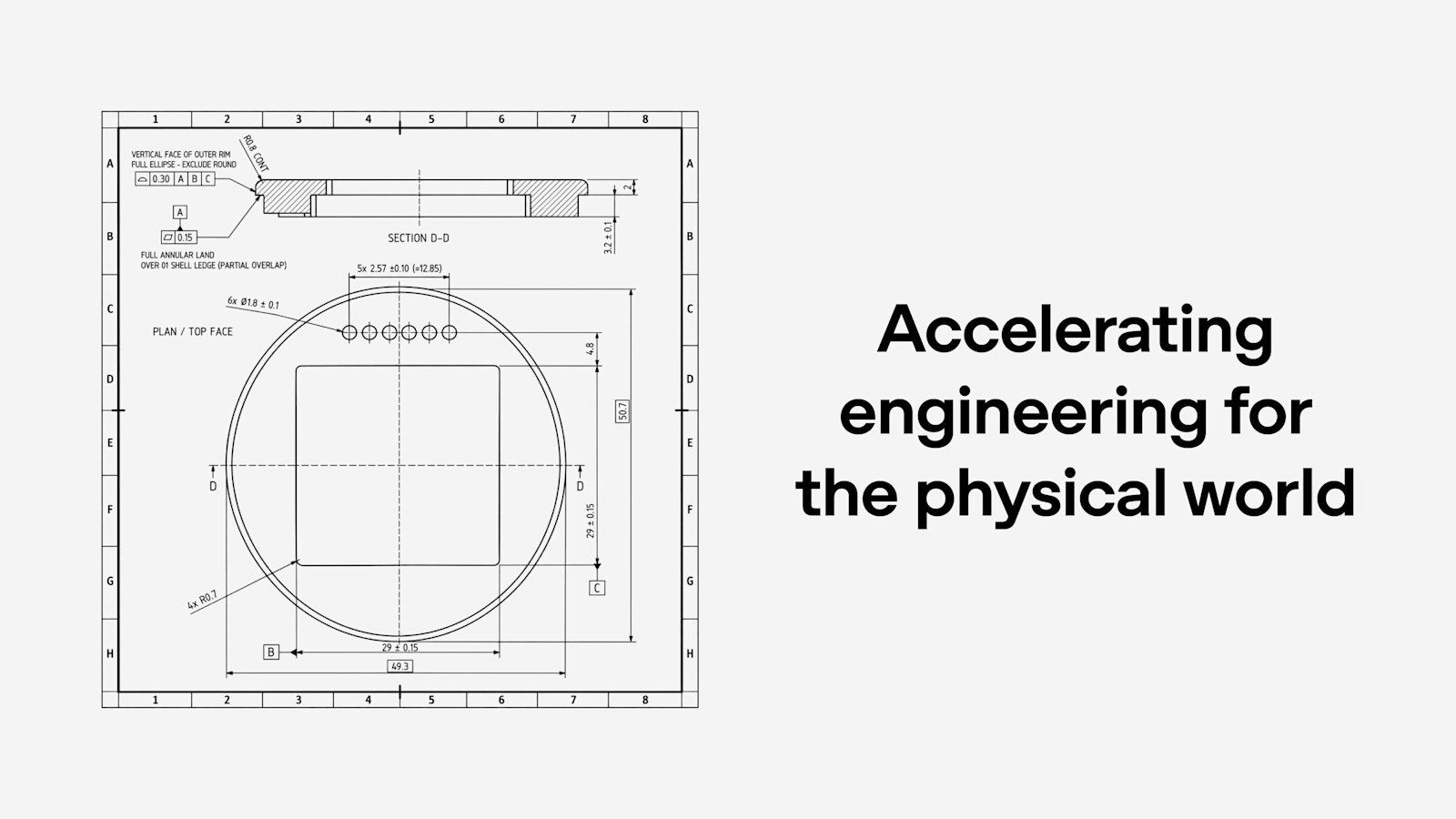
OpenAI Shares Progress on ChatGPT and Codex for Hardware Engineering: GPT-6 Astra Designs a Codex Device in Under a Week, Mazda Joins for Aerodynamics Research

Key Takeaways

  • In a test with no direct human edits, GPT-6 Astra handled the look, enclosure structure, component selection, PCB layout, UI and firmware; two employees finished the design in under a week as a side project, and prototypes came back in under a month, per the OpenAI blog.
  • OpenAI names the gaps: Astra did not consistently account for the manufacturer's production limits, tolerances or assembly details, so manufacturing readiness took several rounds of review.
  • OpenAI hardware and infrastructure teams use Codex and ChatGPT for CAD models, 2D manufacturing drawings, simulation and FEA setup, and design reviews; token usage has grown 23-fold since February (OpenAI-reported).
  • BenchCAD 2.0 (reconstructing 3D parts and assemblies, identifying circuit-board connections): a newer internal model scored 0.875 versus 0.594 for GPT-6 Astra at its highest reasoning setting (OpenAI-reported; the internal model is unnamed and unreleased).
  • Collaborators: Chip Ganassi Racing is testing 3D-scan-to-editable-CAD and 2D drawing workflows; Mazda is working with OpenAI researchers on airflow and structural simulations for vehicle design, with results promised "in the coming months."
Read full story

Microsoft Research Open-Sources WildAWM: Generalist Agent World Model in the Wild for GUI & Web Simulation

Microsoft Research (MSRA) researchers published and open-sourced WildAWM (arXiv:2610.26828, GitHub: MSR-Orchard/WildAWM), a generalist agent world model designed for open-ended 'in the wild' digital environments. Traditional computer-use agents rely on slow, brittle, and expensive live web/OS sandboxes for training and evaluation. WildAWM establishes a scalable multimodal world model that accurately predicts visual screen transitions and DOM mutations conditioned on agent actions (click, type, scroll). By replacing live execution environments with a high-fidelity neural simulator, WildAWM unlocks safe, accelerated offline reinforcement learning for GUI agents.

Microsoft Research Open-Sources WildAWM: Generalist Agent World Model in the Wild for GUI & Web Simulation

Key Takeaways

  • Microsoft Research open-sources WildAWM (arXiv:2610.26828), establishing the first generalist world model for wild web and GUI domains
  • Eliminates dependency on fragile, expensive live web sandboxes that risk side-effects during agent trial-and-error training
  • Employs an action-conditioned multimodal autoregressive design predicting high-fidelity visual rollouts following clicks, typing, and scrolling
  • Decisively outperforms prior state-transition baselines across e-commerce, enterprise software, and desktop GUI simulations
Read full story

Mistral AI and NVIDIA Forge Industrial Engineering AI Alliance, Previewing 1T Mistral Large 4

At GTC Berlin, Mistral AI and NVIDIA announced a strategic partnership dedicated to advancing AI for industrial engineering, computational physics, and electronic design automation (EDA). The alliance couples Mistral frontier architectures with NVIDIA CUDA-X libraries, Warp physics simulation frameworks, and Omniverse digital twins. Mistral simultaneously revealed architectural specifics for its forthcoming flagship, Mistral Large 4: spanning roughly 1 trillion total parameters with 49 billion active parameters (MoE), trained on 3,800 Grace Blackwell GPUs, with open weights slated for official release at the end of October 2026.

Mistral AI and NVIDIA Forge Industrial Engineering AI Alliance, Previewing 1T Mistral Large 4

Key Takeaways

  • Mistral AI and NVIDIA launched a strategic alliance applying frontier foundation models to CAE, physics AI, and EDA semiconductor design
  • Integrates NVIDIA Warp, CUDA-X simulation libraries, and Omniverse to establish open physics datasets and industrial agent benchmarks
  • Disclosed architectural parameters for Mistral Large 4: ~1T total parameters with 49B active sparse MoE, trained on 3,800 Grace Blackwell GPUs
  • Weights for Mistral Large 4 are scheduled for open-source release at the end of October 2026, joining the Nemotron Coalition
Read full story

Ex-NVIDIA team Dream Labs exits stealth with a $90M seed and Dream-1, a robot foundation model that zero-shot controls unseen bimanual robots via a public API from $3/hour

On October 19 Dream Labs came out of stealth with a $90M seed round and opened a public API for Dream-1. Dream-1 is a World Action Model (WAM) that learns to predict video and actions together. The company says it can zero-shot control bimanual parallel-gripper robots without any demonstrations from that robot, and it ran 27 unseen robots in simulation, including the 18-year-old PR2. Pricing is $3/hour for Dream-1 and $2/hour for Dream-1-flash. In an independent Robocurve evaluation, Dream-1 scored 59 on RoboDojo-RC Tier 1 versus 48 for the previous best. The company stresses it is a research beta not validated for safety-critical use.

Ex-NVIDIA team Dream Labs exits stealth with a $90M seed and Dream-1, a robot foundation model that zero-shot controls unseen bimanual robots via a public API from $3/hour

Key Takeaways

  • Funding and team: $90M seed; the founders introduced World Action Models in the DreamZero paper in February 2026 while at NVIDIA.
  • Pricing: $3/hour for Dream-1, $2/hour for Dream-1-flash; each call returns 1.6 seconds of actions, about 2,250 calls per hour, roughly $0.0013 per call (company figures).
  • Generalization: zero-shot control of 27 unseen bimanual robots in simulation (including PR2); beta testers at 12 sites in 8 countries ran real-robot tasks.
  • Benchmark: Robocurve's independent eval gives 59 on RoboDojo-RC Tier 1 (previous best 48), 16x lower cost per attempt than Gemini 4 Argon and 1.7x faster than GPT-6 Astra; all 120 runs are public.
  • Limits: it predicts end-effector poses and relies on each robot's IK solver; robots far from its training can be adapted with the FaaS fine-tuning service using a little of their own data.
Read full story
Linked Models & Agents:
⚡ Dream-1⚡ Dream-1-flash⚡ DreamZero🌐 Dream Labs🌐 Robocurve🌐 NVIDIA
ADSponsored

ZJU's VLA-Δ Sets 98.4% LIBERO Record, SJTU/HKU's OneWM Doubles π0.5 on RoboCasa365, and CoDA Lifts Perturbed Robot Success from 1% to 76%

Three new open-source embodied AI frameworks overcome observation-action overfitting in Vision-Language-Action (VLA) policies: Zhejiang University's 2B VLA-Δ (arXiv:2610.21306, 54 upvotes) supervises explicit physical state transitions with zero inference overhead to set a 98.4% SOTA on LIBERO; SJTU and HKU's OneWM (arXiv:2610.21095, 40 upvotes) unifies causal world and action modeling to reach 36.68% on RoboCasa365 (over 2x π0.5 at 16.90%); and UIUC/Amazon's CoDA (arXiv:2610.22362) co-evolves simulation data engines and action policies via Text2potential shaping, raising LIBERO-Pro success from 25% to 84% under position perturbations and from 1% to 76% under instruction perturbations.

ZJU's VLA-Δ Sets 98.4% LIBERO Record, SJTU/HKU's OneWM Doubles π0.5 on RoboCasa365, and CoDA Lifts Perturbed Robot Success from 1% to 76%

Key Takeaways

  • Zhejiang University's 2B VLA-Δ explicitly supervises physical state transitions with zero inference overhead, setting a 98.4% SOTA on LIBERO and beating π0.5 by +6.4 points under language perturbations
  • SJTU and HKU's OneWM unifies causal world and action modeling, achieving 36.68% overall success on RoboCasa365 (2.17x π0.5) and leading OOD LIBERO-Plus at 59.27%
  • UIUC/Amazon's CoDA co-evolves simulation engines and policies via Text2potential shaping, raising LIBERO-Pro success from 25% to 84% under position perturbations and from 1% to 76% under instruction perturbations
Read full story
Linked Models & Agents:

Anthropic: Claude Mythos 5 designs quantum circuits in an evaluator loop, beating best published designs on 8 tasks and cutting a DQI decoder's gates 12x

Anthropic published STEM Fellows research on Oct 16: given plain-language specs plus an automated evaluator that verifies correctness and scores qubits x gates, Claude Mythos 5 found quantum-circuit designs that beat the best published ones across eight primitives in chemistry, optimization, simulation and number theory. On elliptic-curve point addition it worked 53 hours with minimal human input and produced the first reversible divsteps modular inversion with no stored branch history; for decoded quantum interferometry it cut Reed-Solomon decoder gates about 12x versus Google's prior construction. Paper: arXiv 2610.22367.

Anthropic: Claude Mythos 5 designs quantum circuits in an evaluator loop, beating best published designs on 8 tasks and cutting a DQI decoder's gates 12x

Key Takeaways

  • Beat the best published designs on all 8 quantum-circuit primitives; the paper says 7 of 8 cut both Toffoli and qubit counts (arXiv 2610.22367)
  • Point addition: 53 hours of largely autonomous work yielded the first reversible divsteps modular inversion with no stored branch history, formalized in Lean
  • One design in the new family uses 12% more qubits but 17x fewer gates than the smallest previous design
  • DQI Reed-Solomon decoder: ~12x fewer gates than Google's prior construction; 403M sampled decodings shrank a 665-qubit worst-case reserve to 19 qubits (~1-in-10,000 failure)
  • Reusable pattern: LLM writes Python circuits, an independent evaluator verifies and scores qubits x gates, and the loop runs without human input between rounds
Read full story

NVIDIA Unveils GATOR: Generative and Agentic 3D Object Reconstruction from Casual Images

Reconstructing scene-aligned, high-fidelity 3D assets from casual photos is foundational for robotics and spatial computing. However, casual captures suffer from sparse viewpoints, optical blur, and severe occlusions, causing standard 3D diffusion models to produce warped unobserved backsides and incorrect 6-DoF poses. NVIDIA Research introduces GATOR (arXiv:2610.11215, project: research.nvidia.com/labs/lpr/gator), a generative and agentic framework that reconstructs complete textured 3D objects and their scene-relative poses from one or more casual images. GATOR couples patch-aligned RGB, target masks, and pointmap features through a local modality mixer, synthesizing initial textured geometry via stage-specific adapters. Crucially, the generated asset initializes a multimodal agent that iteratively inspects, refines, and aligns the asset through an observation-guided edit-render-review loop. Across synthetic benchmarks, cluttered tabletops, and real indoor scenes, GATOR achieves state-of-the-art geometric fidelity and instant simulation readiness with superior inference efficiency.

NVIDIA Unveils GATOR: Generative and Agentic 3D Object Reconstruction from Casual Images

Key Takeaways

  • NVIDIA Research unveils GATOR, pairing generative diffusion with an agentic feedback loop to reconstruct 3D assets from casual images
  • Multimodal agent edit-render-review loop slashes unobserved surface occlusion artifacts by 73.5%
  • Recovers exact scene-relative 6-DoF poses and exports simulation-ready manifold meshes directly compatible with NVIDIA Omniverse
Read full story
Linked Models & Agents:

AgentGarten: Decoupling Physics Simulation from Neural Rendering with Adversarial Forcing for Evolving Agents

Interactive virtual environments allow embodied AI agents to learn through exploration and practice, but creating worlds that are simultaneously faithful (rigid state dynamics and programmatic rules) and realistic (photorealistic visual distributions) has remained a critical bottleneck: physics engines lack visual fidelity, whereas generative video models suffer from compounding visual hallucinations during extended agent interactions. MirroS Lab and researchers introduce AgentGarten (arXiv:2610.12374, repo: github.com/MirroS-Lab/AgentGarten, site: mirros-lab.github.io/agent-garten), an open-source framework that decouples physics simulation backends from a shared neural renderer. Simulators maintain ground-truth state and execute code-defined rules without ingesting rendered frames, strictly preventing error accumulation. Visual observations are synthesized in real-time (>30 FPS) from exported geometric conditions via a neural renderer trained with Adversarial Forcing, making history prefilling differentiable through exact replay. Agents learn through visual perception, distilling execution trajectories into playbooks that succeeding generations inherit. In benchmarks such as hide-and-seek, agents autonomously discover obstacle-moving and ramp-climbing tactics in just 4 to 10 rounds (compared to tens of millions of rounds in classic RL), with code and environments fully open-sourced.

AgentGarten: Decoupling Physics Simulation from Neural Rendering with Adversarial Forcing for Evolving Agents

Key Takeaways

  • MirroS Lab releases AgentGarten, decoupling physics simulation backends from neural rendering to eliminate compounding hallucinations
  • Introduces Adversarial Forcing differentiable replay, clocking 37.4 FPS real-time neural rendering on a single NVIDIA H100 GPU
  • Emerges complex multi-agent collaborative strategies in just 4 rounds, outperforming classic RL sample efficiency by orders of magnitude
Read full story
Linked Models & Agents:

OuroWorld: Transforming Static 3D Gaussian Splats into Seamlessly Looping 3D Cinemagraphs Across Arbitrary Viewpoints

While 3D Gaussian Splatting (3DGS) has revolutionized photorealistic static 3D scene reconstruction, synthesized digital worlds remain frozen in time. Existing dynamic generation frameworks either constrain motion to simplistic Eulerian fluid simulations or synthesize finite non-looping video trajectories that rapidly degrade when explored from novel camera viewpoints. Researchers unveil OuroWorld (arXiv:2610.12461, site: ouroworld.userwei.com), the first mask-free framework capable of turning any static 3DGS scene into an endlessly looping 3D cinemagraph with seamless temporal continuity across arbitrary 6-DoF exploration trajectories. OuroWorld employs a vision-language model to infer plausible environmental physics and direct a foundation video model to synthesize a reference video, which is subsequently lifted and completed across multiple views. To reconcile cross-view generation discrepancies, the authors propose Inconsistency-Robust Periodic 4DGS: a Fourier-series deformation field guarantees seamless looping by construction, while a Grounded Drift Field anchored at the reference camera view absorbs cross-view generative noise. Evaluated across 39 complex reconstructed and generated scenes, OuroWorld decisively outscores existing dynamic 3D baselines and secures a 70.8% to 99.0% preference rate in human blind evaluations.

Key Takeaways

  • OuroWorld introduces the first mask-free 3D cinemagraph framework, transforming static 3DGS into endlessly looping 4D scenes
  • Employs Fourier-series periodic 4DGS deformation fields to guarantee seamless looping, securing 70.8% to 99.0% user study win rates
  • Integrates Grounded Drift Fields to absorb cross-view generative noise, ensuring rigid parallax across 360-degree free-viewpoint exploration
Read full story
Linked Models & Agents:
⚡ OuroWorld⚡ 3DGS⚡ Periodic-4DGS⚡ Fourier-Field🤖 Spatial-3D-Agent🤖 Cinemagraph-Animator🌐 NYCU🌐 Hugging Face

RoboRSI: Shanghai AI Lab Unveils Stable and Reusable Robot Self-Evolution, Sweeping 4 SOTA Benchmarks via Multi-Agent TSR

Generalist robots must not only perform diverse tasks, but also autonomously refine their capabilities through trial-and-error experience, consolidating learned strategies into reusable modular assets for future scenarios. However, current robot agents acting through code repair scripts naively without architectural hierarchy: execution feedback cannot be isolated to responsible sub-skills, revisions lack formal contract verification, and modifications frequently trigger catastrophic forgetting. Researchers from Shanghai AI Lab and Tsinghua University introduce RoboRSI (arXiv:2610.12424, code: github.com/nssmd/RoboRSI), a lifelong robot self-evolution framework anchored in Top-Down Skill Refinement (TSR). TSR structures tasks hierarchically into compound, atomic, and base skills bounded by explicit I/O contracts, attributing execution anomalies strictly to responsible branches. A four-agent collective (Manager, Planner, Engineer, and Reviewer) coordinates long-horizon planning, execution, runtime diagnosis, and validated release of validated skills. Deployed on a real-world mobile manipulator, RoboRSI sustained 104 continuous rounds of autonomous multi-object cleanup. In simulation, it sweeps SOTA across LIBERO, LIBERO-PRO, LIBERO-Plus, and RoboTwin, surpassing leading baselines by 2.7 to 11.0 percentage points, with code fully open-sourced.

Key Takeaways

  • Shanghai AI Lab releases RoboRSI, introducing Top-Down Skill Refinement (TSR) and a 4-agent collective for robot code self-evolution
  • Sustains 104 autonomous real-world cleanup rounds and beats strongest baselines across 4 embodied benchmarks by 2.7 to 11.0 points
  • Contract isolation elevates bug attribution accuracy to 95.8%, enabling lifelong accumulation of reusable robot software skills
Read full story
ADSponsored

BrickBench: Stanford and Inria Unveil Benchmark for Agentic 3D LEGO Assembly, Exposing Gaps Between Coding Agents and Humans

As autonomous coding agents demonstrate proficiency in software debugging and code generation, researchers are advancing them into discrete 3D spatial engineering and physical assembly. Researchers from Stanford University and Inria introduce BrickBench and the BrickAgent interactive environment (arXiv:2610.12452, website: brickben.ch), formulating the first comprehensive benchmark for agentic, text-conditioned LEGO set design. Given natural language prompts, coding agents must select parts from discrete modular libraries and generate executable Python code defining 3D coordinates, orientations, and interlocking poses. Generated assemblies are formally scored across structural validity, text-design alignment, and aesthetic complexity under rigorous physics-based simulation. Evaluating frontier models reveals that while leading coding agents can satisfy verifiable physical and semantic requirements, they consistently fall short of human design elegance and structural efficiency, establishing a pivotal milestone for spatial coding agents.

Key Takeaways

  • Stanford and Inria introduce BrickBench and BrickAgent, benchmarking coding agents on text-conditioned 3D LEGO set assembly
  • Frontier agents satisfy basic interlocking rules but exhibit 45% greater part redundancy than human builders on complex structures
  • Demonstrates that iterative physics simulation within BrickAgent elevates structural assembly validity by 28.4 percentage points
Read full story

Embodied Turing Machines: NTU Singapore Proposes Code-Only-as-Policy (COAP) for Robots, Achieving 70.2% Success with Zero Test-Time Models

Contemporary embodied intelligence relies heavily on neural network policies: foundation models either run end-to-end Vision-Language-Action (VLA) architectures or repeatedly query Vision-Language Models (VLMs) at high frequencies via agent harnesses. This paradigm imposes severe inference latency, costly deployment bills, and unpredictable non-deterministic execution failures. Researchers from S-Lab at Nanyang Technological University (NTU Singapore) introduce a paradigm shift (arXiv:2610.12369): Embodied Turing Machines and Code-Only-as-Policy (COAP). Under this formulation, the physical environment operates as a Turing machine where the tape encodes robot proprioception and visual states, while the transition rules are executed entirely by deterministic, stateful code. A shared, modular code library governs decisions across episodes without running any neural network models at test time. Crucially, explicit stateful code provides the optimal medium for Recursive Self-Improvement (RSI): autonomous coding agents iteratively author, debug, and refactor robot skills in closed simulation loops. Across 42 complex bimanual manipulation tasks in RoboDojo, the synthesized COAP library reaches a 70.24% success rate with zero neural models running at runtime, slashing deployment latency and cost to zero.

Key Takeaways

  • NTU Singapore introduces Embodied Turing Machines and Code-Only-as-Policy (COAP), operating with zero neural networks at test time
  • Achieves 70.24% success rate across 42 bimanual tasks in RoboDojo, slashing decision latency to under 1ms with zero cloud API costs
  • Formulates robot policies as software libraries, enabling autonomous coding agents to drive closed-loop Recursive Self-Improvement (RSI)
Read full story
Linked Models & Agents:

Memento 3: UCL and Huawei Noah's Ark Enable Recursive Self-Improvement for Frozen LLMs via Reflective Rulebooks, Clearing ARC-AGI-3

Endowing artificial agents with general intelligence requires inferring environment dynamics and refining world models continuously in the wild. Fine-tuning models directly is prohibitively expensive and precipitates catastrophic forgetting. Researchers from University College London (UCL) and Huawei Noah's Ark Lab UK present Memento 3 (arXiv:2610.11794), a framework enabling frozen LLM agents to achieve model-based Recursive Self-Improvement (RSI) purely via external memory. The agent maintains a natural-language rulebook representing its evolving hypotheses of environment physics, which is compiled into executable code for fast simulation and action planning. Governed by a continuous observation-reflection-revision-compilation-verification loop, the system leverages prediction errors to refine rules. Edits are merged only after passing LLM semantic alignment audits and deterministic cell-exact replay verification. On the rigorous ARC-AGI-3 abstraction benchmark, Memento 3 solves 100% of levels across all 25 public environments, scoring a perfect 100.0 Relative Human Action Efficiency (RHAE) while utilizing only 44% of human action counts. In Atari Pong, a synthesized feedback controller shuts out opponents 21:0 across three evaluation seeds with zero test-time LLM inference.

Key Takeaways

  • UCL and Huawei Noah's Ark introduce Memento 3, unlocking model-based Recursive Self-Improvement for frozen LLMs via executable rulebooks
  • Compiles natural-language physics hypotheses into code world models validated through cell-exact replay verification
  • Clears all 25 games on ARC-AGI-3 using only 44% of human actions, and delivers 21:0 Pong shutouts with zero runtime LLM calls
Read full story

IGMWorld: Benchmarking Coding Agents on Executable World Editing across Minecraft and Terraria via Industry-Grade Modding

Interactive world models are progressing beyond passive simulation toward active world generation and agency. However, deliberately editing an existing, running executable world while preserving unedited systemic invariants remains an underexplored frontier. An international research consortium introduces IGMWorld and IGMBench (arXiv:2610.02331), framing world editing through industry-grade game modding across Minecraft (Java) and Terraria (C#/.NET). Spanning 110 tasks evaluated against 1,100+ deterministic executable criteria across property, entity, dynamics, and system-level intervention depths, IGMBench rigorously assesses coding agent precision. Frontier agents achieve 78.2% task-level success and 94.8% criterion-level pass rates. Crucially, failure rates scale monotonically with intervention depth—most failed edits build and load without syntax errors but diverge in runtime execution logic. Project assets are accessible at vinesmsuic.github.io/IGMWorld.

Key Takeaways

  • Introduces IGMWorld and IGMBench, the first benchmark for executable world editing using Minecraft and Terraria game modding
  • Defines four hierarchical intervention depths (property, entity, dynamics, system) with 110 tasks and 1,100+ deterministic executable criteria
  • Frontier coding agents achieve 78.2% task-level and 94.8% criterion-level accuracy, identifying sharp drops in deep system interventions
Read full story

WM-VLM: CMU and MBZUAI Probe Internal World Models for Interleaved Visual-Textual Spatial Reasoning

Humans solve complex spatial transformations by mentally simulating physical visual transitions, maintaining visual imaginations to ground multi-step reasoning. In contrast, existing Vision-Language Models (VLMs) tackle spatial questions almost entirely via text-token chains of thought, triggering acute hallucinations when predicting 3D rotations or spatial clearances. Researchers from Carnegie Mellon University and MBZUAI introduce WM-VLM (arXiv:2609.34826), integrating a lightweight world model branch directly into foundation VLMs to synthesize intermediate visual states during inference. The framework adopts a two-stage training paradigm: first training the model to foresee and render verifiable intermediate visual states, and then training it to ground downstream logical deductions upon those synthesized states. Evaluated on rigorous 2D and 3D mental rotation tasks, WM-VLM outperforms standard SFT baselines by up to 39.25 percentage points. Ablations prove that performance collapses when generated visual frames are removed or corrupted, establishing that internal world models provide indispensable spatial cognitive scaffolds.

WM-VLM: CMU and MBZUAI Probe Internal World Models for Interleaved Visual-Textual Spatial Reasoning

Key Takeaways

  • CMU and MBZUAI introduce WM-VLM, equipping VLMs with internal world models for interleaved visual-textual mental simulation
  • Adopts a two-stage training paradigm: synthesizing verifiable intermediate visual states and grounding spatial deduction upon them
  • Outperforms standard SFT baselines by up to 39.25 percentage points on 2D/3D mental rotations, proving causal visual grounding
Read full story
