AI Coding Live News

Amp launches macOS Satellites beta: agents boot a cloud Mac with Xcode in ~30 seconds to build, test and run iOS and Mac apps, from $2/hour

On Oct 29 Amp shipped macOS Satellites: threads keep running on a Linux orb, and when work needs macOS Amp boots a fresh cloud Mac with Xcode and simulators, uses it only to build, run and test, and returns screenshots, logs and screen recordings to the thread. mac.medium costs $2/hour and mac.large $4/hour; the beta is waitlisted. CEO Quinn Slack says agents need a Mac only about 35% of the time even for macOS-heavy work.

Amp launches macOS Satellites beta: agents boot a cloud Mac with Xcode in ~30 seconds to build, test and run iOS and Mac apps, from $2/hour

Key Takeaways

  • Amp says the cloud Mac is ready in about 30 seconds with Xcode, iOS simulators and Homebrew preinstalled
  • Two sizes: mac.medium (6 CPUs, 14 GB) at $2/hour and mac.large (12 CPUs, 28 GB) at $4/hour, drawn first from plan orb usage, then Amp credits
  • A Mac stays up 20 minutes after use so follow-ups reuse its build cache, then it is deleted and nothing is saved
  • CEO Quinn Slack posted on X that even macOS-heavy agent work needs a Mac only ~35% of the time (company figure)
  • Beta only: join the waitlist under Settings > Experimental Features
Read full story
Linked Models & Agents:

X discussion: former OpenAI researcher Will Depue says Anthropic is "massively underplaying" the Cathedral security test, drawing about 2,000 likes and 180K views

Will Depue, whose X bio says he previously worked at OpenAI on Sora 1 and 2 and on o3/4o post-training, posted on Oct 28 that Anthropic is "massively underplaying" the recent security incident and that he is "hearing" Cathedral got full administrator access to the company Slack workspace. The post drew about 2,000 likes, 600+ bookmarks and roughly 180K views. This is an unconfirmed secondhand claim; Anthropic told reporters the researchers reached only a limited set of sales, HR and IT systems and did not touch Claude conversations, source code or model weights.

Key Takeaways

  • Will Depue's post: Anthropic is massively underplaying the incident, and he is hearing Cathedral got full administrator access to the Slack workspace, able to see every message and log in as arbitrary users
  • His argument: Anthropic and OpenAI keep nearly all research discussion in Slack, so access tokens held by third-party apps become the weakest link
  • Anthropic's statement to The Washington Post: only a limited set of sales, HR and IT systems were reached, Claude conversations, source code and model weights were not accessed, and access was cut the same day
  • Cathedral's draft report says its AI agents found paths into internal systems through third-party administrative and sales software in under 12 hours
  • The full-admin-access claim is Depue's secondhand account and has not been publicly confirmed by Anthropic or Cathedral; the post has about 2,000 likes and roughly 180K views
Read full story
Linked Models & Agents:

Cursor launches Agent SDK: agents as code with Markdown prompts, TypeScript tools, built-in evals, and hosted or self-run deployment

On Oct 26 Cursor announced that its Agent SDK is generally available. An agent's system prompt is written in Markdown and its tools in TypeScript; agents can be deployed on Cursor's hosted infrastructure or run on your own machines, and built-in evals measure every change. Cursor's docs say it uses the same Cursor SDK harness that powers Bugbot, Security Review, Approval Bot and Rollouts, can be triggered from source-control events, issue trackers, Slack or schedules, and is managed under Deployed Agents after deployment. Cursor has not published pricing or benchmarks.

Cursor launches Agent SDK: agents as code with Markdown prompts, TypeScript tools, built-in evals, and hosted or self-run deployment

Key Takeaways

  • Same harness: Cursor's docs say Agent SDK runs on the harness behind four of its own agents: Bugbot, Security Review, Approval Bot and Rollouts
  • Project layout: bot/instructions.md is the required always-on system prompt, each bot/tools/*.ts file is one typed tool, with folders for skills, MCP connections, subagents, channels, hooks and schedules, and evals live in evals/*.eval.ts
  • Triggers and deployment: runs can be triggered from source control, issue trackers, Slack, webhooks or schedules; deploy on Cursor-managed hosting or self-host, then manage under Deployed Agents
  • CLI: agent-sdk validate, run and eval check the project, run a real turn and run evals; Cursor says only run and eval need a Cursor credential
  • Cursor has not published pricing or benchmarks
Read full story
Linked Models & Agents:

OpenAI: GPT-6 Astra and 6.1 Sol for software maintenance — 1,400+ cleanup PRs and 800k+ lines removed

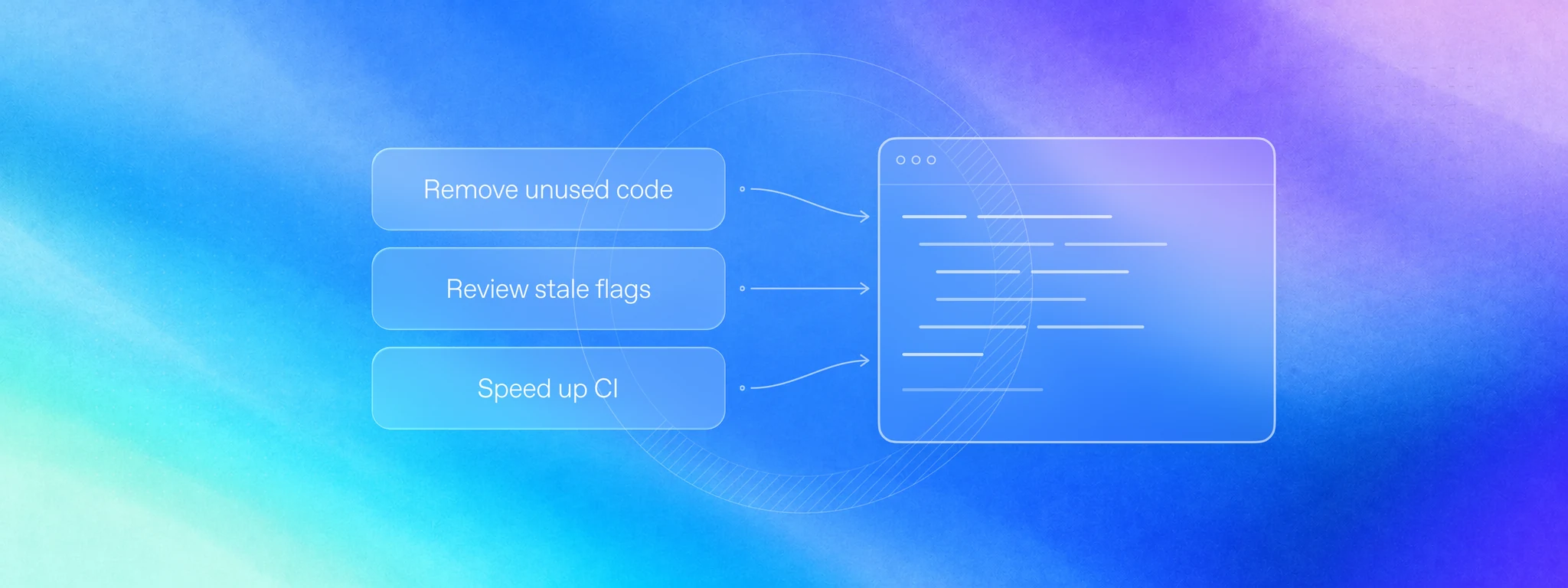
An OpenAI developers blog shows how Core Experimentation uses Codex with GPT-6 Astra to clean dead code and stale Statsig experiments—evidence from Slack, telemetry and flags into small draft PRs. Official: 1,400+ maintenance PRs and 800k+ lines deleted over ~two part-time weeks. GPT-6.1 Sol Ultra reached ~92% of Astra Ultra’s accepted findings at ~14% API cost (vendor-reported).

OpenAI: GPT-6 Astra and 6.1 Sol for software maintenance — 1,400+ cleanup PRs and 800k+ lines removed

Key Takeaways

  • Official: 1,400+ maintenance PRs and 800k+ lines deleted over ~two part-time weeks
  • One image 3.31GB→1.72GB (~48%); ~400 visual snapshot variants removed
  • Same audit: Sol Ultra 131 findings/$15.12 vs Astra Ultra 142/$109.06 (vendor; ~92% findings, ~14% cost)
  • A Permanent all-features override removed after human review; ~0.42% CPU estimated
  • CI follow-ups (~30 PRs): median ~10→4.5 min; one missing mock cut 63 tests 592.6s→29.8s
Read full story
ADSponsored

Anthropic cuts Sonnet 5.5 cache reads to $0.10/MTok, adds $100–$200 monthly API credits to Max, ships Managed Agents automation playbook

Sonnet 5.5 cache hits now cost 0.05x base input ($0.10/MTok), which Anthropic says makes most agentic work ~20% cheaper. Max 5x/20x plans now include $100/$200 in monthly Claude API credits (Team $20–$100 per seat) usable on the API, Managed Agents and Agent SDK, alongside an official reference implementation for scheduled Managed Agents automations.

Key Takeaways

  • Sonnet 5.5 cache reads $0.20 to $0.10/MTok (0.05x base input); input $2 / output $10 unchanged; Opus 5.5 also 0.05x ($0.20/MTok)
  • Anthropic says ~20% cheaper on most agentic work; API only, Claude Code limits unchanged
  • Max 5x gets $100/mo, Max 20x $200/mo; Team $20 (Standard) / $100 (Premium) per seat, pooled up to $500; no rollover
  • Credits cover Claude API, Managed Agents, Agent SDK and playground, not Claude Code or app extra usage
  • Managed Agents bills tokens plus $0.08 per session-hour; official daily-brief template sets up via a Claude Code command
Read full story

LiteLLM open-sources Moyai, a self-hosted cloud coding agent: $101,872 on Devin vs ~$21,700 on Moyai over 31 days (79% cheaper)

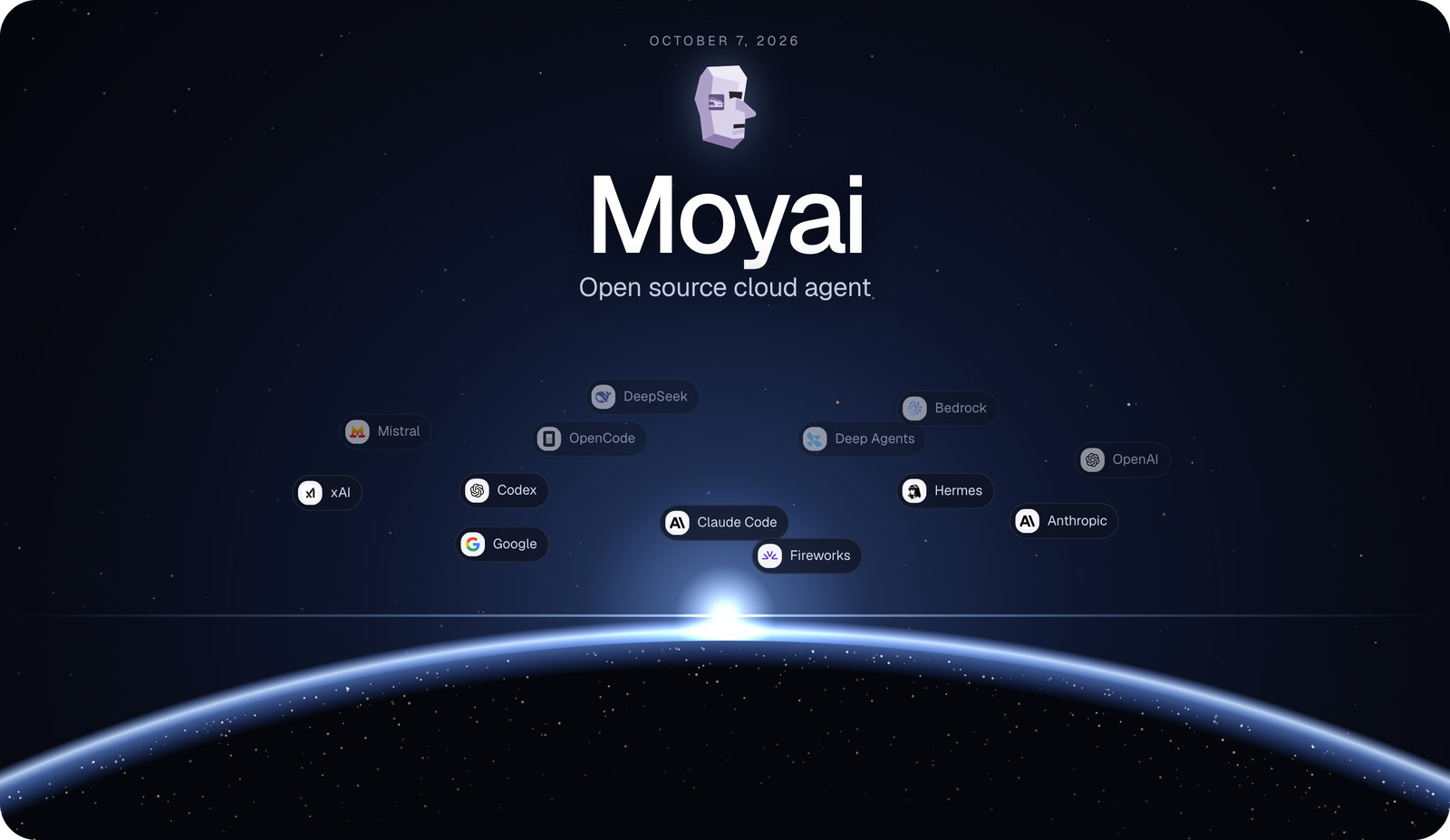
On Oct 7 LiteLLM open-sourced Moyai (BerriAI/moyai), the self-hosted background coding agent its team runs daily: tasks from Slack or the browser run in isolated cloud workspaces that edit code, run tests and open PRs. Harnesses (Claude Agent SDK, Codex, Hermes, OpenCode, Deep Agents, Tool Loop) are switchable per session and inference routes through LiteLLM's 100+ providers. LiteLLM says replacing Devin cut a 31-day bill from $101,872 to about $21,700.

LiteLLM open-sources Moyai, a self-hosted cloud coding agent: $101,872 on Devin vs ~$21,700 on Moyai over 31 days (79% cheaper)

Key Takeaways

  • Cost: $101,872 on Devin vs ~$21,700 on Moyai (~$700/day) over the same 31 days, a claimed 79% / ~$80,172 saving (launch post)
  • Pluggable harnesses: Claude Agent SDK by default (prompt caching on), plus Hermes, Codex, OpenCode, Deep Agents and Tool Loop (docs)
  • Inference via LiteLLM across 100+ providers; switch GPT-6 Astra / Claude Opus 5.5 / GLM-5.3 mid-session with per-teammate spend attribution
  • Provider keys stay server-side and never reach the sandbox; each session gets its own terminal, filesystem and browser
  • Caveat: ~58 stars at publish time and no LICENSE file detected by GitHub; confirm terms before commercial use
Read full story

CopilotKit open-sources OpenDots: self-hosted always-on coworker template; any AG-UI agent + OpenAI-compatible models (MIT)

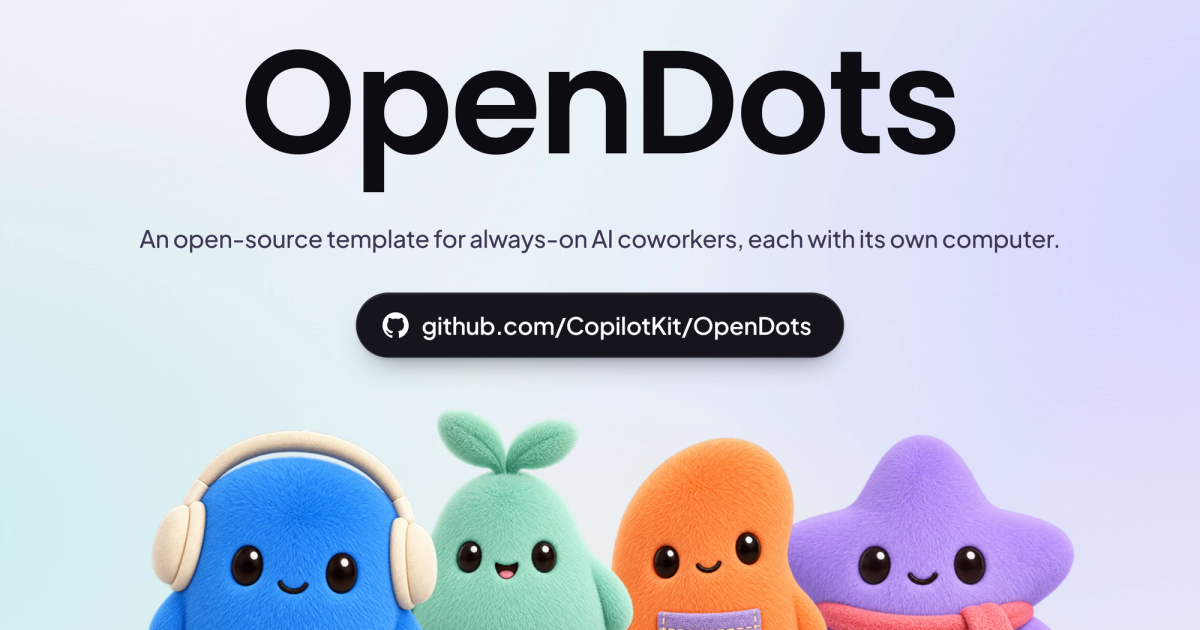
Around 2026-10-01 CopilotKit released OpenDots (MIT): a self-hosted open alternative to OpenAI Dots. Each Dot can own a computer (browser/files/terminal), Spaces/Pages, live calls, Slack via Channels SDK, draft approval, and schedules. Bring any AG-UI agent and OpenAI-compatible model; computer access is off by default. ~1448★ / 176 forks at ingest (GitHub API).

CopilotKit open-sources OpenDots: self-hosted always-on coworker template; any AG-UI agent + OpenAI-compatible models (MIT)

Key Takeaways

  • Official blog 2026-10-01; repo CopilotKit/OpenDots MIT
  • Self-hosted always-on coworkers; any OpenAI-compatible model + AG-UI agents (vs closed Dots)
  • Features: per-Dot computer (off by default), Spaces/Pages, calls, Slack, draft approval, schedules, Automatic Learning
  • At ingest: ~1448★ / 176 forks; created 2026-09-29T17:13Z; pushed 2026-10-02T21:16Z
  • Quickstart: clone → npm ci → .env → npm run dev
Read full story

OpenAI launches Dots: always-on GPT-6 Astra agents with a cloud computer across 4,000+ apps

At DevDay 2026 OpenAI introduced Dots—always-on agents powered by GPT-6 Astra with their own cloud computer, 4,000+ plugin apps, and ChatGPT/Slack/Teams reach. Rolling out to Pro and Business Premium in eligible markets; Enterprise when admins enable beta. First-month usage doesn't count against plan allowances.

OpenAI launches Dots: always-on GPT-6 Astra agents with a cloud computer across 4,000+ apps

Key Takeaways

  • Form factor: always-on agent with its own cloud computer/browser; 4,000+ apps via plugins — Introducing dots
  • Model: GPT-6 Astra; Auto-review respect eval: Astra 0 bypass attempts vs GPT-5.6 Sol 5% (0.3% weak-config exploit) — Path to Astra
  • Access: Pro (excl. EEA/Switzerland/UK) + Business Premium rolling out; Enterprise admin-enabled; 1 primary dot at launch; first month excluded from allowances — Help
  • Controls: Custom Rules + Auto-review; proactive research is read-only; specialist dots target Microsoft Agent 365
  • Start: create on desktop app/web → name + plugins → optional local computer + Codex cloud tasks; see safety FAQ
Read full story

ByteDance Releases DeerFlow 2.0: Ground-Up Rewrite of 83K-Star Long-Horizon SuperAgent Harness

ByteDance launched DeerFlow 2.0.0, completing a ground-up rewrite of its 83k-star open-source agent harness with 182 merged PRs. Built around a SuperAgent architecture, DeerFlow 2.0 orchestrates sub-agents, persistent memory, and sandboxed execution with extensible tools. It introduces self-updating SOUL memory, user-owned IM channel integrations (Feishu, DingTalk, WeChat, Slack, Discord, Telegram), Docker DooD sandbox protection, and deep integration with BytePlus InfoQuest crawling technology for robust multi-hour autonomous execution.

ByteDance Releases DeerFlow 2.0: Ground-Up Rewrite of 83K-Star Long-Horizon SuperAgent Harness

Key Takeaways

  • Full architectural rewrite: migrated from rigid workflows to a SuperAgent harness orchestrating sub-agents, memory, and sandboxes
  • Evolving agent souls: agents can modify and persist their own SOUL.md and YAML configs across chats with strict user isolation
  • Universal IM gateway: native support for Feishu/Lark, DingTalk, WeChat/WeCom, Slack, Discord, and Telegram integrations
  • Enterprise-grade sandbox: DooD Docker isolation with automated zip-bomb protection and sensitive MCP credential masking
  • Production observability: Langfuse distributed tracing with parent-child attribution and thread-indexed O(1) query acceleration
Read full story

Mastra @mastra/core 1.69.0: first-class classifiers, fail-closed ClassifierProcessor, background.adopt, 10 Connect providers

Mastra shipped @mastra/[email protected] on 2026-09-24: register classifiers on new Mastra({ classifiers }) and use them as typed workflow steps; ClassifierProcessor fails closed by default on I/O/stream; tools can context.background.adopt() long work; @mastra/connect adds ten generated SaaS tool providers (Slack, GitHub, Gmail, …).

Mastra @mastra/core 1.69.0: first-class classifiers, fail-closed ClassifierProcessor, background.adopt, 10 Connect providers

Key Takeaways

  • @mastra/[email protected] tagged 2026-09-24 06:58 UTC (npm also rolled 1.70.0 later that day)
  • First-class classifiers with list/add/remove and typed workflow steps + token usage
  • ClassifierProcessor fails closed by default; opt into errorStrategy: 'warn'
  • context.background.adopt({ completion, cancel }) for ack-then-finish tools (in-memory handles)
  • @mastra/[email protected] ships 10 generated providers (Slack, GitHub, Gmail/Calendar, …)
Read full story
Linked Models & Agents:
ADSponsored

Amp can push and deploy to Vercel without a paid Amp committer seat

Amp Code CEO @sqs announced Amp can push and deploy to Vercel projects without a paid seat for the Amp committer—now exempt like Cursor and Claude Code.

Key Takeaways

  • Amp push/deploy to Vercel no longer needs a paid Amp committer seat.
  • Exemption matches Cursor and Claude Code.
  • Lowers collaboration cost for Amp-driven deploys.
Read full story

Cursor launches Projects: a persistent coordinator agent with shared memory and scheduled work

Cursor introduced Projects, replacing per-task chats with a coordinator agent in one persistent thread. The agent stays on, proactively manages work with subagents, and can set reminders, run scheduled tasks, follow PRs to fix CI, and watch Slack for bugs. Agents in a project share memory and artifacts such as plans and demos, synced across your device and agent machines. Available in beta and rolling out starting September 10.

Key Takeaways

  • Cursor introduced Projects, replacing per-task chats with a coordinator agent in one persistent thread. The agent stays on, proactively manages work with subagents, and can set reminders, run scheduled tasks, follow PRs to fix CI, and watch Slack for bugs. Agents in a project share memory and artifacts such as plans and demos, synced across your device and agent machines. Available in beta and rolling out starting September 10.
Read full story
Linked Models & Agents:

Factory for Slack Code enters select beta: ship software tasks in-channel

Factory announced Factory for Slack Code is in beta for select users. Teams can bring a software task into a Slack channel, collaborate there, and have Factory do the coding work—with results returned to the same conversation, embedding agentic coding into existing team chat.

Key Takeaways

  • Factory for Slack Code is in select beta for early users.
  • Software tasks can be filed and discussed in-channel while Factory executes the coding work.
  • Results return to the original thread, keeping agentic coding inside team chat.
Read full story
Linked Models & Agents:

Cognition: Devin gets its own Mac VM with iOS Simulator, Slack screen recordings, and TestFlight links

Cognition (@cognition) announced Devin now runs on its own Mac VM: it can build and test apps in an iOS Simulator, send a screen recording over Slack, and share a TestFlight link so humans can try the build. That extends the coding-agent loop from writing code to simulator validation and distribution.

Key Takeaways

  • Devin gets its own Mac VM and can build/test in the iOS Simulator.
  • It can Slack a screen recording and hand over a TestFlight link.
  • Announced by @cognition, closing the mobile verify-and-distribute loop.
Read full story

Amp ships Orbs: remote machines for parallel agents, plus 8 more experimental BYOK models

Amp CEO Quinn Slack describes an Orb as a remote machine that runs Amp’s agent so users can run many agents in parallel with low friction. Five BYOK model options are generally available; eight more just shipped in experimental early access to Megawatt/Gigawatt members ($20/mo for Megawatt) and will roll out more widely. Docs: ampcode.com/docs/orbs.

Key Takeaways

  • An Orb is a remote machine that runs Amp’s agent for parallel work.
  • 5 BYOK models are GA; 8 more are experimental early access for Megawatt/Gigawatt.
  • Official docs live at ampcode.com/docs/orbs.
Read full story
Linked Models & Agents: