AI Coding Live News

Microsoft MAI-Transcribe-2 Goes GA in Foundry: One Speech Model for 60 Languages With Built-In Diarization, an Hour of Audio in About 10 Seconds, $0.10 per Hour Through 2026

Microsoft AI announced on November 12 that MAI-Transcribe-2, its in-house speech-to-text model, is generally available in Microsoft Foundry for production use at $0.10 per hour of audio, a limited-time price through the end of 2026. The model entered public preview on September 3 and covers 60 languages in one model, with built-in speaker diarization, word-level timestamps and keyword biasing. Microsoft says it transcribes an hour of audio in about ten seconds of inference and averages 3.4% word error rate on the top 25 FLEURS languages.

Microsoft MAI-Transcribe-2 Goes GA in Foundry: One Speech Model for 60 Languages With Built-In Diarization, an Hour of Audio in About 10 Seconds, $0.10 per Hour Through 2026

Key Takeaways

  • From preview to production: public preview on September 3, general availability in Microsoft Foundry on November 12 (Microsoft Learn docs)
  • Price: $0.10 per hour of audio, which Microsoft labels a limited-time offer through December 31, 2026; check the official pricing page for later rates
  • One model, 60 languages: automatic language identification, code-switching such as Hinglish and Spanglish, and accuracy held in noisy audio
  • Built in rather than bolted on: speaker diarization, word-level timestamps, keyword biasing (phraseList) and clean or verbatim transcript styles
  • Speed and accuracy are Microsoft-reported: about 10 seconds of inference per hour of audio, 10x faster than GPT-Transcribe, 7x faster than Scribe v2 and 5x faster than Gemini 3.5 Transcribe; 5.2% average WER across all 60 FLEURS languages
Read full story
Linked Models & Agents:
⚡ MAI-Transcribe-2⚡ MAI-Transcribe-1.5⚡ GPT-Transcribe⚡ Scribe v2⚡ Gemini 3.5 Transcribe🌐 Microsoft🌐 Microsoft AI

DeepSeek Opens Its Full App Feature Set Through the API: deepseek-flash Gets Built-in Web Search, Deep Thinking Search, File Input, URL Reading and Safety Checks, Plus Standalone OCR, ASR and TTS APIs and an MIT Open-Source Chat Demo

On November 13, DeepSeek said the capabilities behind the DeepSeek App are now available through its API. V4.1-Flash (model name deepseek-flash) supports server-side web search (including image search with citations), deep thinking search, file input for PDF, Office and image files, automatic reading of links in user messages, and input/output safety checks across the Messages, Responses and Chat Completions protocols. OCR, speech-to-text (ASR) and text-to-speech (TTS) also launch as standalone APIs. Tool calls are billed on top of token charges: Search and Fetch cost $0.75 per 1K requests, OCR $0.225 per 1K pages, ASR $0.058 per hour and TTS $0.225 per 10K characters (both at a limited-time 50% discount). DeepSeek also open-sourced an MIT-licensed chat front end that can import DeepSeek chat history. Public-facing apps must enable safety checks.

DeepSeek Opens Its Full App Feature Set Through the API: deepseek-flash Gets Built-in Web Search, Deep Thinking Search, File Input, URL Reading and Safety Checks, Plus Standalone OCR, ASR and TTS APIs and an MIT Open-Source Chat Demo

Key Takeaways

  • All three protocols are supported: Messages (/anthropic/v1/messages), Responses (/responses) and Chat Completions (/chat/completions), all with the deepseek-flash model
  • Turn features on with the deepseek_web_search and deepseek_read_url tools and the safety_check and title parameters; tool calls and context assembly run server-side
  • Tool prices (vendor figures, on top of tokens): Search and Fetch $0.75 per 1K requests, OCR $0.225 per 1K pages, ASR $0.058 per hour, TTS $0.225 per 10K characters (ASR and TTS at a limited-time 50% off)
  • The open-source demo deepseek-ai/chat-demo is TypeScript under MIT, imports DeepSeek chat history and keeps your API key only in the browser
  • The launch post drew about 117K views and 2,100+ likes in two hours; DeepSeek has published no search-quality or OCR/ASR accuracy benchmarks
Read full story

Salesforce Open-Sources SOV-Transcribe-1 Speech Recognition Model: 2.3% on the Artificial Analysis Word Error Rate Index, #1 Among Open-Weight Models and #7 Overall; 26.6B Total and Only 4.6B Active Parameters, Apache 2.0 for Self-Hosting

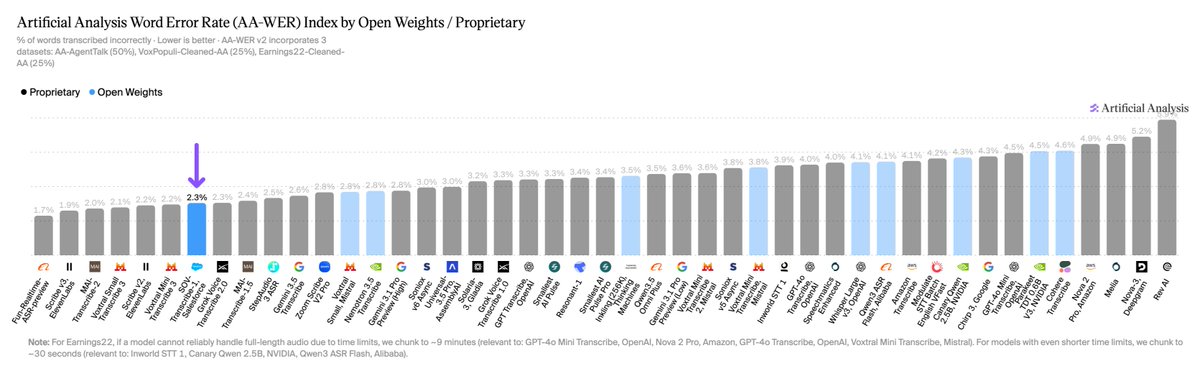
At 00:30 Singapore time on November 13, Artificial Analysis (@ArtificialAnlys) posted that Salesforce's newly released SOV-Transcribe-1 is now the #1 open-weights speech-to-text model: 2.3% word error rate on the AA-WER Index, ranking 7th of 44 models including proprietary ones. That is 0.5 points better than the next open-weights models, Mistral Voxtral Small and NVIDIA Nemotron 3.5 Transcribe (both 2.8%). Built by Salesforce's Missionforce Sovereign AI team, the model has 26.6B total and 4.6B active parameters, pairs a Whisper large-v3 audio encoder with a Gemma 4 26B A4B MoE decoder, and ships on Hugging Face under Apache 2.0. It is non-streaming, so it suits recorded audio rather than live captions.

Salesforce Open-Sources SOV-Transcribe-1 Speech Recognition Model: 2.3% on the Artificial Analysis Word Error Rate Index, #1 Among Open-Weight Models and #7 Overall; 26.6B Total and Only 4.6B Active Parameters, Apache 2.0 for Self-Hosting

Key Takeaways

  • AA-WER 2.3%: #1 among open-weights models and #7 of 44 overall; Voxtral Small and Nemotron 3.5 Transcribe both score 2.8%
  • By dataset: 4.1% on Earnings22 earnings calls (Voxtral Small 4.8%), 1.5% on VoxPopuli (rivals 1.8%), and 1.8% on AA-AgentTalk voice agent conversations, level with Nemotron
  • 26.6B total / 4.6B active parameters; Whisper large-v3 encoder + projector + Gemma 4 26B A4B MoE; BF16, tested on audio up to 30 minutes, 7 languages (EN, FR, DE, ES, IT, PT, NL)
  • Salesforce reports a 76.3% task success rate and 93.4% entity recovery on VoiceCodeBench (phone numbers, emails), #2 of 23 systems; 8.21% average WER across 14 English accents on AppTek, lowest on 8 of them including Singaporean English
  • Apache 2.0; deploy with a vLLM plugin (vLLM 0.32.0) or Transformers; Salesforce measured up to 1,039 seconds of audio transcribed per second on one RTX PRO 6000 Blackwell with the DFlash draft model
Read full story
Linked Models & Agents:
⚡ SOV-Transcribe-1⚡ Voxtral Small⚡ Nemotron 3.5 Transcribe⚡ Gemma 4⚡ Whisper large-v3🌐 Salesforce🌐 Artificial Analysis🌐 Mistral AI🌐 NVIDIA🌐 Google

ElevenLabs Launches Scribe v3 and Scribe v3 Live Speech-to-Text Models: 27% Fewer Word Errors Than v2 Across 102 Languages, First Realtime Speaker Diarization, and API Pricing of $0.20/$0.22 per Hour

On November 10 (02:10 on November 11 Singapore time) ElevenLabs released two speech-to-text models: Scribe v3 for recorded audio and Scribe v3 Live for realtime streams. By the vendor's numbers, Scribe v3 cuts word error rate (WER) by 27% versus Scribe v2 across 102 FLEURS languages, improving in every language, while Scribe v3 Live lowers semantic WER by 43% versus Scribe v2 Realtime and, for the first time, adds speaker diarization and context-aware turn detection to realtime transcription. Both models are live in ElevenAPI, where switching from v2 is a one-line model ID change; the API pricing page lists $0.20 per audio hour for v3 and $0.22 for v3 Live. Third-party evaluator Voice Arena tested v3 Live on 70+ hours of real phone calls and ranked it first in Romanian and Indian English.

ElevenLabs Launches Scribe v3 and Scribe v3 Live Speech-to-Text Models: 27% Fewer Word Errors Than v2 Across 102 Languages, First Realtime Speaker Diarization, and API Pricing of $0.20/$0.22 per Hour

Key Takeaways

  • Accuracy (vendor figures): Scribe v3 lowers WER by 27% versus v2 across 102 languages, with German -42%, Spanish -35%, English -23%, Thai -28%
  • Realtime: Scribe v3 Live cuts semantic WER by 43% and WER by 31% versus v2 Realtime, Greek improves 77%, and ElevenLabs cites about 150ms latency
  • Diarization: v3 makes 12% fewer errors than v2 and 17% fewer on recordings with 3+ speakers; v3 Live makes 39% fewer than the next-best realtime model, with a 3.1% English error rate
  • Pricing: $0.20 per audio hour for v3 and $0.22 for v3 Live on the API, plus $0.05/hour for keyterm prompting and $0.07/hour for transcript edits
  • Getting started: model IDs are scribe_v3 and scribe_v3_live; keyterm prompting takes up to 1,000 terms, and enterprise plans offer EU, India and Singapore data residency
Read full story
Linked Models & Agents:
⚡ Scribe v3⚡ Scribe v3 Live🤖 ElevenAgents🌐 ElevenLabs
ADSponsored

Cartesia launches Managed Agents voice agent platform: #1 of 30 on Speech Agent Arena, $0.03 per minute at launch

Voice model company Cartesia launched Managed Agents on Oct 29, an end-to-end voice agent platform for enterprise phone calls that tunes its own speech-to-text and text-to-speech models together with the agent harness, and bundles telephony, knowledge bases, tool calls and outbound batches. Cartesia says it ranks #1 on Artificial Analysis's Speech Agent Arena with a 1115 Elo and scores 87.4% accuracy and 90.7% experience on ServiceNow's EVA-Bench (vendor-reported, with GPT-5.5 as the reasoning model). Launch pricing is 50% off at $0.03 per minute.

Cartesia launches Managed Agents voice agent platform: #1 of 30 on Speech Agent Arena, $0.03 per minute at launch

Key Takeaways

  • On Artificial Analysis's Speech Agent Arena blind preference test, Managed Agents ranks #1 of 30 agents with a 1115 Elo, ahead of Gemini 3.1 Flash Live Minimal (1099), Grok Voice 3.0 (1064) and GPT-Live-1 (1041) (Cartesia blog, as cited by the vendor)
  • First-attempt results on ServiceNow EVA-Bench across 200+ customer service, IT service and HR scenarios: 87.4% accuracy and 90.7% experience, versus 73.7%/71.2% for Grok Voice 3.0 and 59.0%/61.6% for GPT Realtime 2.1 (EVA-Bench)
  • All these benchmark runs use GPT-5.5 as the reasoning model; Cartesia's internal evaluation says 85% of calls had no turn-taking issues, versus 67% for other agents
  • Launch pricing is 50% off at $0.03 per minute; Cartesia says the platform has already handled tens of millions of conversations in finance, retail, hospitality and healthcare
  • It supports 44 languages; English, Spanish, Hindi, French and Japanese can switch mid-call today, with the rest coming soon
Read full story

Mistral launches the Voxtral 3 speech model family and a voice agent SDK: transcription in 50+ languages, TTS at $13 per 1M characters, EU-hosted or self-deployed

On Oct 20 Mistral released Voxtral 3: the Voxtral Small/Mini Transcribe 3 speech-to-text models, Voxtral Mini Transcribe Realtime 3, the Voxtral Mini TTS 3 (Voxtral Speech 3) text-to-speech model, and a LiveKit-based voice agent SDK that streams listening, reasoning with tool calls, and speaking as one pipeline, with each turn completing in under a second per Mistral. Transcription covers 50+ languages with diarization and context biasing; TTS covers 35+ languages and 50+ dialects, plus Pro Voice cloning from 30 minutes of audio. It is live on the Mistral API (EU, US and global endpoints) and can be self-deployed.

Mistral launches the Voxtral 3 speech model family and a voice agent SDK: transcription in 50+ languages, TTS at $13 per 1M characters, EU-hosted or self-deployed

Key Takeaways

  • Multilingual transcription (vendor-reported): macro WER over 45 FLEURS languages is 4.1% (language forced) / 4.0% (inferred) for Voxtral Small Transcribe 3, tied with Microsoft AI Transcribe 2 and ahead of Scribe v2 (4.9%) and Whisper large-v3 (16.0%/14.9%)
  • Diarization (vendor-reported): cpWER of 18.4% for Small and 18.6% for Mini, vs 30.9% for the previous Voxtral Mini Transcribe 2 and 38.4% for Gemini 3.5 Transcribe
  • Pricing: Voxtral Mini Transcribe 3 is 4B parameters at $0.0035/min (docs list it as Public Preview with 32k context); Voxtral Speech 3 costs $13 per 1M characters
  • Realtime: Voxtral Mini Transcribe Realtime 3 runs below 500 ms latency; in Mistral's 35-language FLEURS chart the 480 ms setting scores 6.4% WER, still behind Gemini 3.5 Realtime Transcribe at 4.2%
  • The voice agent SDK is built on LiveKit with SIP telephony and WebRTC; each stage (LLM, voice, language) is swappable, and Pro Voice clones a voice from 30 minutes of audio
Read full story
Linked Models & Agents:
⚡ Voxtral Small Transcribe 3⚡ Voxtral Mini Transcribe 3⚡ Voxtral Mini Transcribe Realtime 3⚡ Voxtral Mini TTS 3🤖 Voxtral voice agent SDK🌐 Mistral AI🌐 LiveKit

Google introduces Gemini 3.8 Live and Live Extended Thinking

Google for Developers introduced Gemini 3.8 Live and Gemini 3.8 Live Extended Thinking. The audio models improve turn-taking and near real-time reasoning, replacing cascaded speech-to-text, reasoning, and text-to-speech stacks with one multimodal API call. They are available through the Gemini API in Google AI Studio.

Key Takeaways

  • Google for Developers introduced Gemini 3.8 Live and Gemini 3.8 Live Extended Thinking. The audio models improve turn-taking and near real-time reasoning, replacing cascaded speech-to-text, reasoning, and text-to-speech stacks with one multimodal API call. They are available through the Gemini API in Google AI Studio.
Read full story
Linked Models & Agents:

Google introduces Gemini 3.8 Live and Live Extended Thinking

Google for Developers introduced Gemini 3.8 Live and Gemini 3.8 Live Extended Thinking. These audio models improve turn-taking and near real-time reasoning, replacing cascaded speech-to-text, reasoning, and text-to-speech stacks with one multimodal API call to reduce latency and cost. They are available in the Gemini API via Google AI Studio and coming soon to the Gemini Enterprise Agent Platform.

Key Takeaways

  • Google for Developers introduced Gemini 3.8 Live and Gemini 3.8 Live Extended Thinking. These audio models improve turn-taking and near real-time reasoning, replacing cascaded speech-to-text, reasoning, and text-to-speech stacks with one multimodal API call to reduce latency and cost. They are available in the Gemini API via Google AI Studio and coming soon to the Gemini Enterprise Agent Platform.
Read full story
Linked Models & Agents:

xAI ships Grok Voice Transcribe 2.0: ~2× accuracy, $0.10/hr batch, AA streaming #1

SpaceXAI (xAI) launched Grok Voice Transcribe 2.0, claiming roughly 2× the accuracy of Transcribe 1.0 on customer-support calls, spoken credentials, and short voice commands at the same price. It ranks #1 for accuracy among 32 streaming transcription models on Artificial Analysis; short-phrase WER fell from about 20.6% to 6.8%. Features include streaming and batch modes, automatic language detection with mid-recording language switches, word-level timestamps and confidence, free speaker diarization, batch at about $0.10/hour and realtime streaming at about $0.20/hour, with existing Speech-to-Text API clients upgraded without code changes.

Key Takeaways

  • Claims ~2× accuracy vs Transcribe 1.0 on support calls, spoken credentials, and short commands at the same price.
  • #1 accuracy among 32 AA streaming transcription models; short-phrase WER ~20.6%→6.8%.
  • Batch ~$0.10/hr and streaming ~$0.20/hr, with diarization, language switching, word timestamps; existing API clients upgrade in place.
Read full story
Linked Models & Agents:
⚡ Grok Voice Transcribe 2🌐 xAI

Meta ships Muse Voice Transcribe: real-time multilingual ASR with 20+ speaker diarization

Meta Superintelligence Labs launched Muse Voice Transcribe on September 1, its first real-time audio perception model: streaming ASR, diarization for 20+ speakers, and endpointing, with native code-switching, 70+ training languages (25 validated at launch), and hour-plus sessions. Meta says it ranks first on Artificial Analysis streaming speech-to-text as of September 1. It already powers Meta AI for Mac (hold Fn to dictate anywhere) and Muse Code, and is on the Meta Model API at $3 per 1,000 audio-minutes (~$0.18/hour).

Key Takeaways

  • Streaming ASR, diarization, and endpointing ship as one model without a post-process chain
  • Already live for system-wide Mac dictation and Muse Code; developers use the Meta Model API
  • API pricing is about $0.18/hour; adaptive delay trades latency for harder words
Read full story
Linked Models & Agents:
⚡ Muse Voice Transcribe⚡ Muse Spark🤖 muse-code🌐 Meta AI
ADSponsored

Google DeepMind Launches Gemini 3.5 Transcribe for High-Precision Multilingual Speech-to-Text

Google DeepMind released Gemini 3.5 Transcribe, an intelligent speech-to-text model designed for clean and structured audio transcription across 85+ languages, now live in Antigravity and AI Studio.

Key Takeaways

  • Significantly improved entity recovery for phone numbers, postal codes, and code snippets in noisy audio;
  • Intelligent filler word removal, automated formatting, and custom dictionary support across 85+ languages;
  • Day-0 availability in macOS Gemini app, Android Gboard, and developer platforms including Antigravity.
Read full story
Linked Models & Agents:

Google DeepMind Launches Gemini 3.5 Transcribe: 4.0% Streaming WER, Screen-Aware Dictation in Antigravity

Google DeepMind launched Gemini 3.5 Transcribe, its most precise speech-to-text model for intelligent voice interactions. Artificial Analysis reports 4.0% streaming WER and 2.6% non-streaming WER, with 85+ languages and screen-aware dictation in Antigravity that grounds filenames, variables, and agent thoughts.

Key Takeaways

  • 4.0% streaming WER and 2.6% non-streaming WER; ~70% faster time-to-final-transcription vs Chirp 3, with 5.50% FLEURS streaming WER
  • Live API model gemini-3.5-transcribe-live for sub-second bidirectional streaming; Interactions API gemini-3.5-transcribe adds speaker attribution and word-level timestamps
  • Live in Google AI Studio, Antigravity with screen/chat grounding, Gemini on macOS, and Gboard Rambler; custom vocabulary plus auto-detect for 85+ languages
Read full story