AI Coding Live News

Google Project Suncatcher Gets First AI Response From a TPU in Orbit: Gemma 4 Downlinks a Haiku, Twin Satellites Planned for 2027

Google CEO Sundar Pichai and Google Research announced that the Project Suncatcher prototype satellite, launched on October 1, finished commissioning and ran a prompt on its onboard TPU with the open Gemma 4 model, downlinking a haiku as it passed over Svalbard, Norway. Google calls it the first AI response from a data-center-class TPU in orbit. Next come thermal-stress and radiation tests, then two interconnected satellites in 2027 to test AI computation distributed across satellites.

Google Project Suncatcher Gets First AI Response From a TPU in Orbit: Gemma 4 Downlinks a Haiku, Twin Satellites Planned for 2027

Key Takeaways

  • The satellite launched on October 1 on SpaceX's Transporter-18 rideshare, built with Planet, and ran its first in-orbit inference after about three weeks of commissioning (official account).
  • Per TechCrunch, it carries four TPUs and generates up to about 1 kW, so power limits it to one TPU at a time for roughly 20 minutes.
  • Sundar Pichai's announcement drew about 26K likes and 3.97M views; Google's official account said "Our TPUs just phoned home... from space."
  • Ground proton-beam tests in Google's paper found high-bandwidth memory irregularities only after a cumulative 2 krad(Si), about 3x the 750 rad(Si) minimum requirement (as cited by The Register).
  • Two interconnected satellites are planned for 2027 to test optical inter-satellite links and AI computation distributed across satellites.
Read full story

Meituan ships LongCat-2.5, a 1.6T-parameter (about 48B active) native multimodal agentic model, with API pricing of $0.30/$1.20 per 1M tokens

On Nov 2 Meituan's LongCat team listed LongCat-2.5 in its API platform change log as the full release of September 25's LongCat-2.5-Preview. The official technical blog says it has 1.6 trillion total parameters with about 48 billion activated per token, builds on LongCat-2.0 with stronger native visual understanding and agentic coding, and was trained and served with W4A4 inference on domestic AI accelerators. Vendor-reported scores include 88.4 on Terminal Bench v2.1, 38.5 on Terminal Bench v4.0, 91.9 on BrowseComp and 83.1 on MCP Atlas. The API speaks both OpenAI and Anthropic formats with a 1M-token context and up to 128K output tokens, at a limited-time price of $0.30 per 1M uncached input tokens, $0.006 cached input and $1.20 output.

Meituan ships LongCat-2.5, a 1.6T-parameter (about 48B active) native multimodal agentic model, with API pricing of $0.30/$1.20 per 1M tokens

Key Takeaways

  • Scale: a 1.6-trillion-parameter MoE with about 48B active per token, a 1M-token context and up to 128K output tokens (official blog, API docs)
  • Code agents (vendor-reported): Terminal Bench v2.1 88.4 (Claude Opus 5 89.1, GPT-5.6-Sol 88.8), Terminal Bench v4.0 38.5 (GPT-5.6-Sol 37.3, Claude Opus 5 53.9), DeepSWE v1.1 64.6
  • General agents (vendor-reported): BrowseComp 91.9, MCP Atlas 83.1, AutomationBench v1.0.6 51.8, HLE with tools 63.1; AutomationBench jumps from 15.8 on LongCat-2.0
  • Pricing: limited-time $0.30 per 1M uncached input tokens, $0.006 cached input and $1.20 output (pricing page)
  • Engineering: W4A4 inference raises prefill throughput 43.3% and decode throughput 42.77% over a W8A8 baseline; FSDP gives 86% higher per-device throughput than DDP in long-sequence SFT
Read full story
x
xAIdocs.x.ai·
👀35
🔥82

xAI will add an invisible watermark to Grok API text by default from Nov 7, covering grok-4.7 and six other models, with per-model admin opt-out

On Oct 31, xAI (signed as SpaceXSI in its docs) added an "Output Watermarking" page to its API docs: starting November 7, 2026, text generated by grok-4.7, grok-4.6, grok-4.5, grok-4.3, and the reasoning, non-reasoning, and multi-agent versions of grok-4.20 will carry an invisible watermark by default, to comply with the EU AI Act. It covers ordinary text, structured outputs, and tool call arguments on both the Responses and Chat Completions APIs, and works by slightly shaping token choice without adding any characters. Developers can read the x-watermark response header to check; team admins can opt out per model in the Console, but must confirm a legal exception applies, and some models may be locked on.

Key Takeaways

  • Timing: on by default from November 7, 2026, with no code change and no request parameter (xAI docs)
  • Scope: 7 model IDs (grok-4.7, 4.6, 4.5, 4.3, and grok-4.20 reasoning, non-reasoning, and multi-agent) on the global and regional endpoints, across both Responses and Chat Completions
  • Coverage: ordinary text, structured outputs, and tool call arguments; the response header x-watermark: true marks a watermarked output
  • Opt-out: team admins switch it off per model, effective for new requests within 5 minutes and logged in the audit log; admins must confirm a legal exception applies, and some models are locked on
  • xAI's position: no effect on quality or speed; detection is statistical with three outcomes (watermarked, not watermarked, uncertain), and the detection API is by application
Read full story

X discussion: Anthropic's head of platform engineering says a team with no Rust developers had Claude port the whole Messages API to Rust, cutting CPU by roughly 40-50%

Katelyn Lesse, Anthropic's head of platform engineering, said on the Latent Space podcast (published Oct 27) that a Rust version of the Messages API fully rolled out the previous week. The old system was a CPU-hungry Python monolith, the team started with "not a single Rust developer", humans designed and verified the system, Claude wrote the implementation, and shadow traffic compared outputs between the old and new versions. Her ballpark figures are roughly 40-50% less CPU and 10-20% better time to first token. A clip posted by Somi (@somi_ai) drew 1,000+ likes and about 140K views on X and was quoted by swyx and others, with the debate centered on whether "never do the big rewrite" is now outdated advice. These are X discussion views and spoken estimates; Anthropic has not published a written engineering report.

X discussion: Anthropic's head of platform engineering says a team with no Rust developers had Claude port the whole Messages API to Rust, cutting CPU by roughly 40-50%

Key Takeaways

  • The first-hand source is Katelyn Lesse speaking on the Latent Space episode "How Anthropic ships Claude with Claude", in the "56:05 Rebuilding the Messages API in Rust" segment
  • Lesse said the move was driven by CPU becoming a bottleneck as usage surged; CPU now has to be capacity-planned in advance, and research sandboxes, product sandboxes and CI all draw from the same pool inside Anthropic
  • The team forked the entire API in Rust in one go, ran shadow traffic to confirm the Python and Rust outputs matched, then turned it on gradually, deliberately adding no new features during the port
  • Her ballpark is about 40-50% CPU savings and 10-20% better time to first token, with larger gains on longer-running workloads; these are spoken estimates from the podcast, not a formal benchmark
  • On X, Somi called "never do the big rewrite" dead advice and swyx said Anthropic "vibecoded their entire backend to Rust"; the latter is an exaggeration, since Lesse only discussed the Messages API
Read full story
Linked Models & Agents:
ADSponsored

OpenAI rolls out GPT-6 Rosalind Research, a GPT-6 generation life sciences model for approved research orgs in Work, Codex and the API at $15/$75 per million tokens

In its October 30 ChatGPT Business release notes, OpenAI said GPT-6 Rosalind Research is rolling out to a limited set of customers with Research approval. It shows up in the model picker in ChatGPT Work and Codex, not in the Chat tab, and separately approved organizations can call it through the API as gpt-6-rosalind. OpenAI's token-based Enterprise rate card lists it at $15 per million input tokens, $1.50 cached input and $75 output, three times the price of GPT-5.5 Rosalind Research.

Key Takeaways

  • Approved orgs only: both the organization and the user need Rosalind Research approval, and Discovery approval does not include it
  • Where to use it: the model picker in ChatGPT Work and Codex, not the Chat tab; in Codex it pairs with the Life Sciences Research plugin
  • API model name gpt-6-rosalind needs separate approval and is limited to internal research tools, not customer-facing products
  • Priced at $15 input, $1.50 cached input and $75 output per million tokens, versus $5/$0.50/$25 for GPT-5.5 Rosalind Research
  • Enterprise workspaces start with a two-week Admin Preview that is off by default until an admin enables it for approved users
Read full story
Linked Models & Agents:
⚡ GPT-6 Rosalind Research⚡ GPT-5.5 Rosalind Research⚡ GPT-6 Astra🤖 Codex🤖 ChatGPT Work🌐 OpenAI

Google Project Suncatcher runs its first in-orbit TPU inference, with Gemma 4 writing a haiku

On Oct 30 Google CEO Sundar Pichai announced a "hello world" milestone for Project Suncatcher on X: the team sent a command to the prototype satellite in orbit, booted the TPU, ran a prompt and received the first complete response back on Earth, a haiku. TechCrunch reports the reply came from Gemma 4 preloaded on the satellite.

Google Project Suncatcher runs its first in-orbit TPU inference, with Gemma 4 writing a haiku

Key Takeaways

  • The prototype launched Oct 1 on SpaceX Transporter-18 and ran its first in-orbit inference after about three weeks of commissioning (commissioning time per TechCrunch)
  • Per TechCrunch the onboard model is Google DeepMind's Gemma 4, and the first prompt asked for a haiku about being in space
  • TechCrunch says the satellite generates up to about 1 kW and the TPU can run only about 20 minutes at a time; TPU count differs by source (Google's earlier X post said four, TechCrunch says one)
  • Next step is two more satellites in 2027 to test higher power and inter-satellite optical links; Google has published no throughput or benchmark numbers
Read full story
A
Anthropic@AICoder·
👀82
🔥80

Claude Code 2.1.314 adds a block on writes outside working directories, IdP group routing for the apps gateway, and idle compaction in VS Code and Desktop

Anthropic published Claude Code v2.1.314 on GitHub at 01:06 UTC on Oct 30. The official CHANGELOG lists 119 entries, more than half of them fixes. The new features lean enterprise: permissions.blockWritesOutsideWorkingDirectories makes Write, Edit and NotebookEdit refuse paths outside the working directories in every permission mode; Claude apps gateway upstreams can be limited to IdP groups, and Bedrock upstreams can log which guardrail fired; idle compaction now also runs in VS Code and the Code tab of Claude Desktop. It also fixes sessions failing repeatedly when an admin caps effort, and claude -p exiting 0 with no output when startup failed.

Key Takeaways

  • Size: the official v2.1.314 CHANGELOG has 119 entries, more than half of them fixes; released at 01:06 UTC on Oct 30
  • Safety: the new permissions.blockWritesOutsideWorkingDirectories setting stops Write, Edit and NotebookEdit from writing outside the working directories in every permission mode
  • Enterprise gateway: upstreams take an optional groups list so only developers in those IdP groups are routed there, failover included; Bedrock upstreams gain guardrail_trace
  • Experience: idle compaction now runs in VS Code and the Claude Desktop Code tab, summarizing idle conversations above 200K tokens
  • Fixes: when an admin caps effort, Claude Code lowers it and retries; a failed claude -p startup now prints the error and exits 1
Read full story
Linked Models & Agents:

OpenAI Daybreak Red (GPT-5.6 Cyber) arrives on Amazon Bedrock in AWS GovCloud (US-East) for vetted defenders, at $16.875 input and $101.25 output per 1M tokens

On Oct 30, AWS announced that Daybreak Red (GPT-5.6 Cyber, model ID openai.gpt-5.6-cyber), the OpenAI security model built for vulnerability research, is now on Amazon Bedrock in AWS GovCloud (US-East), after previously being offered only in US East (Ohio). Access still requires passing OpenAI Daybreak eligibility. GovCloud short-context pricing is $16.875 input and $101.25 output per 1M tokens, about 23% above Ohio at $13.75 and $82.50.

Key Takeaways

  • Regions: Daybreak Red can now be called In-Region in us-east-2 (Ohio) and us-gov-east-1 (GovCloud US-East); Geo and Global cross-Region inference are not supported (AWS announcement)
  • Eligibility: customers must first enroll in OpenAI Daybreak / Trusted Access for Cyber, then have their AWS account team enable access
  • Pricing: GovCloud short context (272K input tokens or fewer) is $16.875 input, $21.09375 for 30-minute cache writes, $1.6875 cache reads and $101.25 output per 1M tokens
  • Data: AWS says inference data is not used for training and Daybreak Red data does not need to be shared with OpenAI; it runs on an inference engine with zero-operator access enforced at the chip
  • API: served through the bedrock-mantle endpoint with OpenAI Responses and Chat Completions, and a 1,050,000-token context window
Read full story

Anthropic details Claude self-assessment for misuse detection: 78% recall at 1% false positives for under 2% extra compute

On Oct 29 Anthropic introduced self-assessment on X: after each response, Claude produces a structured preliminary safety assessment of the whole conversation for offline review. Anthropic's Safeguards blog says that on Claude Fable 5, at a 1% false-positive rate, it flags 78% of the conversations a stronger prompted classifier flags and 94% of high-priority ones. Because the conversation is already in the KV cache, it adds about 10 output tokens on average and an estimated under 2% of inference compute. It has run in production since June, but Anthropic says it is not robust against an attacker who targets it directly and is only one layer of defense in depth.

Anthropic details Claude self-assessment for misuse detection: 78% recall at 1% false positives for under 2% extra compute

Key Takeaways

  • On Claude Fable 5, at a 1% false-positive rate it recalls 78% of what the prompted classifier flags and 94% of high-priority (7+) conversations (vendor figures, Safeguards blog)
  • It reuses the KV cache, adding about 10 output tokens per assessment on average; Anthropic estimates under 2% extra inference compute and does not bill customers for it
  • Across four model sizes, recall at 1% false positives rises from about 16% to about 96% and AUC from 0.862 to 0.995
  • As a real-time blocker it is weak: attack success on 24 cyber tasks only drops from 79% to 54%, versus 25% with a prompted classifier
  • In August it raised over 100k child sexual abuse flags from a single API customer, reported to NCMEC; about a third of flags fall outside the existing taxonomy
Read full story
Linked Models & Agents:

Suhail launches Particle and its first model, Particle-1: a DeepSeek V4.1 Flash post-train that uses about 45% fewer tokens on coding tasks

On Oct 28, Mixpanel founder Suhail Doshi announced his new company Particle on X, with its first model, Particle-1, live now. Particle's blog says it is a reinforcement-learning post-train of DeepSeek V4.1 Flash that uses 28.4% to 52.2% fewer output tokens and costs 34.4% to 51.6% less per task across four coding and data engineering benchmarks, with pass rates inside the base model's confidence intervals. It is available through the Particle API, OpenRouter and Vercel AI Gateway; Particle's docs list $0.25 input and $1.00 output per million tokens with a 1,048,576-token context window.

Suhail launches Particle and its first model, Particle-1: a DeepSeek V4.1 Flash post-train that uses about 45% fewer tokens on coding tasks

Key Takeaways

  • Across four benchmarks (Terminal-Bench 2.1, ReactBench, ADE Bench, DeepSWE 1.1), 28.4% to 52.2% fewer output tokens and 34.4% to 51.6% lower cost per task (vendor-reported)
  • Particle's summary table: $0.2211 per task versus $0.3368 for DeepSeek V4.1 Flash and $0.6523 for GLM 5.3 Flash; 59,580 mean output tokens versus 83,246 and 98,155
  • Task pass rate 72.57% versus 71.15% for the base model and 66.82% for GLM 5.3 Flash; GPQA Diamond 90.40% (base 90.91%), MMLU 86.08% (base 85.98%)
  • Training: a rank-64 LoRA on the experts in all layers, about 1.25% of the model's parameters, trained with sequence-level GSPO in two RL stages
  • Pricing: Particle docs currently list $0.25 input, $0.03 cached input and $1.00 output per million tokens, a 1,048,576-token context and a 131,072-token output ceiling
Read full story
ADSponsored

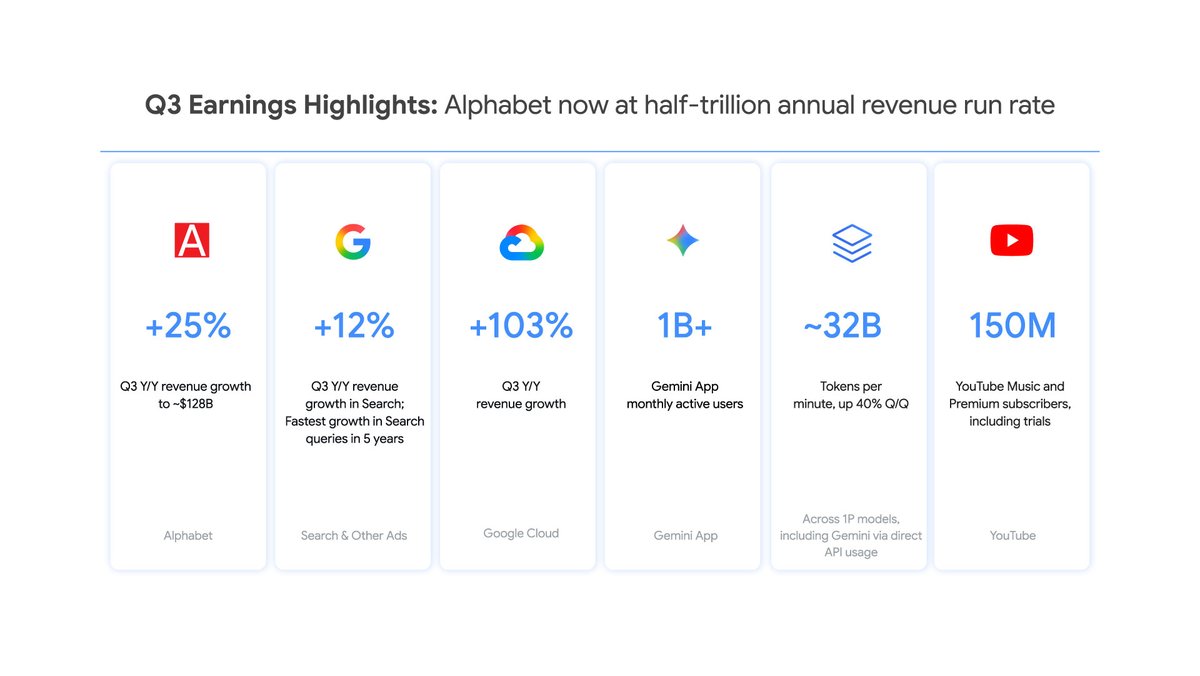
Alphabet Q3 2026: revenue up 25% to $127.6B, Google Cloud up 103%, first-party model APIs near 32B tokens per minute

After the US market close on Oct 28, Alphabet reported Q3 2026 results: revenue rose 25% to $127.6B, and Google Cloud revenue more than doubled, up 103% to $30.7B, which the company attributes to enterprise AI infrastructure, AI solutions and TPU system sales. In the release and on X, Sundar Pichai said first-party model APIs now process nearly 32B tokens per minute, more than four times a year ago, and that the Gemini app has reached one billion users. The cost: Q3 capital expenditures of $51.4B and free cash flow of negative $9.1B.

Alphabet Q3 2026: revenue up 25% to $127.6B, Google Cloud up 103%, first-party model APIs near 32B tokens per minute

Key Takeaways

  • Revenue of $127.58B, up 25% year over year and the 13th straight quarter of double-digit growth; Pichai says Alphabet is on a $500B annual revenue run rate
  • Google Cloud revenue of $30.71B versus $15.16B a year ago, up 103%; Cloud operating income of $11.12B versus $3.59B
  • First-party model APIs process nearly 32B tokens per minute, more than 4x a year ago; Pichai's X post puts quarter-over-quarter growth at 40%
  • The Gemini app reached one billion users, which Google calls the fastest-growing product in its history; Search query growth is the highest in five years
  • Q3 capex of $51.36B versus $23.95B a year ago, and free cash flow of negative $9.07B, the second negative quarter in a row
Read full story

Google releases Gemini 4 Carbon two weeks after Argon: 59 and first place on the Artificial Analysis Intelligence Index v5, state-of-the-art cybersecurity and long-horizon coding, with early access for cyber defenders in the Fairwind program

Google DeepMind announced Gemini 4 Carbon on Oct 28, calling it its strongest model, just two weeks after Gemini 4 Argon. The official blog says it ranks first on v5.0 of the Artificial Analysis Intelligence Index at 59 and leads three cybersecurity evaluations: 88.2% on SEC-bench Pro for finding vulnerabilities, 54.8% on ExploitGym for exploitation and 71.0% on CWE-bench for patching; it also gains 89 points to rank fourth on WebDev Arena at 1769. Access starts this week for a subset of cyber defenders in the Fairwind program, with developers, businesses and consumers to follow. Introductory pricing matches Argon at $2 per million input tokens and $10 per million output tokens, rising to $4 and $20 afterwards.

Google releases Gemini 4 Carbon two weeks after Argon: 59 and first place on the Artificial Analysis Intelligence Index v5, state-of-the-art cybersecurity and long-horizon coding, with early access for cyber defenders in the Fairwind program

Key Takeaways

  • Positioning: Google calls it its strongest model, aimed at cybersecurity and long-horizon agentic work; internal teams saw it run for days to root-cause and patch subtle bugs across large codebases and low-level systems
  • Official scores (evaluated without guardrails): 88.2% on SEC-bench Pro, 54.8% on ExploitGym and 71.0% on Collinear's CWE-bench; 59 and first place on the Artificial Analysis Intelligence Index v5.0; +89 to fourth place on WebDev Arena at 1769
  • Safety and alignment: successful cheating on Terminal-Bench 4.0 fell to 0.0% with a 0.4% attempt rate, high-severity misalignment alerts in internal live coding dropped by almost 80%, unsupported claims are about half of Argon's, and the Gray Swan indirect prompt injection attack success rate fell from Argon's 0.7% to 0.0%
  • Internal examples: more than 2x Argon's success rate at generating secure code, and the Chrome team reports more than 10x better high-quality patches than another lab's large frontier model
  • Rollout: a subset of cyber defenders in the Fairwind program first, alongside the U.S. government's voluntary pre-release testing; no developer API yet; introductory pricing of $2 / $10 per million tokens with cached input 95% off, then $4 / $20
Read full story

Mistral launches its Responses API in public preview: OpenAI Responses-compatible, returning the answer, reasoning and tool calls as separate items for building agents

Mistral AI announced on X on Oct 28 that its Responses API is in public preview, positioned as the interface for building agents on Mistral. The official docs say it uses the OpenAI Responses format, and each response's output array carries the models messages, its reasoning and its function calls as separate items, which is easier to handle step by step than Chat Completions. The preview is stateless, so the app keeps the conversation history and sends it back; it supports text, image and file input, JSON Schema structured output, streaming events, client-executed function calls, reasoning.effort, and token counting via POST /v1/responses/input_tokens. It is served in the EU and US on Mistral AI Cloud Inference. The same thread says Mistral now also serves DeepSeek V4.1 Flash (public preview) and GLM 5.3 Flash (generally available).

Key Takeaways

  • The Responses API is in public preview and uses the OpenAI Responses format, so existing Responses integrations can move to Mistral more easily
  • Each response splits the answer, reasoning and function calls into separate output items, which suits step-by-step agent loops
  • The preview is stateless: the app keeps the history and sends earlier output items back along with function_call_output results
  • It supports image and file input, JSON Schema structured output, streaming, function calling (including namespaces), reasoning.effort and token counting via /v1/responses/input_tokens
  • It is served in the EU and US on Mistral AI Cloud Inference; Mistral also added DeepSeek V4.1 Flash (preview) and GLM 5.3 Flash (GA)
Read full story

OpenBMB open-sources the MiniCPM-OCR suite: a 1.3B parser scoring 93.68 on Real5-OmniDocBench, plus a 2B judge model that flags OCR errors

On Oct 27 OpenBMB (ModelBest) open-sourced the MiniCPM-OCR suite with two models: MiniCPM-OCR 1.0, a 1.3B-parameter document parser that scores 93.68 on Real5-OmniDocBench and 54.7 on OCRBench v2 (vendor-reported), and MiniCPM-OCR Jev, a 2B OCR quality judge that scores any parser's output region by region from 0 to 1 and flags content that needs human review. Code and weights are Apache 2.0, with day-one support for vLLM, SGLang, llama.cpp, Ollama and multiple chip platforms.

OpenBMB open-sources the MiniCPM-OCR suite: a 1.3B parser scoring 93.68 on Real5-OmniDocBench, plus a 2B judge model that flags OCR errors

Key Takeaways

  • MiniCPM-OCR 1.0 has just 1.3B parameters and scores 93.68 on Real5-OmniDocBench and 54.7 on OCRBench v2 (vendor-reported, both claimed SOTA)
  • The 2B MiniCPM-OCR Jev judge reaches 93.6 AUROC on JevOCRBench, above JEV-35B-A3B at 90.1 and close to Qwen3.5-397B-A17B at 93.8 (vendor-reported)
  • Jev is parser-agnostic: AUROC stays between 91.9 and 93.4 on outputs from MiniCPM-OCR, GLM-OCR, PaddleOCR-VL-1.6 and Xiaomi-OCR-0
  • Throughput is about 1.49x PaddleOCR-VL-1.6 and 3.62x MinerU2.5 Pro, reaching up to about 128 pages per minute with SDK concurrency (vendor-reported)
  • Code and weights on GitHub are all Apache 2.0, with GGUF/AWQ/GPTQ quantized builds and a SKILL.md for coding agents
Read full story
Linked Models & Agents:
⚡ MiniCPM-OCR 1.0⚡ MiniCPM-OCR Jev⚡ PaddleOCR-VL-1.6⚡ MinerU2.5 Pro⚡ Qwen3.5-397B-A17B🌐 OpenBMB🌐 ModelBest🌐 Intel🌐 NVIDIA🌐 Arm

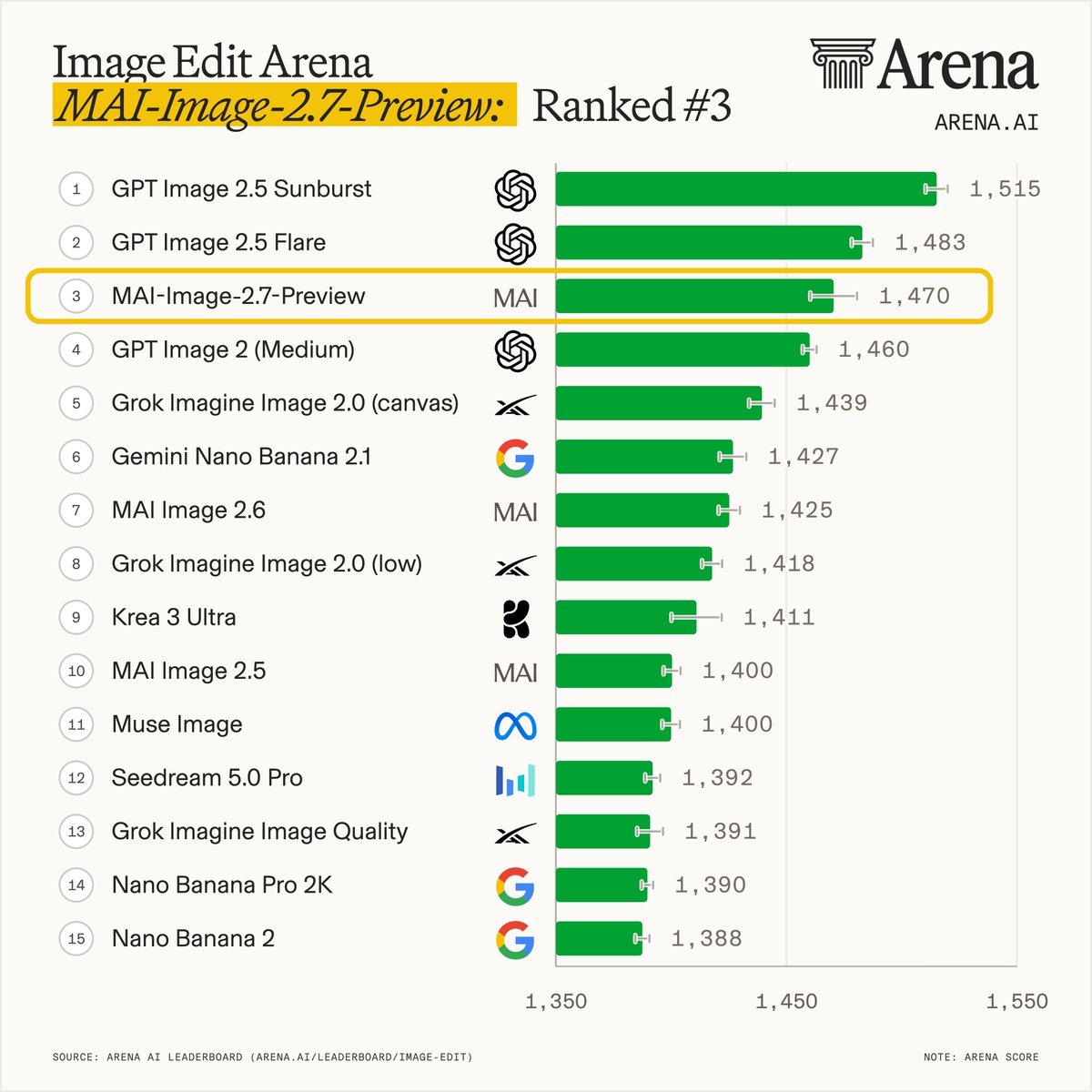
Microsoft makes MAI-Image-2.6 and MAI-Image-2.6-Flash generally available in Foundry as MAI-Image-2.7-Preview reaches #3 in Image Edit Arena

Microsoft AI announced on Oct 27 that MAI-Image-2.6 and MAI-Image-2.6-Flash are generally available in Microsoft Foundry, with multi-reference editing from up to five images, Bing web grounding, output up to 1.5K and published per-token pricing. The same day its next image editing model, MAI-Image-2.7-Preview, reached #3 overall in Arena's Image Edit leaderboard at 1470 points, 45 points above 2.6; for now it is available only for editing in MAI Playground.

Microsoft makes MAI-Image-2.6 and MAI-Image-2.6-Flash generally available in Foundry as MAI-Image-2.7-Preview reaches #3 in Image Edit Arena

Key Takeaways

  • MAI-Image-2.6 and MAI-Image-2.6-Flash are generally available in Microsoft Foundry, and Microsoft says 2.6 is coming soon to Adobe Firefly
  • Official pricing: 2.6 costs $5 text input, $8 image input and $38 image output per 1M tokens; Flash costs $1.75, $2.50 and $19
  • 2.6 supports multi-reference editing with up to five images, Bing web grounding, dynamic aspect ratios and output up to 1.5K
  • Per Arena, MAI-Image-2.7-Preview is #3 overall in Image Edit Arena at 1470 points, 45 points above 2.6 (#7), putting Microsoft AI #2 among labs
  • Per Artificial Analysis, 2.7-Preview is #2 on AA-Image-Editing v2.1 and beats 2.6 on all 7 editing actions, ranking #1 on 4 of them
Read full story
Linked Models & Agents:
⚡ MAI-Image-2.6⚡ MAI-Image-2.6-Flash⚡ MAI-Image-2.7-Preview🌐 Microsoft🌐 Microsoft AI