Robbyant, the embodied AI company under Ant Group, open-sourced LingBot-Touch on November 9 under Apache 2.0. It uses JEPA-style latent prediction and a shared Haptic Transformer to turn piezoresistive, magnetic, and visuotactile sensor signals into one set of tactile tokens. Per the official technical report, adding the frozen 5.46M-parameter Tiny encoder raised average success of Diffusion Policy, pi0.5, LingBot-VLA, and T-Rex by 13.9 to 24.8 points across 26 real dual-arm dexterous-hand tasks, while feeding raw tactile signals gave at most about half that gain. Tiny and Small weights are on Hugging Face.
Zoom
Key Takeaways
Pretraining corpus: 4,983 hours, 464K episodes, about 1.33B frames from tactile gloves and teleoperated robot hands, covering piezoresistive, magnetic, and visuotactile sensing
Vendor figures on 26 real-robot tasks: LingBot-VLA 48.3% to 73.1%, pi0.5 48.1% to 69.9%, T-Rex 45.4% to 68.6%, Diffusion Policy 21.6% to 35.6%
The Tiny encoder has only 5.46M parameters, adding under 0.2% to the policies it augments; Small has 21.76M, both are 12-layer Transformers
In 12 simulated dexterous RL tasks, success reaches 69% vs 46% with task-specific CNN features and 21% without touch
Caveat: it transfers to sensor models unseen in pretraining, but a new taxel layout still needs geometry calibration first
NVIDIA Robotics announced GR00T 2 at CoRL 2026, and NVIDIA GEAR lab lead Yuke Zhu posted the technical details. GR00T 2 is a new generation of world action model (WAM) built on Cosmos: one diffusion transformer denoises future video and an action chunk together, and one model drives parallel grippers, dexterous hands and humanoids. Pretraining mixes 402,730 hours of egocentric human video, 10,184 hours of handheld UMI gripper demos and 23,500 hours of robot teleoperation. By NVIDIA's numbers, it reaches 40% zero-shot success on 50 tasks the target robot never practiced, rising to 95% with five demos per task (under 3 minutes of robot data) and a 30-minute LoRA fine-tune on one RTX 5090. Reasoning models can call GR00T 2 as a tool through the WAM API. Code arrives in December; 100,000 hours of the human video data are already on Hugging Face.
Zoom
Key Takeaways
Architecture: one diffusion transformer predicts future video and action chunks together; small per-robot heads let one model cover grippers, dexterous hands and humanoids
Data: 402,730 h of egocentric human video + 10,184 h of UMI demos (2,897 tasks) + 23,500 h of teleoperation; going from 0% to 100% of the human video lifts real-robot task progress from 50% to 70% (NVIDIA figures)
Adaptation: 40% zero-shot on 50 unseen tasks, 71% with 1 demo, 95% with 5 demos, about a 30-minute LoRA fine-tune on one RTX 5090
Agents: a reasoning model calling GR00T 2 via the WAM API completes 97+ of 100 back-to-back assemblies for each of three toys; marking grasp points on the camera view lifts instruction following from 40% to 92%
GR00T 2 Turbo is a 2B-parameter variant running at 124 ms per prediction on the Unitree G1's Jetson Thor; code ships in December, and 100k hours of human video are already on Hugging Face
On November 5 Meta AI (@AIatMeta) said Muse Realtime Avatar, previewed at Connect, is rolling out in the US Muse app, turning Muse Realtime Voice into interactive live avatars. The research blog describes an audio-driven Diffusion Transformer that shares the speech-token stream with voice for lip-sync and expression; a single GB200 session streams 448×768 at 25 fps with about 870 ms from end of user turn to first synchronized audio-video byte, with Meta Video Seal invisible watermarking. Muse is for users 18+; no global schedule or developer API was announced.
Zoom
Key Takeaways
US Muse app rollout of Realtime Avatar after the Connect preview (@AIatMeta)
Shared speech VQ tokens drive audio decode and avatar video; causal chunks with self-forcing distillation cut ~120 teacher NFEs to 2 student NFEs (~60x)
Vendor perf: 448×768@25fps, ~870ms first-byte latency; ~8x serving capacity vs BF16 baseline, up to 12 concurrent sessions on one GB200
Vendor preference study favored Muse over Runway Characters and HeyGen LiveAvatar on overall and most axes
Safety: Video Seal invisible watermark; blog demos are not the full in-app avatar set; no public developer API stated
Ricursive Intelligence released its first model, Ripple-65B Preview, on November 4 (18:24 UTC), open-sourcing the instruction-tuned model (BF16 and NVFP4) and a base model on Hugging Face under Apache 2.0. The official model card describes a 65B dense Transformer pretrained on 12T tokens with up to 1M context, and self-reports TerminalBench 2.1 80.5, SWE-bench Pro v2.0 Hard 79.1 and DeepSWE 1.1 44.3, ahead of much larger US open-weight models on agentic coding. It fits on local hardware such as the DGX Spark. CEO Anna Goldie says it cost about a tenth of the prior comparable state of the art.
Zoom
Key Takeaways
Ripple-65B Preview is a 65B dense model with a thin-and-deep shape (80 layers, d_model 5120), moving from an Olmo 3 baseline to a Gemma 3N-like architecture.
It was pretrained on 12T tokens at 8K sequence length, then went through mid-training, long-context training, SFT and mixed-domain RL, with up to 1M context.
Self-reported TerminalBench 2.1 is 80.5, above Reflection Beam 501B (80.1) and Muse Spark Open 816B (76.4), but SWE-bench Verified 76.5 and DeepSWE 1.1 44.3 show it does not lead everywhere.
Ricursive says the core team grew from one to five people and code compute efficiency improved 16x versus the Olmo 3 ladder; it reaches about 250 tok/s on 2x B200.
Hugging Face hosts BF16, NVFP4, base and DFlash2 speculative-decoding checkpoints, all under Apache 2.0.
DeepSeek Harness, DeepSeek's open-source, MIT-licensed agent app, announced Creator Mode on its official X account on November 2: users describe the plugin they want in plain language, and the agent turns it into a plugin they can use. Demos include a 3D landmark gallery, a 3D Transformer visualizer, a video editing workbench and a paper reader. DeepSeek also published seven bilingual demo prompts on cdn.deepseek.com, cautioning that some plugins took several rounds of conversation, so a single prompt may not reproduce the video exactly. The post drew about 20,000 likes and 1.69 million views. No benchmarks were published.
Zoom
Key Takeaways
Creator Mode: describe the plugin you want in natural language and the agent turns it into a usable plugin, from a design workspace to a sandbox game or a 3D LLM visualizer.
DeepSeek published 7 demo prompts: a 3D landmark gallery, a 3D Transformer demo, a five-style app theme switcher, a poster workbench, a video editor, a paper reader and a token-usage statistics plugin.
The entry point shipped in v0.2.1-rc.5 (Oct 30 pre-release): plugin management gained a "Let Agent create a plugin" button that opens Creator mode and keeps the draft.
The GitHub repo has about 270,000 stars under the MIT license; Harness is still in preview.
No benchmarks or success rates were published; the announcement drew about 20,000 likes and 1.69 million views.
On Oct 30, SenseTime released SenseNova-Loop-9B-Preview (Apache 2.0) on its official X account and Hugging Face. It runs layers 4 to 27 of a 32-layer decoder twice with the same weights, so each forward pass executes 56 layer computations while storing about 9B parameters, about 14.6B at inference, and it uses two-stream mHC (manifold-constrained hyper-connections) to manage the residual streams. It takes text and images, with training sequences up to 262,144 tokens. SenseTime charts show it beating Qwen3.5 and Qwen3.6 peers on BIRD-Dev, WorkBuddy Bench, and other agent and data tasks, while it still trails on Terminal Bench 2.1; the technical report is not out yet. The official launch post drew about 910 likes.
Zoom
Key Takeaways
Structure: 32 distinct decoder layers, with layers 4 to 27 looped twice on shared weights for 56 layer computations per forward pass; about 9B stored and about 14.6B inference parameters (model card)
Weak spots from the same vendor chart: Terminal Bench 2.1 at 40.45, below Qwen3.6-27B at 47.19; tau3-Banking at 18.56, slightly below Qwen3.5-27B at 19.59
Training context up to 262,144 tokens; hybrid attention uses three linear-attention layers plus one full-attention layer per four-layer group; MTP speedup is available, DSpark and DFlash2 are still training
Apache 2.0, requires trust_remote_code=True; official examples cover Transformers 5.18.0, a 4-GPU LightLLM setup, and an SGLang PR, and the technical report is still to come
On Oct 20, the FastVideo team at UCSD's Hao AI Lab open-sourced FastH3 Omni, a distilled version of MiniMax H3's reference-to-video-and-audio (Ref2VA) model that generates video with synchronized stereo audio from text plus up to nine images, video clips and voice references. Sampling drops from 50 steps to eight transformer evaluations, cutting end-to-end latency 5.6-11.9x on eight GB200s by the team's measurements. Training code is open, with NVFP4 weights for DGX Spark and RTX 5090 and ComfyUI support.
Zoom
Key Takeaways
Steps: eight transformer evaluations versus 50 for base MiniMax H3, via PDD plus DMD distillation
Speed (team figures): 5.6-11.9x lower end-to-end latency across 27 matched workloads on 8x GB200; a 15-second single-image request drops from 139.69s to 14.14s
Inputs: up to nine images, three videos and three audio clips, at most 12 references; output is 24 FPS video with 32 kHz stereo audio
Local: NVFP4 QAD weights for DGX Spark (128 GB) and RTX 5090 (32 GB), 480p by default; FP8 weights for RTX 4090
License: MiniMax-H3 Community License, not Apache or MIT
At PyTorch Conference 2026 on Oct 20, Google open-sourced TorchTPU on GitHub, co-developed with Meta's PyTorch team, making TPUs a native PyTorch device alongside GPUs and CPUs: eager mode and torch.compile, about 450 ATen ops, and torch.distributed collectives. Google also released vLLM-TorchTPU and SGLang-TorchTPU engines, integrations with TorchTitan, Ray, VeRL and Hugging Face Transformers v5 (device_map="tpu"), and a preview TPU agent suite for coding assistants such as Claude Code and Antigravity. AWS shipped the comparable TorchNeuron a day earlier.
Zoom
Key Takeaways
Porting (official PyTorch blog): existing code runs by changing model.to("cuda") to model.to("tpu") and the distributed backend to tpu_dist; the team notes peak TPU performance still needs TPU-aware shapes and sharding
Coverage (vendor-reported): 98% of about 4,917 popular Hugging Face models (4,821) run without crashing, and 97% of 657 architecture representatives (638) match GPU numerics
Training scale (vendor-reported): Qwen3 MoE 235B on TorchTitan scales from 1,024 to 8,192 TPU v7 chips with MFU roughly flat at 27-29%; on 64 TPU v7 chips it reaches 1,828 TPS versus 1,937 TPS for JAX/MaxText
Inference cost (Google citing SemiAnalysis InferenceX): TPU v7 with vLLM-TorchTPU hits 2.01 cents per million tokens on 8K/1K, down from 3.6 cents at its September debut
Four repos open-sourced: torch_tpu, vllm-torchtpu, sglang-torchtpu and a TPU TorchTitan; the TPU agent suite is in preview for TPU v6e and TPU7x
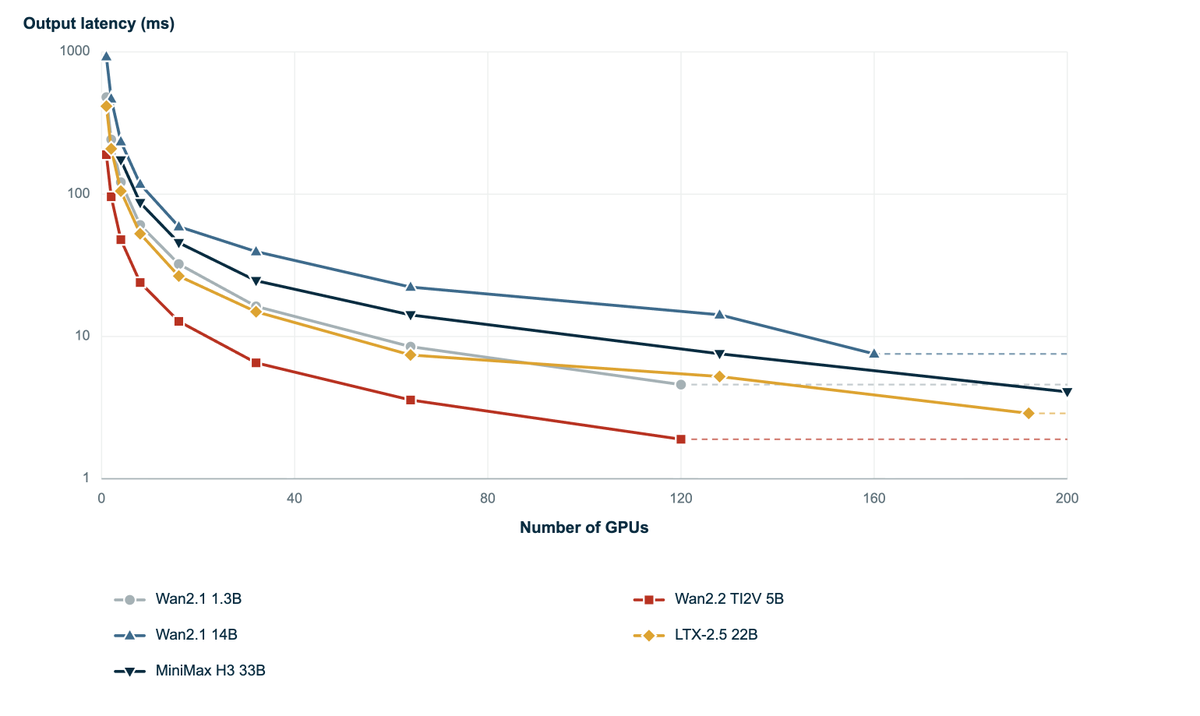
The vLLM Project officially announced that PhysisServe's core physical-world serving techniques are being integrated into vLLM-Omni. Addressing the severe memory bottlenecks and latency spikes of multi-step video diffusion and physical AI generation, PhysisServe introduces cross-denoising-step pipeline parallelism across Transformer blocks, time-shared batching, and virtual-rank joint scheduling. Benchmarked on MiniMax H3 33B across 200 GPUs, it generates a chunk every 4.1 ms (~1,000 FPS without VAE decoding), while cutting single-GPU latency for Wan2.2 5B from 173 ms down to 98 ms.
Zoom
Key Takeaways
The vLLM project announced the upstream integration of PhysisServe's serving architecture into vLLM-Omni for physical AI and video models
Introduces cross-timestep block pipelining and time-shared batching to eliminate GPU communication bubbles in multi-step diffusion
Generates a video chunk every 4.1 ms on MiniMax H3 33B across 200 GPUs (~1,000 FPS), cutting Wan2.2 5B single-card latency to 98 ms
Expands 24-GPU serving concurrency by 1.7x to 3.3x, with full open-source code merging into the vLLM-Omni mainline
Adobe Research and Brown University released OmniXRef (arXiv:2610.22744), a unified framework for multimodal multi-reference video editing. Overcoming the limitations of prior systems constrained to text prompts or single visual exemplars, OmniXRef utilizes a single-stream Diffusion Transformer with Mix-Patchify and Reference-Relative RoPE (R2-RoPE) to jointly control camera motion, subject content, dynamic motion, style, and visual effects (VFX). In camera trajectory evaluations, OmniXRef cuts rotation and translation errors by more than 5x compared to leading commercial engines.
Zoom
Key Takeaways
Adobe Research and Brown University released OmniXRef (arXiv:2610.22744), a unified framework for multi-reference video editing across text, images, and videos
Features a single-stream Diffusion Transformer with Mix-Patchify and R2-RoPE for multimodal cross-attention
Cuts camera trajectory error by more than 5x over commercial flagship Seedance 2.5, recording 0.874 RotErr and 3.961 TransErr
Achieves modular control across Camera, Motion, Content, Style, and VFX with an interactive project page now live
Traditional speculative decoding relies on static target hidden features that fail to supply varying contextual needs across draft positions. HKU researchers introduced ReaDy (arXiv:2610.20503). Designed specifically for Hybrid Linear Attention (HLA) architectures combining Transformers with recurrent linear attention states, ReaDy leverages compact recurrent states as dynamic context for drafting. On a single NVIDIA B200 GPU serving Qwen3.8-27B, ReaDy achieves an acceptance length of 4.53 and 302.78 TPS, accelerating inference by 2.4x over standard autoregressive decoding.
Zoom
Key Takeaways
HKU introduced ReaDy (arXiv:2610.20503), the first speculative decoding framework customized for Hybrid Linear Attention (HLA) LLMs
Reuses compact recurrent states as dynamic context for drafting, overcoming the static context bottleneck of feature-based drafters
Achieves 302.78 TPS for Qwen3.8-27B on a single NVIDIA B200 GPU (2.40x over AR and +7.97% over SOTA DSpark)
Reaches an acceptance length of 4.53 tokens using an ultra-lightweight Rank-8 reader
Looped language models reuse physical Transformer blocks across logical depth to compress parameter footprints, but existing approaches entangle recurrence placement, input injection, and recurrent-state topologies. CMU and Fudan researchers published Part I of 'Towards Looped Models Done Right' (arXiv:2610.23036). Introducing a Prelude-Recurrent-Coda sandwich architecture, an 8.0B-resident / 794M-active Huginn MoE trained on 500B tokens matches a 32.0B-resident / 3.2B-active feedforward reference across MMLU, GSM8K, and MATH500.
Zoom
Key Takeaways
CMU and Fudan University established Part I of 'Towards Looped Models Done Right' (arXiv:2610.23036), decoupling recurrence placement from state design
Proposes the Prelude-Recurrent-Coda sandwich architecture (Huginn) to prevent representational collapse in looped transformers
Demonstrates that an 8.0B-resident / 794M-active Huginn MoE trained on 500B tokens fully matches a 32.0B-resident / 3.2B-active feedforward reference
Slashes resident memory footprint by 75%, charting a clear path to run 30B-tier reasoning models on 16GB–24GB consumer GPUs
Continuous diffusion language models (CDLMs) currently transplant architectures from causal LLMs or vision DiTs that are not optimized for parallel diffusion. Researchers from Xiaohongshu (Dots Studio), Peking University, CUHK Shenzhen, and UCLA introduced LangDiT (arXiv:2610.22330). By separating feature normalization from noise modulation, detaching shortcut gradients, and introducing confidence-gated self-conditioning, LangDiT reduces generation perplexity (GenPPL) to 21.72 on LangFlow and 11.33 on Plaid across 1024-token OpenWebText rollouts.
Zoom
Key Takeaways
Xiaohongshu, PKU, and CUHK Shenzhen introduced LangDiT (arXiv:2610.22330), the first transformer backbone customized for continuous diffusion language models
Decouples representation scaling from noise modulation via Q/K RMSNorm and stabilizes training through vocabulary shortcut detachment
Drives 1024-token generation perplexity on OpenWebText down to 21.72 on LangFlow and a record 11.33 on Plaid formulations
Maintains strong quality (27.51 GenPPL) even under 128 denoising steps, isolating transformer design as the core lever for diffusion text generation
Tackling step-level verification in mathematical reasoning and in-context copying bottlenecks in Transformers, NYU/UCLA/Stanford researchers introduce LeanPRM (arXiv:2610.17697)—using the Lean 4 theorem prover to automatically label 152K steps across 10,634 natural-language proofs with zero human annotation, boosting Qwen3-4B step accuracy on LeanPRM-Bench from 48.2% to 74.7% (vs. 60.3% for PRM800K). Meanwhile, Cornell University's Copy-Paste Language Models (CPLMs, arXiv:2610.19247) add a lightweight Copy-Paste head (~3% compute overhead) that relieves the LM head gradient bottleneck, boosting LAMBADA accuracy by +2.5-4.0 points and allowing a w=128 sliding-window CPLM to match full-attention perplexity.
Zoom
Key Takeaways
LeanPRM uses the Lean 4 proof assistant and a syntax-error filter to generate 152K step-level labels across 10,634 proofs with zero human annotation
A Qwen3-4B verifier trained on LeanPRM reaches 74.7% step accuracy on LeanPRM-Bench (vs. 48.2% base and 60.3% with PRM800K) and improves 0.6B-8B verifiers on Hard2Verify and IMO-GradingBench
Cornell's Copy-Paste Language Models (CPLMs) add a ~3%-overhead copy head that relieves the LM head gradient bottleneck, boosting LAMBADA by +2.5-4.0 points and matching full-attention perplexity with a w=128 sliding window
Google AI Studio launched Gemini 4 Argon access in AI Studio Build and Playground for Google AI Pro subscribers, while Hugging Face Transformers v5.20.0 and v5.20.1 added native support for Reflection AI's frontier coding model Beam, Meta's 816B-parameter (42B active, 1M context) multimodal agentic coding model Muse Spark Open, InclusionAI's Ling 3.0 Flash, and OpenBMB's MiniCPM-V 4.7.
Zoom
Key Takeaways
Google AI Studio opens Gemini 4 Argon in AI Studio Build and Playground (https://ai.studio/build) for Google AI Pro subscribers
Hugging Face Transformers v5.20.1 natively integrates Reflection AI's token-efficient coding model Beam and fixes DeepGEMM Mega MoE under expert parallelism
Adds native support for Meta's 816B-parameter (42B active, 1M context, BF16/NVFP4) omni-modal coding model Muse Spark Open and InclusionAI's KDA+MLA hybrid Ling 3.0 Flash