
AI Coding Live News

GitHub Agentic Workflows is generally available: write automation in Markdown, compile it to Actions YAML, run Copilot or your own coding agent, now with ARC self-hosting and micro-VM isolation

At Universe 2026 on Oct 28, GitHub made GitHub Agentic Workflows, an open source GitHub Next project, generally available on GitHub Free, Team and Enterprise. Developers describe tasks such as issue triage, CI failure analysis, documentation updates and test writing in natural-language Markdown, and gh aw compiles them into standard Actions YAML run by Copilot or a coding agent of their choice. GA adds self-hosted ARC runners with Docker-in-Docker, a non-experimental gh aw forecast cost estimate, per-workflow model providers and model routing, and Cloud Hypervisor or NVX micro-VM isolation.
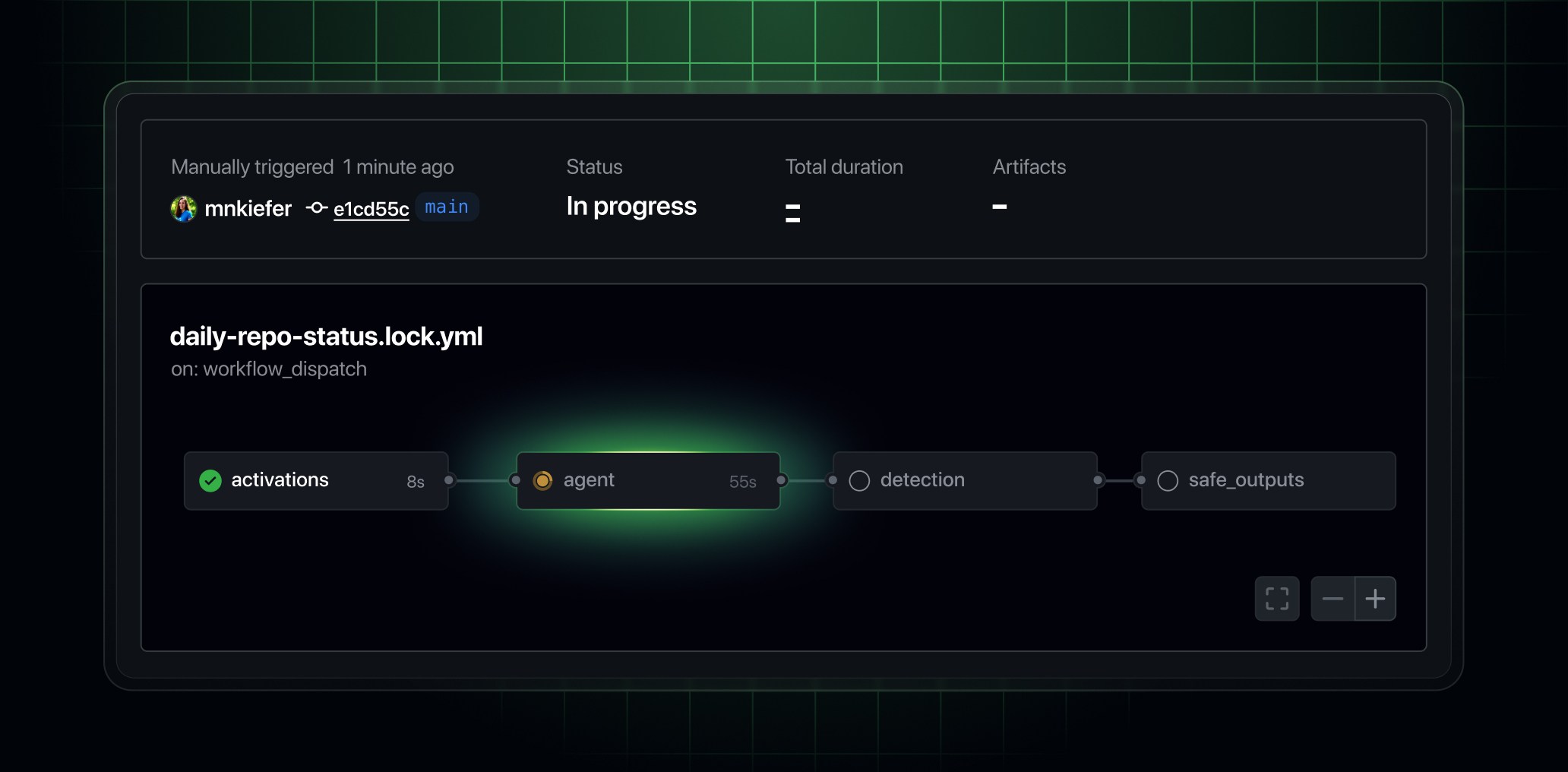
GitHub Agentic Workflows is generally available: write automation in Markdown, compile it to Actions YAML, run Copilot or your own coding agent, now with ARC self-hosting and micro-VM isolation

Key Takeaways

  • Availability: GitHub Free, Team and Enterprise on github.com; using the default Copilot CLI engine requires a Copilot license
  • How it works: requirements in Markdown, compiled to standard Actions YAML that reuses existing runner groups and policies; run with Copilot or your own coding agent
  • Safe defaults: read-only permissions, a sandboxed container behind the Agent Workflow Firewall, safe-outputs validation, and a threat detection job before changes are applied
  • New at GA: self-hosted ARC runners with Docker-in-Docker, gh aw forecast out of experimental (with threat detection credits and monthly ranges), per-workflow model providers, model routing, micro-VM isolation and cross-repo enclaves
  • Customer story (Accenture's figures): one lead saved about 29 hours a week, AI authors 91% of the team's commits, and production errors fell from about 11,000 a day to under 1,000
Read full story

OpenAI Upgrades GPT-6 Astra Pro in ChatGPT with Parallel Multi-Agent Execution and Showcases Always-On 'dots' Triaging 3 AM Incidents via Codex

OpenAI announced a major upgrade to GPT-6 Astra Pro in ChatGPT for Pro users, introducing faster response times, stronger plugin and tool orchestration, and native parallel multi-agent execution where multiple agents tackle different parts of a complex task simultaneously. Concurrently, OpenAI Developers showcased how internal engineers put always-on 'dots' agents on call to autonomously triage 3 AM production incidents, launch Codex debugging threads, and clear codebase maintenance backlogs.

OpenAI Upgrades GPT-6 Astra Pro in ChatGPT with Parallel Multi-Agent Execution and Showcases Always-On 'dots' Triaging 3 AM Incidents via Codex

Key Takeaways

  • Parallel multi-agent execution in GPT-6 Astra Pro: upgrades speed and tool use while enabling multiple agents to work on different task components concurrently in ChatGPT Pro
  • Always-on 'dots' on-call incident triage: autonomously investigates 3 AM production alerts and initiates Codex coding threads before waking the engineer
  • Mobile steering & backlog automation: engineers supervise Codex fixes from the ChatGPT mobile app and deploy Codex to continuously clear repository maintenance backlogs
Read full story
Linked Models & Agents:

Anthropic Cyber Mission: free OSS Scanner reports 77 critical and 803 high findings in its first week, plus Critical Infrastructure Defense with 11 partners

On Oct 8 Anthropic launched the Cyber Mission: (1) free opt-in OSS Scanner for critical open-source projects using strongest models including Claude Mythos, with PoC/explanation/candidate patches and >90% expected true-positive rate, no human triage; (2) Critical Infrastructure Defense Program with 11 founding partners including CrowdStrike, Palo Alto, Dragos, and Rockwell. Project Glasswing has surfaced 29,000+ candidate vulns. Oct 19 update: first scans have reported 77 critical and 803 high model-rated findings to maintainers; curl 8.23.0's high-severity HTTP/2 use-after-free CVE-2026-92392 was found by an early version.

Key Takeaways

  • Two tracks: free opt-in OSS Scanner (model-only reports) + Critical Infrastructure Defense Program (OT/power/water/transport; 11 founding partners)
  • Glasswing legacy: 29,000+ candidate vulns, ~6,000 human-triaged; ~5,000 reports sent when maintainers asked for bulk
  • Quality bar: 88% of 97 critical/high samples met CVD bar; expected true-positive >90% (no human review; severity can be off)
  • Enroll: core maintainers PR into Anthropic’s enrollment repo; also Claude for OSS free Max + Cyber Verification Program
  • First week (vendor-reported, model-rated, unreviewed): 77 critical and 803 high findings sent to maintainers; curl 8.23.0 fixed CVE-2026-92392 (HTTP/2 upload use-after-free, 8.12.0–8.22.0) found by an early version
Read full story

TRIAGE: Nanjing University Stabilizes Native NVFP4 Reinforcement Learning with Zero Performance Degradation and 2.3x Higher Throughput

Reinforcement learning post-training generates massive rollout bottlenecks, driving interest in low-precision execution like NVIDIA Blackwell's native NVFP4 (W4A4). However, numerical discrepancies between learner and sampler forward passes destabilize policy-gradient optimization, triggering policy collapse. Researchers from Nanjing University and Polixir present TRIAGE (arXiv:2610.07043), isolating how quantization mismatches interact with policy-gradient directions. The authors reveal that native NVFP4 introduces an early asymmetry that amplifies negative-advantage updates across concentrated tail tokens. TRIAGE implements segment-level diagnostics to rebalance policy updates while preserving native W4A4 forward execution across both learners and samplers. Validated on Qwen3-4B and Qwen3-30B-A3B, TRIAGE matches full-precision BF16 performance across five mathematical reasoning benchmarks while delivering up to 2.3x higher rollout throughput.

Key Takeaways

  • Nanjing University and Polixir introduce TRIAGE, stabilizing native NVFP4 (W4A4) RL training on NVIDIA Blackwell architecture
  • Pioneers direction-aware policy-gradient stabilization and segment diagnostics, mitigating learner-sampler numerical mismatch
  • Matches full BF16 precision on mathematical reasoning benchmarks while delivering 2.3x higher rollout throughput
Read full story
Linked Models & Agents:
ADSponsored

Ollama 0.35.0: Decision Models via /v1/systemone (Jev); Nimble & Tev1 return choices, probabilities, confidence

Ollama shipped v0.35.0 on 2026-09-28 (GitHub prerelease): Decision Models via TypeSafe’s Jev API at /v1/systemone. Instead of free text, models answer choice/noul/score questions with options, probabilities, and confidence—for ticket triage, model routing, and classification. First models: Nimble (Bespoke Labs) and Tev1 (Together AI). ~7 commits / 66 files vs v0.34.4; Settings no longer blocks on discovery; macOS update menu and stalled MLX downloads fixed.

Ollama 0.35.0: Decision Models via /v1/systemone (Jev); Nimble & Tev1 return choices, probabilities, confidence

Key Takeaways

  • v0.35.0 (prerelease) adds Decision Models at POST /v1/systemone (TypeSafe Jev)
  • Question types: choice (with probabilities), noul, score — not free-text generation
  • First models: Nimble (Bespoke Labs) and Tev1 (Together AI) on ollama.com/library
  • ~7 commits / 66 files vs v0.34.4; Settings/macOS update/MLX download fixes
Read full story

mcp-typesafe: Rust MCP server exposing TypeSafe Jev System One tools to any agent

Community release mcp-typesafe (github.com/sf-stav/mcp_typesafe): an unofficial Rust MCP server that exposes TypeSafe System One / Jev structured judgments (choice/score) plus higher-level filter/rank/classify/choose-one and stability tools to any MCP client. It targets bulk triage without burning LLM context and calibrated probabilities instead of prose confidence; most calls are ~100ms. stdio and SSE transports, TypeSafe API key required, single static binary.

Key Takeaways

  • Unofficial Rust MCP exposing Jev/System One structured judgments to any agent.
  • Bulk filter/rank/classify/choose-one plus stability sampling; most calls ~100ms.
  • stdio + SSE; TypeSafe API key required; single static binary.
Read full story
Linked Models & Agents:

OpenRouter ships Jev Labs demos: decision-model triage, tool pick, and ticket tags

OpenRouter explained TypeSafe Jev as a decision model for yes/no and multiple-choice questions with confidence scores, saying it can be about 10x cheaper and faster than an LLM for those steps. OpenRouter Labs published mini apps with source for support triage, agent tool selection, X reply classification, and meeting-note actions, plus a model page link.

Key Takeaways

  • Framed as a decision model for yes/no and multiple-choice answers with confidence, fit for every message or tool call.
  • Labs mini apps with source are at openrouter.ai/labs/jev.
  • Model page: openrouter.ai/~typesafe/jev-latest.
Read full story
Linked Models & Agents:

nexos.ai Unveils Smart Router for Coding Agents, Slashing Inference Costs by 60%

To counter ballooning token expenses in autonomous agent workflows, nexos.ai launched an AI smart router. It dynamically triages coding subtasks between frontier reasoning models and cost-efficient engines, cutting inference bills by up to 60% with zero accuracy loss.

Key Takeaways

  • Solves the token paradox and runaway costs in multi-step agent coding loops
  • Dynamically routes complex architecture tasks to frontier models and boilerplate to lean engines
  • Reduces token expenditure by 60% while speeding up turn latency by 35% in benchmark suites
Read full story
Linked Models & Agents:

GitHub Copilot lands in Slack and Microsoft Teams for in-chat planning, incident triage, and agent handoff

GitHub launched Copilot integrations for Slack and Microsoft Teams. Teammates can mention @GitHub in the channels where work is already coordinated to plan changes, investigate problems, and hand coding tasks to agents. The update embeds agentic work in existing chat surfaces instead of forcing a context switch back to the IDE.

Key Takeaways

  • Mention @GitHub in Slack or Teams to plan diffs, investigate issues, and hand off coding tasks.
  • Agentic work starts in the chat surface teams already use, cutting IDE context switches.
  • Fits on-call, review, and requirements threads that need an agent without leaving the channel.
Read full story
Linked Models & Agents: