AI Coding Live News

X Discussion: DHH Says the Age of Agents Will Be Great for Most Programmers but Hard on Cantankerous Ones Who Relied on Rare Skills

Ruby on Rails creator and 37signals CTO DHH (David Heinemeier Hansson) posted two related takes on X on November 2. First: "The great gift of agents is how they allow you to route around every insufferable gatekeeper in software." Then: the age of agents will be amazing for most programmers but hard on the cantankerous ones, because specialized knowledge and rare skills will no longer offer immunity to people who are a pain to work with, so they should learn basic people skills. The second post drew about 3,600 likes, 106K views and 280+ replies in roughly four hours. This is a personal opinion, not an announcement from any company.

Key Takeaways

  • This is a personal opinion post by DHH, not an official statement from 37signals or any AI company, and it cites no data or study.
  • The main post (2026-11-02 13:03 UTC) had about 3,609 likes, 180 reposts, 282 replies, 60 quotes, 106K views and 400 bookmarks at fetch time.
  • His earlier post about 1.5 hours before, saying agents let you route around every insufferable gatekeeper in software (11:41 UTC), had about 2,831 likes, 131 reposts and 80K views.
  • Supporters: tech analyst Ben Dickson (@bendee983) quoted it saying great engineers used to get a free pass for being difficult, and AI is leveling the field, though solid engineering knowledge is still required.
  • Pushback and additions: one reply joked that cantankerous people just found a coworker who never complains back; another argued an agent will do the work but will not make you nicer, so being easy to work with becomes more valuable.
Read full story
Linked Models & Agents:

X discussion: Pieter Levels posts a 13-minute video on "what is left when AI can build everything", saying his businesses are shrinking, the sense of achievement is gone, and moats shift to community and content

Indie developer Pieter Levels (@levelsio) posted a roughly 13.5-minute walk-and-talk video on X on November 1, following up his October 11 "software is dead" post. He says AI has finally hit programmers themselves, and the identity and sense of achievement that came from building paid products is fading; his own businesses and many friends' are flat or shrinking, and competition has exploded because anyone can now ship a landing page or app. He sees the remaining moats as community, audience, content and slower-moving enterprise B2B, and has already made Nomad List free as nomads.com. The post had about 2,478 likes and 205K views. These are personal views, not industry data.

X discussion: Pieter Levels posts a 13-minute video on "what is left when AI can build everything", saying his businesses are shrinking, the sense of achievement is gone, and moats shift to community and content

Key Takeaways

  • Original post: @levelsio video, Nov 1, 10:44 UTC, about 2,478 likes, 2,441 bookmarks, 204 replies and 205K views at fetch time
  • It quotes his October 11 "Software is dead" post (about 5,747 likes, 1.94M views); the video expands on what is left to do when AI can build everything
  • His GTA cheat-code analogy: every new model makes building faster and easier, but "where's the achievement?"; he says he is not pessimistic, just looking for a new source of achievement
  • His own observations: his and many friends' businesses are flat or shrinking, the ones still growing often rely on AI or VC sponsorships, and big labs building legal and medical products will absorb many small businesses
  • Nomad List is now free as nomads.com; he says sign-ups went from about 200 when paid to about 3,000 (period not stated), with revenue now from sponsorship and a $1 anti-spam membership
Read full story
g
guregodevo (Memdoor author)github.com·
👀14
🔥81

Memdoor reproduces GVS5H: a team of five Qwen3.8-27B agents averages 9.8/10 on the first 10 LiveCodeBench Hard problems, against 8.0 for a single Fable 5 call

On Oct 31 the open-source coding agent Memdoor (GitHub guregodevo/memdoor, Apache 2.0) published its team-solve workflow: using the GVS5H paper authors' exact prompts and loop, five Qwen3.8-27B instances act as planner, two ideators, solver and manager, talk only through files on disk, and a script that runs the tests decides success. Over five passes on the first 10 LiveCodeBench Hard problems from the GVS5H list it averaged 9.8/10, against 9.6 for the authors' own harness and 8.0 for a single Fable 5 call; 49 of 50 runs solved the problem for $35.79 in total, and every request and reply is public. The Hacker News post has about 200 points. This is a community reproduction on only 10 problems, and the author notes that training-data contamination cannot be ruled out.

Key Takeaways

  • Score: a mean of 9.8/10 over five passes (10, 10, 10, 10, 9), against 9.6 for the GVS5H authors' own harness and 8.0 for a single Fable 5 call (team-solve README, project-reported)
  • Cost: 49 of 50 runs solved, $35.79 and 15.3M output tokens in total; a median run took about 40 minutes of model time and $0.39, the longest 4 hours
  • Method: five roles (planner, two ideators, solver, manager) plus a repair worker each start from a fresh context, talk only through files on disk, and a shell script that runs the tests decides success instead of a model
  • Limits: only 10 problems rather than the paper's 100; the contests date from March and April 2025 and may be in training data; Fable 5's column comes from the GVS5H authors' result files and was not rerun in this harness
  • Reach: the HN post has about 200 points as of Nov 1, 16:10 SGT; the original GVS5H paper is arXiv 2608.26480, which reached #1 on HN on Oct 25
Read full story

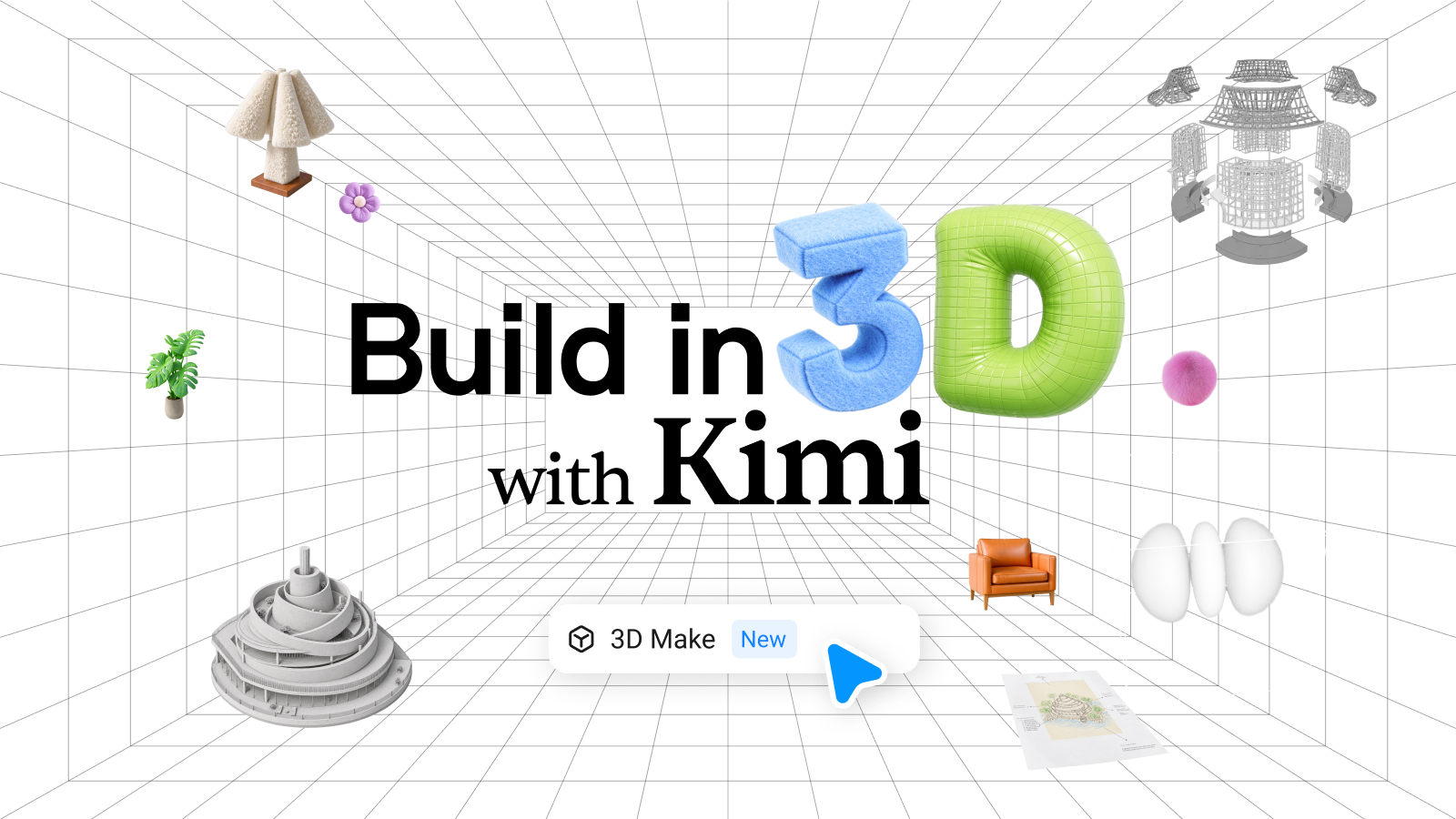
Kimi launches 3D Make: K3.1 Pro drives Blender, CAD tools and Unreal, Unity and Godot to build models, scenes and games

Moonshot AI's official Kimi account announced 3D Make at 03:14 UTC on Oct 30, saying Kimi connects to tools such as Blender and CAD software to create models, assemble scenes and develop games, available now on kimi.ai and Kimi Work. The companion 3D guide says K3.1 Pro was specifically trained to drive 3D software through Python scripts, so specialized tools without MCP support can join the workflow, while meshes such as people and animals are handed to diffusion services like Tripo. Plugins that need locally installed software work only in Kimi Work.

Kimi launches 3D Make: K3.1 Pro drives Blender, CAD tools and Unreal, Unity and Godot to build models, scenes and games

Key Takeaways

  • Availability: 3D Make is live on kimi.ai and Kimi Work; plugins that need locally installed software are Kimi Work only
  • Two modeling routes: parametric models (furniture, mechanical parts, buildings) via Python scripts written by K3.1 Pro, and meshes via services such as Tripo, Meshy and Hyper3D
  • Engines: Kimi says it is adapted to Unreal Engine, Unity and Godot to import models, assemble scenes and build gameplay step by step
  • Showcase: the celestial palace in the K3.1 Pro launch video was built in Unreal Engine 5.8 from source models totaling 36 million triangles, rendered with Nanite and Lumen
  • Benchmarks: no 3D benchmarks were published; the guide admits some tasks need several rounds, and rigging and complex materials remain weak spots
Read full story
ADSponsored

Cursor launches Computer Use: agents can control your computer and drive desktop apps like the iOS Simulator to test what they build

On 2026-10-23 (15:59 UTC) the official Cursor account @cursor_ai announced "Cursor can now control your computer": agents can drive desktop apps such as the iOS Simulator to test the features they build. A follow-up post says Computer Use lets agents click and type across any app on your computer, not just the browser. Cursor turns it on by itself when a task needs it, and you can also request it by @-mentioning Computer Use in your prompt; updating Cursor is enough to try it. A community changelog in September mentioned Computer Use on Mac in version 3.20.21, and this is the official launch. Supported platforms, the permission model and benchmarks were not published.

Cursor launches Computer Use: agents can control your computer and drive desktop apps like the iOS Simulator to test what they build

Key Takeaways

  • Cursor officially says its agents can now control your computer and drive desktop apps like the iOS Simulator to test the features they build
  • Computer Use lets agents click and type across any app, not just the browser
  • Cursor uses it automatically when a task needs it, and you can request it by @-mentioning Computer Use in a prompt
  • Update Cursor to try it; supported platforms, the permission model and benchmarks were not published
Read full story

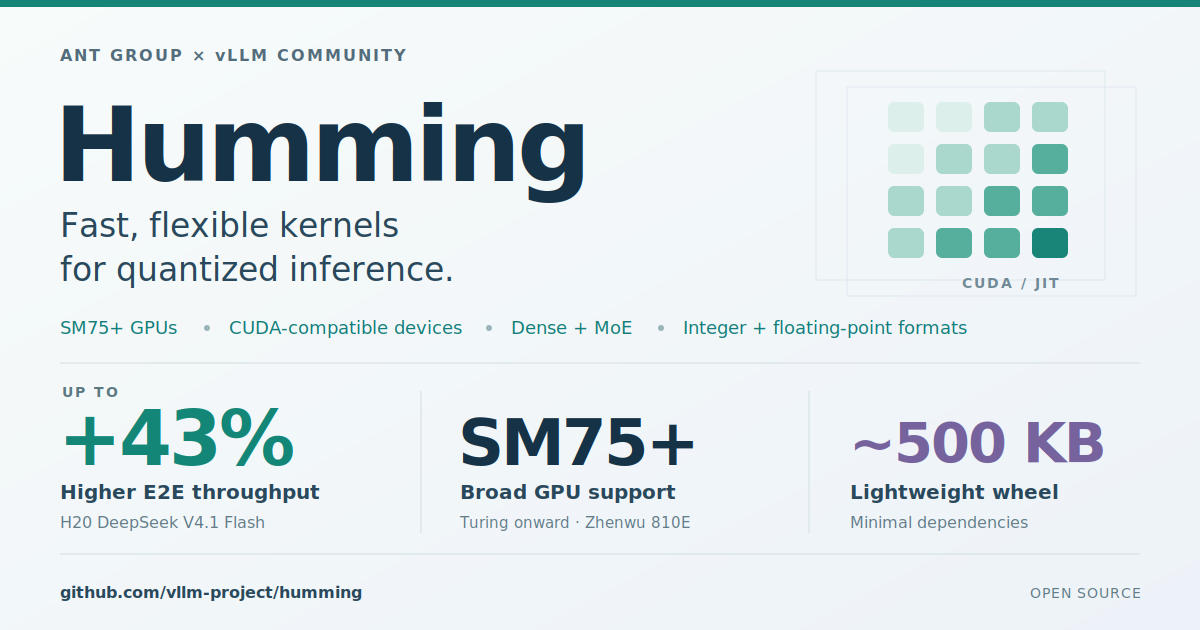
vLLM and Ant Group open-source Humming, one quantized-inference kernel library for many formats and every NVIDIA GPU since Turing, lifting DeepSeek-V4.1-Flash end-to-end throughput by 14-43%

On Oct 21 the vLLM community and Ant Group open-sourced Humming (Apache 2.0), a quantized-inference library that JIT-compiles GEMM kernels on demand. It supports every NVIDIA architecture from Turing on plus T-Head's Zhenwu 810E, and covers weight and activation combinations from INT1-INT8 and FP4-FP8 for dense and MoE workloads. In vLLM's microbenchmarks it runs 2-5x faster than vLLM Marlin, FlashInfer or DeepGEMM in some cases; on 8 H20 GPUs, switching DeepSeek-V4.1-Flash MoE from Marlin W4A16 to Humming W4A8 raised throughput 14-43%. vLLM 0.29.0 ships it built in.

vLLM and Ant Group open-source Humming, one quantized-inference kernel library for many formats and every NVIDIA GPU since Turing, lifting DeepSeek-V4.1-Flash end-to-end throughput by 14-43%

Key Takeaways

  • One JIT kernel framework instead of a hand-written kernel per format: WNA16, W8A8, W4A8, W4A4, INT1-INT8 and FP4-FP8 weights, dense and MoE
  • Hardware: every NVIDIA GPU from Turing (SM75) on, including Blackwell SM100/103/120/121, plus T-Head Zhenwu 810E
  • End to end: DeepSeek-V4.1-Flash on 8x H20 at TP=8, Humming W4A8 beats Marlin W4A16 by 14-43% in throughput and cuts mean TTFT 25-32%; at concurrency 64 output goes from 442 to 634 tok/s
  • Microbenchmarks run by the vLLM community: W4A8-MXFP4 on H200 is about 4.5x DeepGEMM W8A8, and the B300 MoE Grouped path is about 5x Marlin; one W4A16 kernel compiles in 1.82 s versus 23.35 s for CUTLASS
  • Use: pip install humming-kernels (about a 500 KB wheel); built into vLLM 0.29.0+, enable with --linear-backend humming --moe-backend humming
Read full story

MiniMax M3.1 Flash weights now open on Hugging Face: 428B-total / 23B-active MoE, $0.15 input and $0.60 output per million tokens, 73.7% on DeepSWE

MiniMax confirmed that Space Bunny, the anonymous model that led usage rankings on OpenRouter and elsewhere, was an early version of M3.1 Flash, and launched it on its API on October 19. Pay-as-you-go pricing is $0.15 input, $0.60 output and $0.015 cache read per million tokens, with a 1M context, text, image and video input, and an effort setting for thinking depth. Per MiniMax, it costs one third of M3 and runs 3x faster, scoring 73.7% on DeepSWE and 62.2% on Automation-Bench; the weights went live on Hugging Face on schedule on October 23 (MiniMax Community license, MXFP8), with day-0 support from Together, Inferact (vLLM) and LightSeek TokenSpeed.

MiniMax M3.1 Flash weights now open on Hugging Face: 428B-total / 23B-active MoE, $0.15 input and $0.60 output per million tokens, 73.7% on DeepSWE

Key Takeaways

  • Official pay-as-you-go pricing: $0.15 input / $0.60 output / $0.015 cache read per million tokens; per token that is half of M3 ($0.30/$1.20), and MiniMax does not explain how it gets one third of the cost.
  • Vendor benchmarks: DeepSWE v1.1 73.7% (Opus 5: 74.0%), Automation-Bench 62.2%, BabyVision with tools 91.0%, Terminal Bench 4.0 38.1% (Opus 5: 51.8%).
  • 1M context, text/image/video input, five effort levels from low to max, default max, thinking cannot be turned off.
  • Weights opened October 23 at Hugging Face MiniMaxAI/MiniMax-M3.1-Flash: ungated, MiniMax Community license (not MIT/Apache), MXFP8 quantized, native multimodal MoE with about 428B total and 23B active parameters per token, plus a DSpark speculative-decoding draft head.
  • Migration: M2.5 and M2.7 closed to new users on October 19 and retire on November 18; M Plan and Token Plan requests now route to M3.1 Flash automatically.
  • Day-0 serving: Together AI runs it fully managed, MiniMax is partnering with Inferact to contribute production-inference improvements back to vLLM, and LightSeek's TokenSpeed added day-0 support.
Read full story

Black Forest Labs releases FLUX 3 Image Klein: 5.6B open-weights image generation and editing model with native 4K, bounding boxes, 8GB-VRAM INT8 build

On 2026-10-15 Black Forest Labs released FLUX 3 Image Klein, a 5.6B open-weights image model for text-to-image, editing and multi-reference generation with up to 10 references, inheriting FLUX 3's native 4K output, pixel-perfect edits and bounding-box control. It ships as a fine-tunable base and a step-distilled model, plus FP8/INT8/NVFP4 builds made with NVIDIA; the INT8 build runs on RTX GPUs with 8GB VRAM. Weights use the FLUX Kommunity License (free commercial use under $5M annual revenue), and it is live on the BFL API.

Black Forest Labs releases FLUX 3 Image Klein: 5.6B open-weights image generation and editing model with native 4K, bounding boxes, 8GB-VRAM INT8 build

Key Takeaways

  • Footprint: 5.6B generator; 11.2GB in BF16, 5.6GB in FP8; the INT8 build runs on RTX GPUs with 8GB VRAM via ComfyUI or Diffusers (blog)
  • Speed (measured by NVIDIA): distilled + INT8 makes a 1MP image in ~4s on an RTX 5090 and under 9s on an RTX 4070; under 0.6s in NVFP4 on GB300, with LoRA adding ~5%
  • Quality (BFL internal evals): +91 Elo text-to-image and +70 Elo editing vs FLUX.2 [klein] 9B with 38% fewer parameters; BFL ranks it above Qwen-Image 2.1 (7B) and Krea 2 (12.9B)
  • API: the distilled model is flux-3-image-klein on the BFL API with prompt upsampling and pixel restoration; listed from $0.009 "per 1K image" (API docs)
  • Ecosystem: day-one ComfyUI, Diffusers, TensorRT-LLM, SGLang Diffusion and vLLM-Omni; LoRA training via Ostris AI Toolkit and NVIDIA NeMo AutoModel
Read full story
Linked Models & Agents:
⚡ Flux 3 Image Klein⚡ Flux 3⚡ Flux 2 Klein⚡ qwen-image-2.1🌐 black-forest-labs🌐 Nvidia (NIM)

Fish Audio ships Drama 3: open-weight 35B MoE TTS with word-level emotion direction, #1 on Artificial Analysis Pronunciation Robustness at 93.2%

On 2026-10-13 Fish Audio launched Drama 3, a TTS model directed with plain-language bracket tags, open weights on Hugging Face, and API header model: drama-3. The backbone is a ~35B MoE (~3B active per token, initialized from Qwen3.5-35B-A3B's language tower) with a codebook-MTP audio decoder and preference-model RL. Independent Artificial Analysis Pronunciation Robustness: 93.2% vs 88.1% for S2.1 Pro; 83 languages and up to 16 speakers; Community License free for commercial use under US$500k annual revenue. Launch promo through Nov 12: about $10 per million characters on the API.

Fish Audio ships Drama 3: open-weight 35B MoE TTS with word-level emotion direction, #1 on Artificial Analysis Pronunciation Robustness at 93.2%

Key Takeaways

  • Open weights on Hugging Face fishaudio/drama-3 under Community License v1.0 (free commercial use under US$500k ARR; no non-consensual voice cloning)
  • Architecture: 35B MoE / ~3B active; hybrid attention (1 full-attn layer per 4); codebook-MTP decoder over 10 codebooks; initialized from Qwen3.5-35B-A3B LM
  • Benchmarks: Artificial Analysis Pronunciation Robustness 93.2% (#1) vs S2.1 Pro 88.1%; brand/place/tech names 95.9%, context-dependent readings 95.3%
  • Vendor H200 streaming: 271 frames/s single stream; concurrency-1 TTFA p50 88.9 ms; concurrency 16 ~927 frames/s, RTF 0.373
  • Ship: API POST /v1/tts with model: drama-3; self-host via SGLang-Omni (sgl-omni serve --model-path fishaudio/drama-3, typically ≥48GB NVIDIA VRAM)
Read full story
Linked Models & Agents:
⚡ Drama 3⚡ Fish Audio S2.1 Pro⚡ Qwen3.5-35B-A3B🌐 Fish Audio🌐 Artificial Analysis🌐 SGLang

Anthropic replaces git with in-house Scion: daily merges grew from ~2,500 to 30,000+, and a 7-person team migrated the monorepo in five months

On Oct 13 Anthropic's engineering blog said merges grew from about 2,500 per day in May 2026 to more than 30,000 in September, making human-scale git infrastructure its biggest bottleneck. A seven-person team built Scion, an always-online version control system, plus the Antique code-review tool, and fully migrated the monorepo off git in five months. Scion's footprint is 200x smaller in CPU and memory than the old git mirrors, CI checkouts went from minutes to seconds, and CI gained 25% CPU capacity. Scion is not being open-sourced; Anthropic wants to work with GitHub, GitLab and the OSS community to bring the ideas to git.

Anthropic replaces git with in-house Scion: daily merges grew from ~2,500 to 30,000+, and a 7-person team migrated the monorepo in five months

Key Takeaways

  • Scale: ~2,500 merges/day in May vs 30,000+ in September; main history near 100 GB, compressed working copy over 25 GB, ~25M CI checkouts per day (600+ PB/day if fetched naively with git)
  • Design: always-online clients, server-side blame/history/commit/merge/rebase, content-addressed data in Spanner and blob storage, no packfiles or repo maintenance
  • Results: 200x smaller CPU/memory footprint than the git mirrors, 99%+ cache hit rate per tier, checkouts two orders of magnitude faster, 25% CI CPU freed
  • Team: seven engineers built Scion, Antique and related systems in five months; an early Claude Mythos Preview rewrite of the ingestion pipeline used 20x less memory and ran 4x faster
  • Process: no global-lock merge queue, replaced by post-merge and pre-deploy testing; Scion stays internal, with ideas offered to GitHub, GitLab and OSS git
Read full story
ADSponsored

Voyager launches: a desktop agent harness that drives Blender, DaVinci Resolve, After Effects and Ableton — 'the Codex for creative work'

Nullframe (the Moda team, YC F26) shipped Voyager, a local desktop agent harness that drives creative apps through their own scripting APIs, ships free Design/Video/DAW engines, and works with your own Claude/Codex sign-in or API keys. The launch post passed 1.48M impressions.

Voyager launches: a desktop agent harness that drives Blender, DaVinci Resolve, After Effects and Ableton — 'the Codex for creative work'

Key Takeaways

  • Launch post: ~1.48M impressions, 3,074 bookmarks, 2,457 likes on X
  • Drives Photoshop, Illustrator, After Effects, Premiere Pro, DaVinci Resolve, Final Cut Pro, Blender, Unity and Ableton Live; skills also cover Cinema 4D, Houdini, Remotion, Manim
  • ~40 built-in skills, MCP server support, and reuse of skills installed for Claude Code / Codex / Cursor
  • Free app with BYO agent/keys; paid plans from $19/mo, generation billed at provider cost with no markup
  • Apple Silicon + macOS 15 required; Windows 11 / Linux in alpha; desktop v0.1.84 shipped Oct 8
Read full story
Linked Models & Agents:

Google Labs launches Playground: no-code, prompt-based game creation powered by Gemini, Nano Banana and Lyria (US 18+)

Google Labs launched Playground on 2026-10-07: describe a game in chat, test it, and share it or publish it to the Explore gallery, with multiplayer and leaderboards in select genres. It runs on Gemini, Nano Banana, and Lyria with a custom harness. US 18+ first; weekly creation tokens with higher limits on Google AI plans; Unity Spark integration coming.

Google Labs launches Playground: no-code, prompt-based game creation powered by Gemini, Nano Banana and Lyria (US 18+)

Key Takeaways

  • Official: Google Labs launched the Playground experiment on 2026-10-07; no-code, prompt-based game creation
  • Availability: US, 18+, at playground.google; weekly creation tokens, higher on Google AI subscriptions
  • Stack: Gemini + Nano Banana + Lyria with a custom harness (per Google spokesperson to The Verge)
  • Sharing: private, link, or Explore gallery; multiplayer and leaderboards in select genres; safety screening
  • Unity Spark integration coming (in testing, closed beta soon); no published quality or latency metrics
Read full story
Linked Models & Agents:
⚡ Google Gemini⚡ Google Nano Banana⚡ Google Lyria🌐 Google DeepMind🌐 unity

Nano Banana 2.1 silent Flow sighting later confirmed by Google's official GA

On 2026-10-05 community screenshots and first-hand checks showed Nano Banana 2.1 already selectable in the Google Flow model picker — a silent product-side rollout with no Google announcement yet. Google then officially shipped it on 2026-10-06 and marked it GA in the Gemini API as gemini-nano-banana-2.1. Full specs, pricing (about half the prior 1K/2K per-image rates), and human-eval Elo 1050 are in our official GA brief: [Google officially ships Nano Banana 2.1](/news/news-20261007-google-nano-banana-2-1-ga-gemini-api-half-price).

Key Takeaways

  • Status update: the silent Flow picker sighting is now confirmed by Google GA — full write-up: [official GA brief](/news/news-20261007-google-nano-banana-2-1-ga-gemini-api-half-price) (API ID gemini-nano-banana-2.1)
  • Official highlights (from the GA brief/docs only — do not invent): ~half prior 1K/2K per-image price; human-eval T2I Elo 1050 (vs Nano Banana 2 at 990 and Pro at 935)
  • Where to try: Google Flow model dropdown still lists Nano Banana 2.1; API / AI Studio use gemini-nano-banana-2.1
  • Migration: old ID gemini-3.1-flash-image is deprecated (no shutdown date yet); see model docs
  • Early evidence: thtbee_ Flow screenshot showed Pro / 2 Lite / 2.1 side by side
Read full story
Linked Models & Agents:
⚡ gemini-nano-banana-2.1⚡ gemini-3.1-flash-image⚡ gemini-3.1-flash-lite-image⚡ Gemini 3 Pro Image🌐 Google DeepMind

GitHub Spec Kit 1.0.12: Bitbucket auth, Agentstandards community packs, taskstoissues deprecation notice

GitHub Spec Kit (specify-cli) shipped v1.0.12 on 2026-09-25: Bitbucket auth provider; community catalog gains Agentstandards bundle, Task Gate preset, and Architecture Council extension; SpecAssay/Intake presets updated. Core /speckit.taskstoissues is slated to leave core for a bundled github extension. Install via uv tool install specify-cli then specify init with Copilot or other integrations.

GitHub Spec Kit 1.0.12: Bitbucket auth, Agentstandards community packs, taskstoissues deprecation notice

Key Takeaways

  • Shipped: v1.0.12 / PyPI specify-cli 1.0.12; repo ~139k stars
  • Install: uv tool install specify-cli; specify init --integration copilot (or other keys)
  • Adds Bitbucket auth; Agentstandards / Task Gate / Architecture Council in community catalog
  • Upcoming: /speckit.taskstoissues moves out of core to bundled github extension
  • Fixes: multi-arg filter rejection, catalog_fetch TOCTOU, Alquimia skills-only rendering
Read full story

Unity Insight: First Production Code-Asset Graph Index for Game-Engine Coding Agents, Slashing Tokens and Time by 52%

Researchers from Unity China and the Tuanjie Engine team introduced Unity Insight (arXiv:2609.27585), a production code-asset graph index natively integrated into the Tuanjie Codely agent CLI. In game-engine repositories, gameplay logic is fundamentally intertwined with serialized YAML assets (.prefab, .unity, .asset) connected via GUIDs rather than raw code imports. Traditional code-only retrievers and ripgrep fail to resolve basic cross-file dependencies. Unity Insight bridges this gap by indexing cross-asset object references and C# fields into typed retrieval tools. In paired experiments across 28 tasks on two commercial Unity games, index-backed agents spent 53% fewer tokens and 52% less wall-clock time compared to baseline exploration agents (p < 0.004).

Unity Insight: First Production Code-Asset Graph Index for Game-Engine Coding Agents, Slashing Tokens and Time by 52%

Key Takeaways

  • Dual code-asset graph: first index bridging C# source files and serialized YAML assets (.prefab, .unity) via Unity GUID tracking
  • 52% time and token reduction: cuts token consumption by 53% and wall-clock execution time by 52% across 28 paired benchmarks (p < 0.004)
  • Production-proven deployment: powers Tuanjie Codely, the official agent CLI for Tuanjie Engine, supporting production game codebases
  • Typed index tools: exposes structured asset-code query primitives, eliminating context window bloat caused by raw YAML dumps
  • Game development breakthrough: provides a standardized blueprint for high-accuracy, low-hallucination agentic refactoring in game studios
Read full story