AI Coding Live News

DeepSeek Harness Launches Creator Mode: Describe a Plugin in Chat and the Agent Builds It, With 7 Official Demo Prompts

DeepSeek Harness, DeepSeek's open-source, MIT-licensed agent app, announced Creator Mode on its official X account on November 2: users describe the plugin they want in plain language, and the agent turns it into a plugin they can use. Demos include a 3D landmark gallery, a 3D Transformer visualizer, a video editing workbench and a paper reader. DeepSeek also published seven bilingual demo prompts on cdn.deepseek.com, cautioning that some plugins took several rounds of conversation, so a single prompt may not reproduce the video exactly. The post drew about 20,000 likes and 1.69 million views. No benchmarks were published.

DeepSeek Harness Launches Creator Mode: Describe a Plugin in Chat and the Agent Builds It, With 7 Official Demo Prompts

Key Takeaways

  • Creator Mode: describe the plugin you want in natural language and the agent turns it into a usable plugin, from a design workspace to a sandbox game or a 3D LLM visualizer.
  • DeepSeek published 7 demo prompts: a 3D landmark gallery, a 3D Transformer demo, a five-style app theme switcher, a poster workbench, a video editor, a paper reader and a token-usage statistics plugin.
  • The entry point shipped in v0.2.1-rc.5 (Oct 30 pre-release): plugin management gained a "Let Agent create a plugin" button that opens Creator mode and keeps the draft.
  • The GitHub repo has about 270,000 stars under the MIT license; Harness is still in preview.
  • No benchmarks or success rates were published; the announcement drew about 20,000 likes and 1.69 million views.
Read full story
Linked Models & Agents:

X discussion: Pieter Levels posts a 13-minute video on "what is left when AI can build everything", saying his businesses are shrinking, the sense of achievement is gone, and moats shift to community and content

Indie developer Pieter Levels (@levelsio) posted a roughly 13.5-minute walk-and-talk video on X on November 1, following up his October 11 "software is dead" post. He says AI has finally hit programmers themselves, and the identity and sense of achievement that came from building paid products is fading; his own businesses and many friends' are flat or shrinking, and competition has exploded because anyone can now ship a landing page or app. He sees the remaining moats as community, audience, content and slower-moving enterprise B2B, and has already made Nomad List free as nomads.com. The post had about 2,478 likes and 205K views. These are personal views, not industry data.

X discussion: Pieter Levels posts a 13-minute video on "what is left when AI can build everything", saying his businesses are shrinking, the sense of achievement is gone, and moats shift to community and content

Key Takeaways

  • Original post: @levelsio video, Nov 1, 10:44 UTC, about 2,478 likes, 2,441 bookmarks, 204 replies and 205K views at fetch time
  • It quotes his October 11 "Software is dead" post (about 5,747 likes, 1.94M views); the video expands on what is left to do when AI can build everything
  • His GTA cheat-code analogy: every new model makes building faster and easier, but "where's the achievement?"; he says he is not pessimistic, just looking for a new source of achievement
  • His own observations: his and many friends' businesses are flat or shrinking, the ones still growing often rely on AI or VC sponsorships, and big labs building legal and medical products will absorb many small businesses
  • Nomad List is now free as nomads.com; he says sign-ups went from about 200 when paid to about 3,000 (period not stated), with revenue now from sponsorship and a $1 anti-spam membership
Read full story

Karpathy builds HackerTube in about 2 hours with Claude Code and Opus 5.5: a YouTube clone of 6,454 videos recommended on Hacker News

On Oct 31 Andrej Karpathy published HackerTube (hackertube.org) on his personal blog: a YouTube-style site that only lists the 6,454 YouTube videos recommended in Hacker News comments from 2007 to 2026, grouped into 150 topics. He says Opus 5.5 in Claude Code did the work: it downloaded every HN comment, ran Sonnet over them in a Workflow to narrow things down to about 40K comments recommending a video, wrapped the result in a YouTube UI, then deployed and hardened it on a VPS, all in about 2 hours. His only manual steps were creating a YouTube API key, booting the VPS and buying the domain. His HN submission reached the front page with about 1,005 points and 308 comments.

Key Takeaways

  • Source: Karpathy's personal blog post HackerTube (Oct 31), with the site live at hackertube.org
  • Scale: from every HN comment it narrowed things down to about 40K comments recommending a YouTube video, giving 6,454 videos across 150 topics from 2007 to 2026 (author-reported)
  • Method: Opus 5.5 ran the download and overall pipeline, used Claude Code's Workflow feature to have Sonnet filter comments and drop spam in bulk, then built a YouTube-style front end and deployed and hardened it on a VPS
  • Product details: it uses the frame at the 50% mark instead of the uploaded thumbnail, offers account-free For You picks with state kept only in the local browser, supports keyboard shortcuts, and exports the site's data so you can hand it to your own agent to build a variant
  • Workflow: Karpathy says Opus 5.5 on Medium effort is his default and he no longer reads or writes code or runs terminal commands himself; the HN post has about 1,005 points and 308 comments (public HN data as of Nov 1, 14:10 SGT)
Read full story
Linked Models & Agents:

Pika releases open-weight video model Pika H3 Flex: post-trained on MiniMax H3, six-step sampling, five audio stems, API from $0.01 per second

On October 29 Pika released Pika H3 Flex, a joint audio-video generator post-trained on MiniMax H3, with weights on Hugging Face, code on GitHub, and ComfyUI and Diffusers support. Pika says it distilled sampling from 50 denoising steps to six, averages about 1.8x faster DiT denoising than Fal H3 Max at 768p, and can produce a 15-second clip with soundtrack in as little as about 7 seconds; the hosted API adds 1080p to 4K upscaling and five exportable audio stems (dialogue, score, SFX, foley, ambience). All speed and quality figures are vendor-reported.

Pika releases open-weight video model Pika H3 Flex: post-trained on MiniMax H3, six-step sampling, five audio stems, API from $0.01 per second

Key Takeaways

  • Pricing (vendor figures): text/image-to-video from $0.01 per output second, reference-to-video from $0.03/s; Pika's comparison table lists MiniMax H3 at $0.08/s and Seedance 2.5 at $0.103/s
  • Speed (vendor figures): six-step sampling, about 1.8x faster DiT denoising than Fal H3 Max at 768p on average and about 2x for 10–15 s text/image-to-video; 1.60x faster end-to-end 5 s 768p generation on eight B300 GPUs
  • Ranking: Pika's product page says it scores 1293 and ranks #7 on DesignArena's text-to-video board, the highest open-weight model there
  • Release form: the Hugging Face repo is tagged as an adapter on MiniMax-H3 under an 'other' license; local inference natively supports 480p/768p with mixed stereo audio, while 4K upscaling and audio stems are hosted-API only
  • Accepts up to 12 reference inputs (image, audio, video, sketch and more) and supports style transfer, motion transfer, character swap and targeted edits
Read full story
Linked Models & Agents:
⚡ Pika H3 Flex⚡ MiniMax H3⚡ Fal H3 Max⚡ HeyGen Video⚡ Gemini Omni 1.1 Flash🌐 Pika🌐 MiniMax
ADSponsored

X discussion: Dario Amodei says some Claude tokens are worth cents and others tens of millions, floating pay-for-results AI pricing

On Oct 26, investor Guillermo Flor (@guilleflorvs) shared a video clip of Anthropic CEO Dario Amodei on X. Amodei says Claude has told people to restart their Mac about 10 million times, which is worth a dollar or less, while telling a pharma company to move an aromatic ring to the other end of a molecule could be worth tens of millions of dollars. He expects pay-for-results pricing, or labor-like hourly pricing, to emerge. The post has about 1.11M views and 2,600+ likes, and has been widely quoted by AI builders and analysts over the past day. This is a discussion of the CEO's view, not an Anthropic pricing change.

X discussion: Dario Amodei says some Claude tokens are worth cents and others tens of millions, floating pay-for-results AI pricing

Key Takeaways

  • Engagement (as of 2026-10-28 01:11 UTC, public X API metrics): about 1.11M views, 2,611 likes, 1,779 bookmarks, 364 replies and 326 quotes
  • Source of the view: a video clip of Anthropic CEO Dario Amodei, posted with a summary by investor Guillermo Flor; the post does not say where the clip is from, and it is not an Anthropic announcement
  • Amodei's two examples: saying 'restart your Mac' about 10 million times is worth a dollar or less, while a molecule-change suggestion to a pharma team could be worth tens of millions of dollars
  • He expects pay-for-results pricing or labor-like hourly pricing, and says many pricing models will be tried because this is a new industry
  • Reality check: per Anthropic's S-1 as cited in the post, usage-based pricing was about 80% of H1 2026 revenue and subscriptions about 20%; much of the debate is that value pricing needs a measurable cost baseline first
Read full story
Linked Models & Agents:

Google brings Gemini Robotics ER 2, DeepMind's embodied reasoning model, to Google Cloud in public preview so enterprises can orchestrate VLA models and multi-robot teams

On Oct 27 Google Cloud announced that Gemini Robotics ER 2, Google DeepMind's embodied reasoning model, is in public preview on the Gemini platform via Model Garden, under the model ID gemini-robotics-er-2-preview and built on Gemini 3.5 Flash. It acts as a robot's high-level brain: it reasons over space and time in video, plans multi-step tasks, checks whether an action succeeded, and calls VLA models and navigation APIs as tools, including across teams of different robots. Google says it pinpoints key video frames with 91.3% accuracy.

Key Takeaways

  • Model ID gemini-robotics-er-2-preview, built on Gemini 3.5 Flash, takes text, image, video and audio input, with a 131,072-token input and 65,536-token output limit
  • The core pattern is declaring VLA models, navigation APIs or custom functions as tools, with ER 2 planning and orchestrating them while explaining itself and accepting redirection in natural language
  • It classifies task progress as binary, discrete or continuous scores; Google cites 91.3% accuracy and a 0.96-second mean frame distance for finding key moments in video
  • It reads values from more than 10 instrument types, including dials, sight glasses, digital displays and rulers
  • The enterprise version adds IAM, security controls and function calling; the Cloud preview supports GenerateContent but not the Live API, and Boston Dynamics and Arm are among early users
Read full story
Linked Models & Agents:

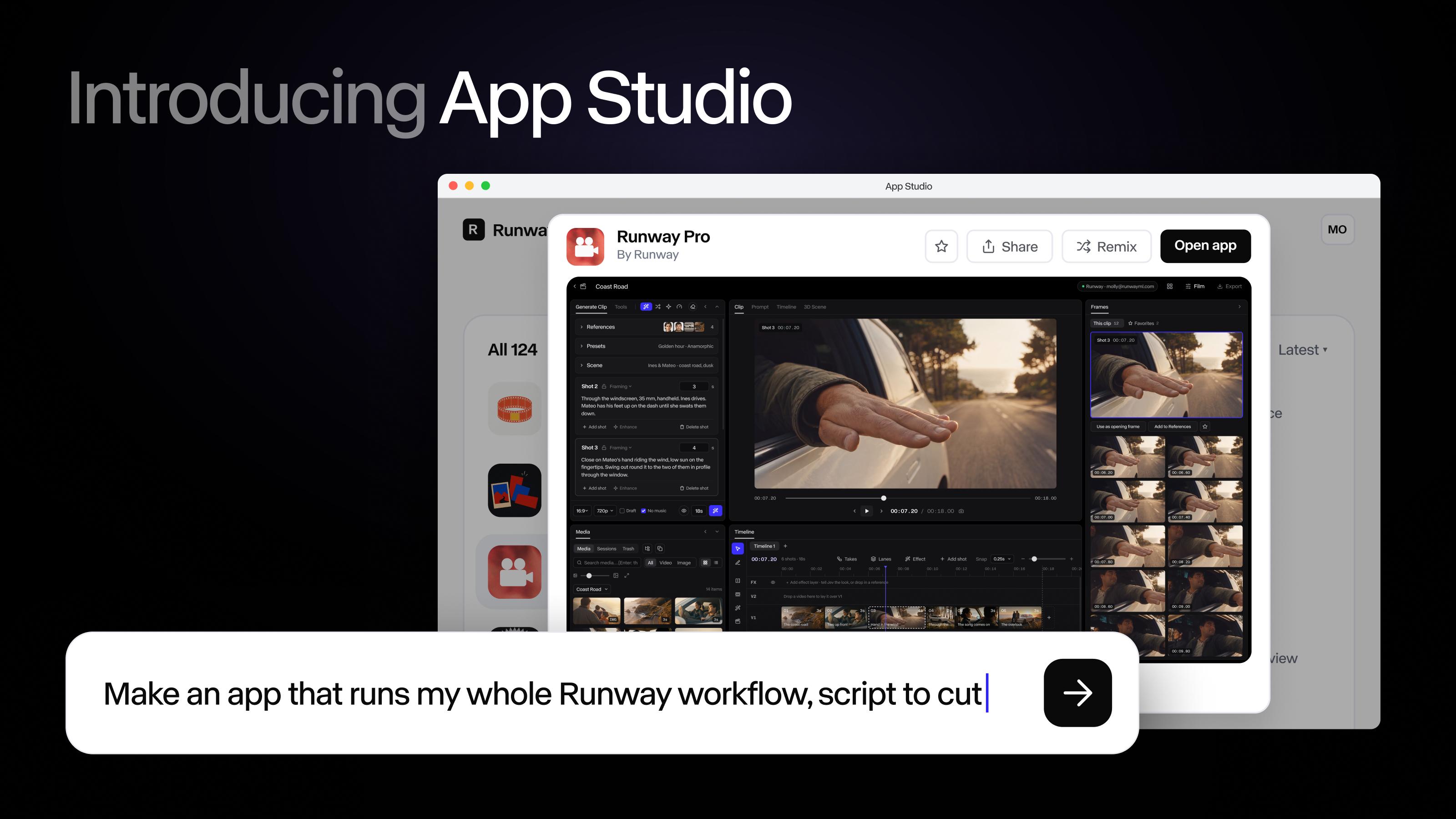
Runway launches App Studio: describe a creative tool in plain language and get a custom app that runs Runway's image, video and audio models on your Brand Kits

In an Oct 26 post on its blog, Runway launched App Studio: describe the tool you want in plain language and App Studio writes, tests and deploys an app with its own interface that generates images, video and audio with Runway's models, using your team's Brand Kits, Workflows and Assets. An existing Agent session or Workflow can be turned into an app in one click. Apps are private by default and can be shared with a team or published as a public link that visitors run on their own credits. Built-in apps at launch include Character Swap, AutoComp and 3D Camera Control. It is available now on every paid plan at no extra charge, drawing on existing Runway credits.

Runway launches App Studio: describe a creative tool in plain language and get a custom app that runs Runway's image, video and audio models on your Brand Kits

Key Takeaways

  • Pricing: available now on every paid plan with no add-on; building, running and hosting draw on existing Runway credits, and visitors to a public link pay for their own generations
  • Six built-in apps at launch: Character Swap, AutoComp (swap a product into footage while keeping packaging accurate), Product Portfolio, 3D Camera Control, Precise Edit and a customizable Runway Pro, each usable as is or remixable
  • One-click conversion: an existing Agent session or Workflow can lock in its prompt, model chain and settings and become an app that exposes only the inputs teammates need; the code stays visible, with preview and rollback
  • Enterprise controls: apps inherit the account's model controls, admins can turn App Studio off per workspace, block public links and see usage across all apps; Enterprise app links require a Runway sign-in
  • Early access (per Runway): architecture firm KPF built an app that turns design renderings into directed camera-move video, and design partners built dozens of custom apps
Read full story
Linked Models & Agents:

CapCut announces a ChatGPT plugin is coming soon, bringing its video generation and editing tools inside ChatGPT with drafts that move to the CapCut web editor

At 18:34 UTC on 2026-10-24, during its CapCut World event in Los Angeles, ByteDance's CapCut announced from its official account (@capcutapp) that a new CapCut plugin is coming soon to ChatGPT (post). According to CapCut, the plugin brings its video editing and generation tools inside ChatGPT: users can start with an idea in ChatGPT, create it with the plugin right in the chat, then move the draft to the CapCut web editor to refine and publish. When we pulled it, the post had about 3,646 likes, 319 reposts, 504 replies and 450K views. The event site lists OpenAI's Head of Partnerships Mahak Sharma and Head of Creator Product Sam Yam as speakers. Many creator posts on X say the plugin is already in early access on ChatGPT desktop with mobile and web around mid-November, but CapCut's own post still says coming soon, so timing and pricing should be taken from CapCut's later announcements.

Key Takeaways

  • Official source: CapCut's post on X, published 18:34 UTC on 10-24, with about 3,646 likes, 319 reposts, 216 quotes, 504 replies and 450K views when we pulled it
  • What it does: CapCut's video editing and generation tools inside ChatGPT, so a chat idea can become a video draft directly
  • Workflow: drafts made with the plugin can move to the CapCut web editor for further editing, sharing and publishing
  • OpenAI involvement: the CapCut World Los Angeles site lists OpenAI's Mahak Sharma (Head of Partnerships) and Sam Yam (Head of Creator Product) as speakers
  • Status: CapCut says coming soon; creator claims of desktop early access now and mobile and web in mid-November are not confirmed by CapCut, and pricing is not announced
Read full story

X discussion: Grok Imagine's official account posts Episode 1 of an AI-made Odyssey series (about 7 minutes, 4K), drawing 2.4M views and a debate over whether AI video can carry a long story

At 19:23 UTC on 2026-10-23, the official Grok Imagine account (@imagine) posted Episode 1 of its Odyssey series (post), saying it was made with Grok Imagine in a creative collaboration with Wonder Studios (@WonderStudiosX) and director Dev Walker (@glumlot_). The video runs about 7 minutes 12 seconds and is served in a 3840x2160 version. When we pulled it, the post had about 12,055 likes, 1,275 reposts, 433 quotes, 974 replies and 2.4M views, and the account asked whether people want a full breakdown of how it was made. Discussion on X kept growing over the past half day: supporters see it as AI video moving from short clips to whole episodes, while critics point to uneven acting and visible AI artifacts. This is an X discussion presented as opinions, not a verdict on the film's quality.

Key Takeaways

  • Main post: official Grok Imagine post, published 19:23 UTC on 10-23, with about 12,055 likes, 1,275 reposts, 433 quotes, 974 replies, 6,361 bookmarks and 2.4M views when we pulled it
  • What the account says: made with Grok Imagine, in collaboration with Wonder Studios and director Dev Walker; the video is about 7 minutes 12 seconds and comes in a 4K (3840x2160) version
  • The account asked whether people want a full breakdown of how it was made; no workflow, clip count or cost has been published yet
  • Opinions are split: some say AI video can now ship by the episode and that directing and storyboarding matter more than the model; others criticize uneven acting and visual artifacts
  • Treated as an X discussion; production-day and asset counts circulating online are not confirmed by the official account, so we do not use them
Read full story
Linked Models & Agents:

ByteDance's BytePlus launches Seedance 2.5 4K: a native 4K, 10-bit video generation model with a low-cost 480p Draft preview mode

On 2026-10-23 (15:31 UTC), ByteDance's enterprise cloud BytePlus (@BytePlusGlobal) launched Seedance 2.5 4K, calling it the most capable model in the Seedance 2.5 generation. It brings more nuanced facial expressions and movement, fuller textures, contours and fine detail, and 10-bit colour depth for smoother gradations that suit the big screen. A new Draft mode lets creators test storyboards and refine shots with lower-cost 480p previews, then render the final version in 4K. It is currently available only to selected enterprise customers, and BytePlus says API availability updates are coming. It debuted in the short film "Otter is Nobody 2".

ByteDance's BytePlus launches Seedance 2.5 4K: a native 4K, 10-bit video generation model with a low-cost 480p Draft preview mode

Key Takeaways

  • The most capable model in the Seedance 2.5 generation, with native 4K output (official announcement)
  • More nuanced facial expressions and movement, with fuller textures, contours and fine detail
  • 10-bit colour depth for richer gradations and smoother transitions
  • Draft mode: refine storyboards with low-cost 480p previews, then render the final cut in 4K
  • Selected enterprise customers only for now; no public API, pricing or benchmarks yet
Read full story
Linked Models & Agents:
⚡ Seedance 2.5 4K🌐 ByteDance🌐 BytePlus
ADSponsored

Kimi teaser video shows the model name Kimi K3.1: Kimi Code terminal reads "K3.1 thinking: high" while generating a Three.js 3D scene

On 2026-10-23 (01:41 UTC) the official Kimi account @Kimi_Moonshot posted a 24-second, retro-CRT-style video with no caption text. The Kimi Code terminal at the start of the clip reads "Model: Kimi K3.1" and "Version: 2.2.0", the status bar shows "Kimi K3.1 thinking: high", and a notice says "Kimi Code Desktop is here". The user then types "Build a complex procedural 3D scene in Three.js." and the model calls the Write tool to create ./scene.js. This is the first time the Kimi K3.1 name has appeared in official material. The post has no caption and no release date, benchmark, price or parameter details, so this is a teaser and not a confirmed release.

Kimi teaser video shows the model name Kimi K3.1: Kimi Code terminal reads "K3.1 thinking: high" while generating a Three.js 3D scene

Key Takeaways

  • In the official teaser the Kimi Code terminal shows "Model: Kimi K3.1" and the status bar reads "Kimi K3.1 thinking: high", the first official appearance of the K3.1 name
  • The clip also shows Kimi Code version 2.2.0 and the notice "Kimi Code Desktop is here", with install via the /desktop command or kimi.com/code
  • The demo task is "Build a complex procedural 3D scene in Three.js." and the model uses the Write tool to create ./scene.js, in a clip of about 24 seconds
  • The post has no caption; release date, benchmarks, price and parameters are not officially announced, so treat this as a teaser and not a release. As of the evening of 10-23 SGT the post had about 1.63M views and 17.6K likes (public X counts)
Read full story

Google previews Gemini API CLI (gemini-api), a zero-dependency Go binary that lets Claude Code, Codex, Cursor and other coding agents generate media, transcribe and run managed agents from the shell

The Google AI Studio team released an experimental preview of the Gemini API CLI (command name gemini-api). It is a stateless, zero-dependency Go binary for macOS, Linux and Windows, open source under Apache 2.0. Any coding agent with shell access and a GEMINI_API_KEY can call text reasoning, image, video, music and speech generation, file and YouTube analysis, audio and video transcription, and managed agents such as Deep Research with one command. Media is written straight to disk and only the file path goes to stdout, so base64 payloads never land in the context window. Google labels it experimental and not a supported Google product.

Google previews Gemini API CLI (gemini-api), a zero-dependency Go binary that lets Claude Code, Codex, Cursor and other coding agents generate media, transcribe and run managed agents from the shell

Key Takeaways

  • Default models (official README): gemini-3.8-flash for generate, analyze and transcribe; gemini-nano-banana-2.1 for image; gemini-omni-1.1-flash for video; lyria-3.5 for music; gemini-3.8-flash-tts for speech
  • Install with a one-line curl script on macOS/Linux, a PowerShell script on Windows, or go install; the latest GitHub release is v0.4.3 (published 2026-10-19)
  • Built for agents: --usage prints the command tree as KDL, --schema prints JSON Schema, --dry-run validates offline with credentials redacted, plus --output-format json/toon and inline --jq
  • Exit codes separate 4 cases: 0 success, 1 runtime/API failure, 2 usage or validation error, 3 auth failure; --agent-mode emits structured JSON errors
  • It also manages sandbox environments, server-side credentials, webhooks and cron triggers for managed agents; files uploaded via the Files API are kept for 48 hours
Read full story
Linked Models & Agents:
⚡ Gemini 3.8 Flash⚡ Gemini Nano Banana 2.1⚡ Gemini Omni 1.1 Flash⚡ Lyria 3.5⚡ Gemini 3.8 Flash TTS🤖 Gemini API CLI🤖 Claude Code🤖 Codex🤖 Cursor🤖 Antigravity🤖 Deep Research🌐 Google

Tencent ARC & Tsinghua Open-Source Looking Ahead: Lookahead Attention Eradicates Autoregressive Video Drift

Tencent ARC in collaboration with Tsinghua University released and open-sourced Looking Ahead (arXiv:2610.29989, GitHub: TencentARC/Looking-Ahead), establishing a breakthrough paradigm for autoregressive video synthesis. Overcoming the chronic pathology of traditional autoregressive video models—where unidirectional sequential extrapolation causes exponential error accumulation and severe visual collapse over extended rollouts—Looking Ahead introduces Lookahead Attention. By coupling casual autoregressive decoding with a forward-looking planning stream that anchors future spatiotemporal keypoints, the framework eliminates cumulative drift and visual jitter in long-form generation.

Tencent ARC & Tsinghua Open-Source Looking Ahead: Lookahead Attention Eradicates Autoregressive Video Drift

Key Takeaways

  • Tencent ARC and Tsinghua University introduce Looking Ahead (arXiv:2610.29989), open-sourcing a long-horizon video framework
  • Eliminates exponential error propagation and visual degeneration inherent to unidirectional token-by-token video rollouts
  • Pioneers Lookahead Attention, leveraging global temporal keypoint anchors to constrain local micro-texture rollouts
  • Establishes a new state-of-the-art across physical consistency and dynamic motion metrics for open-weight autoregressive models
Read full story
Linked Models & Agents:

SolarRenderer Breaks Generative Video: 4-Step Denoising on Greyboxes and Depths for Real-Time 768p World Synthesis

Researchers from NUS and CUHKSZ have introduced SolarRenderer (arXiv:2610.28630), a structure-conditioned generative reference rendering framework. Converting game engine grey-boxes, pose skeletons, semantic maps, and depth passes into photorealistic video, SolarRenderer adapts a frozen MiniMax-H3 33B backbone via lightweight control and 4-step generation LoRAs. Using structure-guided distribution matching, it renders stylized video in just 4 denoising steps (~12.3x faster than 50-step diffusion) and introduces a block-causal variant for real-time 768p streaming synthesis in generative game engines.

SolarRenderer Breaks Generative Video: 4-Step Denoising on Greyboxes and Depths for Real-Time 768p World Synthesis

Key Takeaways

  • SolarRenderer (arXiv:2610.28630) enables high-fidelity video rendering directly from coarse 3D geometry (grey-boxes, skeletons, depth, meshes)
  • Adapts a frozen MiniMax-H3 33B backbone with lightweight Control and 4-step LoRA modules, preserving visual priors
  • Requires only 4 denoising steps via structure-guided distribution matching, achieving a 12.3x acceleration over 50-step baselines
  • Block-causal streaming variant achieves real-time continuous 768p video generation for next-generation generative gaming engines
Read full story
Linked Models & Agents:
⚡ MiniMax-H3⚡ SolarRenderer

OverSeer: Multi-Agent World Models Beyond What Agents See via Joint Auxiliary Streaming

Researchers introduced OverSeer in arXiv:2610.28554, pioneering a new class of multi-agent world models operating beyond the field of view of individual agents. Standard video world models collapse in multi-agent environments because individual agents operate under partial observability; naive frameworks feeding external global map inputs suffer severe spatial inconsistency and state hallucination. OverSeer resolves this by jointly predicting auxiliary spatial representation streams alongside the agents' first-person camera streams. In comprehensive Minecraft benchmarks, OverSeer achieves decisive state-of-the-art results across physical grounding, long-horizon spatial memory, and cross-view consistency.

OverSeer: Multi-Agent World Models Beyond What Agents See via Joint Auxiliary Streaming

Key Takeaways

  • OverSeer introduced in arXiv:2610.28554, establishing the first scalable multi-agent video world model framework
  • Replaces external static map inputs with auxiliary spatial streams jointly predicted alongside agents' egocentric perspectives
  • Achieves state-of-the-art performance across spatial grounding, long-horizon memory, and multi-view consistency in Minecraft
  • Provides an ungrounded simulation backbone for multi-robot swarm collaboration, multiplayer game AI, and embodied multi-agent fleets
Read full story
Linked Models & Agents: