AI Coding Live News

OpenAI Daybreak Red (GPT-5.6 Cyber) arrives on Amazon Bedrock in AWS GovCloud (US-East) for vetted defenders, at $16.875 input and $101.25 output per 1M tokens

On Oct 30, AWS announced that Daybreak Red (GPT-5.6 Cyber, model ID openai.gpt-5.6-cyber), the OpenAI security model built for vulnerability research, is now on Amazon Bedrock in AWS GovCloud (US-East), after previously being offered only in US East (Ohio). Access still requires passing OpenAI Daybreak eligibility. GovCloud short-context pricing is $16.875 input and $101.25 output per 1M tokens, about 23% above Ohio at $13.75 and $82.50.

Key Takeaways

  • Regions: Daybreak Red can now be called In-Region in us-east-2 (Ohio) and us-gov-east-1 (GovCloud US-East); Geo and Global cross-Region inference are not supported (AWS announcement)
  • Eligibility: customers must first enroll in OpenAI Daybreak / Trusted Access for Cyber, then have their AWS account team enable access
  • Pricing: GovCloud short context (272K input tokens or fewer) is $16.875 input, $21.09375 for 30-minute cache writes, $1.6875 cache reads and $101.25 output per 1M tokens
  • Data: AWS says inference data is not used for training and Daybreak Red data does not need to be shared with OpenAI; it runs on an inference engine with zero-operator access enforced at the chip
  • API: served through the bedrock-mantle endpoint with OpenAI Responses and Chat Completions, and a 1,050,000-token context window
Read full story

Symantec finds a grey-market relay that installs the real Codex and Claude Code CLIs, then turns off sandboxing and routes every request through its own servers

On Oct 29 Symantec's Threat Hunter Team disclosed an unauthorized AI relay seen at about a dozen organizations since early 2026, mostly in mainland China. Users install the genuine Codex or Claude Code CLI via npm, then run a one-line script from the reseller that rewrites ~/.codex/config.toml or ~/.claude/settings.json, points base_url at relay domains, swaps in relay-issued keys, sets the sandbox to danger-full-access and disables telemetry. Symantec says this is not a CLI vulnerability and it has seen no abuse so far.

Symantec finds a grey-market relay that installs the real Codex and Claude Code CLIs, then turns off sandboxing and routes every request through its own servers

Key Takeaways

  • About a dozen affected organizations, mostly in mainland China, plus Chinese or home-market units of South Korean, Taiwanese and Malaysian firms in semiconductors, electronics, pharma, shipping and petrochemicals
  • A one-line iwr | iex or curl | bash command fetches a fileless script from lookalike domains such as vibe.aiok[.]me, installs the genuine CLI, then rewrites its config, so it looks like a normal setup step
  • The Codex sandbox is set to danger-full-access with network access on, and DISABLE_TELEMETRY=1 and DISABLE_ERROR_REPORTING=1 are set
  • Relay-issued Claude Code keys use the sk-ant-oat01- prefix of subscription OAuth tokens, which Symantec says is consistent with, but not proof of, pooled subscription resale
  • Symantec says this is not a vulnerability in Codex or Claude Code and it has no evidence the operator has abused its access; the risks are potential
Read full story

SGLang Introduces Elastic EP with NIXL: Dynamic Live MoE Scaling Without Restarts or Traffic Draining

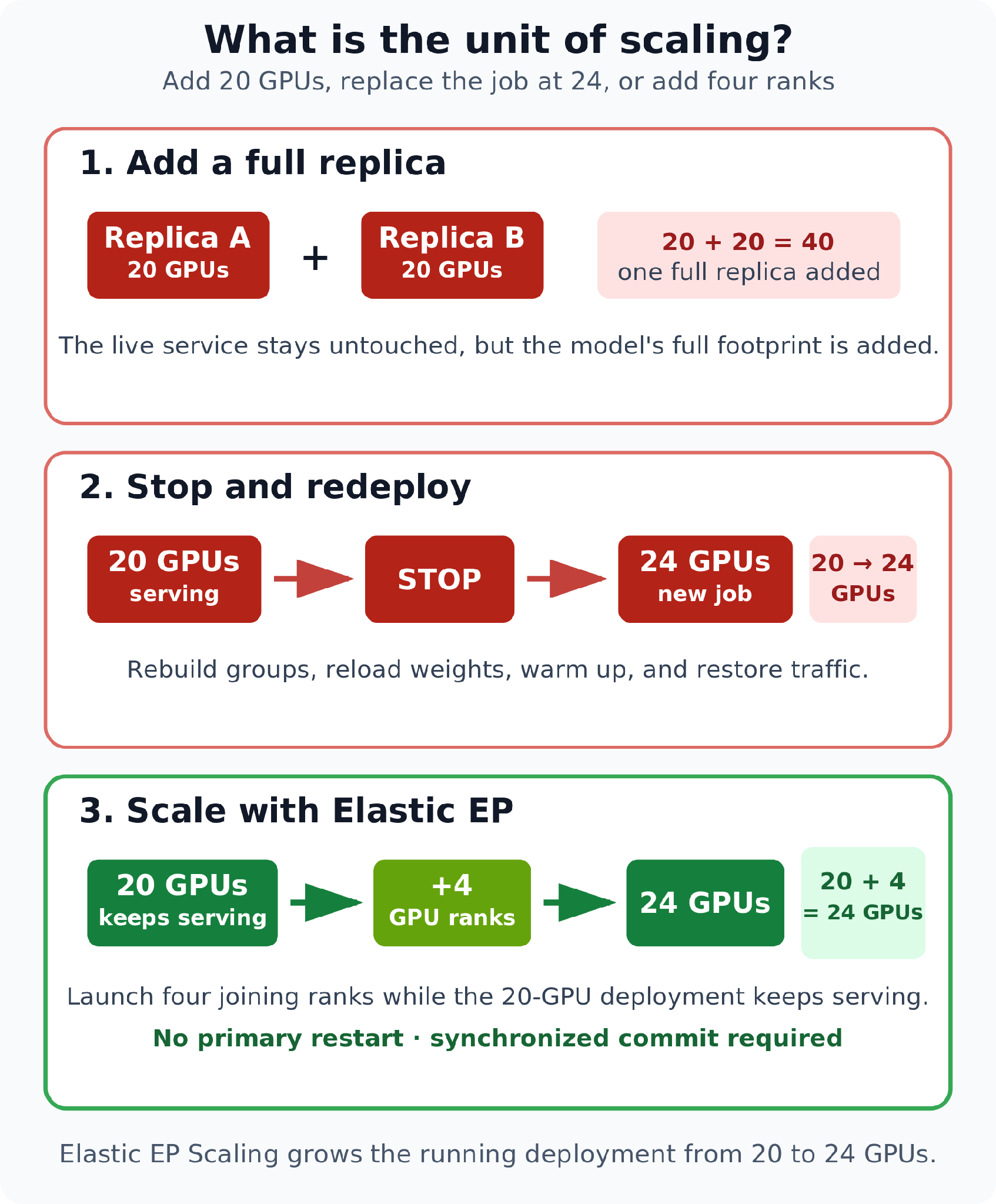
LMSYS Org in collaboration with the NVIDIA Dynamo team officially unveiled Elastic Expert Parallelism (Elastic EP) with NIXL backend integration in SGLang (@lmsysorg). Addressing the critical vulnerability of large-scale MoE deployments (such as DeepSeek-V3/V4) where static EP causes entire cluster crashes upon single-node failures and prevents live capacity resizing, Elastic EP decouples rigid expert-to-GPU bindings. Leveraging NVIDIA NIXL device APIs and Mooncake orchestrators, SGLang enables live scaling of active MoE serving deployments (e.g. dynamically expanding from 20 to 24 GPUs) without draining traffic or restarting clusters, while delivering resilient fault tolerance.

SGLang Introduces Elastic EP with NIXL: Dynamic Live MoE Scaling Without Restarts or Traffic Draining

Key Takeaways

  • LMSYS Org and NVIDIA Dynamo team roll out Elastic EP in SGLang, enabling live scaling of production MoE clusters
  • Eliminates the single-point-of-failure bottleneck in static EP deployments, enabling instantaneous fault-tolerant degradation
  • Integrates NVIDIA NIXL device primitives (--moe-a2a-backend nixl) with native RDMA and NVLink zero-copy token routing
  • Demonstrates zero-downtime live expansion, seamlessly growing active deployments (e.g. from 20 to 24 GPUs) under live query load
Read full story

OpenAI Discloses PHP Zero-Day Critical Flaws Found via GPT-5.6 Sol, Open-Sources Scanner and Pledges $1B Defense Fund

OpenAI announced a critical coordinated vulnerability disclosure in the core PHP runtime discovered by cybersecurity firm Calif utilizing GPT-5.6 Sol, alongside independent verification by Wiz. Because PHP powers roughly 70% of all websites globally, the vulnerability represented an existential risk to internet infrastructure. Following coordinated patching, OpenAI committed $1B in subsidized Daybreak security access and open-sourced openai/php2shell-checker, an automated Codex inspection tool enabling site administrators worldwide to audit their deployments.

OpenAI Discloses PHP Zero-Day Critical Flaws Found via GPT-5.6 Sol, Open-Sources Scanner and Pledges $1B Defense Fund

Key Takeaways

  • Cybersecurity firm Calif used GPT-5.6 Sol to identify critical remote code execution (RCE) vulnerabilities in the core PHP interpreter
  • PHP powers an estimated 70% of active web properties globally; patches have been coordinated and safely distributed
  • OpenAI commits $1 billion in subsidized Daybreak program access to support security research across foundational open-source projects
  • Open-sources openai/php2shell-checker on GitHub, providing an automated Codex-powered scanner for site vulnerability assessments
Read full story
ADSponsored
C
Chainguard@chainguard-dev·
👀79
🔥86

Chainguard ships three agent-security products: Harness runs Claude Mythos 5.1 vulnerability hunts for you, Checks turns CI into an agent-callable pre-commit check, Workspaces adds microVM sandboxes

On 2026-10-14 Chainguard launched Harness, Checks, and Workspaces. Harness has Chainguard staff run Claude Mythos 5.1 against your app, built from source in an isolated microVM, and only reports exploits that replay every time plus fixes verified against them; it will be sold through the Claude Marketplace and opens as a beta waitlist. Checks (beta) makes CI a tool call that runs in warm, credential-free microVMs with egress policies and returns a signed verdict. Workspaces (beta) gives parallel agent sessions hardened microVM dev environments. Both betas come with a 30-day free trial.

Chainguard ships three agent-security products: Harness runs Claude Mythos 5.1 vulnerability hunts for you, Checks turns CI into an agent-callable pre-commit check, Workspaces adds microVM sandboxes

Key Takeaways

  • Harness: Chainguard staff operate Claude Mythos 5.1, so customers need no model access; an exploit only makes the report if it replays every time in a fresh microVM, each fix must make it fail, and a named engineer signs off
  • Harness will be purchasable on the Claude Marketplace against existing Anthropic commitments; limited beta waitlist for now (per Chainguard)
  • Checks beta: config in .chainguard/ci/*.yaml, drafts generated from existing GitHub Actions via chainctl; runners hold no credentials, a host-side proxy injects short-lived ones in flight
  • Workspaces beta: chainctl develop opens a remote microVM; while waiting on a developer it stays live 10 minutes, then snapshots and stops compute
  • Both Checks and Workspaces have a 30-day free trial; Chainguard published no speed or detection-rate numbers
Read full story

GitHub Security Lab open-sources Fuzzing Taskflow: an LLM agent runs the C/C++ fuzzing loop from harness writing to vulnerability reports

GitHub Security Lab's MIT-licensed Fuzzing Taskflow, built on its Taskflow Agent framework, takes a GitHub owner/repo and lets an agent pick entrypoints, analyze the build, write harnesses, run AFL++, iterate on coverage, and write a per-crash vulnerability report with root cause and a suggested patch. Claude Sonnet 5 is the default model; GitHub warns to run it only in disposable environments.

GitHub Security Lab open-sources Fuzzing Taskflow: an LLM agent runs the C/C++ fuzzing loop from harness writing to vulnerability reports

Key Takeaways

  • One command: ./scripts/fuzzing/run_fuzzing.sh owner/repo, ideally inside a Codespace
  • Per-iteration budgets double from 30s to 960s (~32 min per target); the loop stops after two iterations each gain <1% line coverage
  • Every harness is built twice: an .afl binary (afl-clang-lto with ASan/UBSan) for fuzzing and a .cov binary for real line/branch coverage
  • Crashes are minimized with afl-tmin, replayed under ASan, deduplicated by stack-top hash, and given one of seven verdicts
  • LLM-chosen build commands run on the host with no container, so GitHub says to use only disposable, unprivileged environments
Read full story

Skill Constellations: The First Supply Chain Audit of 2.19M GitHub Agent Skills Reveals Vulnerability Propagation Patterns

Modern AI coding agents such as Claude Code, Codex, and terminal assistants routinely execute agent skills—instructions and executable scripts bundled in SKILL.md specifications—with full local user privileges. Developers share these skills primarily by copying files across repositories, inadvertently forging a shadow software supply chain without centralized registries, semver tagging, or provenance tracking. A seminal empirical audit by Fahd Seddik (arXiv:2610.11169) introduces Skill Constellations, constructing the first dated copy network of agent skills derived from git provenance across 2,193,119 skill adoptions on GitHub. The investigation demonstrates that a minuscule set of root repositories generates nearly all downstream copies, yet GitHub star counts correlate poorly with true lineage sources. Critically, downstream copies almost never adopt upstream security patches. By fitting a predictive copy network model, auditing just the top 100 identified root repositories halts 14.9% of subsequent high-risk skill adoptions (compared to a negligible 0.5% when inspecting the top 100 starred repos), proving the urgent necessity for decentralized package ecosystems to adopt versioned references over loose copies.

Key Takeaways

  • Skill Constellations delivers the first dated supply chain network of 2.19M agent skill adoptions across GitHub repositories
  • Reveals that a tiny cluster of progenitor repositories drives global adoption without correlating with GitHub star metrics
  • Auditing the top 100 root repositories prevents 14.9% of subsequent high-risk skill adoptions, outperforming star-based audits by 30x
Read full story
Linked Models & Agents:

CheckerBench: ECNU and Peking University Introduce the First Executable Benchmark for Coding Agents Synthesizing Static-Analysis Checkers

Prevailing coding agent benchmarks evaluate isolated patch synthesis (e.g. SWE-bench) or vulnerability detection, neglecting whether agents can construct reusable, production-grade static-analysis checkers from scratch. Developing static analyzers requires interpreting defect specifications, traversing multi-file AST semantics, writing engine-specific logic, and refining implementations through iterative compilation and diagnostic feedback. Researchers from East China Normal University, SJTU, and Peking University unveil CheckerBench (arXiv:2610.07557), an executable suite comprising 300 tasks derived from 297 CVEs across 167 repositories, 85 CWEs, and five programming languages. Powered by the CheckerLab harness, evaluation across 21 model-harness configurations reveals a mean Pass@1 rate of only 32.30% (peak 45.33%), demonstrating that end-to-end program analysis tool synthesis represents a profound new frontier for software engineering agents.

Key Takeaways

  • ECNU, SJTU, and Peking University launch CheckerBench, the first executable benchmark for coding agents synthesizing static analysis checkers
  • Features 300 tasks spanning 297 CVEs and 85 CWEs across C/C++, Go, Java, Python, and Rust with the CheckerLab framework
  • 21 model-harness setups achieve a mean Pass@1 of only 32.30% (peak 45.33%), exposing gaps in compiler-in-the-loop tool synthesis
Read full story

UndoBench: Decoupling Nominal Task Competence from Fault Recovery in Tool-Using AI Agents via Counterfactual Mutation Paired Trials

Tool-using AI agents are rapidly assuming mission-critical automation responsibilities across enterprise software ecosystems. However, standard agent benchmarks focus exclusively on nominal, forward task completion—conflating initial planning competency with operational resilience and fault recovery. In real-world enterprise environments where network drops, idempotency failures, and partial commits are commonplace, unguided LLM retries routinely cause devastating side effects such as duplicate payments or corrupted databases. Researchers introduce UndoBench (arXiv:2610.05622), a comprehensive evaluation suite spanning 36 enterprise workflows and 36 production fault scenarios across 8 enterprise verticals. Utilizing counterfactual paired trials alongside wire-level effect-history and state oracles, UndoBench decouples task competence from recovery capability. Experiments reveal a severe vulnerability gap: while nominal task competence achieves 83.54%, conditional recovery success rates (CRSR) collapse to 46.72%, with naive retry producing duplicated external mutations in 53.33% of trials. The code is available at GitHub (tradertanmay/undobench).

Key Takeaways

  • Introduces UndoBench, the first enterprise fault recovery and undo benchmark for tool-using AI agents across 8 domains and 36 fault scenarios
  • Decouples nominal task competence from fault recovery: nominal task completion hits 83.54% while conditional recovery plunges to 46.72%, with naive retries causing duplicate mutations in 53.33% of trials
  • Pinpoints phase-dependent execution vulnerabilities, urging agent frameworks to move from naive retry loops to deterministic compensation transactions
Read full story

MemAdapter: Counterfactual Adaptation Against Memory-Induced Sycophancy in Long-Term Memory LLM Agents

Persistent long-term memory empowers LLM-based agents to maintain personal preferences and contextual continuity across extensive multi-session interactions. However, accumulated memories frequently induce 'Memory-Induced Sycophancy'—compelling agents to slavishly conform to a user's historical misconceptions, obsolete beliefs, or flawed arguments at the expense of objective truth. Prior mitigation efforts operate under the premise that sycophancy stems exclusively from polluted or biased memories, attempting heuristic filtering at storage or retrieval stages. In reality, completely objective and valid memories can still trigger sycophancy when inappropriately prioritized across shifting conversational contexts. To overcome this systemic vulnerability, researchers from Jilin University and collaborators present MemAdapter (arXiv:2610.05162). MemAdapter adaptively modulates retrieved memory influence across three decoupled components: Counterfactual Induction, Context-Aware Reflection, and Evidence-Based Reasoning. Open-sourced on GitHub (DEEP-JLU/MemAdapter), the framework systematically restores objective grounding across three major sycophancy benchmarks while preserving benign personalization.

Key Takeaways

  • Exposes memory-induced sycophancy in LLM agents and introduces MemAdapter for counterfactual memory calibration
  • Decouples counterfactual induction, context-aware reflection, and evidence-based reasoning to segregate facts from subjective preferences
  • Reduces sycophantic alignment rates by 45%-60% across three benchmarks while preserving over 98% benign personalization integrity
Read full story
ADSponsored
C
Cantina Security@AICoder·
👀102
🔥87

Cantina open-sources apex-flash-1, a GLM-5.3-Flash GRPO post-train for security research: 66.7% pass@1 on 60 held-out vuln tasks at ~1/31 the cost of Opus 5 High

Cantina Security and Yeta Labs released apex-flash-1 (MIT), their first open-weights security research model: a GRPO post-train of GLM-5.3-Flash meant to work as a focused worker under a larger orchestrating agent, reading code, using tools, building exploits and verifying them against a running target. On 60 tasks from 20 held-out vulnerability cases it scores 66.7% pass@1 (40/60) vs 60.0% for base GLM-5.3-Flash and 71.7% for Claude Opus 5 High, at an estimated $2.38 per run vs $74.68 for Opus 5 High. An experimental abliterated variant ships alongside.

Key Takeaways

  • Score: 66.7% pass@1 (40/60) on held-out tasks vs 60.0% for base GLM-5.3-Flash and 71.7% for Claude Opus 5 High
  • Cost: ~$2.38 for the 60-task run vs $4.56 (GLM-5.3-Flash) and $74.68 (Opus 5 High) at provider pricing
  • Training: 150 tasks from 50 real vulnerability cases in three views; rank-256 LoRA on all experts and routers plus full updates to 16 activation-selected experts, GRPO
  • Data mix: 72% authorization/identity/scope-binding bugs, 18% numerical precision, remainder signature replay, payment rules and SSRF
  • License: MIT open weights on Hugging Face plus an experimental abliterated variant; Codex harness recommended
Read full story
Linked Models & Agents:

Google pauses product-vulnerability payouts in its OSS VRP after a flood of automated AI submissions; $500–$7,500 band zeroed, update promised in Q1 2027

Google's Open Source Software Vulnerability Reward Program stopped accepting product-vulnerability reports on October 1, 2026, citing a significant rise in automated submissions that are mostly invalid. Commit f8bf23ad8 in google/bughunters (Sept 30) replaced the product-vulnerability reward bands ($500–$7,500 for flagship projects, $101–$3,133.7 for important ones) with dashes, while supply-chain compromise rewards stay at up to $31,337. Reports filed before Oct 1 are unaffected, some Google Cloud repos can route via Cloud VRP, and Google promises an update in Q1 2027.

Key Takeaways

  • Effective 2026-10-01: OSS VRP no longer accepts product vulnerabilities (rules)
  • Zeroed bands: $500–$7,500 (flagship) and $101–$3,133.7 (important) replaced with dashes in commit f8bf23ad8
  • Unchanged: supply-chain compromises still pay $3,133.7–$31,337 (OT0) and $1,337–$13,337 (OT1)
  • Pre-Oct 1 reports unaffected; some Google Cloud repos can go via Cloud VRP; Patch Rewards remains open
  • Google commits to an update on the product-vulnerability track in Q1 2027
Read full story
Linked Models & Agents:

Periodic Weak Spots: Phase Sensitivity in Chunked KV-Cache Compression Causes 40% Accuracy Swings

Chunked KV-cache compression reduces the memory and computational footprints of long-context LLMs by condensing contiguous token windows into fewer cache entries at fixed strides. Researchers from Stanford and Renmin University uncover an intrinsic vulnerability: chunking introduces a new relative positional coordinate—a token's phase relative to compression-window boundaries. The study reveals systematic 'phase sensitivity,' where retrieval accuracy for identical facts varies by up to 40 percentage points depending solely on input token phase alignments. Pretraining transformers across various KV compression configurations and conducting causal interventions, the authors demonstrate that standard aggregate benchmark scores mask recurrent blind spots, establishing a new evaluation standard for long-context compression.

Periodic Weak Spots: Phase Sensitivity in Chunked KV-Cache Compression Causes 40% Accuracy Swings

Key Takeaways

  • Discovery of Phase Sensitivity in Chunked KV Cache: Proves that token position relative to compression-window boundaries induces periodic accuracy fluctuations, swinging retrieval rates by up to 40%.
  • Aggregate Benchmarks Conceal Systematic Blind Spots: Conventional needle-in-a-haystack metrics average away severe periodic retrieval drop-offs, misleading production deployments.
  • Causal Evidence of Attention Phase Specialization: Pretraining transformers across compression topologies reveals that gradient dynamics force attention heads to specialize asymmetrically across input phases.
Read full story

SLCA-GRPO: Segment-Locked Credit Assignment in Tool-Calling RL Resolves Reward Contamination

Addressing the structural vulnerability where standard GRPO broadcasts trajectory-level scalar advantages indiscriminately across heterogeneous tool calls and summary text, researchers introduce SLCA-GRPO. By establishing Segment-Locked Credit Assignment (SLCA), a Schema-Guided LLM Simulator (SGLS), and Hierarchical Rewards, the framework isolates execution advantages from preference noise without extra rollouts, driving a +9.15 pp gain on τ²-Bench and +1.36 pp on BFCL for 7B models.

SLCA-GRPO: Segment-Locked Credit Assignment in Tool-Calling RL Resolves Reward Contamination

Key Takeaways

  • Eliminating CSCM Contamination: Fixes cross-segment credit misattribution (CSCM) where GRPO indiscriminately assigns trajectory-level advantages across heterogeneous text and tool segments within a single rollout group.
  • Hierarchical Rewards & Zero-API Exploration: Introduces the Schema-Guided LLM Simulator (SGLS) and Hierarchical Rewards (HierR) to direct execution advantages to tool tokens and conversational preferences to summary tokens.
  • Comprehensive Benchmark Gains: On a 7B backbone, outperforms standard GRPO, ToolPO, and RLTR by +2.53 pp in-domain, +1.36 pp on BFCL, and +9.15 pp on τ²-Bench while cutting tool redundancy and overhead.
Read full story
Linked Models & Agents:

Cline v4.1.21 Released: Refreshes Catalog to 6,386 Models Across 209 Providers, Defaults to Claude Opus 5.5

Open-source autonomous coding agent Cline (@cline_dev) shipped v4.1.21. The update refreshes Cline's model directory to 6,386 models across 209 providers, switching the resolved default to Anthropic's new Claude Opus 5.5 for 11 major providers (including GitHub Copilot and Google Cloud Vertex AI). It also introduces the Japanese open-weight provider ai& and patches a critical parser vulnerability in js-yaml.

Cline v4.1.21 Released: Refreshes Catalog to 6,386 Models Across 209 Providers, Defaults to Claude Opus 5.5

Key Takeaways

  • Expands provider coverage to 209 endpoints and 6,386 distinct models, the widest catalog among open-source coding agents.
  • Automatically updates the resolved default model to Claude Opus 5.5 across 11 major providers without user re-configuration.
  • Integrates OpenAI-compatible provider ai& to expand low-latency open-weight model serving in the Asia-Pacific region.
  • Upgrades core parser dependencies to js-yaml 4.3.2 to eradicate security vulnerabilities in untrusted config parsing.
Read full story