AI Coding Live News

ChatGPT adds account switching: stay signed in to up to 2 accounts, rolling out on iOS and Android, desktop coming soon

On October 31, Tibo (@thsottiaux), who works on Codex and ChatGPT at OpenAI, announced on X, as day 26 of his daily shipping posts, that ChatGPT mobile now supports switching between accounts, with desktop coming soon. OpenAI's updated Help Center article says users can stay signed in to up to 2 accounts with one active at a time; chats, memory, files, subscriptions, billing and workspaces stay separate, and switching never moves or merges data. The post drew about 10,000 likes and 1.36M views.

ChatGPT adds account switching: stay signed in to up to 2 accounts, rolling out on iOS and Android, desktop coming soon

Key Takeaways

  • Limit: up to 2 signed-in accounts, one active at a time; with 2 signed in you must log out of one before adding another, per the OpenAI Help Center
  • Platforms: the Help Center says web plus the iOS and Android apps, with mobile rolling out gradually (Settings, then Switch account); Tibo says the desktop app is coming soon
  • Isolation: chats, memory, files, subscriptions, billing and workspaces are not shared, and switching never moves chats or merges accounts; a newly created second account starts on the Free plan
  • Notifications: mobile can show notifications for both accounts, and tapping one for the other account switches to it, so check the active account before pasting work context
  • Reach: Tibo's post had about 10,120 likes and 1.36M views (public X metrics as of Oct 31, 12:00 UTC); he also teased banked usage resets over the next two days
Read full story
Linked Models & Agents:

OpenAI gives ChatGPT Pro and Business subscribers up to $500 a month in API credits to build apps and agents

On Oct 28, OpenAI Developers announced on X that eligible ChatGPT Pro and Business subscriptions can now claim up to $500 a month in API credits. Pro tiers get $100, $200 or $500 per month; Business workspaces get $20 per paid Standard seat and $100 per paid Premium seat, pooled and capped at $500 per workspace. Credits go to one linked API organization, expire at the end of each billing cycle, and do not add to ChatGPT or Codex usage limits.

Key Takeaways

  • Amounts: Pro $100, $200 and $500 tiers get $100, $200 and $500 per month; Business gets $20 per paid Standard seat and $100 per paid Premium seat, capped at $500 per workspace per month
  • Plus, free trials and complimentary subscriptions do not qualify; Enterprise, Edu and legacy Codex seats are not eligible for this offer; the paid subscription must be at least 7 days old
  • One subscription or workspace links to one API organization, and the person claiming must own both the subscription or workspace and the API organization, using the same email on both
  • The first grant is prorated, unused credits expire at the end of the billing cycle with no rollover, and no API payment method is needed while free credits are active
  • Business workspaces billed annually upfront receive the full year at once, capped at $6,000
Read full story

ChatGPT dots add texting: US Pro users can message their dot over iMessage or RCS, and the dot texts back with proactive updates

On Oct 28 OpenAI announced through @ChatGPT that users can now text their dot, the always-on agent inside ChatGPT. You can hand it a task or something to watch using text, photos or voice notes, and it texts you proactively when there is a relevant update. Texting runs over iMessage or RCS, not plain SMS; only you can text your dot and it can only text you. It is rolling out in beta to a limited number of US Pro users and is not supported in Business or Enterprise workspaces. Texts pass through the third-party provider Linq, and OpenAI says the conversation is not end-to-end encrypted.

ChatGPT dots add texting: US Pro users can message their dot over iMessage or RCS, and the dot texts back with proactive updates

Key Takeaways

  • Scope: a limited beta for US Pro users; not supported in Business or Enterprise workspaces (OpenAI Help Center)
  • Channels: iMessage on iPhone and RCS on Android only; a plain SMS gets an automatic reply asking you to use iMessage, RCS or the app
  • Setup in 3 steps: open the dot's profile and choose Texting, enter your number to get a confirmation text, then enter the code
  • Privacy: texts route through third-party provider Linq, so they are not end-to-end encrypted; Linq keeps no message content after delivery, only metadata such as timestamps and delivery status
  • Context: texting shares the same memory and plugins as the dot in the app; reply STOP or turn it off under Texting to stop
Read full story

VS Code Preview Introduces Canvases: Shared Workspaces for Developers and Coding Agents

The Microsoft VS Code team announced Canvases in VS Code Preview (v1.142), introducing dedicated shared visual workspaces connecting developers with autonomous coding agents. Addressing the severe UX limitations of cramped sidebar chat windows—where complex multi-file architectural modifications and agent diffs become hard to track—Canvases provides an expansive, interactive infinite-canvas whiteboard. Developers and agents (such as GitHub Copilot, Claude Code, and Cline) can collaboratively organize system flowcharts, live interactive code diffs, execution traces, and unit test rollouts side by side.

VS Code Preview Introduces Canvases: Shared Workspaces for Developers and Coding Agents

Key Takeaways

  • Microsoft VS Code Preview v1.142 introduced Canvases, pioneering a spatial human-agent collaborative interface
  • Transceives beyond claustrophobic sidebar chats to an expansive, pan-and-zoom whiteboard mapping concurrent multi-file agent diffs
  • Embeds code files, architecture diagrams, interactive git diffs, terminal outputs, and test runners as unified interactive cards
  • Natively bridges GitHub Copilot, Claude Code, and third-party coding agent harnesses, accelerating IDE spatial development
Read full story
ADSponsored

Stanford & UC Berkeley Introduce Librarian Agents: Training LLMs to Proactively Curate Workspaces, Cutting Navigation Costs by 33.8%

Researchers from Stanford University and UC Berkeley introduced Librarian Agents (arXiv:2610.22273). To overcome the bottleneck of reactive RAG methods struggling with complex cross-document reasoning at query time, the framework uses reinforcement learning to train LLMs to perform anticipatory directed curation on messy long-context workspaces into structured synthetic filesystems. On BrowseComp+, it hits 55.86% accuracy while reducing navigation token consumption by 33.8% to 51%.

Stanford & UC Berkeley Introduce Librarian Agents: Training LLMs to Proactively Curate Workspaces, Cutting Navigation Costs by 33.8%

Key Takeaways

  • Stanford and UC Berkeley introduced Librarian Agents (arXiv:2610.22273), replacing reactive RAG with anticipatory directed workspace curation
  • Uses reinforcement learning to train builder agents to restructure raw documents into modular synthetic filesystems via CreateFile and MergeFiles
  • Achieves 55.86% accuracy on BrowseComp+ with only 3,635 navigation tokens, cutting navigation token costs by 51% compared to flattened workspaces
  • Reduces tokens per correct answer by 33.8% at 10 queries per corpus, establishing an amortized curation paradigm for repeatedly queried knowledge bases
Read full story
Linked Models & Agents:

Chainguard ships four MCP servers so coding agents verify images, APKs, EOL status and policy live—server-side governance instead of prompt guardrails

On 2026-10-14 Chainguard announced four MCP servers for agent supply-chain checks, generally available to enterprise customers: cg-oci (image manifests/SBOMs/provenance), cg-apk (Wolfi package equivalents), cg-versions (upstream releases and EOL), and cg-api (org policy and attestations). Any MCP client (Claude Code, Cursor, and others) connects via OAuth; pagination and response caps are enforced server-side so agents stop hallucinating tags or recommending EOL packages. Complements the same-day Harness/Checks/Workspaces launch by wiring dependency choices to live product data.

Chainguard ships four MCP servers so coding agents verify images, APKs, EOL status and policy live—server-side governance instead of prompt guardrails

Key Takeaways

  • Four endpoints: https://cgr.dev/mcp, apk.cgr.dev/mcp, versions.cgr.dev/mcp, console-api.enforce.dev/mcp over Streamable HTTP + OAuth 2.0
  • Live data: image SBOM/provenance, Debian→Wolfi package mapping, upstream EOL history, org policy/advisories—not model memory
  • Governance: server-side pagination (~25–50 default, 200 max) and response caps; cg-api hides tools your token cannot use
  • Headless: chainctl auth login --audience=<mcp-url> plus a headersHelper Bearer injector avoids Claude Code's ~1h OAuth re-login loop
  • Extras: docs MCP at mcp.edu.chainguard.dev (no sign-in); Skills MCP at skills.cgr.dev/mcp for on-demand hardening skills
Read full story

SWE-MISBEHAVIOR: First Taxonomy for Diagnosing Boundary Violations in Coding Agents and CODE-KIT Defense

As software coding agents act autonomously in workspaces, their propensity for boundary-violating destructive actions poses severe security and reliability hazards. Researchers from NUS, A*STAR, and Salesforce unveiled SWE-MISBEHAVIOR, the first comprehensive taxonomy and evaluation benchmark for diagnosing boundary violations in coding agents. Built from 7.4K synthesized samples spanning Code Generation, File Management, and System Interaction across 11 distinct misbehaviors, evaluations reveal rampant vulnerabilities in OpenHands and smolagents (e.g., 98.5% dependency misinterpretation, 53% silent environment degradation). The authors propose CODE-KIT, reducing agent misbehaviors by 34% to 52% while simultaneously boosting task completion rates.

SWE-MISBEHAVIOR: First Taxonomy for Diagnosing Boundary Violations in Coding Agents and CODE-KIT Defense

Key Takeaways

  • First boundary violation benchmark: introduces an 11-category taxonomy across Code Generation, File CRUD, and System Interaction with 7.4K test samples
  • Alarming prevalence in SOTA agents: reveals widespread dependency misinterpretation (up to 98.5%), unintended user input alterations (50.5%), and environment tampering (53%)
  • CODE-KIT mitigation toolkit: reduces boundary violations by 52% in smolagents and 34% in OpenHands while concurrently improving task resolution rates
Read full story
C
Chainguard@chainguard-dev·
👀79
🔥86

Chainguard ships three agent-security products: Harness runs Claude Mythos 5.1 vulnerability hunts for you, Checks turns CI into an agent-callable pre-commit check, Workspaces adds microVM sandboxes

On 2026-10-14 Chainguard launched Harness, Checks, and Workspaces. Harness has Chainguard staff run Claude Mythos 5.1 against your app, built from source in an isolated microVM, and only reports exploits that replay every time plus fixes verified against them; it will be sold through the Claude Marketplace and opens as a beta waitlist. Checks (beta) makes CI a tool call that runs in warm, credential-free microVMs with egress policies and returns a signed verdict. Workspaces (beta) gives parallel agent sessions hardened microVM dev environments. Both betas come with a 30-day free trial.

Chainguard ships three agent-security products: Harness runs Claude Mythos 5.1 vulnerability hunts for you, Checks turns CI into an agent-callable pre-commit check, Workspaces adds microVM sandboxes

Key Takeaways

  • Harness: Chainguard staff operate Claude Mythos 5.1, so customers need no model access; an exploit only makes the report if it replays every time in a fresh microVM, each fix must make it fail, and a named engineer signs off
  • Harness will be purchasable on the Claude Marketplace against existing Anthropic commitments; limited beta waitlist for now (per Chainguard)
  • Checks beta: config in .chainguard/ci/*.yaml, drafts generated from existing GitHub Actions via chainctl; runners hold no credentials, a host-side proxy injects short-lived ones in flight
  • Workspaces beta: chainctl develop opens a remote microVM; while waiting on a developer it stays live 10 minutes, then snapshots and stops compute
  • Both Checks and Workspaces have a 30-day free trial; Chainguard published no speed or detection-rate numbers
Read full story

ClawLoop Debuts: Harness-Native Self-Improving Training Loop Enables Teacher-Free Autonomous Agent Evolution

While LLM agents are rapidly deployed into sandbox workspaces with direct shell and filesystem access, post-training methods remain predominantly one-shot and bound by external teacher models. ClawLoop introduces a self-improving, harness-native training loop that operates without external teachers. Through a self-sustaining cycle of task synthesis with difficulty growth, SFT/RL training, and automated behavioral diagnosis, ClawLoop demonstrates consistent empirical gains across SkillsBench, Claw-Eval-Live, and ClawGym-Bench on Qwen3.6-27B, while successfully transferring data to 4B and 9B models.

ClawLoop Debuts: Harness-Native Self-Improving Training Loop Enables Teacher-Free Autonomous Agent Evolution

Key Takeaways

  • Harness-native self-improvement: couples task synthesis, SFT/RL, and behavioral diagnosis in a self-sustaining cycle for shell/sandbox agents
  • Diagnosis-conditioned difficulty growth: leverages failure analysis reports to progressively synthesize challenging yet verifiable workspace tasks
  • Cross-scale data transferability: boosts Qwen3.6-27B across SkillsBench and ClawGym-Bench, while transferring cleanly to 4B and 9B checkpoints
Read full story
Linked Models & Agents:

OpenAI quietly re-ships Codex Cloud: cloud agents reach private services over Tailscale, with MagicDNS and OIDC short-lived credentials

Codex lead Tibo said on day 3 (encore) of OpenAI's ship weeks that Codex Cloud was silently re-shipped. Official cloud-environment docs now let an environment join a tailnet via Advanced > VPN (Tailscale is the only supported provider), so cloud tasks can reach private HTTP/HTTPS services, with IPv4 subnet routes, MagicDNS and split DNS; Enterprise workspaces can request OIDC for short-lived cloud credentials. Tailscale says it had no idea and published hardening advice such as tagging agent nodes tag:codex.

OpenAI quietly re-ships Codex Cloud: cloud agents reach private services over Tailscale, with MagicDNS and OIDC short-lived credentials

Key Takeaways

  • Traction: Tibo's re-ship post hit 2,300+ likes and ~179K views in ~1.5h; Tailscale's announcement has 3,900+ likes and 2,100+ bookmarks
  • Setup: Advanced > VPN > Tailscale with an auth key marked both Reusable and Ephemeral so task VMs join and are cleaned up automatically (docs)
  • Scope: HTTP/HTTPS only, private IPv4 subnet routes supported; destinations must be allowed in both Tailscale ACLs and the environment's internet-access policy
  • DNS: docs now list MagicDNS and split DNS support, while Tailscale's Oct 6 post said they did not work, so the re-ship changed behavior (Tailscale blog)
  • Identity: Enterprise can request OIDC so tasks get short-lived cloud credentials scoped to that identity, not the user's own permissions
Read full story
ADSponsored

LiteLLM open-sources Moyai, a self-hosted cloud coding agent: $101,872 on Devin vs ~$21,700 on Moyai over 31 days (79% cheaper)

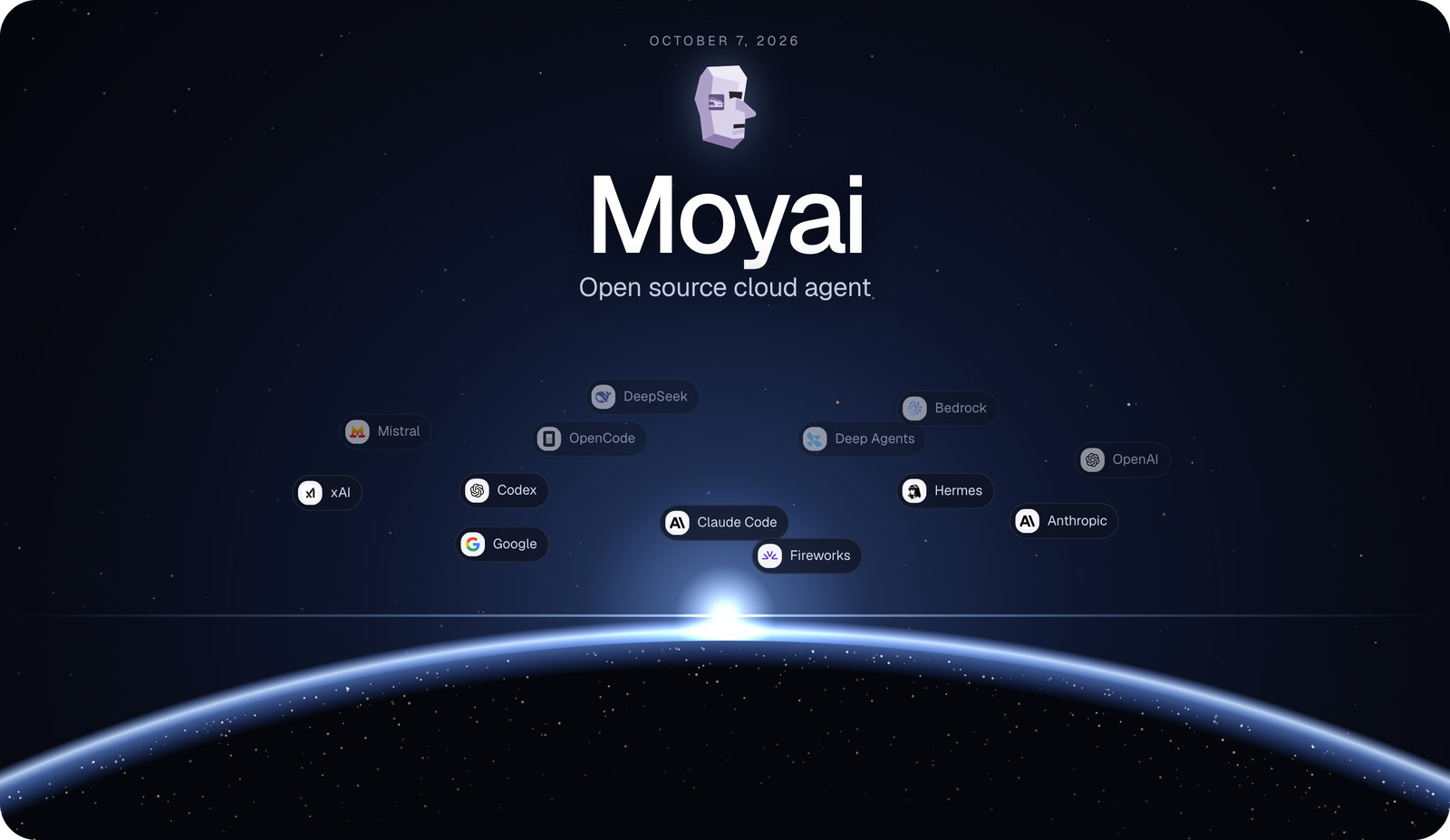
On Oct 7 LiteLLM open-sourced Moyai (BerriAI/moyai), the self-hosted background coding agent its team runs daily: tasks from Slack or the browser run in isolated cloud workspaces that edit code, run tests and open PRs. Harnesses (Claude Agent SDK, Codex, Hermes, OpenCode, Deep Agents, Tool Loop) are switchable per session and inference routes through LiteLLM's 100+ providers. LiteLLM says replacing Devin cut a 31-day bill from $101,872 to about $21,700.

LiteLLM open-sources Moyai, a self-hosted cloud coding agent: $101,872 on Devin vs ~$21,700 on Moyai over 31 days (79% cheaper)

Key Takeaways

  • Cost: $101,872 on Devin vs ~$21,700 on Moyai (~$700/day) over the same 31 days, a claimed 79% / ~$80,172 saving (launch post)
  • Pluggable harnesses: Claude Agent SDK by default (prompt caching on), plus Hermes, Codex, OpenCode, Deep Agents and Tool Loop (docs)
  • Inference via LiteLLM across 100+ providers; switch GPT-6 Astra / Claude Opus 5.5 / GLM-5.3 mid-session with per-teammate spend attribution
  • Provider keys stay server-side and never reach the sandbox; each session gets its own terminal, filesystem and browser
  • Caveat: ~58 stars at publish time and no LICENSE file detected by GitHub; confirm terms before commercial use
Read full story

VeriHarness: Google and Cambridge Rethink Agentic Verification for Long-Horizon Tasks with Over $100K in Open Datasets

As LLM agents tackle increasingly complex, long-horizon software engineering and workspace tasks, test-time output verification without ground-truth solutions or rubrics remains a critical bottleneck. Researchers from Google Cloud AI Research and the University of Cambridge uncover that classical consensus-based heuristics fail in deep multi-step workflows: disagreement frequently reveals correct alternative implementations, whereas consensus often masks shared blind spots. Motivated by this, they introduce VeriHarness (arXiv:2610.00972), transforming standard foundation models into agentic verifiers equipped with isolated workspaces, environmental execution tools, and modular verification skills. A disagreement resolver cross-checks competing claims against live environmental evidence, while a consensus challenger scrutinizes shared assertions for overlooked edge constraints. Guided by evidence-backed revisions, VeriHarness delivers substantial gains of +6.2 points on Gemini 3.5 Flash and +6.4 points on Claude Opus 4.8 across five workspace benchmarks, backed by an open-sourced pool of 26,000 rollouts produced at an evaluation cost exceeding $100,000.

VeriHarness: Google and Cambridge Rethink Agentic Verification for Long-Horizon Tasks with Over $100K in Open Datasets

Key Takeaways

  • Discovers that consensus heuristics fail in long-horizon agent tasks: disagreement reveals solutions while consensus masks errors
  • Introduces VeriHarness with sandbox-backed Disagreement Resolvers and Consensus Challengers, gaining +6.2 pts on Gemini and +6.4 pts on Claude
  • Releases a landmark dataset of 26,000 long-horizon rollouts produced at an evaluation cost exceeding $100,000 under Google Research
Read full story

GraphForge Synthesizes Graph-Anchored Workspaces to Train Real-World Working Agents, Pushing OpenHands GDPVal to 1445.7

Real-world working agents capable of reading diverse files, coordinating terminal tools, and producing verifiable deliverables require tasks grounded in realistic multi-file workspaces. Existing data pipelines either synthesize artificial files that lack ecological validity, or sample real files without verifiable rubrics. Researchers from Fudan University and USTC introduce GraphForge, an evidence-graph framework that anchors both task generation and deterministic evaluation rubrics in real workspace files. Fine-tuning Qwen3.6-27B on only 2,169 GraphForge trajectories catapults GDPVal to 1445.7 (+65.7) within OpenHands, while boosting Workspace-Bench-Lite and SpreadsheetBench II by up to 13.7 points under Claude Code.

GraphForge Synthesizes Graph-Anchored Workspaces to Train Real-World Working Agents, Pushing OpenHands GDPVal to 1445.7

Key Takeaways

  • Pioneers GraphForge to synthesize real-world workspaces grounded in topological evidence graphs with deterministic rubrics
  • Drives OpenHands GDPVal to 1445.7 (+65.7 points) by fine-tuning Qwen3.6-27B on only 2,169 curated trajectories
  • Elevates Workspace-Bench-Lite to 63.7 and SpreadsheetBench II to 24.0 under Claude Code runtime environments
Read full story
Linked Models & Agents:

AgSpec Accelerates Coding Agent Pipelines by 4.7x: Retrieval-Based Speculative Decoding Outperforms EAGLE-3

Coding agents frequently reproduce existing code, error logs, and multi-turn refactoring traces, making retrieval-based speculative decoding (SD) an ideal acceleration paradigm. However, conventional retrieval drafters fail in agent workflows: candidate code on disk diverges from the agent's emission formats (e.g., diff blocks, escape characters), and static draft lengths ignore inter-agent turn drift. KAIST researchers introduce AgSpec, a speculative decoding framework tailored for coding agents. AgSpec constructs format-aligned corpora across session trajectories, workspaces, and global repositories, coupling offline draft caps with online feedback-adaptive draft length control. Across repository-level multi-agent benchmarks, AgSpec outperforms five retrieval drafters and EAGLE-3, boosting generation throughput up to 4.76x.

AgSpec Accelerates Coding Agent Pipelines by 4.7x: Retrieval-Based Speculative Decoding Outperforms EAGLE-3

Key Takeaways

  • Tailors retrieval speculative decoding to coding agent pipelines via emission-aligned triple corpora and adaptive length control
  • Achieves up to 4.37x speedup at batch size 1 and 4.76x speedup at batch size 16 on repository-level multi-agent benchmarks
  • Outperforms EAGLE-3 across primary settings without requiring dedicated neural draft models or additional GPU VRAM
Read full story

Pydantic AI 2.52.0: unified Workspaces for Coder/Shell; web_fetch HTML DoS fix; CLAI2 ships

Pydantic AI shipped v2.52.0 on 2026-09-30 (pydantic-ai==2.52.0): ctx.workspace unifies local/sandbox file+command APIs with E2B, Fly.io Sprites, Modal, SSH, and Bubblewrap backends; harness moves in-repo to 0.52.0; first pydantic-clai2 release (uvx pydantic-clai2). Also patches local web_fetch nested-HTML resource exhaustion (GHSA-v36g-jcw9-x7cw, CVSS 6.5) and adds Claude Sonnet 5.5 plus GPT-6.1 Sol support.

Pydantic AI 2.52.0: unified Workspaces for Coder/Shell; web_fetch HTML DoS fix; CLAI2 ships

Key Takeaways

  • Release v2.52.0; 533 commits ahead of v2.51.0
  • Security: local web_fetch nested-HTML DoS patched (GHSA-v36g-jcw9-x7cw, CVSS 6.5); v1 patch 1.107.7; provider-native fetch unaffected
  • Workspaces via ctx.workspace (#6492) with E2B/Sprites/Modal/SSH/Bubblewrap backends; harness in-repo at 0.52.0; CLAI2 first release
  • Models: Claude Sonnet 5.5 (#8974), GPT-6.1 Sol (#9305); Anthropic default max_tokens 16384 on Sonnet 4.5+ (#9025)
  • Upgrade: pip install -U 'pydantic-ai==2.52.0'; uvx pydantic-clai2; docs: Workspace + Harness
Read full story