AI Coding Live News

Microsoft Open-Sources Mage-VL-Cowork, a 4B Computer-Use Agent That Chooses Between Clicking the GUI and Running Bash, Scoring 66.0% on OSWorld-Verified

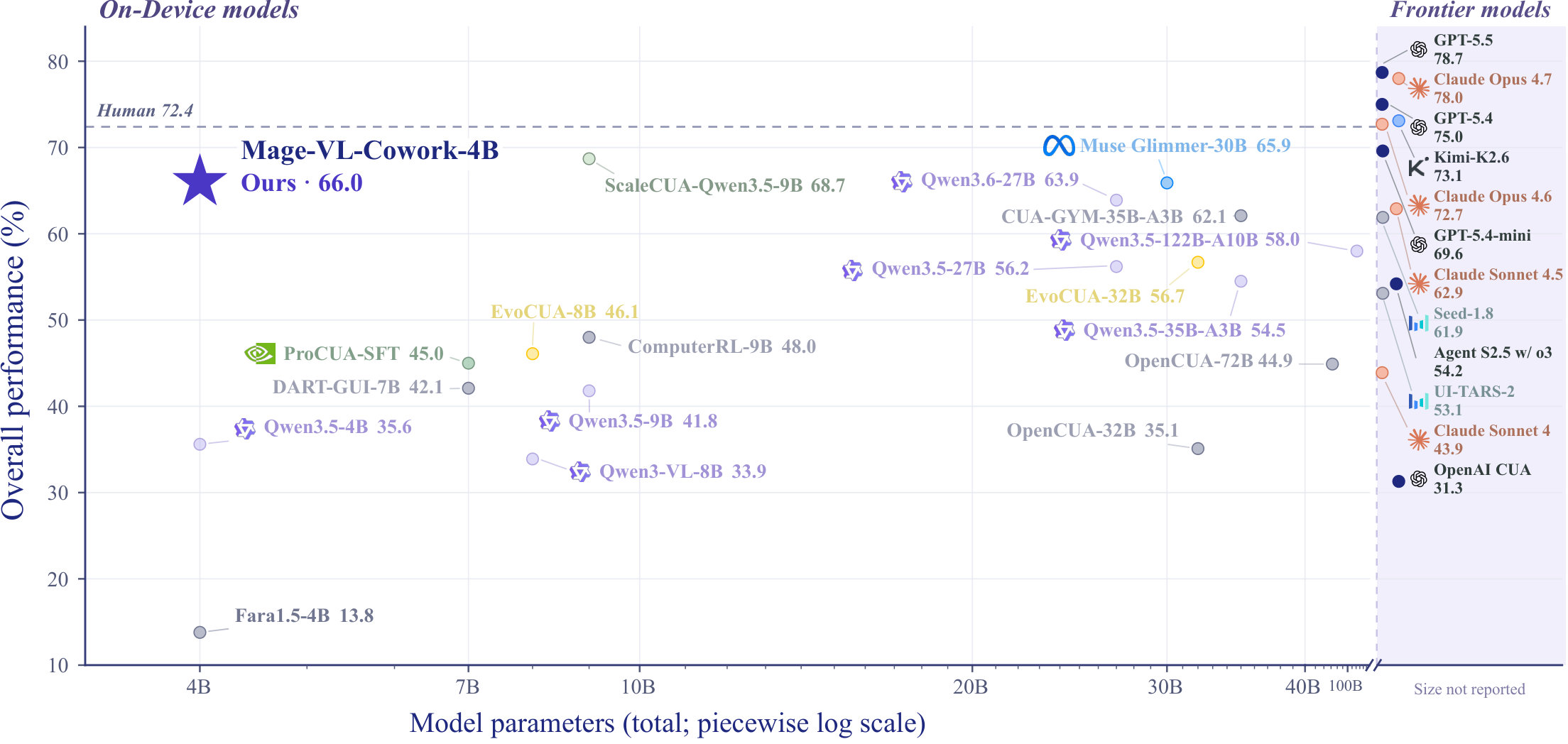
On October 30, Microsoft's Mage team released Mage-VL-Cowork on Hugging Face under Apache-2.0: a 4B multimodal computer-use agent in which a single model decides at every step whether to act through screenshots and GUI clicks (computer_use) or through bash and Python in a terminal, with no external orchestrator. Microsoft reports a two-run average of 66.0% on OSWorld-Verified (361 tasks, 50-step budget), above Qwen3.6-27B at 63.9% but below the 9B SCALECUA-Qwen3.5-9B at 68.7%.
Microsoft Open-Sources Mage-VL-Cowork, a 4B Computer-Use Agent That Chooses Between Clicking the GUI and Running Bash, Scoring 66.0% on OSWorld-Verified

Key Takeaways

  • 4B parameters, built on Mage-VL (Mage-ViT vision encoder plus Qwen3-4B-Instruct-2507); about 9.48 GB of bf16 weights under Apache-2.0.
  • On OSWorld-Verified, two independent runs scored 65.33% and 66.75% for a 66.0% average; 87.5% on operating-system tasks and 62.7% on multi-app workflows.
  • In Microsoft's side-by-side, a LibreOffice Calc chart task took 39 seconds (6 steps) via Python in the terminal, versus 9:56 (39 steps) for GUI-only Qwen3.6-27B.
  • Online RL adds 10.16 points over hybrid SFT while cutting mean model calls by 13.0% and output tokens by 25.4%.
  • Training data came from Mage-CUA-Forge, which synthesized about 294K desktop and web tasks across 6,915 skills and cut per-task generation cost from $0.906 to $0.158.
Read full story
Linked Models & Agents:
⚡ Mage-VL-Cowork⚡ Mage-VL⚡ Qwen3-4B⚡ Qwen3.6-27B🌐 Microsoft

Vercel Labs launches agent-desktop: computer use for any coding agent via OS accessibility trees, not pixels, on macOS, Windows and Linux

On October 31, Chris Tate of Vercel Labs, creator of agent-browser, announced agent-desktop on X as "agent-browser, for your whole computer". It is an Apache-2.0 Rust CLI and C library that reads a desktop app's OS accessibility tree and returns every actionable element as a JSON ref; the agent clicks or types on a ref and snapshots again to verify, with no pixel matching, headless by default. Version 1.0.0 shipped on October 27 and added Linux support; the current npm release is 1.0.2.

Vercel Labs launches agent-desktop: computer use for any coding agent via OS accessibility trees, not pixels, on macOS, Windows and Linux

Key Takeaways

  • Install: npm install -g agent-desktop, one package with native x64/ARM64 binaries; 1.0.0 (Oct 27) added Linux (glibc 2.35+, via AT-SPI), and the latest npm release is 1.0.2 (Oct 30)
  • Loop: snapshot prints a JSON tree with refs, click @<snapshot_id>:eN acts, then snapshot again to verify; a changed UI returns STALE_REF, and errors say whether a retry is safe
  • Scope: the README lists 60 command names, 56 of them operational, spanning windows, keyboard and mouse, notifications, clipboard, waits and session traces
  • Headless by default: ref actions go through accessibility APIs without moving the pointer or stealing focus, with --headed for physical input; Chris Tate says multiple agents can use the computer in parallel, each with its own cursor
  • Benchmarks: no official success-rate or speed numbers; it is a tool with no model inside, and web pages stay with agent-browser
Read full story

Tencent Hunyuan open-sources Hy-SimulMT, a Chinese-English real-time simultaneous interpreting model with ~3s lag and live voice cloning

On Oct 26 Tencent Hunyuan (Tencent Hy) open-sourced Hy-SimulMT, a real-time simultaneous interpreting model for bidirectional Chinese-English speech-to-speech translation. It translates while the speaker talks, outputs both translated text and speech, and can clone the speaker's voice in real time. Six checkpoints landed on Hugging Face (30B-A3B translation-only and source-plus-translation Interleave variants, each in BF16, FP8 and GGUF), with the model card listing Apache-2.0; GitHub ships the SimulInfer serving stack and SimulTrain training tools. Vendor-reported: about 3s StreamLAAL on RealSI long-form audio, the lowest among compared systems.

Tencent Hunyuan open-sources Hy-SimulMT, a Chinese-English real-time simultaneous interpreting model with ~3s lag and live voice cloning

Key Takeaways

  • Size and variants: 30B-A3B MoE (about 3B active), six checkpoints: translation-only and Interleave (source plus translation), each in BF16, FP8 and GGUF (Hugging Face collection)
  • Latency (vendor-reported): about 3s StreamLAAL on RealSI long-form audio, the lowest among compared systems, with a GEMBA quality score above the compared open models and 4 of 5 commercial APIs
  • Short-form (vendor-reported): FLEURS 90.3, CoVoST2 75.5, ACL6060 81.2, RealSI-Sentence 84.7, the last being the top score in the table; Qwen3.8-LiveTranslate scores 88.4/82.1/80.5/84.4 in the same table
  • Human comparison: 18 real Chinese and English recordings of about 6 minutes each against 6 CATTI Level 1/2 interpreters; Tencent says quality was on par with often lower latency, and notes the result only covers this small test
  • Deployment: one SimulInfer deploy.sh command starts vLLM (>=0.31) plus a web/WebSocket service; speech output and voice cloning need a separate TTS service; llama.cpp support is not yet merged upstream (SimulInfer docs)
Read full story
Linked Models & Agents:
⚡ Hy-SimulMT-30B-A3B⚡ Hy-SimulMT-30B-A3B-Interleave⚡ Qwen3.8-LiveTranslate🌐 Tencent

Alibaba Tongyi Labs Open-Sources OpenGCUA: Full-Stack Generalist Computer-Use Agent Cutting OSWorld Steps by 53%

Alibaba Tongyi Labs (Tongyi-MAI) has published and open-sourced OpenGCUA (arXiv:2610.22200), establishing a fully open software stack for Generalist Computer Use Agents. Moving beyond brittle single-click GUI paradigms, OpenGCUA introduces a 'Code-Execution-as-Action' framework combining visual screen perception, accessibility trees, bash scripts, and Playwright APIs into unified programmatic execution blocks. Evaluated across eight frontier models on OSWorld-v2, OpenGCUA boosted mean scores by +19.6 points while cutting task steps by 53.0%, releasing an Apache-2.0 macOS menu-bar harness and Cross-Device SDK.

Alibaba Tongyi Labs Open-Sources OpenGCUA: Full-Stack Generalist Computer-Use Agent Cutting OSWorld Steps by 53%

Key Takeaways

  • OpenGCUA published in arXiv:2610.22200 and released under Apache 2.0 as an open generalist computer-use agent stack
  • Pioneers 'Code-Execution-as-Action', synthesizing loops, conditionals, and programmatic APIs into unified Python/Bash blocks
  • On OSWorld-v2, boosts mean score by +19.6 points across eight frontier models while reducing steps per task by 53.0%
  • Releases a native macOS menu-bar harness for physical execution alongside a Cross-Device SDK spanning PC, web, and mobile
Read full story
ADSponsored

Tencent Hunyuan open-sources Hy Memory 2.0: ~3B-active memory writer averages 55.49 across four harnesses (vendor-reported, edging Opus 5), plus MemHub local memory for Claude Code, Cursor and Codex

On Oct 16 Tencent Hunyuan open-sourced Hy Memory 2.0 in three layers: the Apache-2.0 memory-writer model Hy-Memory-30B-A3B (~3B active, HF weights plus arXiv report), a Python SDK covering Chat, Working and Coding scenes (PyPI hy-memory 2.0.x), and local-first MemHub (CLI + macOS, preview). Per Tencent, swapping it in as the writer across Mem0, MemOS, Hy-Memory and held-out EverMemOS yields a 55.49 average vs 54.62 for Claude Opus 5, measured on fixed 20% subsamples; it still trails Opus 5 on several individual metrics.

Tencent Hunyuan open-sources Hy Memory 2.0: ~3B-active memory writer averages 55.49 across four harnesses (vendor-reported, edging Opus 5), plus MemHub local memory for Claude Code, Cursor and Codex

Key Takeaways

  • Vendor-reported: 55.49 four-harness average vs 54.62 for Claude Opus 5 and 53.64 for DeepSeek V4.1 Flash
  • Held-out EverMemOS: 56.89 vs Opus 5 at 54.04; still trails on Mem0 LoCoMo (59.54 vs 69.47)
  • ~3B active, Apache-2.0, tested on vLLM v0.31.0 with an OpenAI-compatible API
  • SDK installs via pip install hy-memory with automatic Chat/Working/Coding routing
  • MemHub runs on Linux and macOS (preview); Windows unsupported
Read full story

IFM and Inception42 launch Jais 3: six open Arabic-native agentic models (0.9B–375B) plus Jais Speech, 512K context on Hugging Face

On 2026-10-15, MBZUAI’s Institute of Foundation Models (IFM) and Inception42 released Jais 3—the first language adaptation of the open K2 Horizon fleet. Six open-weight sizes run from a 0.9B dense phone model to a 375B-A23B sparse MoE (≈23B active), plus Jais Speech for Arabic ASR. Models share one training recipe and agent stack, with up to 512K context (128K on 0.9B), Apache-2.0 weights and stage checkpoints on Hugging Face, and day-0 vLLM support.

IFM and Inception42 launch Jais 3: six open Arabic-native agentic models (0.9B–375B) plus Jais Speech, 512K context on Hugging Face

Key Takeaways

  • Sizes: 0.9B / 3.7B / 7B / 32B dense + 36B-A4B (MoE+MoVA, ~4B active) + 375B-A23B (~23B active); flagship needs ~8×H200 BF16 (model card)
  • Vendor Arabic average: 375B leads open peers at 84.0 (Qwen3.5-397B 82.0); 7B scores 79.4 vs K2 Horizon base 56.4→79.6 (tech blog)
  • Agents: 3.7B/7B lead their size class by ~20 points; 375B agentic average 60.2 with SWE-Bench Verified 70.2 and Terminal-Bench 2.1 73.8 (same-harness vendor runs)
  • Speech: Jais Speech macro-average WER/CER 22.85/8.37 across six public ASR sets, ahead of Audar, Cohere Transcribe Arabic, omniASR (Jais page)
  • Ship: Apache-2.0; HF collection IFM/jais-3; vLLM≥0.30 / SGLang≥0.5.20 recipes; k2_horizon parsers; companion github.com/ifm-ai/JaisVoice
Read full story
Linked Models & Agents:

Skywork open-sources Matrix-Game 4.0: game engine owns state, a 5B causal video model renders playable games in real time on one GPU

Skywork AI (Kunlun Tech) open-sourced Matrix-Game 4.0 on 2026-10-15. An executable game engine owns world state, physics and rules and emits a cheap low-poly RGB proxy; a 5B causal video model built on Wan2.2-Fun-5B-Control re-renders it into finished frames with 1–2 denoising steps. Inference code, a WebRTC browser demo and game source (Apache-2.0) are on GitHub, with Castle, Ancient Egypt and City Racing weights on Hugging Face. Skywork claims 480p/60 FPS and 112 ms end-to-end on an RTX 5090; the repo's own A100 measurements are ~38–39 FPS. Training code and data are not released.

Key Takeaways

  • Scale: each scene checkpoint has 5,001,016,512 BF16 params on an alibaba-pai/Wan2.2-Fun-5B-Control base, output 480×864 (HF card)
  • Vendor claim (RTX 5090): 480p at 60 FPS, 112 ms end-to-end, up to 83.4 FPS generation; repo-measured on one A100-80GB: ~38–39 FPS for Castle/Egypt fixed prompts, ~28.9 FPS for Racing dynamic prompts (v4 README)
  • Presets: realtime = TAEHV codec + 1-step denoise + CUDA graphs; quality = Wan VAE + 2 steps; 21-latent attention cache incl. sink, 4 frames per chunk
  • License: code and scene weights Apache-2.0; no training code or data; weights need the Matrix-Game 4.0 runtime (not drop-in Diffusers)
  • Design: a harness where the engine owns state and rules, a coding agent turns natural-language requests into new rules and prompts, and the video model only renders
Read full story
Linked Models & Agents:
⚡ matrix-game-4.0⚡ wan2.2-fun-5b-control🌐 skywork🌐 kunlun-tech🌐 huggingface

Google Cloud AI Unveils Harness²: Two-Level Recursive Agent Harnessing Unlocks Self-Evolution in Open-World Tasks

An LLM agent's practical capabilities depend as much on its execution harness as on its underlying model. Deploying recursive self-improvement (RSI) in open worlds is hampered by the absence of ground-truth verifiers and poor generalization across novel domains. Google Cloud AI Research introduced Harness², a two-level recursive framework: task-level recursion refines task-specific harnesses via a contrastive Propose-Probe-Compose step without ground-truth verifiers, while harnessing-level recursion extracts continual adaptation experience. Harness² delivers up to +11.8% on LAB, +11.5 points on WorkBuddy-Bench, and +4.5 points on JobBench on GLM-5 and Gemini 3.5 Flash. Code is open-sourced on GitHub under Apache-2.0 (google-research/harness2), supporting OpenCode and Codex executors plus JobBench, LAB and WorkBuddy-Bench.

Google Cloud AI Unveils Harness²: Two-Level Recursive Agent Harnessing Unlocks Self-Evolution in Open-World Tasks

Key Takeaways

  • Two-level recursion architecture: disentangles task-level harness adaptation from continuous harnessing-level meta-learning without ground-truth verifiers
  • Propose-Probe-Compose mechanism: guides runtime harness modifications via contrastive probes, bypassing reliance on fixed unit tests in open-world tasks
  • Consistent cross-model gains: boosts GLM-5 and Gemini 3.5 Flash by +11.8% on LAB, +11.5 points on WorkBuddy-Bench, and +4.5 points on JobBench
Read full story

Physical Intelligence opens the Pi API beta: upload robot data, fine-tune π models on managed compute, and run hosted inference

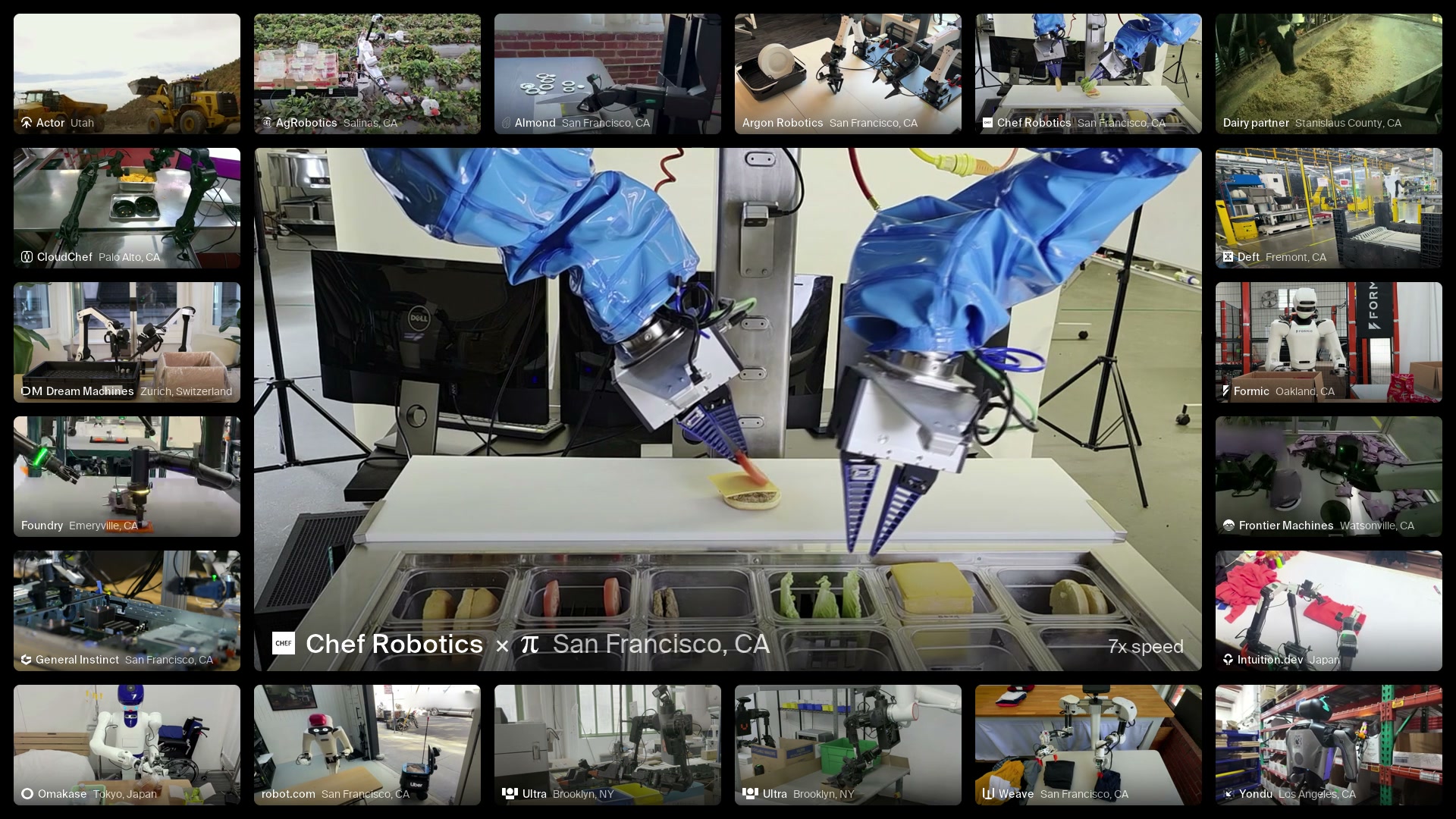
On Oct 13 Physical Intelligence opened a beta of the Pi API: teams upload robot demonstrations, fine-tune Pi's latest robot foundation model on Pi-managed compute, and serve the result to their robots through a hosted inference gateway. Showcased deployments range from an operator-less wheel loader to strawberry harvesting and server assembly; early-access customer Almond got a deburring policy for its Axol dual-arm robot after four days of iteration. Access is by application and pricing/API parameters are not published; self-hosters can still use the Apache-2.0 openpi repo (π0/π0.5 base checkpoints).

Physical Intelligence opens the Pi API beta: upload robot data, fine-tune π models on managed compute, and run hosted inference

Key Takeaways

  • Three-step loop: upload data → fine-tune a π model on Pi-managed compute → run it on your robot via hosted inference, using eval data to plan the next collection round
  • Early-access customer Almond iterated with the API for 4 days to get a policy that lets its Axol dual-arm robot deburr its own assembly parts
  • ~20 named partners/early users (Actor, Chef Robotics, Formic, Ultra, etc.) across Japan, Switzerland and the US; most ran cloud-hosted inference, and Pi flags network connectivity as a known issue
  • Self-host alternative: openpi (Apache-2.0, ~14k stars) ships π0 / π0-FAST / π0.5 base checkpoints pre-trained on 10k+ hours of robot data; inference needs >8 GB VRAM, LoRA fine-tuning >22.5 GB, full fine-tuning >70 GB
  • Beta access is by application; pricing, endpoints and parameters are not published
Read full story
Linked Models & Agents:
⚡ π0⚡ π0-FAST⚡ π0.5🌐 Physical Intelligence

LightOn open-sources ColGrep-Agent-2B: local 2B code-search agent cuts Claude Code API tokens ~34% and cache-aware cost ~40%

On 2026-10-12 LightOn AI released ColGrep-Agent-2B (fine-tuned from MiniCPM5-2B, Apache-2.0): a local 2B code-localization agent that searches with ColGrep multi-vector retrieval plus a read-only terminal, then returns file paths and line ranges to a frontier coding agent. On 52 code-search questions across 13 unseen repos (624 Claude Code / Sonnet 5.5 sessions), delegating search cut API tokens ~34.3% and cache-aware cost ~40% vs grep, with 80.8% vs 83.3% accuracy (not statistically significant). On SWE-bench Lite localization it posted 19.92 line F1—best among models evaluated in the same ColGrep harness, including several >10× larger. Ships brew/cargo/GGUF installers and hooks for Claude Code, Codex, and OpenCode.

LightOn open-sources ColGrep-Agent-2B: local 2B code-search agent cuts Claude Code API tokens ~34% and cache-aware cost ~40%

Key Takeaways

  • Official: HF Blog — ColGrep-Agent (2026-10-12); model lightonai/colgrep-agent-2B; repo lightonai/next-plaid
  • Vendor Claude Code + Sonnet 5.5 study (52×3): −34.3% tokens vs grep (95% CI 28–40), ~−40% cache-aware cost (7.3¢→4.4¢/q); accuracy 80.8% vs 83.3%
  • Localization: SWE-bench Lite file F1 76.18 / line F1 19.92; Multi-SWE-bench Flash file F1 62.57 / line F1 15.93 (5-seed avg)
  • Train: MiniCPM5-2B → SFT (Qwen3.5-27B teacher) → GRPO 500 steps; tools: colgrep / read-only terminal / finish; 10-turn budget
  • Install: brew install lightonai/tap/colgrep && colgrep --install-agent; default GGUF ~2.5GB; hooks for Claude Code / Codex / OpenCode
Read full story
ADSponsored

OpenBMB open-sources MiniCPM-V 4.7: a 35B-A3B MoE multimodal model that runs on-device at 13+ tokens/s on iPhone 17 Pro Max

On 2026-10-12 OpenBMB released MiniCPM-V 4.7, an Apache-2.0 open multimodal family with a 35B-A3B variant (the series' first MoE) and a 1B variant. Its Lookahead Expert Scheduling (LES) prefetches experts across layers and, combined with layer-wise mixed-precision quantization and DSpark speculative sampling, lifts SSD-offloaded decoding on an iPad Pro M4 (16GB) from 2.97 to 17.39 tokens/s (5.86x), per OpenBMB. Weights are on Hugging Face, ModelScope and Ollama, with vLLM, SGLang, llama.cpp and iOS/Android/HarmonyOS support.

OpenBMB open-sources MiniCPM-V 4.7: a 35B-A3B MoE multimodal model that runs on-device at 13+ tokens/s on iPhone 17 Pro Max

Key Takeaways

  • Two Apache-2.0 open-weight models: 35B-A3B (first MoE in the series, Qwen3.6 language backbone) and 1B, plus FP8 / AWQ / GPTQ / int4 / GGUF builds and DSpark draft models (Hugging Face)
  • LES on-device decode (OpenBMB, iPad Pro M4 16GB): baseline 2.97 → LES 9.81 → +layer-wise quant 14.92 → +DSpark 17.39 tokens/s, 5.86x overall (LES doc)
  • 35B-A3B reaches 13+ tokens/s on iPhone 17 Pro Max; mixed 4x/16x visual-token compression trades detail for cost per task
  • Vendor-reported (Instruct, 4x): MMBench 91.72, OCRBench 91.20, OmniDocBench v1.6 94.24, MMMU 80.22 vs Qwen3.6-35B-A3B at 86.76 / 86.00 / 80.17 / 77.44; still behind on SimpleVQA and ScreenSpot
  • Day-0 chip support for Rockchip, Houmo, Intel, AMD and Arm; runs on vLLM, SGLang, llama.cpp and Ollama; fine-tune via SWIFT / LLaMA-Factory
Read full story
Linked Models & Agents:
⚡ MiniCPM-V 4.7 35B-A3B⚡ MiniCPM-V 4.7 1B⚡ Qwen3.6-35B-A3B🌐 OpenBMB🌐 面壁智能

vLLM Semantic Router open-sources Decision 3.0: six multimodal decision models from 0.6B to 27B, #1 on Jev Decision Index in its own evaluation

On Oct 11 the vLLM Semantic Router (vllm-sr) team released the Decision 3.0 family (d3, d3-flash, d3-mini, d3-nano, d3-lite, d3-edge) on Hugging Face under Apache-2.0. Built on Qwen3.5/3.8, the models take text, images and video and return probabilities for choice, yes/no and score questions in one call without generating text. Vendor-reported: the 27B d3 scores 64.7 on Jev Decision Index 0.3.1, ahead of Perplexity Decider v1.1 (62.8) and Decision 2.0 (55.9), with a 55 ms median text latency on one AMD MI325X.

vLLM Semantic Router open-sources Decision 3.0: six multimodal decision models from 0.6B to 27B, #1 on Jev Decision Index in its own evaluation

Key Takeaways

  • Six sizes: d3-edge 0.59B, d3-lite 0.85B, d3-nano 2.2B, d3-mini 4.5B, d3-flash 8.4B, d3 26.1B, all Apache-2.0 (HF collection)
  • Vendor-reported Jev Decision Index 0.3.1: d3 64.7 vs Perplexity Decider v1.1 62.8, Jev 60.1, Decision 2.0 55.9
  • Vision Index 0.3.1: d3 71.6 vs Perplexity Decider v1.1 70.6 and JEV-27B-VL 69.6
  • Median latency on one AMD MI325X, batch 1: d3 55 ms text / 273 ms image / 553 ms 10-second video; d3-edge 6.7 ms text
  • No text generation: every option gets a probability, and several Choice / Yes-No / Score questions share one call
Read full story
Linked Models & Agents:
⚡ Decision 3.0⚡ d3⚡ D3 Flash⚡ D3 Edge⚡ Qwen3.5⚡ Qwen3.8🌐 vLLM🌐 vLLM Semantic Router
P
Perplexityperplexity-ai·
👀124
🔥84

Perplexity open-sources pplx-decider-v1.1-27b: Decision Index rises from 56.4 to 61.56, beating Jev by 3.6 points

Perplexity released pplx-decider-v1.1-27b (Apache-2.0, fine-tuned from Qwen3.8-27B) on Hugging Face. It returns typed, probability-calibrated answers instead of text. Overall Decision Index is 61.56 vs 56.4 for v1 and 57.9 for Jev, and it is served via the Perplexity Decisions API.

Perplexity open-sources pplx-decider-v1.1-27b: Decision Index rises from 56.4 to 61.56, beating Jev by 3.6 points

Key Takeaways

  • Overall Decision Index 61.56: +5.16 over v1 (56.4) and +3.66 over Jev (57.9) on the same Qwen3.8-27B backbone
  • Categories: Language 69.45, Retrieval 61.26, Tools 78.88, Knowledge 48.18 (still below Jev's 51.4)
  • Gains come mainly from lifting the causal mask on full-attention layers plus more training data incl. tasksource
  • Decision head is a BF16 [255, 5120] readout, not a full-vocab lm_head; ~49 GiB of weights on a CUDA GPU
  • Hosted via POST /v1/decisions with noul / choice / score questions, many per request (docs)
Read full story
Linked Models & Agents:
⚡ pplx-decider-v1.1-27b⚡ Pplx Decider V1 27b⚡ Qwen3.8-27B⚡ Jev🌐 Perplexity

openTPU, an open-source AI accelerator developed by AI agents, goes viral: full RTL/ISA/compiler stack runs Qwen3.5, Gemma 4 and a 35B MoE on a Kintex-7 FPGA card at up to 85.8 tok/s

FeSens/openTPU (Apache-2.0) hit the Hacker News front page (250+ points, 300+ comments). Reusing the AI-driven method from auto-arch-tournament (AI-designed RISC-V cores), the author had AI agents iterate on an inference accelerator; one repo holds SystemVerilog RTL, the ISA, a bit-exact simulator, a kernel language/compiler and a profiler. On a Kintex-7 xc7k480t PCIe card it runs Qwen3, Qwen3.5, Gemma 4, Phi-4-mini and others with real weights, token-for-token identical to the simulator; LFM2.5-230M decodes at 85.8 tok/s in 4-bit and Qwen3.5-35B-A3B reaches 3.95 tok/s with host-streamed experts.

openTPU, an open-source AI accelerator developed by AI agents, goes viral: full RTL/ISA/compiler stack runs Qwen3.5, Gemma 4 and a 35B MoE on a Kintex-7 FPGA card at up to 85.8 tok/s

Key Takeaways

  • Full stack in one repo: SystemVerilog RTL, 8x32-bit-word ISA, bit-exact Python simulator, @ol.jit kernel compiler and Lens profiler, Apache-2.0 (GitHub)
  • Measured device decode (4-bit, int8 head): LFM2.5-230M 85.8 tok/s, Qwen3-0.6B 31.3, Qwen3.5-2B 12.09, Gemma 4 E2B 12.14 tok/s
  • Uses 82-94% of the 17.1 GB/s DDR3-1066 peak while decoding; 133.33 MHz clock, four-column systolic array
  • MoE offload: Qwen3.5-35B-A3B at 3.95 tok/s (153 MB of experts streamed per token, 62% slot hit), LFM2.5-8B-A1B at 10.6 tok/s (offload docs)
  • 4-bit weights (FP4 with two-level block scales, 4.25 bits/weight) decode 40-45% faster than int8, with per-model perplexity cost documented
Read full story
Linked Models & Agents:
⚡ Qwen3.5⚡ Gemma 4⚡ LFM2.5⚡ Phi-4 Mini

OpenAI publishes 722 math manuscripts from an unreleased internal frontier model on GitHub, claiming results on the quasi-Riemann hypothesis, the Hodge conjecture for CM abelian varieties and more

On 2026-10-06 OpenAI published Sharing AI progress in mathematics and released openai/math (Apache-2.0): 722 manuscripts in 372 result families produced by an unreleased internal frontier model, drawn from an evaluation of ~4,000 open problems at an average of ~3 hours of ChatGPT Pro thinking compute per result, with 10 abridged reasoning summaries and Lean formalizations for many results. OpenAI notes unformalized results may have issues; none are peer reviewed yet.

OpenAI publishes 722 math manuscripts from an unreleased internal frontier model on GitHub, claiming results on the quasi-Riemann hypothesis, the Hodge conjecture for CM abelian varieties and more

Key Takeaways

  • Scale: 722 manuscripts in 372 result families, selected from an evaluation of ~4,000 open problems
  • Compute: ~3 hours of ChatGPT Pro thinking per result on average, same unreleased internal model and fixed procedure
  • Checkability: 235 of 372 families link to Lean; formalization.yaml lists 162 papers with a formalized main result, checkable via Comparator
  • Transparency: 10 abridged reasoning summaries (irrationality exponent of pi, Mahler conjectures, free group factors, etc.) plus revision/citation protocols shaped with the IAS advisory group
  • Caveat: OpenAI says some unformalized results could have issues; nothing is peer reviewed yet and the model is not released
Read full story
Linked Models & Agents:
⚡ OpenAI internal frontier model🌐 OpenAI