AI Coding Live News

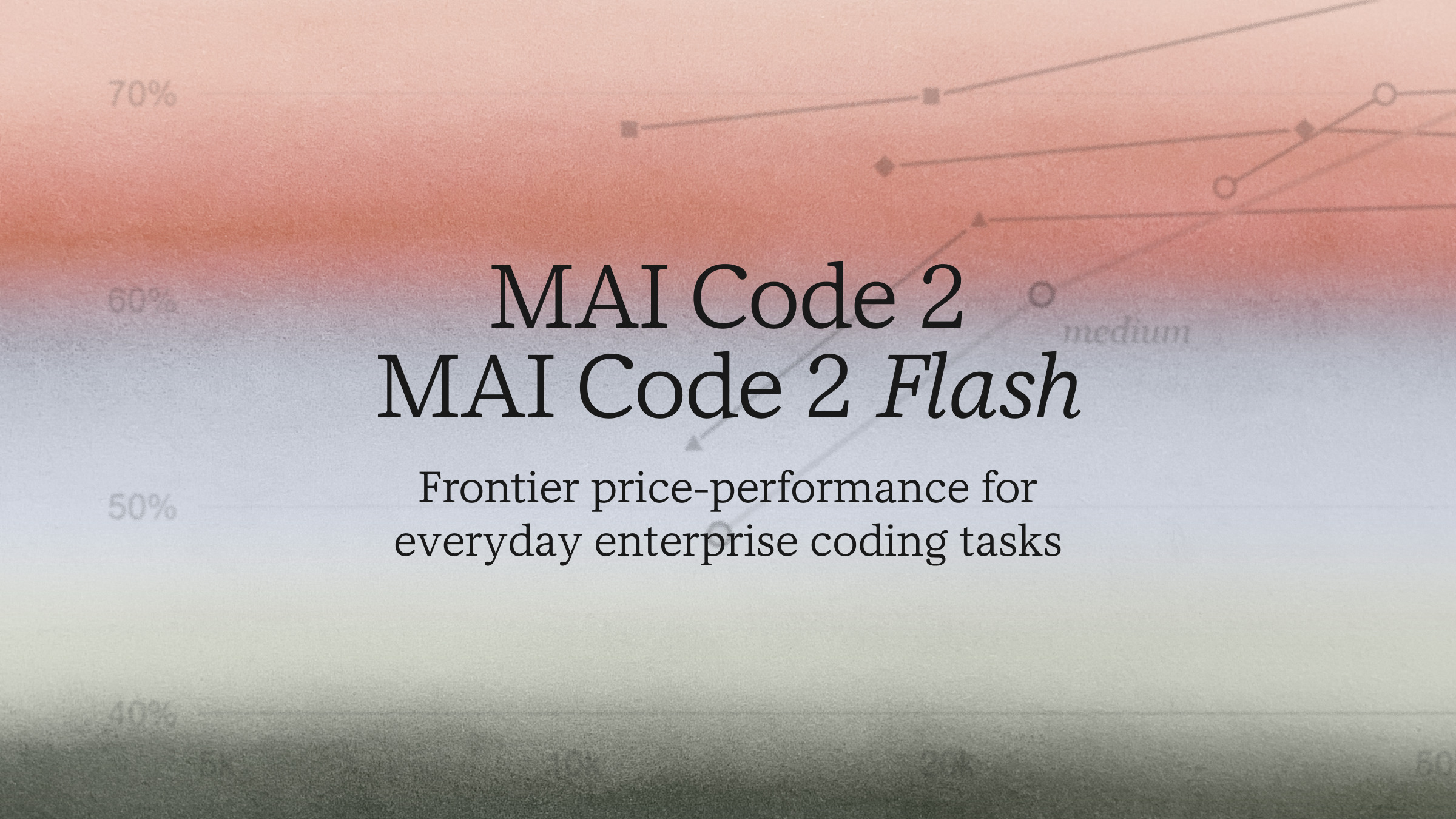
Microsoft Launches MAI Code 2 and MAI Code 2 Flash at Ignite, Now in GitHub Copilot: Code 2 Reaches 98% of GPT-6.1 Sol at About 40% of the Price, Alongside the MAI Cyber 2 Flash Security Model

Microsoft AI (MAI) announced two coding models at Ignite on November 17. MAI Code 2 targets multi-file implementation, deep debugging and repo-wide reasoning, while MAI Code 2 Flash handles high-volume work such as code explanations, targeted edits and routine fixes. Both are available in GitHub Copilot today, Code 2 Flash is in limited-access preview in Microsoft Foundry, and the VS Code team says both are 50% off through May 17, 2027. Microsoft says that averaged over four everyday enterprise coding benchmarks, Code 2 reaches 98% of GPT-6.1 Sol at about 40% of the price and 96% of Claude Opus 5.5 at 5% of the price. It also released the MAI Cyber 2 Flash security model.
Microsoft Launches MAI Code 2 and MAI Code 2 Flash at Ignite, Now in GitHub Copilot: Code 2 Reaches 98% of GPT-6.1 Sol at About 40% of the Price, Alongside the MAI Cyber 2 Flash Security Model

Key Takeaways

  • Two models: MAI Code 2 for taking code to production, deep debugging, multi-file implementation, repo-wide reasoning and UI; MAI Code 2 Flash for code explanations, targeted edits, routine fixes and rapid iteration
  • Official scores: averaged over DeepSWE 1.1, Terminal Bench 2.1, SWE-Atlas and FrontierCode v1.1, Code 2 reaches 98% of GPT-6.1 Sol at about 40% of the price and 96% of Claude Opus 5.5 at 5% of the price, with cost measured at the 50% promotional price
  • Code 2 Flash matches GPT-6 Luna and Claude Haiku 5.5 on three everyday coding benchmarks at 65% and 20% of their price; in blind frontend app reviews, raters preferred Code 2 over GPT-6 Sol 67% of the time
  • Availability: in GitHub Copilot today, including VS Code; Code 2 Flash is in limited-access preview in Microsoft Foundry, with OpenRouter, Vercel, OpenCode and Kilo coming soon
  • MAI Cyber 2 Flash: 92.3% on CyberGym-E2E versus 91.5% for GPT-6 Astra at under 2% of the cost per task, with a 1 million token context; it comes only to Microsoft security products such as MDASH from mid-December
Read full story
Linked Models & Agents:
⚡ MAI Code 2⚡ MAI Code 2 Flash⚡ MAI Cyber 2 Flash🤖 GitHub Copilot🌐 Microsoft🌐 GitHub

Arena analyzes 105 coding models: matching April's best now costs under 1/20 as much, the top score is climbing 3x faster than last winter, and a new model lands almost every other day

Arena studied 105 models across 44 weekly Code Arena: WebDev boards since December 2025. Xiaomi's MiMo-V2.6-Flash now beats April's leader Claude Opus 4.7 at under a twentieth of the price, the top score has risen about 41 points a month since May (3x the winter pace), and 19 of the 25 price-performance frontier models under $1 per answer are Chinese.

Arena analyzes 105 coding models: matching April's best now costs under 1/20 as much, the top score is climbing 3x faster than last winter, and a new model lands almost every other day

Key Takeaways

  • Cadence: about 5 new models a month last winter, 12 to 14 a month from July to September, and 11 by October 23; OpenAI listed 12, Anthropic, Alibaba and Google 11 each
  • Top score: April's best, Claude Opus 4.7, scores 1558 on today's board versus 1807 for today's leader Claude Opus 5.5; a new top score now lasts about three weeks instead of two months
  • Price: between 5 cents and $1 per answer, today's best has an estimated 65-80% win rate against April's best at the same price; Opus 5.5 (Max) has about 81% but costs about $10 per answer
  • Volatility: nearly half the top 10 labs change rank each week, and the #10 lab cut its gap to #1 by 38% (282 to 176 points)
  • Regional split: 13 of the 15 frontier models above $1 are American; 17 of 21 Chinese frontier models have open weights versus 2 of 19 American ones
Read full story

ScaleDown ships Constrained Decoding Models: 1M-token task models for summarize, compress, extract and classify, with LangChain Deep Agents middleware

On Oct 13 ScaleDown launched Constrained Decoding Models (CDMs): each model is trained for a single task and only returns answers that task allows (a label or spans of the input) instead of free-form token-by-token generation. LangChain shipped a langchain-scaledown integration and LangSmith LLM Gateway support the same day, with middleware for history summarization, tool-result compression and structured extraction. ScaleDown claims 200x faster and 467x cheaper than frontier models on these narrow tasks; Extract and Summarize are on OpenRouter at $0.04 per million input tokens.

ScaleDown ships Constrained Decoding Models: 1M-token task models for summarize, compress, extract and classify, with LangChain Deep Agents middleware

Key Takeaways

  • Four single-task models (Summarize, Compress, Extract, Classify), each taking up to 1M input tokens; Extract, Summarize and Classify accept images and scanned PDFs
  • Vendor-reported: vs the average of GPT-5.5, GPT-5.4 Mini and GPT-5.4 Nano, Summarize is 41x cheaper and 2.7x faster, Compress 138x cheaper and 1.8x faster, both with higher accuracy
  • Classify vs Jev: Jev is text-only with 32K tokens of state per question; Classify takes 1M tokens plus images and adds a one-sentence reason per decision
  • LangChain's trace example compresses a docs page from 18,402 to 3,110 characters; if a ScaleDown call fails the middleware leaves history untouched and the agent keeps running
  • On OpenRouter, Extract and Summarize cost $0.04/M input tokens with 1M context; Summarize caps output at 4,000 tokens and neither supports tools or response_format
Read full story
Linked Models & Agents:
⚡ ScaleDown Classify-1⚡ ScaleDown Extract⚡ ScaleDown Summarize⚡ ScaleDown Compress🤖 LangChain Deep Agents🌐 ScaleDown🌐 LangChain🌐 OpenRouter

OpenRouter introduces Smart Fallbacks for coding models, switching endpoints in milliseconds during rate limits

OpenRouter launched Smart Fallbacks tailored for coding agents. Developers can configure ordered fallback lists (e.g., Claude 3.7 Sonnet → GPT-5.6 Sol → DeepSeek-V3) under a single endpoint. If upstream rate limits or timeouts occur, the router transparently switches providers in under 50ms to keep long-running agent tasks running uninterrupted.

Key Takeaways

  • Configurable multi-provider fallback chains under a single unified API endpoint.
  • Transparent 50ms failover during upstream rate limits ensures uninterrupted agent sessions.
  • Customizable routing rules based on latency, price, and throughput constraints.
Read full story
ADSponsored

DeepSeek open-sources lightweight tensor-parallel inference patch enabling smooth 67B coding MoE on single RTX 4090

DeepSeek open-sourced an inference acceleration patch for consumer GPUs. Combining 4-bit quantization with dynamic expert caching and CPU offloading, developers can run 67B sparse MoE coding models on a single 24GB VRAM GPU (RTX 4090/3090) at speeds exceeding 45 tokens per second.

Key Takeaways

  • Runs 67B sparse MoE coding models locally on standard 24GB consumer GPUs.
  • Dynamic expert caching and 4-bit quantization sustain speeds over 45 tokens/sec.
  • Patches upstreamed directly into llama.cpp and SGLang repositories.
Read full story